Species · Birds
Dusky Moorhen Gallinula tenebrosa
The scientific name of the Dusky Moorhen is Gallinula tenebrosa. It is a species of bird in the family Rallidae (rail), order Gruiformes. The name dates from 1846.
- Scientific name
- Gallinula tenebrosa Gould, 1846
- Common name
- Dusky Moorhen
- Genus
- Gallinula
- Family
- Rallidae (Rail)
- Order
- Gruiformes
- Class
- Aves
- Red List category
- LC Least Concern
- Environment
- freshwater, terrestrial
- Recorded in
- 6 countries
- Name status
- accepted in the Catalogue of Life

Overview
The species occurs in Australia, New Guinea, Borneo and Indonesia. It has predominantly dark grey-black plumage, a red frontal shield and a red bill tipped with yellow.
Written 26 November 2026 from the sources listed below. Each statement was checked against the passage it cites; statements that could not be supported were removed.
Appearance
Adult Dusky Moorhens have predominantly dark grey-black plumage with browner upperparts. They have a red frontal shield and a red bill tipped with yellow, while their legs are orange-yellow.[1][2][3]
The species lacks the white flank line present in the Common Moorhen and has white feathers beneath its tail. It frequently flicks its conspicuous white and black tail.[4][5][6]
The frontal shield becomes brighter during warmer months. In females and young males, it becomes duller during autumn and winter.[7][8]
Australian Dusky Moorhens measure approximately 34–38 centimetres in length, while New Guinea birds measure approximately 25–32 centimetres. Adult males have an average body mass of approximately 570 grams and adult females approximately 493 grams.[9][10][11][12]
Habitat
Dusky Moorhens inhabit freshwater marshes and swamps. They use wetlands, ponds, creeks, swamps and urban waterways.[13][14]
The species occupies calm freshwater environments with dense waterside vegetation. It requires open water with vegetation such as grass and reeds for cover.[15][16]
Dusky Moorhens are commonly found around dams and riverbanks and generally occupy low-lying areas. They can inhabit urban parks and stormwater ponds around Sydney.[17][18][19]
Diet
Dusky Moorhens eat seeds, shrub and grass tips, algae, fruits, molluscs and other invertebrates. Their diet also includes insects, worms, snails and tadpoles.[20][21]
The species also consumes carrion, bread and bird droppings. Chicks are initially fed mostly annelid worms and molluscs.[22][23]
Dusky Moorhens commonly forage while walking through shallow water or along muddy pond and creek edges. They may forage in groups.[24][25]
Behaviour
Dusky Moorhens are active during the day and roost at night. They are territorial during breeding but generally gregarious outside the breeding period.[26][27]
The species uses its large feet and long toes to walk across floating vegetation.[28]
Dusky Moorhens produce loud territorial calls described as kurk or krik. These calls can be heard from distances exceeding two kilometres.[29][30]
The species produces sharp squawks and squeaks as alarm calls.[31]
Reproduction and life cycle
The breeding season in southern Australia extends from August to January, while in northern Australia it extends from January to June. Dusky Moorhens generally produce one brood in southern Australia and may produce two broods in northern Australia.[32][33][34][35]
Dusky Moorhens construct bulky nests from reeds or grasses at the water's edge or slightly above the water. A clutch typically contains between five and eleven eggs.[36][37]
The eggs are matte whitish and marked with red-brown dots and splotches. They measure approximately 53 millimetres long and 36 millimetres wide.[38][39]
Both parents help incubate the eggs and protect the nest. Young Dusky Moorhens leave the nest shortly after hatching.[40][41]
Similar species
The Dusky Moorhen is often confused with the Purple Swamphen and Eurasian Coot because of their similar appearance and overlapping distributions. It lacks the white flank line present in the Common Moorhen.[42][4]
Classification of the Dusky Moorhen
| Kingdom | Animalia |
|---|---|
| Phylum | Chordata |
| Subphylum | Vertebrata |
| Infraphylum | Gnathostomata |
| Parvphylum | Osteichthyes |
| Megaclass | Tetrapoda |
| Class | Aves (Bird) |
| Order | Gruiformes (Rails) |
| Family | Rallidae (Rail) |
| Genus | Gallinula (Moorhen) |
| Species | Gallinula tenebrosa Gould, 1846 |
Where the Dusky Moorhen is found
Checklists and occurrence records place Gallinula tenebrosa in 6 countries across Asia and Oceania. GBIF holds 714,375 georeferenced records of it.
Countries
- Australia 713,066
- Indonesia 371
- New Caledonia 92
- Papua New Guinea 827
- Solomon Islands 4
- Timor Leste 15
Regions and cities with the most records
- Victoria, Australia 246,295
- New South Wales, Australia 188,316
- Queensland, Australia 159,824
- Balwyn North, Australia 99,823
- Burwood, Australia 98,123
- Melbourne, Australia 90,458
- Brisbane, Australia 60,511
- St Albans, Australia 52,955
- Sydney, Australia 42,673
- Australian Capital Territory, Australia 38,529
- Canberra, Australia 38,342
- South Australia, Australia 35,534
- Logan City, Australia 34,658
- Capalaba, Australia 34,429
- Western Australia, Australia 33,906
- Parramatta, Australia 29,738
- Tuggeranong, Australia 29,405
- Perth, Australia 26,848
- Frankston East, Australia 22,998
- Liverpool, Australia 22,307
- Hornsby, Australia 21,057
- Narangba, Australia 19,454
- Adelaide, Australia 18,430
- Adelaide Hills, Australia 17,608
- Geelong, Australia 15,800
- Ballarat, Australia 13,043
- Torquay, Australia 8,340
- Gold Coast, Australia 7,775
- Sunshine Coast, Australia 7,761
- Wollongong, Australia 7,602
- Newcastle, Australia 6,805
- Maitland, Australia 5,506
- Central Coast, Australia 4,276
- Mount Barker, Australia 4,071
- Shepparton, Australia 4,044
- Bundaberg, Australia 3,937
2 more countries have a few records outside this range
These countries hold a few records of Gallinula tenebrosa but lie outside the range the checklists give for it. Such records are often zoo or garden specimens, museum material or vagrants, so the species is not counted as occurring there.
Range as the checklists state it
Southern Asia
Australia
A number beside a place is its count of GBIF occurrence records. A place without a number comes from a checklist alone. Records show where a species has been observed or collected, which can include escapes and vagrants.
Common names
English
- Dusky Moorhen
Names in 30 other languages
- Arabic
- دجاج الماء الداكن, دجاجة الماء الداكنة
- Catalan
- polla endolada
- Chinese
- 暗色水雞, 暗色水鸡, 烏水雞
- Croatian
- mrka mlakuša
- Czech
- slípka tmavá
- Danish
- Mørk Rørhøne
- Dutch
- Zwart Waterhoen
- Esperanto
- Sombra galinolo, malhela galinolo
- Estonian
- tumetait
- Finnish
- tummaliejukana
- French
- Gallinule sombre
- German
- Mohrenteichhuhn, Papua-Teichhuhn, Papuateichhuhn
- Hebrew
- סופית כהה
- Hungarian
- pápua vízityúk
- Indonesian
- Mandar kelam
- Italian
- Gallinella fosca, Gallinella tenebrosa
- Japanese
- ネッタイバン
- Korean
- 어둑쇠물닭
- Lithuanian
- tamsioji vištelė
- Norwegian
- australsivhøne
- Polish
- kokoszka ciemna
- Portuguese
- galinha-d'água-enlutada, galinha-d'água-enlutado, galinha-d'água-escura, galinha-de-água-enlutada
- Russian
- Тёмная камышница
- Serbian
- Australijska barska kokica
- Slovak
- sliepočka tmavá
- Spanish
- Gallineta enlutada
- Swedish
- mörk rörhöna
- Turkish
- Karaca Sutavuğu
- Ukrainian
- курочка чорна
- Welsh
- iâr ddŵr dywyll
Subspecies and varieties
- Gallinula tenebrosa frontata subspecies
- Gallinula tenebrosa neumanni (New Guinea Dusky Moorhen) subspecies
- Gallinula tenebrosa tenebrosa (Australian Dusky Moorhen) subspecies
Related species
-
 Common MoorhenGallinula chloropus
-
 Common GallinuleGallinula galeata
-
 Gough MoorhenGallinula comeri
-
 Tristan MoorhenGallinula nesiotis
- Makira WoodhenGallinula silvestris
-
 Samoan MoorhenGallinula pacifica
-
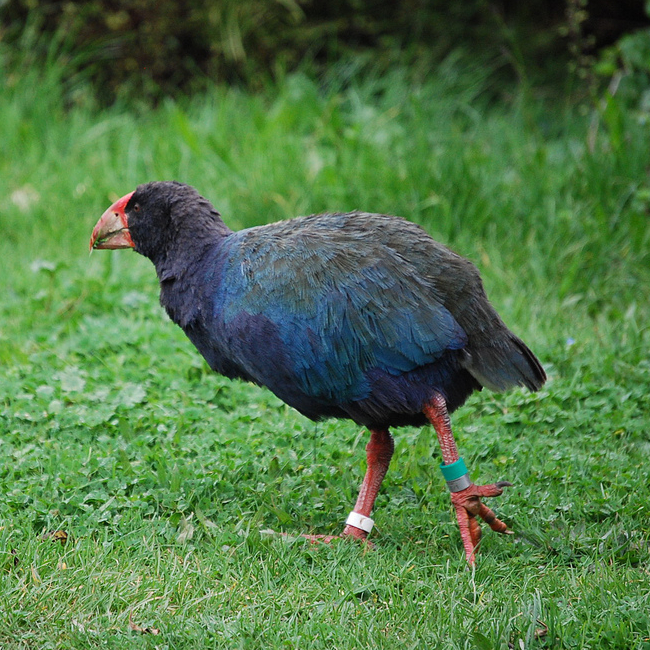 TakahēPorphyrio hochstetteri
-
 Australasian SwamphenPorphyrio melanotus
Compare
Questions and answers
What is the scientific name of the Dusky Moorhen?
The scientific name of the Dusky Moorhen is Gallinula tenebrosa. Written with its author, the full name is Gallinula tenebrosa Gould, 1846.
Which family does the Dusky Moorhen belong to?
Gallinula tenebrosa belongs to the family Rallidae, in the order Gruiformes and the class Aves.
Where is the Dusky Moorhen found?
Checklists and occurrence records place Gallinula tenebrosa in 6 countries: Australia, Papua New Guinea, Indonesia, New Caledonia, Timor Leste and Solomon Islands.
What is the conservation status of the Dusky Moorhen?
The IUCN Red List category recorded for Gallinula tenebrosa is Least Concern (LC).
Sources
Passages the profile rests on
- Adult Dusky Moorhens have predominantly dark grey-black plumage with browner upperparts. Source passage: “The adult dusky moorhen is mainly dark grey-black, with a browner tinge to the upper parts.” — English Wikipedia
- The species has a red frontal shield and a red bill tipped with yellow. Source passage: “It has a red frontal shield and yellow-tipped red bill” — English Wikipedia
- The species has orange-yellow legs rather than yellow legs. Source passage: “has orange-yellow rather than yellow legs.” — English Wikipedia
- The Dusky Moorhen lacks the white flank line present in the Common Moorhen. Source passage: “lacks the white flank line shown by common moorhen” — English Wikipedia
- The species has white feathers beneath its tail. Source passage: “long green legs and white feathers under the tail.” — fieldofmar-e.schools.nsw.gov.au
- The species frequently flicks its conspicuous white and black tail. Source passage: “The moorhens frequently flick their conspicuous white and black tail.” — English Wikipedia
- The frontal shield becomes brighter during warmer months. Source passage: “During the warmer months, in the breeding season, the shield grows brighter again in both sexes.” — English Wikipedia
- The frontal shield becomes duller in females and young males during autumn and winter. Source passage: “During autumn and winter, the colour of the frontal shield grows duller in females and young males.” — English Wikipedia
- Australian Dusky Moorhens measure approximately 34–38 centimetres in length. Source passage: “than the Australian race 34–38 centimetres (13–15 in).” — English Wikipedia
- New Guinea Dusky Moorhens measure approximately 25–32 centimetres in length. Source passage: “The New Guinea birds are smaller, at 25–32 centimetres (9.8–12.6 in) in length” — English Wikipedia
- Adult males have an average body mass of approximately 570 grams. Source passage: “Adult males generally weigh on average around 570 grams” — English Wikipedia
- Adult females have an average body mass of approximately 493 grams. Source passage: “adult females 493 grams.” — English Wikipedia
- The species inhabits freshwater marshes and swamps. Source passage: “with a preference for freshwater marshes and swamps” — English Wikipedia
- Dusky Moorhens use wetlands, ponds, creeks, swamps and urban waterways. Source passage: “live around wetlands, ponds, creeks, swamps and urban waterways across eastern Australia.” — fieldofmar-e.schools.nsw.gov.au
- The species requires open water with vegetation such as grass and reeds for cover. Source passage: “They require open water, usually with some cover such as grass, reeds, and other vegetation.” — English Wikipedia
- Dusky Moorhens inhabit calm freshwater environments with dense waterside vegetation. Source passage: “These birds prefer calm water where they can hide from predators and build nests among vegetation.” — fieldofmar-e.schools.nsw.gov.au
- The species is commonly found around dams and riverbanks. Source passage: “They are also found in urban parks such as Gold Coast Regional Botanic Gardens and often in dams and river banks.” — English Wikipedia
- The species generally occupies low-lying areas. Source passage: “They usually live in low-lying areas” — English Wikipedia
- Dusky Moorhens can inhabit urban parks and stormwater ponds around Sydney. Source passage: “Dusky moorhens are common in parks, stormwater ponds and bushland wetlands around Sydney” — fieldofmar-e.schools.nsw.gov.au
- The species eats seeds, shrub and grass tips, algae, fruits, molluscs and other invertebrates. Source passage: “Its diet consists of seeds, the tips of shrubs and grasses, algae, fruits, molluscs, and other invertebrates.” — English Wikipedia
- The species eats insects, worms, snails and tadpoles. Source passage: “They also eat insects, worms, snails, tadpoles and other small animals found around wetlands.” — fieldofmar-e.schools.nsw.gov.au
- Dusky Moorhens also consume carrion, bread and bird droppings. Source passage: “It will also consume carrion, bread and droppings from birds including gulls and ducks.” — English Wikipedia
- Chicks are initially fed mostly annelid worms and molluscs. Source passage: “The chicks are fed mostly on annelid worms and molluscs” — English Wikipedia
- Dusky Moorhens commonly forage while walking through shallow water or along muddy pond and creek edges. Source passage: “These birds usually feed while walking slowly through shallow water or along muddy edges of ponds and creeks.” — fieldofmar-e.schools.nsw.gov.au
- The species may forage in groups. Source passage: “sometimes forage in groups.” — fieldofmar-e.schools.nsw.gov.au
- The species is territorial during breeding but generally gregarious outside the breeding period. Source passage: “It is territorial when breeding, but otherwise gregarious.” — English Wikipedia
- Dusky Moorhens are active during the day and roost at night. Source passage: “Dusky moorhens are diurnal, and roost at nighttime alone, in breeding groups, or in non-breeding flocks.” — English Wikipedia
- Dusky Moorhens use their large feet and long toes to walk across floating vegetation. Source passage: “They are strong swimmers and can also walk across floating vegetation using their large feet and long toes.” — fieldofmar-e.schools.nsw.gov.au
- The species produces loud territorial calls described as kurk or krik. Source passage: “The territorial call is a loud kurk or krik” — English Wikipedia
- Territorial calls can be heard from distances exceeding two kilometres. Source passage: “This call is taken up by birds in surrounding territories and can be heard from over two kilometres away.” — English Wikipedia
- Dusky Moorhens produce sharp squawks and squeaks as alarm calls. Source passage: “The birds also make a series of short, sharp squawks and squeaks as alarm calls.” — English Wikipedia
- The breeding season in southern Australia extends from August to January. Source passage: “Breeding season is from August to January in the south of Australia” — English Wikipedia
- The breeding season in northern Australia extends from January to June. Source passage: “and January to June in the north” — English Wikipedia
- Dusky Moorhens generally produce one brood in southern Australia. Source passage: “with generally one brood” — English Wikipedia
- The species may produce two broods in northern Australia. Source passage: “often brooding twice.” — English Wikipedia
- Dusky Moorhens construct bulky nests from reeds or grasses at the water's edge or slightly above the water. Source passage: “This species builds a bulky nest of reeds or grasses at the water's edge or a few centimetres above the water” — English Wikipedia
- A clutch typically contains between five and eleven eggs. Source passage: “lays a clutch of 5–11 matte whitish eggs” — English Wikipedia
- The eggs are matte whitish and marked with red-brown dots and splotches. Source passage: “matte whitish eggs that are covered with red-brown dots and splotches.” — English Wikipedia
- The eggs measure approximately 53 millimetres long and 36 millimetres wide. Source passage: “they measure 53 mm long by 36 mm wide each” — English Wikipedia
- Both parents help incubate the eggs and protect the nest. Source passage: “both parents help incubate them and protect the nest.” — fieldofmar-e.schools.nsw.gov.au
- Young Dusky Moorhens leave the nest shortly after hatching. Source passage: “the black fluffy chicks leave the nest quickly and begin following adults through the wetland.” — fieldofmar-e.schools.nsw.gov.au
- The Dusky Moorhen is often confused with the Purple Swamphen and Eurasian Coot because of their similar appearance and overlapping distributions. Source passage: “It is often confused with the purple swamphen and the Eurasian coot due to similar appearance and overlapping distributions.” — English Wikipedia
Data
- Catalogue of Life, 2026-10-16 XR cc by
- Global Biodiversity Information Facility CC BY 4.0
- Wikidata CC0
- GeoNames CC BY 4.0
- Wikimedia Commons per image; credit shown with each image
- Within the Catalogue of Life, this name comes from The Integrated Taxonomic Information System cc0
References
- Peters, & James Lee. (1934). Check-List of Birds of the World, Vol. 2.
- Gill, Frank, & and Minturn Wright. (2006). Birds of the World: Recommended English Names.
- Dickinson, E. C., and J. V. Remsen Jr., eds. (2013). The Howard and Moore Complete Checklist of the Birds of the World, 4th Edition, Vol. 1 Non-Passerines.
This species in other databases
- Catalogue of Life 3F6W5
- Wikidata Q1078223
- iNaturalist 357
- WoRMS urn:lsid:marinespecies.org:taxname:1515895
- Avibase dusmoo1
Page built on 27 November 2026. See how the catalog is made and all sources and licences.
Cite this page
ScientificNames.org. (2026). Gallinula tenebrosa (Dusky Moorhen). Retrieved November 27, 2026, from https://scientificnames.org/species/gallinula-tenebrosa
“Gallinula tenebrosa (Dusky Moorhen).” ScientificNames.org, 2026, scientificnames.org/species/gallinula-tenebrosa. Accessed 27 Nov. 2026.
ScientificNames.org. “Gallinula tenebrosa (Dusky Moorhen).” Accessed November 27, 2026. https://scientificnames.org/species/gallinula-tenebrosa.
@misc{scientificnames_gallinula_tenebrosa_dusky_moorhen,
  author = {{ScientificNames.org}},
  title = {Gallinula tenebrosa (Dusky Moorhen)},
  year = {2026},
  url = {https://scientificnames.org/species/gallinula-tenebrosa},
  note = {Accessed 2026-11-27}
}