Species · Crustaceans
Lacustrine Scud Gammarus lacustris
The scientific name of the Lacustrine Scud is Gammarus lacustris. It is a species of crustacean in the family Gammaridae (scuds), order Amphipoda. The name dates from 1863.
- Scientific name
- Gammarus lacustris G.O. Sars, 1863
- Common name
- Lacustrine Scud
- Genus
- Gammarus
- Family
- Gammaridae (Scuds)
- Order
- Amphipoda
- Class
- Malacostraca
- Environment
- brackish, freshwater
- Recorded in
- 32 countries
- Name status
- accepted in the Catalogue of Life

Overview
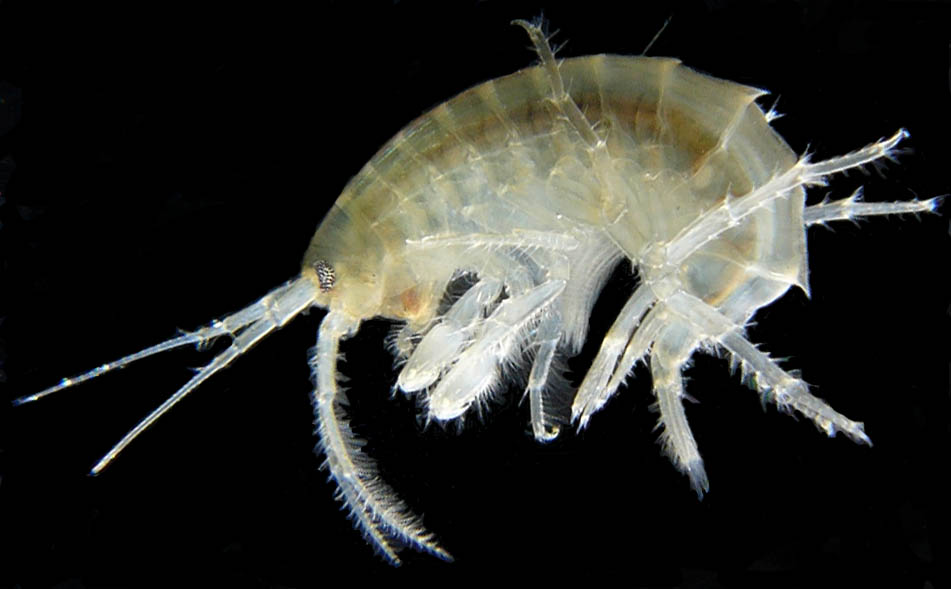
Gammarus lacustris inhabits freshwater lakes ranging from low-altitude calcium-rich environments to high-altitude cold lakes with little calcium. It has a semi-transparent, laterally compressed body with seven abdominal segments, a fused cephalothorax, two pairs of antennae, and no carapace or webbed tail.
Written 26 November 2026 from the sources listed below. Each statement was checked against the passage it cites; statements that could not be supported were removed.
Appearance
Lacustrine Scud has a semi-transparent body and resembles a freshwater shrimp. Its coloration can be colorless, brown, reddish, or bluish depending on the local environment.[1][2][3]
Its laterally compressed body lacks a carapace and has seven abdominal segments, a fused cephalothorax, and two pairs of antennae. It also lacks a webbed tail.[1][4][5]
Habitat
Lacustrine Scud inhabits freshwater lakes ranging from low-altitude calcium-rich environments to high-altitude cold lakes with little calcium. It occurs in both shallow and deep lakes.[6][7]
Its distribution within the water follows the thermocline.[8]
Diet
Its diet can include algae, particularly diatoms. It also consumes three parasite groups: Diplostomum, Apatemon, and Trichobilharzia.[9][10]
Behaviour
Lacustrine Scud typically avoids light. Infection by Pomphorhynchus laevis can alter its light response from photophobic to photophilic.[11][12]
Parasite infections can alter its daily migration patterns and increase its exposure to predators. The species is more abundant in lakes without fish than in lakes containing fish.[13][14]
Reproduction and life cycle
Females carry their eggs in a brood pouch on the ventral side of the body. Individuals at higher elevations tend to produce fewer but larger eggs than individuals at lower elevations.[15][16]
Juveniles resemble adults, and development involves several molts.[17]
Similar species
Lacustrine Scud resembles a freshwater shrimp.[3]
Uses
Lacustrine Scud serves as an intermediate host for several parasite species, including Pomphorhynchus laevis.[18]
It is an important food source for numerous organisms and is preyed upon by birds, fish, and some insects.[19][20]
Conservation
Lacustrine Scud plays an important ecological role in many freshwater ecosystems where it occurs. It is considered an indicator of overall ecosystem health and stability.[21][22]
Classification of the Lacustrine Scud
| Kingdom | Animalia |
|---|---|
| Phylum | Arthropoda |
| Subphylum | Crustacea |
| Class | Malacostraca |
| Order | Amphipoda |
| Suborder | Senticaudata |
| Infraorder | Gammarida |
| Parvorder | Gammaridira |
| Superfamily | Gammaroidea |
| Family | Gammaridae (Scuds) |
| Genus | Gammarus (Scuds) |
| Species | Gammarus lacustris G.O. Sars, 1863 |
Where the Lacustrine Scud is found
Checklists and occurrence records place Gammarus lacustris in 32 countries. GBIF holds 6,659 georeferenced records of it.
Countries
- Afghanistan 3
- Armenia 5
- Austria 33
- Canada 926
- China 147
- Denmark 15
- Estonia 18
- Finland 322
- France 59
- Georgia 16
- Germany 17
- India 11
- Iran 5
- Ireland 13
- Italy 18
- Kazakhstan 99
- Kyrgyzstan 13
- Lithuania 3
- Mongolia 19
- Nepal 9
- Norway 3,355
- Poland 31
- Russia 145
- Slovenia 3
- Sweden 455
- Switzerland 74
- Tajikistan 6
- The Netherlands 4
- Ukraine 9
- United Kingdom 202
- United States 621
- Uzbekistan 3
Regions and cities with the most records
- Alaska, United States 360
- Manitoba, Canada 320
- Buskerud, Norway 308
- Alberta, Canada 272
- Trondheim, Norway 266
- Nordland, Norway 237
- Finnmark, Norway 234
- Lapland, Finland 206
- Troms, Norway 159
- Telemark, Norway 110
- Jämtland, Sweden 94
- British Columbia, Canada 88
- Akershus, Norway 83
- Norrbotten, Sweden 78
- Scotland, United Kingdom 71
- Saskatchewan, Canada 67
- Møre og Romsdal, Norway 63
- Wales, United Kingdom 57
- Asker, Norway 53
- Dalarna, Sweden 52
- Stjørdalshalsen, Norway 52
- Vestfold, Norway 49
- Drammen, Norway 46
- Oslo, Norway 46
- Västerbotten, Sweden 45
- England, United Kingdom 44
- Rogaland, Norway 42
- Östergötland, Sweden 40
- Nevada, United States 38
- Västra Götaland, Sweden 37
- Auvergne-Rhône-Alpes, France 34
- Larvik, Norway 33
- Colorado, United States 32
- Sarpsborg, Norway 32
- Ontario, Canada 31
- Sandnes, Norway 30
A number beside a place is its count of GBIF occurrence records. A place without a number comes from a checklist alone. Records show where a species has been observed or collected, which can include escapes and vagrants.
Common names
English
- Lacustrine Scud
Names in 10 other languages
- Estonian
- Järve-kirpvähk
- Finnish
- järvikatka
- Latvian
- Ezeru sānpelde
- Lithuanian
- Ežerinė šoniplauka
- Northern Sami
- hirrá, hirrát, širra
- Norwegian Bokmål
- grunnåte, nordlig marflo
- Norwegian Nynorsk
- grunnåt m., grunnåte f., nordleg marflo
- Polish
- kiełż jeziorowy
- Russian
- Бокоплав-кузнечик
- Swedish
- nordlig sötvattensmärla
Synonyms
8 other scientific names have been used for this species and are now treated as synonyms of Gammarus lacustris.
- Gammarus alpinus Alther, Fiser & Altermatt, 2016
- Gammarus bolkayi S. Karaman, 1934
- Gammarus pulex (De Geer, 1778) Brandt, 1851
- Gammarus pulex sibiricus
- Gammarus scandinavicus S. Karaman, 1931
- Gammarus wigrensis Micherdzinski, 1959
- Rivulogammarus lacustris (G.O. Sars, 1863)
- Rivulogammarus scandinavicus S. Karaman, 1931
Subspecies and varieties
- Gammarus lacustris limnaeus subspecies
Related species
-
 Common Freshwater AmphipodGammarus pulex
-
 Trench ScudGammarus fossarum
- Illinois Cave AmphipodGammarus acherondytes
-
 Lacustrine ShrimpGammarus roeselii
-
 Locust AmphipodGammarus locusta
-
 Bitter Lakes AmphipodGammarus desperatus
-
 Pecos AmphipodGammarus pecos
-
 Gammarus mucronatus
Compare
Questions and answers
What is the scientific name of the Lacustrine Scud?
The scientific name of the Lacustrine Scud is Gammarus lacustris. Written with its author, the full name is Gammarus lacustris G.O. Sars, 1863.
Which family does the Lacustrine Scud belong to?
Gammarus lacustris belongs to the family Gammaridae, in the order Amphipoda and the class Malacostraca.
Where is the Lacustrine Scud found?
Checklists and occurrence records place Gammarus lacustris in 32 countries, including Norway, Canada, United States, Sweden, Finland and United Kingdom.
Sources
Passages the profile rests on
- The species has a semi-transparent body and lacks a webbed tail. Source passage: “Gammarus lacustris is semi-transparent and lacks a webbed tail.” — English Wikipedia
- Its coloration can be colorless, brown, reddish, or bluish depending on the local environment. Source passage: “It may be colorless, brown, reddish or bluish in color, depending on the local environment.” — English Wikipedia
- The species resembles a freshwater shrimp. Source passage: “G. lacustris resembles a freshwater shrimp.” — English Wikipedia
- Its body has seven abdominal segments, a fused cephalothorax, and two pairs of antennae. Source passage: “It has seven abdominal segments, a fused cephalothorax, and two pairs of antennae.” — English Wikipedia
- Its laterally compressed body lacks a carapace. Source passage: “Unlike other crustaceans, amphipods lack carapaces and have laterally compressed bodies.” — English Wikipedia
- The species inhabits freshwater lakes ranging from low-altitude calcium-rich environments to high-altitude cold lakes with little calcium. Source passage: “G. lacustris can also inhabit a wide array of environments, ranging from low altitude calcium-rich lakes to high altitude, cold, and calcium-poor lakes.” — English Wikipedia
- The species occurs in both shallow and deep lakes. Source passage: “It can be found in shallow or deep lakes” — English Wikipedia
- The species' distribution within the water follows the thermocline. Source passage: “Its distribution follows the thermocline in the water.” — English Wikipedia
- Its diet can also include algae, particularly diatoms. Source passage: “may also consume algae, mainly diatoms.” — English Wikipedia
- The species consumes three parasite groups, including Diplostomum, Apatemon, and Trichobilharzia. Source passage: “when G. lacustris feeds on three different parasite species (Diplostomum spp., Apatemon spp. and Trichobilharzia spp.)” — English Wikipedia
- The species typically exhibits avoidance of light. Source passage: “G. lacustris typically shows photophobic behaviour” — English Wikipedia
- Infection by Pomphorhynchus laevis can alter its light response from photophobic to photophilic. Source passage: “when parasitized this can be altered to photophilic behaviour when infected by Pomphorhynchus laevis” — English Wikipedia
- Parasite infections can alter the species' daily migration patterns and increase its exposure to predators. Source passage: “Parasites can affect the diel migration of G. lacustris, making it more visible and susceptible to predation” — English Wikipedia
- The species is more abundant in lakes without fish than in lakes containing fish. Source passage: “It is more abundant in fishless lakes than in those with fish.” — English Wikipedia
- Females carry their eggs in a brood pouch located on the ventral side of the body. Source passage: “The female carries eggs in a brood pouch on its ventral side.” — English Wikipedia
- Individuals at higher elevations tend to produce fewer but larger eggs than individuals at lower elevations. Source passage: “G. lacustris in higher elevations were more likely to have fewer but larger eggs than those living at lower elevations.” — English Wikipedia
- Juveniles resemble adults, and the species undergoes several molts during development. Source passage: “G. lacustris undergoes several molts and juveniles resemble the adult.” — English Wikipedia
- The species serves as an intermediate host for several parasite species, including Pomphorhynchus laevis. Source passage: “it serves as an intermediate host for several parasite species (e.g. Pomphorhynchus laevis).” — English Wikipedia
- The species is preyed upon by birds, fish, and some insects. Source passage: “Birds, fishes, and some insects are known to prey upon G. lacustris.” — English Wikipedia
- The species is an important food source for numerous organisms. Source passage: “As a small aquatic invertebrate G. lacustris is an important food source for many organisms.” — English Wikipedia
- The species plays an important ecological role in many freshwater ecosystems where it occurs. Source passage: “Gammarus lacustris plays an important role in many of the freshwater ecosystems that it inhabits.” — English Wikipedia
- The species is considered an indicator of overall ecosystem health and stability. Source passage: “It is considered an indicator species for the overall health and stability of the ecosystem.” — English Wikipedia
- At low altitudes, individuals are known to die after their first reproductive event. Source passage: “at low altitudes, it is known to die after first reproduction” — English Wikipedia
- In colder waters, individuals can survive to reproduce repeatedly. Source passage: “but in colder waters, it lives to reproduce repeatedly.” — English Wikipedia
Data
- Catalogue of Life, 2026-10-16 XR cc by
- Global Biodiversity Information Facility CC BY 4.0
- Wikidata CC0
- GeoNames CC BY 4.0
- Wikimedia Commons per image; credit shown with each image
- Within the Catalogue of Life, this name comes from World Register of Marine Species cc by
References
- Sars, G. O. (1863). Beretning om en i Sommeren 1862 foretagen zoologisk Reise i Christianias og Trondhjems Stifter. [Report on a zoological trip undertaken in the summer of 1862 in Christiania and Trondhjem Stifter.]. Nyt Magazin for Naturvidenskaberne, 12: 193–252. where the name was published
This species in other databases
- Catalogue of Life 6K99B
- Wikidata Q3932955
- iNaturalist 220287
- WoRMS urn:lsid:marinespecies.org:taxname:234085
- ITIS 93789
Page built on 26 November 2026. See how the catalog is made and all sources and licences.
Cite this page
ScientificNames.org. (2026). Gammarus lacustris (Lacustrine Scud). Retrieved November 26, 2026, from https://scientificnames.org/species/gammarus-lacustris
“Gammarus lacustris (Lacustrine Scud).” ScientificNames.org, 2026, scientificnames.org/species/gammarus-lacustris. Accessed 26 Nov. 2026.
ScientificNames.org. “Gammarus lacustris (Lacustrine Scud).” Accessed November 26, 2026. https://scientificnames.org/species/gammarus-lacustris.
@misc{scientificnames_gammarus_lacustris_lacustrine_scud,
  author = {{ScientificNames.org}},
  title = {Gammarus lacustris (Lacustrine Scud)},
  year = {2026},
  url = {https://scientificnames.org/species/gammarus-lacustris},
  note = {Accessed 2026-11-26}
}