Species · Birds
Kentucky Warbler Geothlypis formosa
The scientific name of the Kentucky Warbler is Geothlypis formosa. It is a species of bird in the family Parulidae (new world warbler), order Passeriformes. The name dates from 1811.
- Scientific name
- Geothlypis formosa (A. Wilson, 1811)
- Common name
- Kentucky Warbler
- Genus
- Geothlypis
- Family
- Parulidae (New World Warbler)
- Order
- Passeriformes
- Class
- Aves
- Red List category
- LC Least Concern
- Environment
- terrestrial
- Recorded in
- 25 countries
- Name status
- accepted in the Catalogue of Life

Overview
Geothlypis formosa occurs in the central and eastern United States during summer and migrates to the Yucatán Peninsula and Caribbean islands during fall and winter.
Written 26 November 2026 from the sources listed below. Each statement was checked against the passage it cites; statements that could not be supported were removed.
Appearance
Females have less black coloration on the sides of their heads than males. Immature birds may have almost no black coloration.[1][2]
The Kentucky Warbler has a short tail and weighs approximately 13–14 g. Its wingspan is approximately 20–22 cm.[3][4][5]
Habitat
The Kentucky Warbler frequents moist deciduous forests and inhabits moist woodlands and forests with dense vegetation. It occurs in relatively large forest tracts.[6][7][8]
Diet
The Kentucky Warbler primarily eats insects and is classified as an omnivore.[9][10]
Behaviour
The Kentucky Warbler spends most of its time on or near the ground, except when singing. It is described as sluggish and heavy.[11][12]
The Kentucky Warbler can migrate nonstop across the Gulf of Mexico.[13]
Reproduction and life cycle
Kentucky Warblers build their nests on the ground, concealed at the base of shrubs or among weeds in areas with abundant vegetation. Females lay between three and six eggs per clutch.[14][15]
The eggs are white or cream-colored and speckled with brown. Only the female incubates the eggs, and the incubation period lasts approximately 12 days.[16][17][18]
Young Kentucky Warblers generally leave the nest approximately 10 days after hatching.[19]
Classification of the Kentucky Warbler
| Kingdom | Animalia |
|---|---|
| Phylum | Chordata |
| Subphylum | Vertebrata |
| Infraphylum | Gnathostomata |
| Parvphylum | Osteichthyes |
| Megaclass | Tetrapoda |
| Class | Aves (Bird) |
| Order | Passeriformes (Passerine) |
| Family | Parulidae (New World Warbler) |
| Genus | Geothlypis (Yellowthroat) |
| Species | Geothlypis formosa (A. Wilson, 1811) |
Where the Kentucky Warbler is found
Checklists and occurrence records place Geothlypis formosa in 25 countries across North America. GBIF holds 285,403 georeferenced records of it.
Countries
- Bahamas 25
- Belize 12,181
- Bermuda 230
- Bonaire, Saint Eustatius and Saba 10
- Canada 2,625
- Cayman Islands 8
- Costa Rica 8,023
- Cuba 65
- Dominican Republic 13
- El Salvador 62
- Guadeloupe 37
- Guatemala 7,899
- Haiti 7
- Honduras 3,209
- Jamaica 13
- Martinique 5
- Mexico 5,009
- Nicaragua 1,197
- Panama 977
- Puerto Rico 153
- Saint Martin 3
- Saint Pierre and Miquelon 3
- Turks and Caicos Islands 3
- U.S. Virgin Islands 11
- United States 243,635
Regions and cities with the most records
- Texas, United States 28,370
- Missouri, United States 23,771
- Tennessee, United States 19,988
- Indiana, United States 15,963
- Ohio, United States 14,973
- Illinois, United States 12,361
- Georgia, United States 12,067
- Alabama, United States 11,774
- Arkansas, United States 11,002
- Maryland, United States 10,538
- Kentucky, United States 9,557
- Pennsylvania, United States 8,633
- Virginia, United States 7,957
- Louisiana, United States 7,954
- Cayo District, Belize 6,540
- North Carolina, United States 6,410
- Petén, Guatemala 6,082
- Florida, United States 5,902
- Mississippi, United States 5,214
- Kansas, United States 4,757
- West Virginia, United States 3,681
- San Ignacio, Belize 3,628
- Wildwood, United States 3,577
- South Carolina, United States 3,116
- Chesterfield, United States 3,059
- New Jersey, United States 2,996
- Columbia, United States 2,975
- Bloomington, United States 2,711
- Ballwin, United States 2,519
- New York, United States 2,516
- Galveston, United States 2,438
- Texas City, United States 2,421
- Oklahoma, United States 2,418
- Ontario, Canada 2,340
- Puntarenas Province, Costa Rica 2,340
- La Marque, United States 2,298
2 more countries have a few records outside this range
These countries hold a few records of Geothlypis formosa but lie outside the range the checklists give for it. Such records are often zoo or garden specimens, museum material or vagrants, so the species is not counted as occurring there.
Range as the checklists state it
North America
A number beside a place is its count of GBIF occurrence records. A place without a number comes from a checklist alone. Records show where a species has been observed or collected, which can include escapes and vagrants.
Common names
English
- Kentucky Warbler
- Kentucky Yellowthroat
Names in 27 other languages
- Catalan
- bosquerola de Kentucky
- Chinese
- 麗色黃喉地鶯, 黄腹地莺
- Croatian
- maslinastoleđa sjeničica
- Czech
- lesňáček žlutobrvý
- Danish
- Kentuckysanger
- Dutch
- Kentuckyzanger
- Esperanto
- kentukia parulio
- Estonian
- habesäälik
- Finnish
- lehtokerttuli
- French
- Paruline du Kentucky
- German
- Kentuckygelbkehlchen, Kentuckywaldsänger
- Hebrew
- סבכון קנטקי
- Italian
- Parula del Kentucky
- Japanese
- メガネアメリカムシクイ
- Latvian
- Kentuki ķauķis
- Lithuanian
- kentukinis oporornis
- Norwegian
- kentuckyparula
- Papiamento
- Chipe di Kentucky
- Polish
- cytrynka czarnouzda
- Portuguese
- mariquita-de-capuz-esverdeado, mariquita-do-kentucky
- Russian
- Златобровая желтогрудка, Кентуккский масковый певун
- Serbian
- Kentaki cvrkutarka
- Slovak
- horárik spevavý
- Spanish
- Chipe patilludo, Cigüita de Kentucky, Reinita Cachetinegra, Reinita de Kentucky
- Swedish
- kentuckyskogssångare
- Turkish
- Kentaki Ötleğeni, Kentucky ötleğeni
- Ukrainian
- цитринка жовтогорла
Synonyms
5 other scientific names have been used for this species and are now treated as synonyms of Geothlypis formosa.
- Geothlypis formosa formosa Wilson, A, 1811
- Geothlypis formosus formosus Stotz et al. (1996)
- Myiodioctes formosa Wilson, A, 1811
- Oporornis formosus (A. Wilson, 1811)
- Sylvia formosa A. Wilson, 1811
Related species
-
 Common YellowthroatGeothlypis trichas
-
 Mourning WarblerGeothlypis philadelphia
-
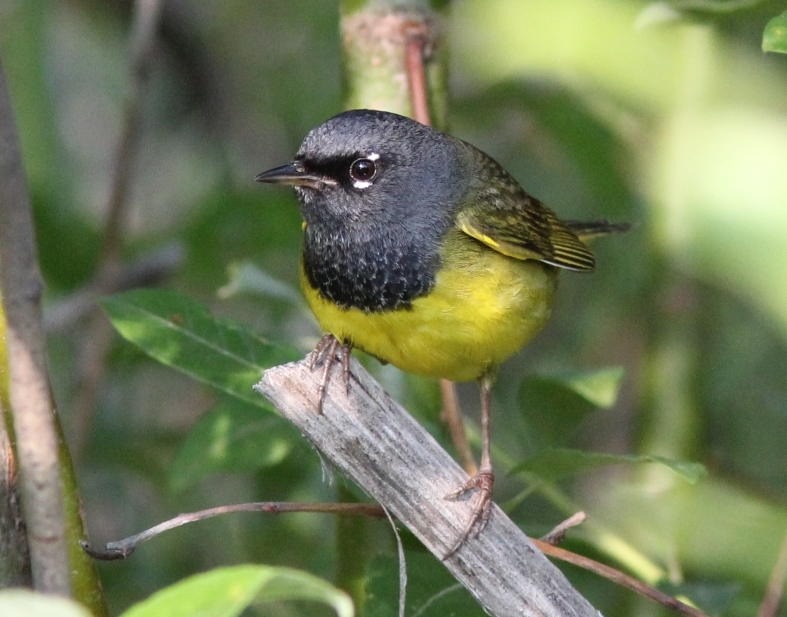 MacGillivray's WarblerGeothlypis tolmiei
-
 Bahama YellowthroatGeothlypis rostrata
-
 Black-polled YellowthroatGeothlypis speciosa
-
 Masked YellowthroatGeothlypis aequinoctialis
-
 Grey-crowned YellowthroatGeothlypis poliocephala
-
 Belding's YellowthroatGeothlypis beldingi
Compare
Questions and answers
What is the scientific name of the Kentucky Warbler?
The scientific name of the Kentucky Warbler is Geothlypis formosa. Written with its author, the full name is Geothlypis formosa (A. Wilson, 1811).
Which family does the Kentucky Warbler belong to?
Geothlypis formosa belongs to the family Parulidae, in the order Passeriformes and the class Aves.
Where is the Kentucky Warbler found?
Checklists and occurrence records place Geothlypis formosa in 25 countries, including United States, Belize, Costa Rica, Guatemala, Mexico and Honduras.
What is the conservation status of the Kentucky Warbler?
The IUCN Red List category recorded for Geothlypis formosa is Least Concern (LC).
What other names does the Kentucky Warbler have?
Geothlypis formosa is also known in English as Kentucky Yellowthroat.
Sources
Passages the profile rests on
- Female Kentucky Warblers have less black coloration on the sides of their heads than males. Source passage: “Female Kentucky warblers have slightly less black on the sides of their head” — English Wikipedia
- Immature Kentucky Warblers may have almost no black coloration. Source passage: “immature birds may have almost no black at all.” — English Wikipedia
- The Kentucky Warbler weighs approximately 13–14 g. Source passage: “Weight: 0.5–0.5 oz (13–14 g)” — English Wikipedia
- The Kentucky Warbler has a wingspan of approximately 20–22 cm. Source passage: “Wingspan: 7.9–8.7 in (20–22 cm)” — English Wikipedia
- The Kentucky Warbler has a short tail. Source passage: “It is a sluggish and heavy warbler with a short tail” — English Wikipedia
- The Kentucky Warbler frequents moist deciduous forests. Source passage: “frequenting moist deciduous forests.” — English Wikipedia
- The Kentucky Warbler inhabits moist woodlands and forests with dense vegetation. Source passage: “The Kentucky warbler's habitat is in moist woodlands and forests with dense ...” — mdc.mo.gov
- The Kentucky Warbler occurs in relatively large forest tracts. Source passage: “Habitat: Kentucky Warblers are found in relatively large forest tracts” — tn.gov
- The Kentucky Warbler primarily eats insects. Source passage: “Kentucky warblers' primary diet is insectivorous.” — animaldiversity.org
- The Kentucky Warbler is classified as an omnivore. Source passage: “Although classified as omnivores” — animaldiversity.org
- The Kentucky Warbler spends most of its time on or near the ground, except when singing. Source passage: “preferring to spend most of its time on or near the ground, except when singing.” — English Wikipedia
- The Kentucky Warbler is described as sluggish and heavy. Source passage: “It is a sluggish and heavy warbler” — English Wikipedia
- The Kentucky Warbler can migrate nonstop across the Gulf of Mexico. Source passage: “flying non-stop across the Gulf of Mexico.” — English Wikipedia
- Kentucky Warblers build their nests on the ground, concealed at the base of shrubs or among weeds in areas with abundant vegetation. Source passage: “Kentucky warblers nest on the ground hidden at the base of a shrub or in a patch of weeds in an area of ample vegetation.” — English Wikipedia
- Female Kentucky Warblers lay between three and six eggs per clutch. Source passage: “The female will lay between 3 and 6 eggs” — English Wikipedia
- Kentucky Warbler eggs are white or cream-colored and speckled with brown. Source passage: “which are white or cream-colored and speckled with brown.” — English Wikipedia
- Only the female Kentucky Warbler incubates the eggs. Source passage: “Incubation is done by the female only” — English Wikipedia
- The incubation period for Kentucky Warbler eggs lasts approximately 12 days. Source passage: “lasts for about 12 days.” — English Wikipedia
- Young Kentucky Warblers generally leave the nest approximately 10 days after hatching. Source passage: “The young Kentucky warblers usually leave the nest about 10 days after hatching.” — English Wikipedia
Data
- Catalogue of Life, 2026-10-16 XR cc by
- Global Biodiversity Information Facility CC BY 4.0
- Wikidata CC0
- GeoNames CC BY 4.0
- Wikimedia Commons per image; credit shown with each image
- Within the Catalogue of Life, this name comes from The Integrated Taxonomic Information System cc0
References
- Am. Ornithol. 3: 85, pl. 25, fig. 3. 1811 where the name was published
This species in other databases
Page built on 26 November 2026. See how the catalog is made and all sources and licences.
Cite this page
ScientificNames.org. (2026). Geothlypis formosa (Kentucky Warbler). Retrieved November 26, 2026, from https://scientificnames.org/species/geothlypis-formosa
“Geothlypis formosa (Kentucky Warbler).” ScientificNames.org, 2026, scientificnames.org/species/geothlypis-formosa. Accessed 26 Nov. 2026.
ScientificNames.org. “Geothlypis formosa (Kentucky Warbler).” Accessed November 26, 2026. https://scientificnames.org/species/geothlypis-formosa.
@misc{scientificnames_geothlypis_formosa_kentucky_warbler,
  author = {{ScientificNames.org}},
  title = {Geothlypis formosa (Kentucky Warbler)},
  year = {2026},
  url = {https://scientificnames.org/species/geothlypis-formosa},
  note = {Accessed 2026-11-26}
}