Species · Birds
Common Yellowthroat Geothlypis trichas
The scientific name of the Common Yellowthroat is Geothlypis trichas. It is a species of bird in the family Parulidae (new world warbler), order Passeriformes. The name dates from 1766.
- Scientific name
- Geothlypis trichas (Linnaeus, 1766)
- Common name
- Common Yellowthroat
- Genus
- Geothlypis
- Family
- Parulidae (New World Warbler)
- Order
- Passeriformes
- Class
- Aves
- Red List category
- LC Least Concern
- Environment
- terrestrial
- Recorded in
- 28 countries
- Name status
- accepted in the Catalogue of Life

Overview
Geothlypis trichas breeds across North America from southern Canada to central Mexico, with northern populations migrating south for winter. It has olive-colored upperparts, yellow throats and chests, and adult males have distinctive black facial masks.
Written 26 November 2026 from the sources listed below. Each statement was checked against the passage it cites; statements that could not be supported were removed.
Appearance
The Common Yellowthroat has olive-colored backs, wings, and tails, yellow throats and chests, and white bellies. It measures 11–13 cm in length, has a wingspan of 15–19 cm, and weighs 7.6–15.5 g.[1][2][3][4]
Adult males have black facial masks extending from the sides of the neck across the eyes and forehead. The masks are bordered above by white or gray.[5][6]
Females have paler underparts than males and lack the black facial mask. Immature birds resemble adult females, while first-year males have faint black masks that become completely dark by spring.[7][8][9]
Subspecies differ mainly in male facial patterns and the brightness of their yellow underparts. Southwestern subspecies have the brightest and most intensely yellow underparts.[10][11]
Habitat
The Common Yellowthroat breeds in marshes and other wet areas containing low, dense vegetation. It also occurs in areas with dense shrubs and is less commonly found in dry areas.[12][13][14]
The species breeds across North America from southern Canada to central Mexico. Northern populations migrate to wintering areas in the southern breeding range, Central America, and the West Indies, while southern populations are largely resident.[15][16][17]
The species is a very rare vagrant in western Europe. The subspecies Geothlypis trichas sinuosa occurs in California.[18][19]
Diet
The Common Yellowthroat feeds on insects.[20]
Behaviour
The Common Yellowthroat usually captures insects in dense vegetation and sometimes catches them in midair.[21][22]
The species produces a loud song consisting of repeated twichety notes and has a soft jip call.[23][24]
Northern populations migrate at night. Males generally reach their spring migration destinations before females.[25][26]
During spring migration, returning birds that have visited Appledore Island more than twice arrive earlier than first-time migrants. Males arrive on Appledore Island an average of five days before females, and both sexes spend approximately one week there before continuing their migration.[27][28][29]
In Florida, peak migration occurs from the last week of September through the second week of October.[30]
Reproduction and life cycle
The Common Yellowthroat builds cup-shaped nests in low vegetation. Females lay 3–5 eggs per clutch.[31][32][33]
Both parents feed the young. Nests are frequently subject to brood parasitism by Brown-headed Cowbirds.[34][35]
Females appear to prefer males with larger facial masks.[36]
Conservation
The Common Yellowthroat remains very common despite declining population numbers. Loss of favored habitat is identified as a cause of population decline.[37][38]
Habitat degradation and habitat loss are major threats throughout the species' range.[39]
Classification of the Common Yellowthroat
| Kingdom | Animalia |
|---|---|
| Phylum | Chordata |
| Subphylum | Vertebrata |
| Infraphylum | Gnathostomata |
| Parvphylum | Osteichthyes |
| Megaclass | Tetrapoda |
| Class | Aves (Bird) |
| Order | Passeriformes (Passerine) |
| Family | Parulidae (New World Warbler) |
| Genus | Geothlypis (Yellowthroat) |
| Species | Geothlypis trichas (Linnaeus, 1766) |
Where the Common Yellowthroat is found
Checklists and occurrence records place Geothlypis trichas in 28 countries across North America. GBIF holds 7,925,638 georeferenced records of it.
Countries
- Aruba 41
- Bahamas 5,217
- Belize 18,438
- Bermuda 4,726
- Bonaire, Saint Eustatius and Saba 10
- British Virgin Islands 3
- Canada 1,106,463
- Cayman Islands 1,370
- Costa Rica 930
- Cuba 10,814
- Curacao 16
- Dominica 3
- Dominican Republic 2,406
- El Salvador 517
- Greenland 3
- Guadeloupe 37
- Guatemala 8,137
- Haiti 836
- Honduras 7,605
- Jamaica 2,284
- Mexico 65,335
- Nicaragua 370
- Panama 458
- Puerto Rico 2,213
- Saint Pierre and Miquelon 572
- Turks and Caicos Islands 82
- U.S. Virgin Islands 39
- United States 6,686,713
Regions and cities with the most records
- California, United States 659,983
- New York, United States 561,807
- Ontario, Canada 441,666
- Florida, United States 391,164
- Pennsylvania, United States 368,370
- Wisconsin, United States 296,226
- Quebec, Canada 292,872
- Massachusetts, United States 284,591
- Ohio, United States 283,626
- Illinois, United States 281,394
- Michigan, United States 255,720
- New Jersey, United States 255,580
- Texas, United States 243,017
- Maryland, United States 217,332
- Minnesota, United States 193,626
- Maine, United States 170,482
- Virginia, United States 170,018
- Oregon, United States 168,883
- British Columbia, Canada 160,883
- North Carolina, United States 159,129
- Washington, United States 153,327
- Arizona, United States 132,597
- New York City, United States 124,595
- Indiana, United States 121,333
- Brooklyn, United States 117,828
- Vermont, United States 116,126
- Queens, United States 113,598
- Bayonne, United States 112,674
- Hoboken, United States 111,737
- Union City, United States 111,408
- Cliffside Park, United States 110,677
- North Bergen, United States 110,187
- West New York, United States 110,168
- Secaucus, United States 109,820
- Jersey City, United States 109,496
- Manhattan, United States 108,730
10 more countries have a few records outside this range
These countries hold a few records of Geothlypis trichas but lie outside the range the checklists give for it. Such records are often zoo or garden specimens, museum material or vagrants, so the species is not counted as occurring there.
Range as the checklists state it
Middle America
North America
Caribbean
A number beside a place is its count of GBIF occurrence records. A place without a number comes from a checklist alone. Records show where a species has been observed or collected, which can include escapes and vagrants.
Common names
English
- Common Yellowthroat
- Belding's Yellowthroat
- Black-Masked Ground Warbler
- Yellow Bandit
- Yellowthroat
Names in 37 other languages
- Catalan
- bosquerola emmascarada comuna
- Chinese
- 普通黃喉地鶯, 黃喉地鶯, 黄喉地莺
- Croatian
- crnolica sjeničica
- Czech
- lesňáček žlutohrdlý
- Danish
- Gulstrube
- Dutch
- Gewone Maskerzanger, maskerzanger
- Esperanto
- flavgorĝa parulio
- Estonian
- põhja-masksäälik
- Faroese
- Svartgríma
- Finnish
- naamiokerttuli
- French
- Paruline masquée
- German
- Weiden-Gelbkehlchen, Weidengelbkehlchen
- Greek
- Αμερικανικός Κιτρινολαίμης
- Hebrew
- פרול, צהוב-גרון, קרקען שעיר
- Hungarian
- északi álarcosposzáta
- Icelandic
- Grímuskríkja
- Irish
- Buíphíb choiteann, Píb-bhuí
- Italian
- Parula golagialla, golagialla comune
- Japanese
- カオグロアメリカムシクイ
- Latvian
- dzeltenrīklīte
- Lithuanian
- Geltongurklė, paprastoji geltongurklė
- Northern Sami
- Fiskesraddi
- Norwegian
- nordgulstrupe
- Papiamento
- Mascarita Comun, Maskarita Komun
- Polish
- cytrynka czarnolica
- Portuguese
- mariquita-de-mascarilha, pia-cobra-boreal
- Russian
- Желтогорлый (масковый) певун, Желтогорлый масковый певун, Желтогорлый певун, Северная желтогрудка, масковый певун
- Scottish Gaelic
- Scoarnagh wuigh
- Serbian
- Žutogrla cvrkutarka
- Slovak
- horárik pastvinový
- Slovenian
- krinkar
- Spanish
- Mascarita común, Reinita picatierra, antifacito común, antifacito norteño, cigüita enmascarada
- Swedish
- Nordlig gulhake, gulhake
- Turkish
- Sarıgerdan, sarı gerdanlı ötleğen, çalıbülbülü
- Ukrainian
- жовтогорлик північний
- Welsh
- Aderyn gyddf-felyn cyffredin, Gyddf-felyn
- hat
- Ti Tchit figi nwa
Synonyms
7 other scientific names have been used for this species and are now treated as synonyms of Geothlypis trichas.
- Motacilla marylandica Bechstein, JM, 1798
- Sylvia marilandica Wilson, A, 1808
- Sylvia marylandica Bechstein, JM, 1798
- Sylvia roscoe Audubon, JJ, 1827
- Trichas marilandica Wilson, A, 1808
- Trichas personatus Swainson, WJ, 1827
- Turdus trichas Linnaeus, 1766
Subspecies and varieties
- Geothlypis trichas arizela (Pacific Yellowthroat) subspecies
- Geothlypis trichas campicola (Northwestern Yellowthroat) subspecies
- Geothlypis trichas chapalensis (Chapala Yellowthroat) subspecies
- Geothlypis trichas chryseola (Sonora Yellowthroat) subspecies
- Geothlypis trichas coloradonicola subspecies
- Geothlypis trichas ignota (Florida Yellowthroat) subspecies
- Geothlypis trichas insperata (Brownsville Yellowthroat) subspecies
- Geothlypis trichas melanops (Central Mexican Common Yellowthroat) subspecies
- Geothlypis trichas modesta (San Blas Yellowthroat) subspecies
- Geothlypis trichas occidentalis (Western Yellowthroat) subspecies
- Geothlypis trichas scirpicola (Tule Yellowthroat) subspecies
- Geothlypis trichas sinuosa (Saltmarsh Yellowthroat) subspecies
- Geothlypis trichas trichas (Eastern Yellowthroat) subspecies
- Geothlypis trichas typhicola (Athens Yellowthroat) subspecies
Related species
-
 Mourning WarblerGeothlypis philadelphia
-
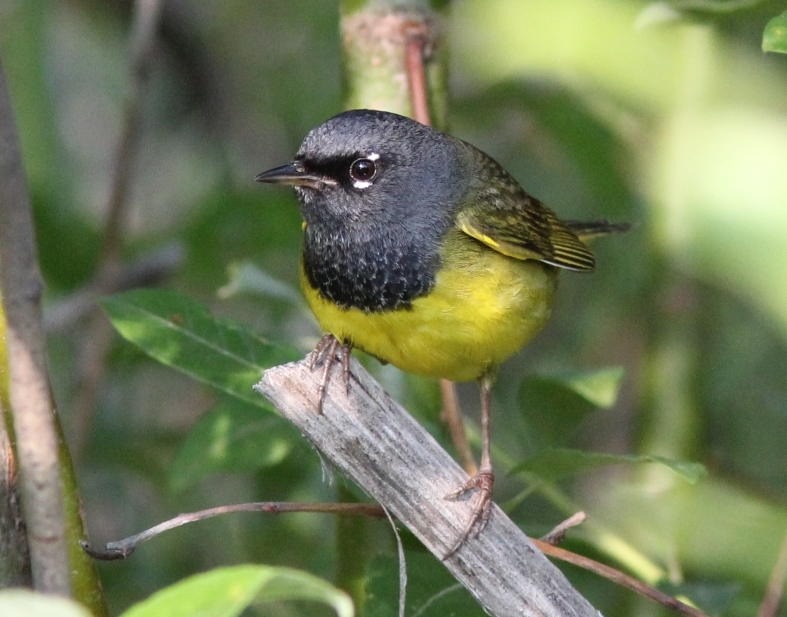 MacGillivray's WarblerGeothlypis tolmiei
-
 Kentucky WarblerGeothlypis formosa
-
 Bahama YellowthroatGeothlypis rostrata
-
 Black-polled YellowthroatGeothlypis speciosa
-
 Masked YellowthroatGeothlypis aequinoctialis
-
 Grey-crowned YellowthroatGeothlypis poliocephala
-
 Belding's YellowthroatGeothlypis beldingi
Compare
Questions and answers
What is the scientific name of the Common Yellowthroat?
The scientific name of the Common Yellowthroat is Geothlypis trichas. Written with its author, the full name is Geothlypis trichas (Linnaeus, 1766).
Which family does the Common Yellowthroat belong to?
Geothlypis trichas belongs to the family Parulidae, in the order Passeriformes and the class Aves.
Where is the Common Yellowthroat found?
Checklists and occurrence records place Geothlypis trichas in 28 countries, including United States, Canada, Mexico, Belize, Cuba and Guatemala.
What is the conservation status of the Common Yellowthroat?
The IUCN Red List category recorded for Geothlypis trichas is Least Concern (LC).
What other names does the Common Yellowthroat have?
Geothlypis trichas is also known in English as Belding's Yellowthroat, Black-Masked Ground Warbler, Yellow Bandit and Yellowthroat.
What are some interesting facts about the Common Yellowthroat?
Adult males have black facial masks, while females lack them. The species produces repeated twichety notes in its loud song and a soft jip call. Both parents feed the young, and its nests are frequently subject to brood parasitism by Brown-headed Cowbirds.[5][7][23][24][34][35]
Where can I find a Common Yellowthroat?
The Common Yellowthroat breeds across North America from southern Canada to central Mexico. It occurs in marshes, other wet areas with low, dense vegetation, and areas with dense shrubs. The subspecies Geothlypis trichas sinuosa occurs in California.[15][19][12][13]
What do common yellowthroats eat?
Common Yellowthroats feed on insects, which they usually capture in dense vegetation and sometimes catch in midair.[20][21][22]
Where do common yellowthroats live?
Common Yellowthroats breed across North America from southern Canada to central Mexico. Northern populations migrate to wintering areas in the southern breeding range, Central America, and the West Indies, while southern populations are largely resident.[15][16][17]
Sources
Passages the profile rests on
- The species has olive-colored backs, wings, and tails, yellow throats and chests, and white bellies. Source passage: “Common yellowthroats are small songbirds that have olive backs, wings and tails, yellow throats and chests, and white bellies.” — English Wikipedia
- The species measures 11–13 cm in length. Source passage: “Length: 11–13 cm (4.3–5.1 in)” — English Wikipedia
- The species has a wingspan of 15–19 cm. Source passage: “Wingspan: 15–19 cm (5.9–7.5 in)” — English Wikipedia
- The species weighs 7.6–15.5 g. Source passage: “Weight: 7.6–15.5 g (0.27–0.55 oz)” — English Wikipedia
- Adult males have black facial masks extending from the sides of the neck across the eyes and forehead. Source passage: “Adult males have black face masks which stretch from the sides of the neck across the eyes and forehead” — English Wikipedia
- The black facial masks of adult males are bordered above by white or gray. Source passage: “which are bordered above with white or gray.” — English Wikipedia
- Females have paler underparts than males and lack the black facial mask. Source passage: “Females are similar in appearance, but have paler underparts and lack the black mask.” — English Wikipedia
- Immature birds resemble adult females. Source passage: “Immature birds are similar in appearance to the adult female.” — English Wikipedia
- First-year males have faint black facial masks that become completely dark by spring. Source passage: “First-year males have a faint black mask which darkens completely by spring.” — English Wikipedia
- Subspecies differ mainly in male facial patterns and the brightness of their yellow underparts. Source passage: “The subspecies mainly differ in the males' facial patterns and the brightness of the yellow underparts.” — English Wikipedia
- Southwestern subspecies have the brightest and most intensely yellow underparts. Source passage: “The southwestern subspecies of this bird are the brightest and the yellowest below.” — English Wikipedia
- The species breeds in marshes and other wet areas containing low, dense vegetation. Source passage: “Common yellowthroats breed in marshes and other wet areas with low, dense vegetation.” — English Wikipedia
- The species also occurs in areas with dense shrubs. Source passage: “They may also be found in other areas with dense shrubs” — English Wikipedia
- The species is less commonly found in dry areas than in wet or densely vegetated habitats. Source passage: “and are less commonly found in dry areas.” — English Wikipedia
- The Common Yellowthroat breeds across North America from southern Canada to central Mexico. Source passage: “It is an abundant breeder in North America, ranging from southern Canada to central Mexico.” — English Wikipedia
- Northern populations migrate to wintering areas in the southern breeding range, Central America, and the West Indies. Source passage: “In the northern parts of its range the birds are migratory, wintering in the southern parts of the breeding range, Central America and the West Indies.” — English Wikipedia
- Southern populations are largely resident rather than migratory. Source passage: “Southern forms are largely resident.” — English Wikipedia
- The species is a very rare vagrant in western Europe. Source passage: “This species is a very rare vagrant to western Europe.” — English Wikipedia
- The subspecies Geothlypis trichas sinuosa occurs in California. Source passage: “Common Yellowthroat (Geothlypis trichas sinuosa).” — ecos.fws.gov
- The species feeds on insects. Source passage: “These birds feed on insects” — English Wikipedia
- The species usually captures insects in dense vegetation. Source passage: “which are usually captured in dense vegetation” — English Wikipedia
- The species sometimes catches insects in midair. Source passage: “but sometimes caught in midair.” — English Wikipedia
- The species produces a loud song consisting of repeated twichety notes. Source passage: “The song is a loud twichety twichety twichety twich.” — English Wikipedia
- The species has a soft jip call. Source passage: “Its call is a soft jip.” — English Wikipedia
- Northern populations migrate at night. Source passage: “Northern subspecies are nocturnal migrants” — English Wikipedia
- Male Common Yellowthroats generally reach their spring migration destinations before females. Source passage: “However, males generally arrive at their destination site before the females during the spring migration months.” — English Wikipedia
- During spring migration, returning birds that have visited Appledore Island more than twice arrive earlier than first-time migrants. Source passage: “Birds returning for more than the second time arrive earlier than birds migrating to the island for their first time.” — English Wikipedia
- Male Common Yellowthroats arrive on Appledore Island an average of five days before females. Source passage: “Every year, males tend to arrive on the island an average of five days earlier than females” — English Wikipedia
- Both sexes spend approximately one week on Appledore Island before continuing their migration. Source passage: “However, both sexes spend about a week on the island before leaving.” — English Wikipedia
- In Florida, peak migration occurs from the last week of September through the second week of October. Source passage: “Peak migration times of the birds in this region are during the last week of September through the second week of October.” — English Wikipedia
- The species builds nests in low vegetation. Source passage: “Common yellowthroats nest in low vegetation” — English Wikipedia
- The species lays 3–5 eggs per clutch. Source passage: “laying 3–5 eggs in a cup-shaped nest.” — English Wikipedia
- The species constructs cup-shaped nests. Source passage: “laying 3–5 eggs in a cup-shaped nest.” — English Wikipedia
- Both parents feed the young. Source passage: “Both parents feed the young.” — English Wikipedia
- Common Yellowthroat nests are frequently subject to brood parasitism by Brown-headed Cowbirds. Source passage: “Common yellowthroat nests are commonly subject to brood parasitism by the brown-headed cowbird (Molothrus ater).” — English Wikipedia
- Females appear to prefer males with larger facial masks. Source passage: “Females appear to prefer males with larger masks.” — English Wikipedia
- The species remains very common despite declining population numbers. Source passage: “Despite a decline in numbers, which is due to loss of favored habitat, this species is still very common.” — English Wikipedia
- Loss of favored habitat is identified as a cause of population decline. Source passage: “which is due to loss of favored habitat” — English Wikipedia
- Habitat degradation and habitat loss are identified as major threats throughout the species' range. Source passage: “Throughout their range, Common Yellowthroats probably suffer most from habitat degradation and loss.” — allaboutbirds.org
Data
- Catalogue of Life, 2026-10-16 XR cc by
- Global Biodiversity Information Facility CC BY 4.0
- Wikidata CC0
- GeoNames CC BY 4.0
- Wikimedia Commons per image; credit shown with each image
- Within the Catalogue of Life, this name comes from The Integrated Taxonomic Information System cc0
References
- Syst. Nat., ed. 12, 1: 293. 1766 where the name was published
- Gill, Frank, & and Minturn Wright. (2006). Birds of the World: Recommended English Names.
This species in other databases
- Catalogue of Life 3FT5J
- Wikidata Q281555
- iNaturalist 9721
- WoRMS urn:lsid:marinespecies.org:taxname:422659
- Avibase comyel
Page built on 27 November 2026. See how the catalog is made and all sources and licences.
Cite this page
ScientificNames.org. (2026). Geothlypis trichas (Common Yellowthroat). Retrieved November 27, 2026, from https://scientificnames.org/species/geothlypis-trichas
“Geothlypis trichas (Common Yellowthroat).” ScientificNames.org, 2026, scientificnames.org/species/geothlypis-trichas. Accessed 27 Nov. 2026.
ScientificNames.org. “Geothlypis trichas (Common Yellowthroat).” Accessed November 27, 2026. https://scientificnames.org/species/geothlypis-trichas.
@misc{scientificnames_geothlypis_trichas_common_yellowthroat,
  author = {{ScientificNames.org}},
  title = {Geothlypis trichas (Common Yellowthroat)},
  year = {2026},
  url = {https://scientificnames.org/species/geothlypis-trichas},
  note = {Accessed 2026-11-27}
}