Species · Birds
MacGillivray's Warbler Geothlypis tolmiei
The scientific name of the MacGillivray's Warbler is Geothlypis tolmiei. It is a species of bird in the family Parulidae (new world warbler), order Passeriformes. The name dates from 1839.
- Scientific name
- Geothlypis tolmiei (J. K. Townsend, 1839)
- Common name
- MacGillivray's Warbler
- Genus
- Geothlypis
- Family
- Parulidae (New World Warbler)
- Order
- Passeriformes
- Class
- Aves
- Red List category
- LC Least Concern
- Environment
- terrestrial
- Recorded in
- 11 countries
- Name status
- accepted in the Catalogue of Life
Overview
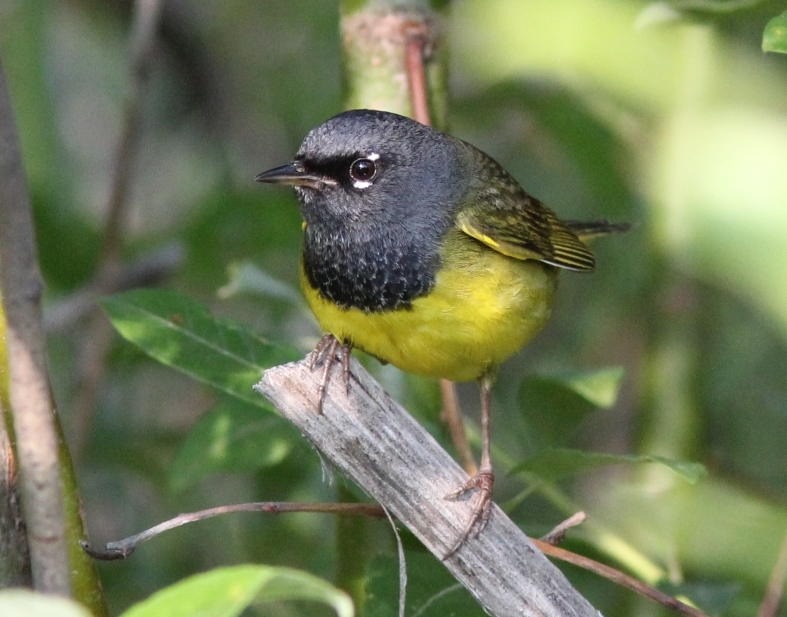
Adult males are distinguished by dark facial markings bordered by prominent white crescents.
Written 26 November 2026 from the sources listed below. Each statement was checked against the passage it cites; statements that could not be supported were removed.
Appearance
Adult males of the nominate subspecies generally have a medium-gray head and nape, sometimes with brownish or olive coloration. Dark gray to blackish markings around and through the eye are bordered by prominent white crescents. The back, rump, and upper tail coverts are yellowish olive-green.[1][2][3]
The subspecies G. t. monticola has grayer upperparts and paler, greener-yellow underparts than the nominate subspecies.[4]
Adults measure 10–15 cm in length and weigh 9–13 g. The wingspan measures approximately 19 cm.[5][6][7]
Habitat
During breeding, the species occupies several forest types with dense understory and moderately open canopy. Breeding birds frequently occupy regenerating clearcuts and burned areas. In the southern portions of its breeding range, the species frequently inhabits riparian zones.[8][9][10]
During migration, the species occurs in non-forested shrublands as well as forests. In Mexico and Central America, it also uses shade coffee plantations.[11][12]
In its winter range, the species occupies mangroves, evergreen forest edges, and thorn scrub at lower elevations. At higher elevations, it mainly occupies forest understory. The species generally avoids open desert.[13][14][15]
Diet
The species feeds on a wide variety of larval and adult insects. It obtains most of its food by gleaning insects from leaves, branches, and bark near or on the ground.[16][17]
Behaviour
During migration, the species travels in a fairly broad front between breeding and wintering areas. Fall migration occurs from late July through late November, while spring migration occurs from mid-March through mid-June.[18][19][20]
Male songs consist of six to eight syllables. Both sexes produce a harsh chip call and a high-frequency chip call.[21][22]
Males sing mainly at dawn and dusk, typically from elevated perches.[23]
Reproduction and life cycle
The breeding season extends from late April through mid-August. Females perform most of the nest construction. The nest is an open cup constructed from coarse plant materials and lined with softer grass, rootlets, and hair.[24][25][26]
Nests are concealed in grass or shrubs at an average height of approximately 0.5 m above the ground. The maximum clutch size is five eggs. The eggs are creamy white with darker spots and speckles.[27][28][29]
Females alone incubate the eggs for approximately 11–13 days. Young birds fledge approximately eight to nine days after hatching. Both parents feed nestlings, although females provide more provisioning than males.[30][31][32]
The brown-headed cowbird is a brood parasite of this species.[33]
Conservation
The species is classified as Least Concern by the IUCN. The estimated population comprises at least 11 million mature individuals, and the population is believed to be decreasing.[34][35][36]
Ecosystem changes resulting from climate change are the only identified threat to the species, and their severity is unknown.[37]
Similar species
MacGillivray's Warbler and the mourning warbler are sister species and hybridize extensively.[38]
Classification of the MacGillivray's Warbler
| Kingdom | Animalia |
|---|---|
| Phylum | Chordata |
| Subphylum | Vertebrata |
| Infraphylum | Gnathostomata |
| Parvphylum | Osteichthyes |
| Megaclass | Tetrapoda |
| Class | Aves (Bird) |
| Order | Passeriformes (Passerine) |
| Family | Parulidae (New World Warbler) |
| Genus | Geothlypis (Yellowthroat) |
| Species | Geothlypis tolmiei (J. K. Townsend, 1839) |
Where the MacGillivray's Warbler is found
Checklists and occurrence records place Geothlypis tolmiei in 11 countries across North America. GBIF holds 415,241 georeferenced records of it.
Countries
- Belize 4
- Bermuda 4
- Canada 53,617
- Costa Rica 688
- El Salvador 1,257
- Guatemala 5,686
- Honduras 1,863
- Mexico 33,083
- Nicaragua 614
- Panama 187
- United States 318,238
Regions and cities with the most records
- California, United States 71,901
- British Columbia, Canada 48,054
- Oregon, United States 38,896
- Washington, United States 35,259
- Colorado, United States 34,143
- Arizona, United States 33,447
- New Mexico, United States 22,940
- Montana, United States 18,071
- Utah, United States 17,922
- Idaho, United States 14,100
- Nevada, United States 9,509
- Wyoming, United States 7,415
- Nayarit, Mexico 6,984
- Langford, Canada 6,751
- Texas, United States 6,728
- Colwood, Canada 6,703
- Esquimalt, Canada 6,568
- Victoria, Canada 6,360
- Albuquerque, United States 5,826
- Jalisco, Mexico 5,093
- Rio Rancho, United States 5,043
- South Valley, United States 4,911
- Catalina Foothills, United States 4,321
- Alberta, Canada 4,280
- Sooke, Canada 4,209
- Cottonwood Heights, United States 4,060
- Casas Adobes, United States 4,020
- Tucson, United States 3,942
- East Millcreek, United States 3,910
- Flowing Wells, United States 3,873
- Oaxaca, Mexico 3,776
- Holladay, United States 3,741
- Boulder, United States 3,497
- Oro Valley, United States 3,462
- Corvallis, United States 3,326
- Louisville, United States 3,298
Range as the checklists state it
Middle America
North America
A number beside a place is its count of GBIF occurrence records. A place without a number comes from a checklist alone. Records show where a species has been observed or collected, which can include escapes and vagrants.
Common names
English
- MacGillivray's Warbler
- Tolmie's Warbler
Names in 25 other languages
- Catalan
- bosquerola de MacGillivray
- Chinese
- 灰头地莺, 麥吉氏黃喉地鶯
- Croatian
- olovastoglava sjeničica
- Czech
- lesňáček křovištní
- Danish
- Gråhovedet Sanger
- Dutch
- Rouwkopzanger
- Esperanto
- plumbokapa parulio
- Estonian
- kiltpugu-säälik
- Finnish
- valkoluomikerttuli
- French
- Paruline des buissons
- German
- Dickichtwaldsänger
- Italian
- Parula di MacGillivray
- Japanese
- ニシノドグロアメリカムシクイ
- Latvian
- Makgilivreja ķauķis
- Lithuanian
- krūmyninis oporornis
- Norwegian
- kjerrparula
- Polish
- cytrynka uboga
- Portuguese
- mariquita-carpideira-ocidental, mariquita-de-capuz-cinzento, mariquita-dos-arbustos
- Russian
- Кустарниковый масковый певун, Приречная хвойница
- Serbian
- Mekgilivrejeva cvrkutarka
- Slovak
- horárik krovinový
- Spanish
- Chipe Lores Negros, Chipe de Tolmie, Reinita de Tolmie, reinita de tupidero
- Swedish
- gråhuvad skogssångare
- Turkish
- Macgillavray Ötleğeni
- Ukrainian
- цитринка західна
Synonyms
7 other scientific names have been used for this species and are now treated as synonyms of Geothlypis tolmiei.
- Geothlypis macgillivrayi Audubon, JJ, 1839
- Geothlypis tolmei Townsend, JK, 1839
- Geothlypis tolmiei tolmiei Stotz et al. (1996)
- Oporornis tolmiei (J. K. Townsend, 1839)
- Oporornis tolmiei austinsmithi Phillips, 1947
- Oporornis tolmiei intermedia Phillips, 1947
- Sylvia tolmiei J. K. Townsend, 1839
Subspecies and varieties
- Geothlypis tolmiei monticola subspecies
- Geothlypis tolmiei tolmiei subspecies
Related species
-
 Common YellowthroatGeothlypis trichas
-
 Mourning WarblerGeothlypis philadelphia
-
 Kentucky WarblerGeothlypis formosa
-
 Bahama YellowthroatGeothlypis rostrata
-
 Black-polled YellowthroatGeothlypis speciosa
-
 Masked YellowthroatGeothlypis aequinoctialis
-
 Grey-crowned YellowthroatGeothlypis poliocephala
-
 Belding's YellowthroatGeothlypis beldingi
Compare
Questions and answers
What is the scientific name of the MacGillivray's Warbler?
The scientific name of the MacGillivray's Warbler is Geothlypis tolmiei. Written with its author, the full name is Geothlypis tolmiei (J. K. Townsend, 1839).
Which family does the MacGillivray's Warbler belong to?
Geothlypis tolmiei belongs to the family Parulidae, in the order Passeriformes and the class Aves.
Where is the MacGillivray's Warbler found?
Checklists and occurrence records place Geothlypis tolmiei in 11 countries, including United States, Canada, Mexico, Guatemala, Honduras and El Salvador.
What is the conservation status of the MacGillivray's Warbler?
The IUCN Red List category recorded for Geothlypis tolmiei is Least Concern (LC).
What other names does the MacGillivray's Warbler have?
Geothlypis tolmiei is also known in English as Tolmie's Warbler.
What does the warbler bird eat?
MacGillivray's Warbler feeds on a wide variety of larval and adult insects. It obtains most of its food by gleaning insects from leaves, branches, and bark near or on the ground.[16][17]
What habitat do warblers like?
MacGillivray's Warbler occupies forests with dense understory and moderately open canopy during breeding. It also uses regenerating clearcuts, burned areas, riparian zones, shrublands, shade coffee plantations, mangroves, evergreen forest edges, thorn scrub, and forest understory, depending on the season and elevation.[8][9][10][11][12][13][14]
Sources
Passages the profile rests on
- Adult males of the nominate subspecies generally have a medium-gray head and nape, sometimes with brownish or olive coloration. Source passage: “Adult males of the nominate subspecies have a mostly medium gray head and nape that often has a brownish or olive wash.” — English Wikipedia
- Adult males have dark gray to blackish markings around and through the eye, bordered by prominent white crescents. Source passage: “They have darker gray to blackish lores and line through the eye and wide white crescents above and below the eye.” — English Wikipedia
- The back, rump, and upper tail coverts of adult males are yellowish olive-green. Source passage: “Their back, rump, and uppertail coverts are yellowish olive-green.” — English Wikipedia
- The subspecies G. t. monticola has grayer upperparts and paler, greener-yellow underparts than the nominate subspecies. Source passage: “Subspecies G. t. monticola has grayer upperparts and paler more greenish yellow underparts than the nominate.” — English Wikipedia
- Adults measure 10–15 cm in length. Source passage: “MacGillivray's warbler is 10 to 15 cm (3.9 to 5.9 in) long” — English Wikipedia
- Adults weigh 9–13 g. Source passage: “weighs 9 to 13 g (0.32 to 0.46 oz)” — English Wikipedia
- The wingspan measures approximately 19 cm. Source passage: “has a wingspan of 19 cm (7.5 in).” — English Wikipedia
- During breeding, the species occupies several forest types with dense understory and moderately open canopy. Source passage: “In its breeding range MacGillivray's warbler inhabits a variety of forest types that are characterized by dense undergrowth and a moderately open canopy.” — English Wikipedia
- Breeding birds frequently occupy regenerating clearcuts and burned areas. Source passage: “It often inhabits regenerating clearcuts and burned areas.” — English Wikipedia
- In the southern portions of its breeding range, the species frequently inhabits riparian zones. Source passage: “Especially in the southern parts of its breeding range it is often in riparian zones.” — English Wikipedia
- During migration, the species occurs in non-forested shrublands as well as forests. Source passage: “In migration it often occurs in non-forested shrublands as well as forests” — English Wikipedia
- During migration in Mexico and Central America, the species also uses shade coffee plantations. Source passage: “and in Mexico and Central America in shade coffee plantations.” — English Wikipedia
- In its winter range, the species occupies mangroves, evergreen forest edges, and thorn scrub at lower elevations. Source passage: “In its winter range, at lower elevations it occurs in mangroves, the edges of evergreen forest, and thorn scrub.” — English Wikipedia
- At higher elevations in its winter range, the species mainly occupies forest understory. Source passage: “At higher elevations it mostly occurs in the undergrowth of forest.” — English Wikipedia
- The species generally avoids open desert. Source passage: “It generally shuns open desert.” — English Wikipedia
- The species feeds on a wide variety of larval and adult insects. Source passage: “MacGillivray's warbler feeds on a wide variety of larval and adult insects.” — English Wikipedia
- The species obtains most of its food by gleaning insects from leaves, branches, and bark near or on the ground. Source passage: “It takes most by gleaning from leaves on the ground and low to the ground from leaves, branches, and bark.” — English Wikipedia
- During migration, the species travels in a fairly broad front between breeding and wintering areas. Source passage: “In migration between them it moves in a fairly broad front.” — English Wikipedia
- Fall migration occurs from late July through late November. Source passage: “Fall migration spans from late July to late November” — English Wikipedia
- Spring migration occurs from mid-March through mid-June. Source passage: “and spring from mid-March to mid June.” — English Wikipedia
- Male songs consist of six to eight syllables. Source passage: “The primary song of male MacGillivray's warbler is "6-8 syllables described as churry churry churry churry cheery cheery".” — English Wikipedia
- Both sexes produce a harsh chip call and a high-frequency chip call. Source passage: “Both sexes make calls, "a harsh chip note" and "a high-frequency chip".” — English Wikipedia
- Males sing mainly at dawn and dusk, typically from elevated perches. Source passage: “Males sing mostly at dawn and dusk, typically from a high perch.” — English Wikipedia
- The species' breeding season extends from late April through mid-August. Source passage: “Overall, MacGillivray's warbler breeds between the end of April and mid-August” — English Wikipedia
- Females perform most of the nest construction. Source passage: “Females do most of the nest building.” — English Wikipedia
- The nest is an open cup constructed from coarse plant materials and lined with softer grass, rootlets, and hair. Source passage: “The nest is an open cup made from grass, bark, leaves, and other coarse plant material lined with softer grass, rootlets, and hair.” — English Wikipedia
- Nests are concealed in grass or shrubs at an average height of approximately 0.5 m above the ground. Source passage: “Nests are concealed in grass or shrubs at an average of about 0.5 m (1.6 ft) above the ground.” — English Wikipedia
- The maximum clutch size is five eggs. Source passage: “The maximum clutch size is five eggs;” — English Wikipedia
- The eggs are creamy white with darker spots and speckles. Source passage: “eggs are creamy white with darker spots and speckles.” — English Wikipedia
- Females alone incubate the eggs for approximately 11–13 days. Source passage: “The female alone incubates, for about 11 to 13 days.” — English Wikipedia
- Young birds fledge approximately eight to nine days after hatching. Source passage: “Fledging occurs about eight to nine days after hatch.” — English Wikipedia
- Both parents feed nestlings, although females provide more provisioning than males. Source passage: “Both parents provision nestlings but females do more than males.” — English Wikipedia
- The brown-headed cowbird is a brood parasite of this species. Source passage: “The brown-headed cowbird (Molthrus ater) is a brood parasite” — English Wikipedia
- The species is classified as Least Concern by the IUCN. Source passage: “The IUCN has assessed MacGillivray's warbler as being of Least Concern.” — English Wikipedia
- The estimated population comprises at least 11 million mature individuals. Source passage: “its estimated population of at least 11 million mature individuals” — English Wikipedia
- The species' population is believed to be decreasing. Source passage: “is believed to be decreasing.” — English Wikipedia
- Ecosystem changes resulting from climate change are the only identified threat to the species, and their severity is unknown. Source passage: “The only identified threat is ecosystem change resulting from climate change, and its severity is not known.” — English Wikipedia
- MacGillivray's warbler and the mourning warbler are sister species and hybridize extensively. Source passage: “MaGillivray's and the mourning warblers are sister species and hybridize extensively.” — English Wikipedia
Data
- Catalogue of Life, 2026-10-16 XR cc by
- Global Biodiversity Information Facility CC BY 4.0
- Wikidata CC0
- GeoNames CC BY 4.0
- Wikimedia Commons per image; credit shown with each image
- Within the Catalogue of Life, this name comes from The Integrated Taxonomic Information System cc0
References
- Narr. Journey Rocky Mount., etc.: 343. 1839 where the name was published
This species in other databases
Page built on 28 November 2026. See how the catalog is made and all sources and licences.
Cite this page
ScientificNames.org. (2026). Geothlypis tolmiei (MacGillivray's Warbler). Retrieved November 28, 2026, from https://scientificnames.org/species/geothlypis-tolmiei
“Geothlypis tolmiei (MacGillivray's Warbler).” ScientificNames.org, 2026, scientificnames.org/species/geothlypis-tolmiei. Accessed 28 Nov. 2026.
ScientificNames.org. “Geothlypis tolmiei (MacGillivray's Warbler).” Accessed November 28, 2026. https://scientificnames.org/species/geothlypis-tolmiei.
@misc{scientificnames_geothlypis_tolmiei_macgillivrays_warbler,
  author = {{ScientificNames.org}},
  title = {Geothlypis tolmiei (MacGillivray's Warbler)},
  year = {2026},
  url = {https://scientificnames.org/species/geothlypis-tolmiei},
  note = {Accessed 2026-11-28}
}