Species · Fishes
Metallic Topminnow Girardinus metallicus
The scientific name of the Metallic Topminnow is Girardinus metallicus. It is a species of fish in the family Poeciliidae (topminnows), order Cyprinodontiformes. The name dates from 1854.
- Scientific name
- Girardinus metallicus Poey, 1854
- Common name
- Metallic Topminnow
- Genus
- Girardinus
- Family
- Poeciliidae (Topminnows)
- Order
- Cyprinodontiformes
- Class
- Teleostei
- Red List category
- LC Least Concern
- Environment
- freshwater
- Recorded in
- 1 country
- Name status
- accepted in the Catalogue of Life

Overview
Girardinus metallicus is endemic to Cuba, occurring on the main island and Isla de la Juventud. Males occur in three color morphs: colorless, black, and yellow.
Written 27 November 2026 from the sources listed below. Each statement was checked against the passage it cites; statements that could not be supported were removed.
Appearance
The species has three male color morphs: colorless, black, and yellow. Females reach 7.9 cm in standard length, while males reach 4.5 cm.[1][2]
Habitat
The metallic topminnow inhabits lowland swamps, lagoons, and flooded savannahs on Cuba's main island. It also occurs in the Itabo River on Isla de la Juventud.[3][4]
It typically inhabits clear, stagnant water and favors sunlit areas where algae grow.[5][6]
Diet
The species feeds chiefly on detritus, algae, and mud. It occasionally consumes insect larvae and small fish.[7][8]
Behaviour
Black-morph males perform courtship displays before inserting their gonopodium into the female's genital opening. During courtship, males lift their heads, extend their gonopodia, and position themselves in front of and alongside females.[9][10]
Larger males with longer gonopodia court and attempt mating more frequently.[11]
Reproduction and life cycle
The species has an average brood size of 13.5 offspring. Newborn fry measure approximately 1 cm in length.[12][13]
The species reaches sexual maturity between 5 and 12 weeks of age.[14]
Uses
The metallic topminnow occurs in the ornamental fish trade. It was imported into Germany in 1906.[15][16]
Conservation
The species is not collected from the wild. It was assessed for the IUCN Red List in 2020.[17][18]
Classification of the Metallic Topminnow
| Kingdom | Animalia |
|---|---|
| Phylum | Chordata |
| Subphylum | Vertebrata |
| Infraphylum | Gnathostomata |
| Parvphylum | Osteichthyes |
| Gigaclass | Actinopterygii |
| Superclass | Actinopteri |
| Class | Teleostei (Teleost) |
| Order | Cyprinodontiformes |
| Family | Poeciliidae (Topminnows) |
| Subfamily | Poeciliinae |
| Genus | Girardinus |
| Species | Girardinus metallicus Poey, 1854 |
Where the Metallic Topminnow is found
Checklists and occurrence records place Girardinus metallicus in 1 country. GBIF holds 878 georeferenced records of it.
Countries
Regions and cities with the most records
- Pinar del Río, Cuba 37
- Pinar del Río, Cuba 17
- Sancti Spíritus Province, Cuba 11
- Cabaiguán, Cuba 10
- San Cristobal, Cuba 9
- Bejucal, Cuba 8
- Fontanar, Cuba 8
- Santiago de las Vegas, Cuba 8
- Bauta, Cuba 7
- La Salud, Cuba 7
- Los Palacios, Cuba 7
- San Antonio de los Baños, Cuba 7
- Alquízar, Cuba 6
- Arroyo Naranjo, Cuba 6
- Mayabeque, Cuba 6
- San José de las Lajas, Cuba 6
- San Miguel del Padrón, Cuba 6
- Villa Clara Province, Cuba 6
- Cojímar, Cuba 5
- Guanabacoa, Cuba 5
- Guanajay, Cuba 5
- Güines, Cuba 5
- Güira de Melena, Cuba 5
- Havana, Cuba 5
- Matanzas Province, Cuba 5
- Regla, Cuba 5
- Artemisa, Cuba 4
- Cruces, Cuba 4
- Ranchuelo, Cuba 4
- Consolación del Sur, Cuba 3
- Isla de la Juventud, Cuba 3
- Minas de Matahambre, Cuba 3
- Santa Clara, Cuba 3
A number beside a place is its count of GBIF occurrence records. A place without a number comes from a checklist alone. Records show where a species has been observed or collected, which can include escapes and vagrants.
Common names
English
- Metallic Topminnow
- Girardinus
Names in 4 other languages
- Czech
- žirardinka lesklá
- Polish
- żerardynka metaliczna
- Russian
- Металлический гирардинус
- Spanish
- guajacón metálico
Synonyms
2 other scientific names have been used for this species and are now treated as synonyms of Girardinus metallicus.
- Girardinus garmani Eigenmann, 1903
- Girardinus pygmaeus Rivas, 1944
Related species
-
 Goldbelly TopminnowGirardinus falcatus
-
 Smallfinger TopminnowGirardinus microdactylus
-
 Creole TopminnowGirardinus creolus
- Singlespot TopminnowGirardinus uninotatus
-
 Cuban TopminnowGirardinus cubensis
-
 Toothy TopminnowGirardinus denticulatus
-
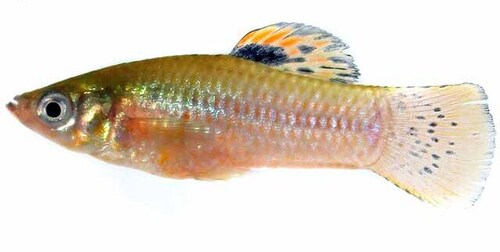 Island MollyPoecilia vandepolli
-
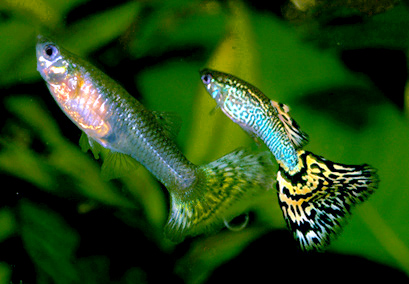 GuppyPoecilia reticulata
Compare
Questions and answers
What is the scientific name of the Metallic Topminnow?
The scientific name of the Metallic Topminnow is Girardinus metallicus. Written with its author, the full name is Girardinus metallicus Poey, 1854.
Which family does the Metallic Topminnow belong to?
Girardinus metallicus belongs to the family Poeciliidae, in the order Cyprinodontiformes and the class Teleostei.
Where is the Metallic Topminnow found?
Checklists and occurrence records place Girardinus metallicus in 1 country: Cuba.
What is the conservation status of the Metallic Topminnow?
The IUCN Red List category recorded for Girardinus metallicus is Least Concern (LC).
What other names does the Metallic Topminnow have?
Girardinus metallicus is also known in English as Girardinus.
Sources
Passages the profile rests on
- Females reach 7.9 cm in standard length, while males reach 4.5 cm. Source passage: “G. metallicus females grow to 7.9 cm in standard length, while males reach 4.5 cm.” — English Wikipedia
- The species has three male color morphs, including colorless, black, and yellow forms. Source passage: “some males are colorless, while others have pronounced black or yellow coloring on their undersides. All three morphs occur together in nature.” — English Wikipedia
- The species inhabits lowland swamps, lagoons, and flooded savannahs on Cuba's main island. Source passage: “It is common in lowland swamps, lagoons, and flooded savannahs on the main island” — English Wikipedia
- The species occurs in the Itabo River on Isla de la Juventud. Source passage: “in the Itabo River on the Isla de la Juventud.” — English Wikipedia
- The species typically inhabits clear, stagnant water. Source passage: “Water tends to be clear and stagnant.” — English Wikipedia
- The species favors sunlit areas where algae grow. Source passage: “It favors sunlit areas where algae grow.” — English Wikipedia
- The species feeds chiefly on detritus, algae, and mud. Source passage: “It feeds chiefly on detritus, algae, and mud” — English Wikipedia
- The species occasionally consumes insect larvae and small fish. Source passage: “but occasionally also takes insect larvae and small fish.” — English Wikipedia
- Black-morph males perform courtship displays before inserting their gonopodium into the female's genital opening. Source passage: “In the black morph, males perform courtship display before inserting their gonopodium (fin modified into sex appendage) into the female's genital opening.” — English Wikipedia
- During courtship, males lift their heads, extend their gonopodia, and position themselves in front of and alongside females. Source passage: “The male displays by lifting his head in a "chin-up" posture, extending his gonopodium almost perpendicular to his body, and positioning himself in front of and alongside the female” — English Wikipedia
- Larger males with longer gonopodia court and attempt mating more frequently. Source passage: “Larger males with longer gonopodia court and try to mate more often” — English Wikipedia
- The species has an average brood size of 13.5 offspring. Source passage: “Broods average 13.5 offspring.” — English Wikipedia
- Newborn fry measure approximately 1 cm in length. Source passage: “Fry are born at a length of about 1 cm.” — English Wikipedia
- The species reaches sexual maturity between 5 and 12 weeks of age. Source passage: “They grow rapidly, reaching sexual maturity from 5 to 12 weeks old.” — English Wikipedia
- The species occurs in the ornamental fish trade. Source passage: “Girardinus metallicus appears in ornamental fish trade.” — English Wikipedia
- The species was imported into Germany in 1906. Source passage: “The species was imported in Germany in 1906.” — English Wikipedia
- The species is not collected from the wild. Source passage: “It is not collected in the wild.” — English Wikipedia
- The species was assessed for the IUCN Red List in 2020. Source passage: “Girardinus metallicus has most recently been assessed for The IUCN Red List of Threatened Species in 2020.” — iucnredlist.org
Data
- Catalogue of Life, 2026-10-16 XR cc by
- Global Biodiversity Information Facility CC BY 4.0
- Wikidata CC0
- GeoNames CC BY 4.0
- Wikimedia Commons per image; credit shown with each image
- Within the Catalogue of Life, this name comes from World Register of Marine Species cc by
References
- Poey, F. (1851). Memorias sobre la historia natural de la Isla de Cuba, acompañadas de sumarios Latinos y extractos en Francés. La Habana, v. 1: 1–463, Pls. 1–34. [publication dates following Norman, 1938: 1–40, pls 1–8 (Nov 1851); 40–120, pls 9–14 (Apr 1852); 121–200, pls 15–22 (Oct 1852); 201–280, pls 23–30 (May 1853); 281–463, pls 31–34 (Jun 1854)]. where the name was published
This species in other databases
- Catalogue of Life 3G3P3
- Wikidata Q963331
- iNaturalist 619443
- WoRMS urn:lsid:marinespecies.org:taxname:1014538
- ITIS 165933
Page built on 28 November 2026. See how the catalog is made and all sources and licences.
Cite this page
ScientificNames.org. (2026). Girardinus metallicus (Metallic Topminnow). Retrieved November 28, 2026, from https://scientificnames.org/species/girardinus-metallicus
“Girardinus metallicus (Metallic Topminnow).” ScientificNames.org, 2026, scientificnames.org/species/girardinus-metallicus. Accessed 28 Nov. 2026.
ScientificNames.org. “Girardinus metallicus (Metallic Topminnow).” Accessed November 28, 2026. https://scientificnames.org/species/girardinus-metallicus.
@misc{scientificnames_girardinus_metallicus_metallic_topminnow,
  author = {{ScientificNames.org}},
  title = {Girardinus metallicus (Metallic Topminnow)},
  year = {2026},
  url = {https://scientificnames.org/species/girardinus-metallicus},
  note = {Accessed 2026-11-28}
}