Species · Flowering plants
Painted-lady Gladiolus carneus
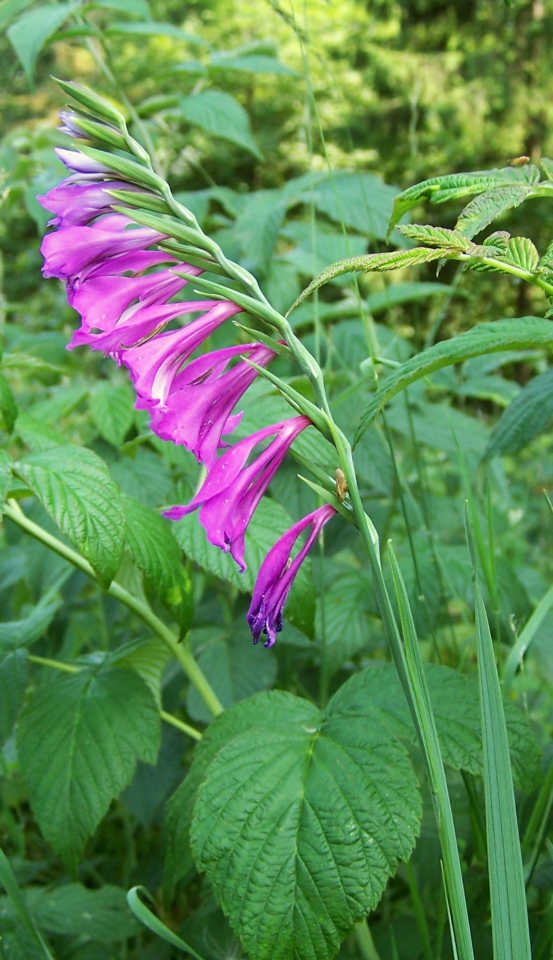
The scientific name of the Painted-lady is Gladiolus carneus. It is a species of flowering plant in the family Iridaceae (iris family), order Asparagales.
- Scientific name
- Gladiolus carneus D.Delaroche
- Common name
- Painted-lady
- Genus
- Gladiolus
- Family
- Iridaceae (Iris Family)
- Order
- Asparagales
- Class
- Liliopsida
- Recorded in
- 3 countries
- Name status
- accepted in the Catalogue of Life

Overview
The painted-lady (Gladiolus carneus) is a perennial herb with annual leaves. It is native to South Africa and occurs widely throughout the winter-rainfall region of southern Africa. It becomes summer dormant and can multiply rapidly by producing numerous small cormlets from its parent corm.
Written 26 November 2026 from the sources listed below. Each statement was checked against the passage it cites; statements that could not be supported were removed.
Appearance
The painted-lady is a perennial herb with annual leaves. It grows approximately 50 cm tall and can reach approximately 80 cm.[1][2][3]
Habitat
The painted-lady occurs along roadsides and around old settlements. It grows in brown gravelly loam and Jarrah-marri woodland.[4][5]
It occurs among tall trees, in grasslands and herbfields, and in gravelly soils and loam. It is found in undisturbed natural vegetation and bare areas.[6][7]
It is recorded on sandstone slopes, often in wet sites, and occurs across habitats ranging from sea level to mountainous areas.[8][9]
It is reported from a variety of habitats in the winter-rainfall region of southern Africa.[10]
Behaviour
The painted-lady becomes summer dormant.[11]
Reproduction and life cycle
The painted-lady can multiply rapidly by producing numerous small cormlets from its parent corm. The parent corm can survive for several years.[12][13]
Conservation
The painted-lady can form dense clumps when growing in full sunlight. Dense growth can shade out adjacent evergreen perennials and small shrubs.[14][15]
Uses
The painted-lady is cultivated as an ornamental plant and is valued as a cut flower.[16][17]
It grows successfully in the ground in Mediterranean climates. It can be dug up and stored during summer.[18][19]
Autumn planting is recommended, with approximately 5 cm of soil covering the corm.[20]
Classification of the Painted-lady
| Kingdom | Plantae |
|---|---|
| Subkingdom | Pteridobiotina |
| Phylum | Tracheophyta |
| Class | Liliopsida |
| Order | Asparagales |
| Family | Iridaceae (Iris Family) |
| Genus | Gladiolus (Gladioli) |
| Species | Gladiolus carneus D.Delaroche |
Where the Painted-lady is found
Checklists and occurrence records place Gladiolus carneus in 3 countries across Africa and Europe. GBIF holds 2,778 georeferenced records of it.
Countries where it is native or its origin is not stated
Countries where it has been introduced
Regions and cities with the most records
- Western Cape, South Africa 2,391
- Muizenberg, South Africa 944
- Retreat, South Africa 941
- Rondebosch, South Africa 781
- Cape Town, South Africa 677
- Grabouw, South Africa 431
- Stellenbosch, South Africa 428
- Somerset West, South Africa 385
- Le Roux, South Africa 197
- Kuils River, South Africa 185
- Franschhoek, South Africa 182
- Kraaifontein, South Africa 105
- Paarl, South Africa 75
- Azores, Portugal 73
- Hermanus, South Africa 65
- Wellington, South Africa 61
- Gansbaai, South Africa 58
- Bredasdorp, South Africa 43
- Durbanville, South Africa 41
- Caledon, South Africa 30
- Ceres, South Africa 15
- Riversdale, South Africa 12
- Malmesbury, South Africa 5
- Swellendam, South Africa 5
- Tanganyika, Democratic Republic of the Congo 5
- Atlantis, South Africa 4
- Baudhuinville, Democratic Republic of the Congo 3
2 more countries have a few records outside this range
These countries hold a few records of Gladiolus carneus but lie outside the range the checklists give for it. Such records are often zoo or garden specimens, museum material or vagrants, so the species is not counted as occurring there.
A number beside a place is its count of GBIF occurrence records. A place without a number comes from a checklist alone. Records show where a species has been observed or collected, which can include escapes and vagrants.
Common names
English
- Painted-lady
- Broadleaf Painted-lady
- White Afrikaner
Names in 1 other language
- Afrikaans
- witbergpypie
Synonyms
29 other scientific names have been used for this species and are now treated as synonyms of Gladiolus carneus.
- Gladiolus albidus Jacq.
- Gladiolus blandus Aiton
- Gladiolus blandus var. albidus (Jacq.) Ker Gawl.
- Gladiolus blandus var. campanulatus (Andrews) Ker Gawl.
- Gladiolus blandus var. carneus (D.Delaroche) Ker Gawl.
- Gladiolus blandus var. excelsus Ker Gawl.
- Gladiolus blandus var. purpureoalbescens Ker Gawl.
- Gladiolus callistus F.Bolus
- Gladiolus callistus var. gracilior F.Bolus
- Gladiolus campanulatus Andrews
- Gladiolus carneus var. hibbertii Baker
- Gladiolus cordatus (Thunb.) Thunb.
- Gladiolus cuspidatus var. ensifolius Baker
- Gladiolus excelsus (Ker Gawl.) Ker Gawl.
- Gladiolus eximius Ingram
- Gladiolus expallescens Schrank
- Gladiolus hibbertii Baker
- Gladiolus lemonia Pourr. ex Steud.
- Gladiolus lunulatus Klatt
- Gladiolus mac-owanianus Klatt
- Gladiolus pictus Sweet
- Gladiolus prismatosiphon Schltr.
- Gladiolus sagittifer Salisb.
- Gladiolus trimaculatus Lam.
- Gladiolus tristis var. cordatus Thunb.
- Gladiolus ventricosus Lam.
- Gladiolus vinulus Klatt
- Gladiolus carneus Jacq. ambiguous synonym
- Moraea ramosa Endl. ambiguous synonym
Related species
-
 Abyssinian GladiolusGladiolus murielae
-
 Italian GladiolusGladiolus italicus
-
 African GladiolusGladiolus dalenii
-
 Eastern GladiolusGladiolus communis
-
 Marsh AfrikanerGladiolus tristis
-
 Wild GladiolusGladiolus illyricus
-
 Marsh GladiolusGladiolus palustris
-
 Turkish Marsh GladiolusGladiolus imbricatus
Compare
Questions and answers
What is the scientific name of the Painted-lady?
The scientific name of the Painted-lady is Gladiolus carneus. Written with its author, the full name is Gladiolus carneus D.Delaroche.
Which family does the Painted-lady belong to?
Gladiolus carneus belongs to the family Iridaceae, in the order Asparagales and the class Liliopsida.
Where is the Painted-lady found?
Checklists and occurrence records place Gladiolus carneus in 3 countries, including South Africa and Democratic Republic of the Congo.
What other names does the Painted-lady have?
Gladiolus carneus is also known in English as Broadleaf Painted-lady and White Afrikaner.
Sources
Passages the profile rests on
- Gladiolus carneus is a perennial herb with annual leaves. Source passage: “They are perennial herbs with annual leaves” — soilhealth.ccmaknowledgebase.vic.gov.au
- Gladiolus carneus grows approximately 50 cm tall. Source passage: “Grows about 50 cm high.” — English Wikipedia
- Gladiolus carneus can grow to approximately 80 cm tall. Source passage: “Grows to about 80 cm” — soilhealth.ccmaknowledgebase.vic.gov.au
- Gladiolus carneus occurs along roadsides and around old settlements. Source passage: “Found on roadsides and around old settlements” — soilhealth.ccmaknowledgebase.vic.gov.au
- Gladiolus carneus grows in brown gravelly loam and Jarrah-marri woodland. Source passage: “Brown gravely loam, Jarrah-marri woodland” — soilhealth.ccmaknowledgebase.vic.gov.au
- Gladiolus carneus occurs among tall trees, in grasslands and herbfields, and in gravelly soils and loam. Source passage: “Amongst tall trees, grassland (herbfields); in gravely soil, loam” — soilhealth.ccmaknowledgebase.vic.gov.au
- Gladiolus carneus occurs in undisturbed natural vegetation and bare areas. Source passage: “growing in undisturbed natural vegetation, on bare areas” — soilhealth.ccmaknowledgebase.vic.gov.au
- Gladiolus carneus is recorded on sandstone slopes, often in wet sites. Source passage: “Sandstone slopes, often wet sites” — soilhealth.ccmaknowledgebase.vic.gov.au
- Gladiolus carneus occurs across habitats ranging from sea level to mountainous areas. Source passage: “Sea level to mountains” — soilhealth.ccmaknowledgebase.vic.gov.au
- Gladiolus carneus is reported from a variety of habitats in the winter-rainfall region of southern Africa. Source passage: “Wide distribution in the winter rainfall area of southern Africa and is found in a variety of habitats” — soilhealth.ccmaknowledgebase.vic.gov.au
- Gladiolus carneus becomes summer dormant. Source passage: “it is summer dormant.” — English Wikipedia
- Gladiolus carneus can multiply rapidly by producing numerous small cormlets from its parent corm. Source passage: “buds off dozens of tiny, new cormlets thereby allowing for very rapid vegetative multiplication” — soilhealth.ccmaknowledgebase.vic.gov.au
- The parent corm of Gladiolus carneus can survive for several years. Source passage: “the parent corm lives for several years” — soilhealth.ccmaknowledgebase.vic.gov.au
- Gladiolus carneus can form dense clumps when growing in full sunlight. Source passage: “extremely vigorous and, in full sun, soon multiplying into embarrassingly thick clumps” — soilhealth.ccmaknowledgebase.vic.gov.au
- Dense growth of Gladiolus carneus can shade out adjacent evergreen perennials and small shrubs. Source passage: “they will often be too successful and shade out adjacent evergreen perennials and very small shrubs.” — soilhealth.ccmaknowledgebase.vic.gov.au
- Gladiolus carneus is cultivated as an ornamental plant. Source passage: “Cultivated (as an ornamental plant)” — soilhealth.ccmaknowledgebase.vic.gov.au
- Gladiolus carneus is valued as a cut flower. Source passage: “Very ornamental and a good cut flower.” — English Wikipedia
- Gladiolus carneus grows successfully in the ground in Mediterranean climates. Source passage: “Gladiolus carneus grows well in the ground in Mediterranean climates” — English Wikipedia
- Gladiolus carneus can be dug up and stored during summer. Source passage: “Can be dug and stored for the summer.” — English Wikipedia
- Gladiolus carneus is recommended for autumn planting with approximately 5 cm of soil covering the corm. Source passage: “Plant in autumn with 5 cm (2 in) of soil over the bulb” — English Wikipedia
Data
- Catalogue of Life, 2026-10-16 XR cc by
- Global Biodiversity Information Facility CC BY 4.0
- Wikidata CC0
- GeoNames CC BY 4.0
- Wikimedia Commons per image; credit shown with each image
- Within the Catalogue of Life, this name comes from The World Checklist of Vascular Plants (WCVP) cc by
References
- Descr. Pl. Aliq. Nov.: 30 (1766) where the name was published
This species in other databases
Page built on 28 November 2026. See how the catalog is made and all sources and licences.
Cite this page
ScientificNames.org. (2026). Gladiolus carneus (Painted-lady). Retrieved November 28, 2026, from https://scientificnames.org/species/gladiolus-carneus
“Gladiolus carneus (Painted-lady).” ScientificNames.org, 2026, scientificnames.org/species/gladiolus-carneus. Accessed 28 Nov. 2026.
ScientificNames.org. “Gladiolus carneus (Painted-lady).” Accessed November 28, 2026. https://scientificnames.org/species/gladiolus-carneus.
@misc{scientificnames_gladiolus_carneus_painted_lady,
  author = {{ScientificNames.org}},
  title = {Gladiolus carneus (Painted-lady)},
  year = {2026},
  url = {https://scientificnames.org/species/gladiolus-carneus},
  note = {Accessed 2026-11-28}
}