Species · Flowering plants
Marsh Gladiolus Gladiolus palustris
The scientific name of the Marsh Gladiolus is Gladiolus palustris. It is a species of flowering plant in the family Iridaceae (iris family), order Asparagales.
- Scientific name
- Gladiolus palustris Gaudin
- Common name
- Marsh Gladiolus
- Genus
- Gladiolus
- Family
- Iridaceae (Iris Family)
- Order
- Asparagales
- Class
- Liliopsida
- Red List category
- DD Data Deficient
- Recorded in
- 22 countries
- Name status
- accepted in the Catalogue of Life

Overview
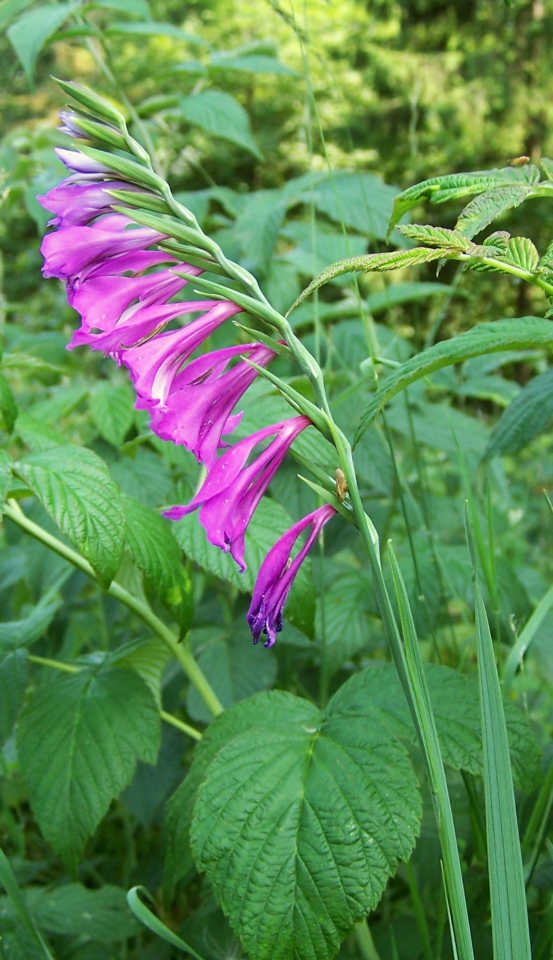
Marsh gladiolus is a herbaceous perennial flowering plant in the family Iridaceae. It is native to Central and Northwestern Europe. It has sword-shaped leaves and rosy violet or magenta flowers.
Written 26 November 2026 from the sources listed below. Each statement was checked against the passage it cites; statements that could not be supported were removed.
Appearance
Marsh gladiolus has an erect, smooth, unbranched stem and a spherical bulb with cross-linked fibers at its top. Its simple leaves are sword-shaped and have parallel venation.[1][2]
The flowers have rosy violet or magenta perigoniums. Each inflorescence contains three to six hermaphroditic flowers.[3][4]
Habitat
Marsh gladiolus grows in calcareous, moist, humus-rich environments that alternate between wet and dry conditions. Its habitats include wet meadows and forest clearings.[5][6]
The species occurs at elevations of up to approximately 1,200–1,500 metres.[7]
Despite its scientific name, Marsh gladiolus does not grow in marshes.[8]
Reproduction and life cycle
Marsh gladiolus flowers between May and July. Bumblebees pollinate the species.[9][10]
Classification of the Marsh Gladiolus
| Kingdom | Plantae |
|---|---|
| Subkingdom | Pteridobiotina |
| Phylum | Tracheophyta |
| Class | Liliopsida |
| Order | Asparagales |
| Family | Iridaceae (Iris Family) |
| Genus | Gladiolus (Gladioli) |
| Species | Gladiolus palustris Gaudin |
Where the Marsh Gladiolus is found
Checklists and occurrence records place Gladiolus palustris in 22 countries across Europe. GBIF holds 17,050 georeferenced records of it.
Countries
- Albania 5
- Austria 710
- Belgium 3
- Bulgaria 5
- Croatia 6
- Czechia 48
- Estonia 3
- France 12,180
- Germany 2,476
- Greece 11
- Hungary 34
- Italy 360
- Liechtenstein 27
- Montenegro 12
- Poland 66
- Portugal 4
- Russia 2
- Slovakia 128
- Slovenia 23
- Spain 3
- Switzerland 936
- Ukraine 8
Regions and cities with the most records
- Auvergne-Rhône-Alpes, France 11,813
- Oyonnax, France 11,113
- Bavaria, Germany 2,206
- Nyon, Switzerland 654
- Thonon-les-Bains, France 558
- Annemasse, France 458
- Weilheim, Germany 449
- Vaduz, Liechtenstein 448
- Hohenems, Austria 435
- Feldkirch, Austria 430
- Starnberg, Germany 396
- Königsbrunn, Germany 388
- Bobingen, Germany 387
- Wolfratshausen, Germany 379
- Augsburg, Germany 378
- Friedberg, Germany 368
- Füssen, Germany 351
- Neusäß, Germany 349
- Bad Reichenhall, Germany 341
- Salzburg, Austria 336
- Freilassing, Germany 335
- Gauting, Germany 327
- Penzberg, Germany 325
- Unterschleißheim, Germany 322
- Gersthofen, Germany 314
- Geneva, Switzerland 304
- Onex, Switzerland 303
- Vernier, Switzerland 303
- Carouge, Switzerland 302
- Meyrin, Switzerland 301
- Karlsfeld, Germany 293
- Munich, Germany 292
- Salzburg, Austria 281
- Gilching, Germany 280
- Garching, Germany 275
- Neufahrn bei Freising, Germany 248
A number beside a place is its count of GBIF occurrence records. A place without a number comes from a checklist alone. Records show where a species has been observed or collected, which can include escapes and vagrants.
Common names
English
- Marsh Gladiolus
- Sword Lily
Names in 16 other languages
- Czech
- mečík bahenní
- Finnish
- nuokkumiekkalilja
- French
- Glaïeul des Marais
- German
- Sumpf-Gladiole, Sumpf-Siegwurz, Sumpfgladiole, Sumpfsiegwurz
- Greek
- Γλαδίολος ο ελοχαρής
- Hungarian
- Mocsári kardvirág
- Italian
- Gladiolo palustre, Gladiolo reticolato
- Lithuanian
- Pelkinis kardelis
- Norwegian Bokmål
- sumpgladiolus
- Persian
- گلایول شمشیری
- Polish
- Mieczyk Błotny
- Russian
- Гладиолус болотный, Шпажник болотный
- Slovak
- mečík močiarny
- Slovenian
- močvirski meček
- Swedish
- kärrsabellilja
- Ukrainian
- Косарики болотні
Synonyms
9 other scientific names have been used for this species and are now treated as synonyms of Gladiolus palustris.
- Gladiolus boucheanus Schltdl.
- Gladiolus communis subsp. palustris (Gaudin) Bonnier & Layens
- Gladiolus felicis Z.Mirek
- Gladiolus imbricatus subsp. parviflorus K.Richt.
- Gladiolus palustris var. vaudensis Gaudin
- Gladiolus pratensis A.Dietr.
- Gladiolus parviflorus Berdau ambiguous synonym
- Gladiolus tenuis Salzm. ex Nyman ambiguous synonym
- Gladiolus triphyllus Bertol. ambiguous synonym
Related species
-
 Abyssinian GladiolusGladiolus murielae
-
 Italian GladiolusGladiolus italicus
-
 African GladiolusGladiolus dalenii
-
 Eastern GladiolusGladiolus communis
-
 Painted-ladyGladiolus carneus
-
 Marsh AfrikanerGladiolus tristis
-
 Wild GladiolusGladiolus illyricus
-
 Turkish Marsh GladiolusGladiolus imbricatus
Compare
Questions and answers
What is the scientific name of the Marsh Gladiolus?
The scientific name of the Marsh Gladiolus is Gladiolus palustris. Written with its author, the full name is Gladiolus palustris Gaudin.
Which family does the Marsh Gladiolus belong to?
Gladiolus palustris belongs to the family Iridaceae, in the order Asparagales and the class Liliopsida.
Where is the Marsh Gladiolus found?
Checklists and occurrence records place Gladiolus palustris in 22 countries, including France, Germany, Switzerland, Austria, Italy and Slovakia.
What is the conservation status of the Marsh Gladiolus?
The IUCN Red List category recorded for Gladiolus palustris is Data Deficient (DD).
What other names does the Marsh Gladiolus have?
Gladiolus palustris is also known in English as Sword Lily.
Why is gladiolus called sword lily?
The genus name Gladiolus derives from the Latin diminutive of gladius, meaning sword.[11]
Do gladioli come back every year?
Marsh gladiolus is a herbaceous perennial plant.[12]
Which flower is known as sword lily?
Marsh gladiolus is also recorded under the English name Sword lily.[12]
Where do sword lilies grow?
Marsh gladiolus is native to Central and Northwestern Europe. Its documented European range includes eastern France, Switzerland, southern and eastern Germany, the Czech Republic, Slovakia and Poland. It also occurs in the Italian Alps, Austria and Hungary, is more common in the Balkan region, and has other recorded locations in Romania and additional parts of Eastern Europe.[13][14][15][16][17]
Sources
Passages the profile rests on
- The species has an erect, smooth, unbranched stem and a spherical bulb with cross-linked fibers at its top. Source passage: “The stem is erect, glabrous and unbranched, the bulbus is spherical with cross-linked fibers at the top.” — English Wikipedia
- Its leaves are simple, sword-shaped and have parallel venation. Source passage: “The leaves are shorter than the stem, simple, with a parallel venation, sword-shaped” — English Wikipedia
- The flowers have rosy violet or magenta perigoniums. Source passage: “with a rosy violet or magenta perigonium” — English Wikipedia
- Each inflorescence contains three to six hermaphroditic flowers. Source passage: “The inflorescence is composed of three to six hermaphroditic flowers” — English Wikipedia
- The species grows in calcareous, moist, humus-rich environments that alternate between wet and dry conditions. Source passage: “they prefer calcareous, moist and humus rich environments alternately wet and dry” — English Wikipedia
- Its habitats include wet meadows and forest clearings. Source passage: “in wet meadows and forest clearings.” — English Wikipedia
- The species occurs at elevations of up to approximately 1,200–1,500 metres. Source passage: “They can be found at a maximum altitude of 1,200–1,500 metres (3,900–4,900 ft).” — English Wikipedia
- Despite its scientific name, the species does not grow in marshes. Source passage: “Notwithstanding the name, these plants do not grow in marshes” — English Wikipedia
- The species flowers between May and July. Source passage: “The flowering period of these plants extends from May through July.” — English Wikipedia
- Bumblebees pollinate this species. Source passage: “They are pollinated by bumblebees.” — English Wikipedia
- The genus name Gladiolus derives from the Latin diminutive of gladius, meaning sword. Source passage: “The genus name Gladiolus is the Latin diminutive of gladius, a sword” — English Wikipedia
- Gladiolus palustris is a herbaceous perennial plant belonging to the genus Gladiolus and family Iridaceae. Source passage: “is a herbaceous perennial plant belonging to the genus Gladiolus of the family Iridaceae.” — English Wikipedia
- Gladiolus palustris is native to Central and Northwestern Europe. Source passage: “This species is native of Central and NW Europe.” — English Wikipedia
- Its documented European range includes eastern France, Switzerland, southern and eastern Germany, the Czech Republic, Slovakia and Poland. Source passage: “It occurs in eastern France, Switzerland, in southern and eastern Germany, the Czech Republic, Slovakia and Poland.” — English Wikipedia
- The species also occurs in the Italian Alps, Austria and Hungary. Source passage: “It is present in the Italian Alps, Austria and Hungary” — English Wikipedia
- The species is more common in the Balkan region. Source passage: “more common in the Balkan region.” — English Wikipedia
- Other recorded locations include Romania and additional parts of Eastern Europe. Source passage: “Other locations are in Eastern Europe, including Romania.” — English Wikipedia
Data
- Catalogue of Life, 2026-10-16 XR cc by
- Global Biodiversity Information Facility CC BY 4.0
- Wikidata CC0
- GeoNames CC BY 4.0
- Wikimedia Commons per image; credit shown with each image
- Within the Catalogue of Life, this name comes from The World Checklist of Vascular Plants (WCVP) cc by
References
- Fl. Helv. 1: 97 (1828) where the name was published
This species in other databases
- Catalogue of Life 3G4V9
- Wikidata Q164542
- iNaturalist 59944
- World Flora Online wfo-0000790159
- GRIN 507521
Page built on 27 November 2026. See how the catalog is made and all sources and licences.
Cite this page
ScientificNames.org. (2026). Gladiolus palustris (Marsh Gladiolus). Retrieved November 27, 2026, from https://scientificnames.org/species/gladiolus-palustris
“Gladiolus palustris (Marsh Gladiolus).” ScientificNames.org, 2026, scientificnames.org/species/gladiolus-palustris. Accessed 27 Nov. 2026.
ScientificNames.org. “Gladiolus palustris (Marsh Gladiolus).” Accessed November 27, 2026. https://scientificnames.org/species/gladiolus-palustris.
@misc{scientificnames_gladiolus_palustris_marsh_gladiolus,
  author = {{ScientificNames.org}},
  title = {Gladiolus palustris (Marsh Gladiolus)},
  year = {2026},
  url = {https://scientificnames.org/species/gladiolus-palustris},
  note = {Accessed 2026-11-27}
}