Species · Flowering plants
African Gladiolus Gladiolus dalenii
The scientific name of the African Gladiolus is Gladiolus dalenii. It is a species of flowering plant in the family Iridaceae (iris family), order Asparagales.
- Scientific name
- Gladiolus dalenii Van Geel
- Common name
- African Gladiolus
- Genus
- Gladiolus
- Family
- Iridaceae (Iris Family)
- Order
- Asparagales
- Class
- Liliopsida
- Recorded in
- 44 countries
- Name status
- accepted in the Catalogue of Life

Overview
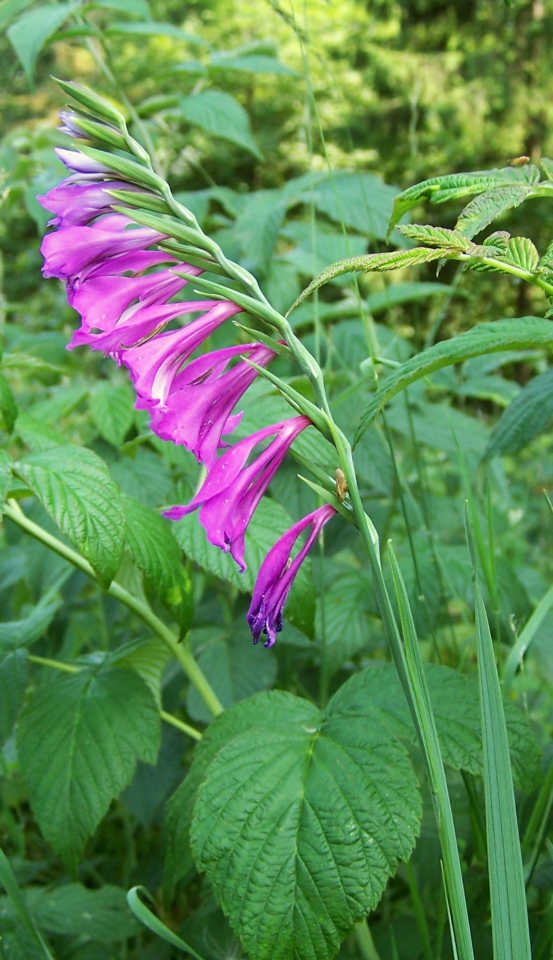
The species occurs across eastern South Africa, Madagascar, tropical Africa and western Arabia. It produces five tall flower spikes with flowers ranging from yellow to scarlet, often with red streaks against a yellow background and generally yellow throats.
Written 26 November 2026 from the sources listed below. Each statement was checked against the passage it cites; statements that could not be supported were removed.
Appearance
The plant produces five tall flower spikes. Its flowers range in colour from yellow to scarlet and often have red streaks against a yellow background, with generally yellow throats.[1][2][3][4]
Habitat
Under cultivation, the plant prefers light sandy soil with a neutral to slightly acidic reaction and a pH of 6.5–7. It also requires stony, gritty loam.[5][6]
Cultivated plants prefer sunny, sheltered growing locations.[7]
Uses
The species serves as the principal parent of the large-flowered grandiflora hybrids. Hybrids derived from this species are frequently tetraploid.[8][9]
Classification of the African Gladiolus
| Kingdom | Plantae |
|---|---|
| Subkingdom | Pteridobiotina |
| Phylum | Tracheophyta |
| Class | Liliopsida |
| Order | Asparagales |
| Family | Iridaceae (Iris Family) |
| Genus | Gladiolus (Gladioli) |
| Species | Gladiolus dalenii Van Geel |
Where the African Gladiolus is found
Checklists and occurrence records place Gladiolus dalenii in 44 countries across Africa, Asia, Europe, North America and South America. GBIF holds 4,233 georeferenced records of it.
Countries where it is native or its origin is not stated
- Angola 98
- Benin 168
- Botswana 6
- Burkina Faso 20
- Burundi 54
- Cameroon 72
- Central African Republic 6
- Chad
- Democratic Republic of the Congo 393
- Eritrea 9
- Eswatini 13
- Ethiopia 70
- Ghana 19
- Guinea 25
- Guinea-Bissau 1
- Ivory Coast 25
- Kenya 163
- Lesotho 33
- Madagascar 197
- Malawi 174
- Mali 4
- Mozambique 97
- Namibia 16
- Nigeria 40
- Republic of the Congo 1
- Reunion 14
- Rwanda 55
- Saudi Arabia 12
- Senegal 1
- Sierra Leone 9
- South Africa 1,306
- South Sudan 3
- Sudan 17
- Tanzania 324
- Togo 19
- Uganda 83
- Yemen 14
- Zambia 169
- Zimbabwe 99
Countries where it has been introduced
Regions and cities with the most records
- KwaZulu-Natal, South Africa 432
- Mpumalanga, South Africa 155
- Gauteng, South Africa 137
- Pinetown, South Africa 109
- Azores, Portugal 108
- Ntuzuma, South Africa 105
- Limpopo, South Africa 100
- Durban, South Africa 92
- Atakora, Benin 88
- Florida, United States 88
- Free State, South Africa 83
- Toukountouna, Benin 67
- Tanguiéta, Benin 62
- Eastern Cape, South Africa 59
- Centurion, South Africa 55
- Pretoria, South Africa 55
- Western Cape, South Africa 52
- Livingstone, Zambia 42
- Victoria Falls, Zimbabwe 42
- Southern Province, Zambia 36
- Haut-Katanga, Democratic Republic of the Congo 35
- Oromiya, Ethiopia 33
- Tongaat, South Africa 33
- North West, South Africa 31
- Randburg, South Africa 31
- Mpumalanga, South Africa 29
- South Carolina, United States 29
- Borgou, Benin 28
- Edenvale, South Africa 26
- Johannesburg, South Africa 26
- Alberton, South Africa 25
- Ballitoville, South Africa 25
- Donga, Benin 25
- Germiston, South Africa 24
- Ivato, Madagascar 21
- Marikana, South Africa 21
12 more countries have a few records outside this range
These countries hold a few records of Gladiolus dalenii but lie outside the range the checklists give for it. Such records are often zoo or garden specimens, museum material or vagrants, so the species is not counted as occurring there.
A number beside a place is its count of GBIF occurrence records. A place without a number comes from a checklist alone. Records show where a species has been observed or collected, which can include escapes and vagrants.
Common names
English
- African Gladiolus
- Dragon's-head Lily
- Dragonhead Gladiolus
- Natal-lily
- Dragon's-head-lily
- Maid-of-the-mist
- Parrot-lily
- Sword-lily
Names in 6 other languages
- Finnish
- liekkimiekkalilja
- German
- Primel-Gladiole
- Malayalam
- ഗ്ലാഡിയോലസ് ഡാലെനി
- Persian
- گلایول دالنی
- Slovak
- mečík Dalenov
- Spanish
- Gladiolo naranja
Synonyms
One other scientific name has been used for this species and is now treated as a synonym of Gladiolus dalenii.
- Gladiolus psittacinus var. psittacinus
Subspecies and varieties
- Gladiolus dalenii subsp. andongensis (Tropical African Gladiolus) subspecies
- Gladiolus dalenii subsp. dalenii (Natal Lily) subspecies
- Gladiolus dalenii subsp. welwitschii (Angolan African Gladiolus) subspecies
Related species
-
 Abyssinian GladiolusGladiolus murielae
-
 Italian GladiolusGladiolus italicus
-
 Eastern GladiolusGladiolus communis
-
 Painted-ladyGladiolus carneus
-
 Marsh AfrikanerGladiolus tristis
-
 Wild GladiolusGladiolus illyricus
-
 Marsh GladiolusGladiolus palustris
-
 Turkish Marsh GladiolusGladiolus imbricatus
Compare
Questions and answers
What is the scientific name of the African Gladiolus?
The scientific name of the African Gladiolus is Gladiolus dalenii. Written with its author, the full name is Gladiolus dalenii Van Geel.
Which family does the African Gladiolus belong to?
Gladiolus dalenii belongs to the family Iridaceae, in the order Asparagales and the class Liliopsida.
Where is the African Gladiolus found?
Checklists and occurrence records place Gladiolus dalenii in 44 countries, including South Africa, Democratic Republic of the Congo, Tanzania, Madagascar, Malawi and Zambia.
What other names does the African Gladiolus have?
Gladiolus dalenii is also known in English as Dragon's-head Lily, Dragonhead Gladiolus, Natal-lily, Dragon's-head-lily, Maid-of-the-mist and Parrot-lily.
Sources
Passages the profile rests on
- The plant produces five tall flower spikes. Source passage: “It produces five tall flower spikes” — English Wikipedia
- Its flowers range in colour from yellow to scarlet. Source passage: “yellow to scarlet flowers” — English Wikipedia
- Its flowers often have red streaks against a yellow background. Source passage: “often streaked red over a yellow ground color” — English Wikipedia
- The flowers generally have yellow throats. Source passage: “generally with a yellow throat.” — English Wikipedia
- Under cultivation, the plant prefers light sandy soil with a neutral to slightly acidic reaction and a pH of 6.5–7. Source passage: “a light sandy neutral to slightly acid soil with a pH between 6.5 and 7” — English Wikipedia
- The species requires stony, gritty loam when cultivated. Source passage: “requires a stony gritty loam.” — English Wikipedia
- Cultivated plants prefer sunny, sheltered growing locations. Source passage: “in a sunny sheltered position” — English Wikipedia
- The species serves as the principal parent of the large-flowered grandiflora hybrids. Source passage: “It is the main parental species of the large flowering grandiflora hybrids.” — English Wikipedia
- Hybrids derived from this species are frequently tetraploid. Source passage: “The hybrids produced from it are often tetraploids.” — English Wikipedia
Data
- Catalogue of Life, 2026-10-16 XR cc by
- Global Biodiversity Information Facility CC BY 4.0
- Wikidata CC0
- GeoNames CC BY 4.0
- Wikimedia Commons per image; credit shown with each image
- Within the Catalogue of Life, this name comes from The World Checklist of Vascular Plants (WCVP) cc by
References
- Sert. Bot. 2(1): 18 (1829) where the name was published
This species in other databases
- Catalogue of Life 3G4LC
- Wikidata Q2109825
- iNaturalist 357461
- World Flora Online wfo-0000789772
- GRIN 406411
Page built on 27 November 2026. See how the catalog is made and all sources and licences.
Cite this page
ScientificNames.org. (2026). Gladiolus dalenii (African Gladiolus). Retrieved November 27, 2026, from https://scientificnames.org/species/gladiolus-dalenii
“Gladiolus dalenii (African Gladiolus).” ScientificNames.org, 2026, scientificnames.org/species/gladiolus-dalenii. Accessed 27 Nov. 2026.
ScientificNames.org. “Gladiolus dalenii (African Gladiolus).” Accessed November 27, 2026. https://scientificnames.org/species/gladiolus-dalenii.
@misc{scientificnames_gladiolus_dalenii_african_gladiolus,
  author = {{ScientificNames.org}},
  title = {Gladiolus dalenii (African Gladiolus)},
  year = {2026},
  url = {https://scientificnames.org/species/gladiolus-dalenii},
  note = {Accessed 2026-11-27}
}