Species · Insects
Grandaustralis boomerang
Grandaustralis boomerang has no English name on record in the checklists used here. It is a species of insect in the family Scarabaeidae (dung beetles), order Coleoptera. The name dates from 2013.
- Scientific name
- Grandaustralis boomerang Hutchinson & Moeseneder, 2013
- Genus
- Grandaustralis
- Family
- Scarabaeidae (Dung Beetles)
- Order
- Coleoptera
- Class
- Insecta
- Recorded in
- 1 country
- Name status
- accepted in the Catalogue of Life
Overview
Wikidata describes Grandaustralis boomerang as “species of beetle”.
Classification of Grandaustralis boomerang
| Kingdom | Animalia |
|---|---|
| Phylum | Arthropoda |
| Subphylum | Hexapoda |
| Class | Insecta (Insect) |
| Order | Coleoptera (Beetle) |
| Suborder | Polyphaga |
| Series | Staphyliniformia |
| Superfamily | Scarabaeoidea |
| Family | Scarabaeidae (Dung Beetles) |
| Subfamily | Cetoniinae |
| Tribe | Schizorhinini |
| Subtribe | Schizorhinina |
| Genus | Grandaustralis |
| Species | Grandaustralis boomerang Hutchinson & Moeseneder, 2013 |
Origin of the name. Etymology. The shape of the male's antennal club and its flight behavior of circling and returning are reminiscent of a boomerang, a weapon used by indigenous Australians. Ecology and geographical distribution. Males were observed over several days at the Ravensthorpe, W. A. site flying from approximately 09: 00 to 13: 00 between mallee bushes and at the edge of lower, open heath areas at a height of approximately 1 m but never above taller vegetation. They were fast and strong flyers, capable of weaving skilfully between the vegetation (Fig. 11). The flight pattern may have been dictated by the height at which the beetles were flying and the height of the vegetation since Hemichnoodes nigriceps (Blanchard, 1850) was observed flying similarly at this locality. Wing color, which is clear in H. nigriceps and smoky to light brown in G. boomerang, allowed differentiation of the two species in flight. On some days, over 100 male specimens of G. boomerang were observed and often several were seen flying at the same time. Occasionally a beetle circled a bush or a spot near a bush for up to two minutes before descending. Usually they continued in flight but very rarely a specimen was observed landing near the bush. Since females are of stocky build and have protibiae adapted to burying, it was assumed that they spend a majority of the time in the soil or decaying plant matter. However, a search for females on every part of the plant where males had landed, above and under the ground and in the soil around the bush, was unsuccessful and did not yield female specimens or any indication of breeding activity. During the days of observation at Ravensthorpe, trees and bushes were in bloom and attracted all other cetoniines known from this area (Metallesthes metallescens (White, 1859), Aphanesthes succinea (Hope, 1844) and H. nigriceps), but G. boomerang were never observed feeding on the flowers or any other food source. It is likely that adult males never feed. The two known females were found walking on the ground from 14: 30 - 16: 00. All recent specimens were collected during the hottest summer months, January and predominantly February. The specimen collected by J. Reeves is in poor condition, which suggests that it may have been collected dead. The date on its label, October, is not indicative of adult activity. Grandaustralis boomerang is known only from the Goldfields-Esperance region in Western Australia. The area where G. boomerang has been collected falls into two climate zones as per Koppen-Geiger climate classification (Peel et al. 2007), Cold semi-arid climate (classification Bsk) and Warm temperate climate with dry summer (classification Csb). Average annual rainfall in this region is 400 - 600 mm.
Where Grandaustralis boomerang is found
Checklists and occurrence records place Grandaustralis boomerang in 1 country. GBIF holds 4 georeferenced records of it.
Countries
Regions and cities with the most records
Range as the checklists state it
Australian(Western Australia)
A number beside a place is its count of GBIF occurrence records. A place without a number comes from a checklist alone. Records show where a species has been observed or collected, which can include escapes and vagrants.
Related species
-
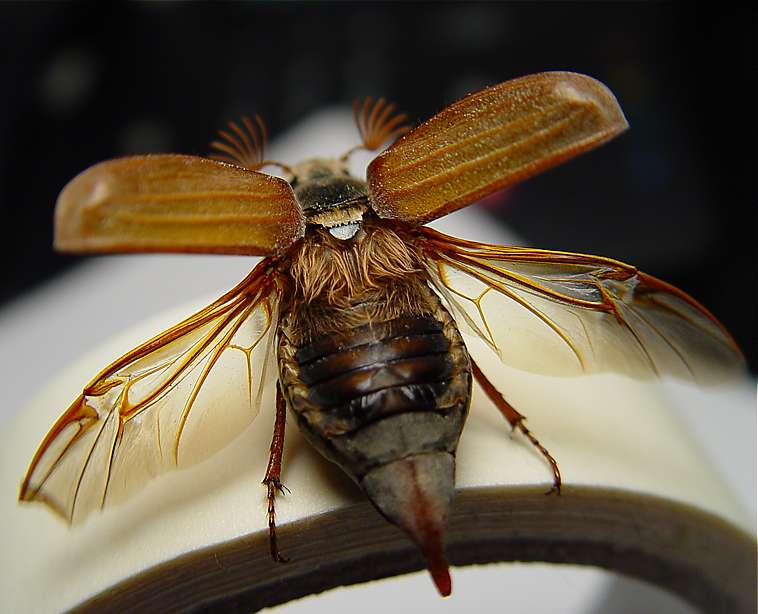 CockchaferMelolontha melolontha
-
 Hercules BeetleDynastes (Dynastes) hercules
-
 Japanese BeetlePopillia japonica
-
 Japanese Rhinoceros BeetleTrypoxylus dichotomus
-
 Sacred ScarabScarabaeus sacer
-
 Figeater BeetleCotinis (Cotinis) mutabilis
-
 Atlas BeetleChalcosoma atlas
-
 Coconut Rhinoceros BeetleOryctes (Rykanes) rhinoceros
Compare
Sources
Data
- Catalogue of Life, 2026-10-16 XR cc by
- Global Biodiversity Information Facility CC BY 4.0
- Wikidata CC0
- GeoNames CC BY 4.0
- Within the Catalogue of Life, this name comes from World Scarabaeidae Database cc by
References
- Hutchinson, P. M., & Moeseneder, C. H. (2013). Grandaustralis, a new genus and Grandaustralis boomerang, a new species of Cetoniinae (Coleoptera: Scarabaeidae) from Western Australia. Zootaxa 3669(1):17-26. https://doi.org/10.11646/zootaxa.3669.1.2 Link where the name was published
This species in other databases
Page built on 28 November 2026. See how the catalog is made and all sources and licences.
Cite this page
ScientificNames.org. (2026). Grandaustralis boomerang. Retrieved November 28, 2026, from https://scientificnames.org/species/grandaustralis-boomerang
“Grandaustralis boomerang.” ScientificNames.org, 2026, scientificnames.org/species/grandaustralis-boomerang. Accessed 28 Nov. 2026.
ScientificNames.org. “Grandaustralis boomerang.” Accessed November 28, 2026. https://scientificnames.org/species/grandaustralis-boomerang.
@misc{scientificnames_grandaustralis_boomerang,
  author = {{ScientificNames.org}},
  title = {Grandaustralis boomerang},
  year = {2026},
  url = {https://scientificnames.org/species/grandaustralis-boomerang},
  note = {Accessed 2026-11-28}
}