Species · Reptiles
Yellow-blotched Map Turtle Graptemys flavimaculata
The scientific name of the Yellow-blotched Map Turtle is Graptemys flavimaculata. It is a species of reptile in the family Emydidae (terrapins), order Testudines. The name dates from 1954.
- Scientific name
- Graptemys flavimaculata Cagle, 1954
- Common name
- Yellow-blotched Map Turtle
- Genus
- Graptemys
- Family
- Emydidae (Terrapins)
- Order
- Testudines
- Class
- Reptilia
- Red List category
- VU Vulnerable
- Environment
- freshwater
- Recorded in
- 1 country
- Name status
- accepted in the Catalogue of Life

Overview
Graptemys flavimaculata is endemic to the southern United States, with a distribution restricted to the Pascagoula River and most of its tributaries in Mississippi.
Written 26 November 2026 from the sources listed below. Each statement was checked against the passage it cites; statements that could not be supported were removed.
Appearance
The shell has tall black ridges across the first four vertebrae, although adult females sometimes lack them. Hatchlings have darker and more distinctly defined markings than adults.[1][2]
Male Yellow-blotched Map Turtles have longer front claws and thicker tails than females.[3]
Habitat
The species inhabits rivers with widths ranging from 20 to 120 m. Its river habitats generally have sandy and silty substrates, sandbars used for nesting, and floating logs used for basking.[4][5][6]
Yellow-blotched Map Turtles prefer flowing water but also occur in stagnant lakes and ponds. They occupy waters with temperatures between 10 and 35 °C.[7][8]
From June through October, individuals tend to occupy areas with reduced water flow. From November through May, they tend to occupy areas with greater water flow.[9][10]
Diet
The species feeds primarily on insects. Its opportunistic diet also includes crustaceans, fish, and fresh plant matter.[11][12]
Behaviour
Males and females occupy different home-range areas, with females having larger average ranges. Females have a mean home-range area of 5.75 hectares associated with nesting activities.[13][14]
Males and females change their preferred water depth and distance from shore throughout the year.[15]
Reproduction and life cycle
The species has separate male and female sexes. Males initiate underwater courtship by approaching females with their necks extended forward.[16][17]
Females may be gravid between May and August. They typically mate once annually but may occasionally mate twice in a year.[18][19]
Females construct nests in sandbars or steep clay riverbanks. Clutches typically contain three to nine eggs, which average 36.8 mm in length, 22.9 mm in width, and 15 g in mass.[20][21][22][23]
Incubation in captivity has been reported to last 98 days. Hatchlings have been observed emerging from their nests in September or October.[24][25]
Male sexual maturity can occur between two and four years of age. Females are thought to reach sexual maturity at approximately eight to ten years of age.[26][27]
Higher incubation temperatures produce female hatchlings, while lower temperatures produce males. Female turtles provide no parental care after laying their eggs.[28][29]
Conservation
The species is listed as threatened under the United States Endangered Species Act. It also receives protection under Appendix III of CITES.[30][31]
Fish crow predation and river flooding contribute to high nest mortality. Nest predators include fish crows, red imported fire ants, common kingsnakes, raccoons, wild boars, nine-banded armadillos, and gray foxes.[32][33]
Pollution and agricultural changes to water levels negatively affect nesting beaches.[34]
Similar species
The ringed sawback and black-knobbed map turtle differ in coloration and head patterns from the Yellow-blotched Map Turtle.[35]
Classification of the Yellow-blotched Map Turtle
| Kingdom | Animalia |
|---|---|
| Phylum | Chordata |
| Subphylum | Vertebrata |
| Infraphylum | Gnathostomata |
| Parvphylum | Osteichthyes |
| Megaclass | Tetrapoda |
| Class | Reptilia (Reptile) |
| Order | Testudines (Turtle) |
| Suborder | Cryptodira |
| Superfamily | Testudinoidea |
| Family | Emydidae (Terrapins) |
| Genus | Graptemys (Map Turtles) |
| Species | Graptemys flavimaculata Cagle, 1954 |
Where the Yellow-blotched Map Turtle is found
Checklists and occurrence records place Graptemys flavimaculata in 1 country across North America. GBIF holds 239 georeferenced records of it.
Countries
Regions and cities with the most records
- Mississippi, United States 128
- Hattiesburg, United States 37
- Pascagoula, United States 6
- Gautier, United States 5
Range as the checklists state it
USA (Pascagoula River system in Mississippi, introduced to Florida)
A number beside a place is its count of GBIF occurrence records. A place without a number comes from a checklist alone. Records show where a species has been observed or collected, which can include escapes and vagrants.
Common names
English
- Yellow-blotched Map Turtle
- Yellow Blotched Sawback
- Yellow-blotched Sawback
Names in 7 other languages
- Arabic
- سلحفاة الخريطة صفراء اللطخات
- Chinese
- 黃斑地圖龜
- Czech
- želva žlutoskvrnná
- German
- Gelbflecken-Höckerschildkröte, Gelbtupfen-Höckerschildkröte, Pascagoula-River-Höckerschildkröte, Zwerg-Höckerschildkröte
- Hungarian
- sárgafoltos tarajosteknős
- Japanese
- キマダラチズガメ
- Spanish
- Tortuga mapa de manchas amarillas
Synonyms
One other scientific name has been used for this species and is now treated as a synonym of Graptemys flavimaculata.
- Graptemys oculifera flavimaculata Cagle, 1954
Related species
-
 Northern Map TurtleGraptemys geographica
-
 Barbour's Map TurtleGraptemys barbouri
-
 False Map TurtleGraptemys pseudogeographica
-
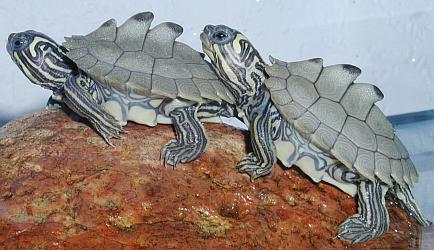 Black-knobbed Map TurtleGraptemys nigrinoda
-
 Ouachita Map TurtleGraptemys ouachitensis
-
 Ringed Map TurtleGraptemys oculifera
-
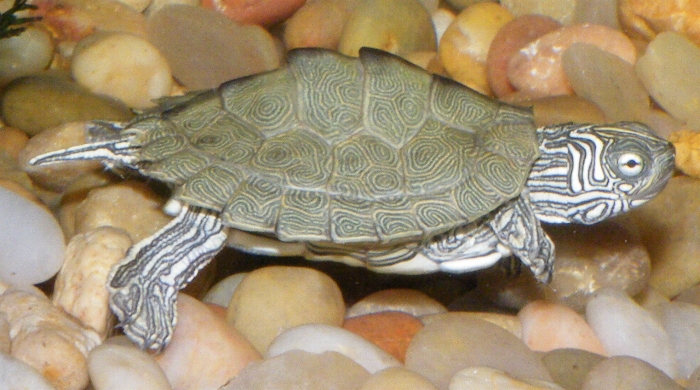 Cagle's Map TurtleGraptemys caglei
-
 Alabama Map TurtleGraptemys pulchra
Compare
Questions and answers
What is the scientific name of the Yellow-blotched Map Turtle?
The scientific name of the Yellow-blotched Map Turtle is Graptemys flavimaculata. Written with its author, the full name is Graptemys flavimaculata Cagle, 1954.
Which family does the Yellow-blotched Map Turtle belong to?
Graptemys flavimaculata belongs to the family Emydidae, in the order Testudines and the class Reptilia.
Where is the Yellow-blotched Map Turtle found?
Checklists and occurrence records place Graptemys flavimaculata in 1 country: United States.
What is the conservation status of the Yellow-blotched Map Turtle?
The IUCN Red List category recorded for Graptemys flavimaculata is Vulnerable (VU).
What other names does the Yellow-blotched Map Turtle have?
Graptemys flavimaculata is also known in English as Yellow Blotched Sawback and Yellow-blotched Sawback.
Sources
Passages the profile rests on
- Its shell has tall black ridges across the first four vertebrae, although adult females sometimes lack them. Source passage: “They also have tall ridges bisecting the shell on the first four vertebrae. These ridges are black and sometimes are lacking in adult females.” — animaldiversity.org
- Hatchlings have darker and more distinctly defined markings than adults. Source passage: “When these turtles hatch, their markings are generally darker and more defined than full-grown adults.” — animaldiversity.org
- Male yellow-blotched map turtles have longer front claws and thicker tails than females. Source passage: “Males possess longer front claws and thicker tails than females.” — animaldiversity.org
- The species inhabits rivers with widths ranging from 20 to 120 m. Source passage: “having been found in rivers with widths between 110 and 120m as well as rivers with widths between 20 and 50m.” — animaldiversity.org
- Its river habitats contain sandbars used for nesting and floating logs used for basking. Source passage: “contain sandbars for nesting, floating logs for basking” — animaldiversity.org
- The species generally inhabits rivers with sandy and silty substrates. Source passage: “The substrates of these rivers are typically sand and silt.” — animaldiversity.org
- Yellow-blotched map turtles prefer flowing water but also occur in stagnant lakes and ponds. Source passage: “prefer areas where there is flowing water, but they have been found in stagnant lakes or ponds.” — animaldiversity.org
- The species occupies waters with temperatures between 10 and 35 °C. Source passage: “they remain in areas where the water stays between 10-35 °C.” — animaldiversity.org
- From June through October, individuals tend to occupy areas with reduced water flow. Source passage: “In warmer weather (June through October), yellow-blotched sawbacks remain in areas with reduced water flow.” — animaldiversity.org
- From November through May, individuals tend to occupy areas with greater water flow. Source passage: “In cooler weather (November through May), these turtles tend to remain where there is greater water flow.” — animaldiversity.org
- The species feeds primarily on insects. Source passage: “Yellow-blotched map turtles feed mostly on insects” — English Wikipedia
- Its opportunistic diet also includes crustaceans, fish, and fresh plant matter. Source passage: “so also consume crustaceans, fish, and some fresh plant matter.” — English Wikipedia
- Males and females occupy different home-range areas, with females having larger average ranges. Source passage: “Males have a mean home range area of 1.12 ha (2.77 acres)” — English Wikipedia
- Females have a mean home-range area of 5.75 hectares associated with nesting activities. Source passage: “Females have a mean home range area of 5.75 ha (14.20 acres), due to nesting activities” — English Wikipedia
- Males and females change their preferred water depth and distance from shore throughout the year. Source passage: “Jones (1996) found that both sexes move to areas differing in depth and the distance from the shore throughout the year.” — animaldiversity.org
- The species has separate male and female sexes. Source passage: “gonochoric/gonochoristic/dioecious (sexes separate)” — animaldiversity.org
- Males initiate underwater courtship by approaching females with their necks extended forward. Source passage: “Mating begins underwater when males approach the females while extending their necks forward.” — animaldiversity.org
- Females may be gravid between May and August. Source passage: “Yellow-blotched sawback females are gravid as early as May and as late as August” — animaldiversity.org
- Females typically mate once annually but may occasionally mate twice in a year. Source passage: “They typically mate once a year but can occasionally mate twice per year.” — animaldiversity.org
- Females construct nests in sandbars or steep clay riverbanks. Source passage: “Females will dig nests in a sandbar, or a steep riverbank made of clay.” — animaldiversity.org
- Clutches typically contain three to nine eggs. Source passage: “Clutch sizes are typically three to nine eggs” — animaldiversity.org
- The eggs average 36.8 mm in length and 22.9 mm in width. Source passage: “The egg sizes are, on average, 36.8mm by 22.9mm” — animaldiversity.org
- Eggs have an average mass of 15 g. Source passage: “with an average mass of 15.0g.” — animaldiversity.org
- Incubation in captivity has been reported to last 98 days. Source passage: “The incubation period in captivity was reported by Ernst and Lovich (2009) as 98 days.” — animaldiversity.org
- Hatchlings have been observed emerging from their nests in September or October. Source passage: “hatchlings in nature were observed by Ernst and Lovich (2009) emerging from their nests in September or October.” — animaldiversity.org
- Male sexual maturity can occur between two and four years of age. Source passage: “Sexual maturity for males is reached when the plastron length is 7.1-8cm, which happens between age 2-4.” — animaldiversity.org
- Females are thought to reach sexual maturity at approximately eight to ten years of age. Source passage: “Females are thought to become sexually mature at 8-10 years of age.” — animaldiversity.org
- Higher incubation temperatures produce female hatchlings, while lower temperatures produce males. Source passage: “Lower temperatures will produce male hatchlings and higher temperatures will produce female hatchlings.” — animaldiversity.org
- Female turtles provide no parental care after laying their eggs. Source passage: “Once the eggs are laid, females leave them and provide no further parental investment.” — animaldiversity.org
- The species is listed as threatened under the United States Endangered Species Act. Source passage: “This species is listed as threatened under the US Endangered Species Act” — English Wikipedia
- The species receives protection under Appendix III of CITES. Source passage: “G. flavimaculata receives protection under Appendix III of the Convention on International Trade in Endangered Species of Wild Fauna and Flora (CITES).” — English Wikipedia
- Fish crow predation and river flooding contribute to high nest mortality. Source passage: “A high level of nest mortality due to fish crow predation and river flooding are also attributed to endangerment.” — English Wikipedia
- Nest predators include fish crows, red imported fire ants, common kingsnakes, raccoons, wild boars, nine-banded armadillos, and gray foxes. Source passage: “other nest predators include red imported fire ants, common kingsnakes, raccoons, wild boars, nine-banded armadilloes and gray foxes.” — English Wikipedia
- Pollution and agricultural changes to water levels negatively affect nesting beaches. Source passage: “Also, its habitat suffers from pollution and agricultural changes to water levels, affecting nesting beaches.” — English Wikipedia
- The ringed sawback and black-knobbed map turtle differ in coloration and head patterns from the yellow-blotched map turtle. Source passage: “Ringed sawbacks ( Graptemys oculifera ) and black-knobbed map turtles ( Graptemys nigrinoda ) have a ring on each costal which is light in color and have patterns on their heads that differ from yellow-blotched sawbacks.” — animaldiversity.org
Data
- Catalogue of Life, 2026-10-16 XR cc by
- Global Biodiversity Information Facility CC BY 4.0
- Wikidata CC0
- GeoNames CC BY 4.0
- Wikimedia Commons per image; credit shown with each image
- Within the Catalogue of Life, this name comes from The Reptile Database cc by
References
- Cagle, F. R. (1954). Two new species of the genus Graptemys. Tulane Studies in Zoology. 1(11): 165-186. where the name was published
- Cagle, Fred R. (1954). Two new species of the genus Graptemys. Tulane Studies in Zoology 1 (11): 165-186.
- Killebrew, F. C. (1979). Osteological Variation between Graptemys flavimaculata and Graptemys nigrinoda (Testudines: Emydidae). Herpetologica 35 (2): 146-153.
- Engert, R. (1986). Schildkröten der Gattung Graptemys, insbesondere G. flavimaculata (CAGLE, 1954) - ihre Pflege und Zucht. Herpetofauna 8 (42): 17-22.
- McCoy C J, & Vogt R C. (1987). Graptemys flavimaculata Cagle. Yellow-blotched sawback. Catalogue of American Amphibians and Reptiles ( 403: 1-2.
- Ernst,C.H. and Barbour,R.W. (1989). Turtles of the World. Smithsonian Institution Press, Washington D.C. - London.
- Conant, R., & Collins, J. T. (1991). A Field Guide to Reptiles and Amphibians of Eastern/Central North America, 3rd ed. Houghton Mifflin (Boston/New York), Xx + 450 P.
- Kirkpatrick, & David. (1993). Map turtles of the United States. Reptile & Amphibian Magazine (November/December): 7-17.
- Jones, R. L. (1996). Home Range and Seasonal Movements of the Turtle Graptemys flavimaculata. Journal of Herpetology 30 (3): 376-385.
- Hertwig, S. (2001). Ökologie, Haltung, und Fortpflanzung im Terrarium von Graptemys caglei, G. flavimaculata, G. nigrinoda nigrinoda und G. oculifera. Salamandra 37 (1): 21-48.
- Horne, B.D., R.J. Braumun, M.J.C. Moore & R.A. Seigel. (2003). Reproductive and nesting ecology of the Yellow-Blotched Map Turtle, Graptemys flavimaculata: Implications for conservation and management. Copeia 2003 (4): 729-738.
- Stephens, P. R., & Wiens, J. J. (2003). Ecological diversification and phylogeny of emydid turtles. Biol. J. Linn. Soc. 79: 577-610.
- Joyce, Walter G. and Christopher J. Bell. (2004). A review of the comparative morphology of extant testudinoid turtles (Reptilia: Testudines). Asiatic Herpetological Research 10: 53-109.
- Selman, & Will and Carl Qualls. (2008). The impacts of Hurricane Katrina on a population of Yellow-blotched Sawbacks (Graptemys flavimaculata) in the lower Pascagoula River. Herp. Cons. Biol. 3: 224.
- Lechowicz, Christopher. (2008). Tour d’horizon de l’histoire naturelle, la taxonomie, la préservation et les problémes actuels des tortues géographiques du genre Graptemys (Agassiz, 1857). Chéloniens 11:30-45.
- Bour, R. (2008). Global diversity of turtles (Chelonii; Reptilia) in freshwater. Hydrobiologia 595:593–598.
- Krysko, K.K.; Enge, K.M.; Donlan, E.M.; Golden, E.Z.; Burgess, J.P. & Larson, K.W. (2009). THE NON-MARINE HERPETOFAUNA OF KEY BISCAYNE, FLORIDA. Herp. Cons. Biol. 5 (1):132-142.
- Ernst, Carl H.; Lovich, Jeffrey E. (2009). Turtles of the United States and Canada, 2nd edition. Johns Hopkins University Press, 827 Pp.
- Selman, W., & Qualls, C. (2009). DISTRIBUTION AND ABUNDANCE OF TWO IMPERILED GRAPTEMYS SPECIES OF THE PASCAGOULA RIVER SYSTEM. Herp. Cons. Biol. 4 (2):171-184.
- TTWG; Rhodin, A.G.J.; van Dijk, P.P.; Iverson, J.B. & Shaffer, H.B. [turtle taxonomy working group]. (2010). Turtles of the World, 2010 Update: Annotated Checklist of Taxonomy, Synonymy, Distribution, and Conservation Status. Chelonian Research Monographs (ISSN 1088-7105) No. 5, Doi:10.3854/Crm.5.000.Checklist.V3.2010.
- Ennen, Joshua R.; Brian R. Kreiser, Carl P. Qualls, and Jeffrey E. Lovich. (2010). Morphological and Molecular Reassessment of Graptemys oculifera and Graptemys flavimaculata (Testudines: Emydidae). Journal of Herpetology 44 (4): 544–554.
- Ennen, Joshua R.; Jeffrey E. Lovich, Brian R. Kreiser, W. Selman, Carl P. Qualls. (2010). Genetic and Morphological Variation Between Populations of the Pascagoula Map Turtle (Graptemys gibbonsi) in the Pearl and Pascagoula Rivers with Description of a New Species. Chelonian Conservation and Biology. 9 (1): 98–113.
- Akeret, & Beat. (2011). Paludarien und Aquaterrarien – eine kurze Einführung in die Thematik. Draco 12 (46): 4-21.
- Selman, Will and Carl P. Qualls. (2011). Basking Ecology of the Yellow-Blotched Sawback (Graptemys flavimaculata), an Imperiled Turtle Species of the Pascagoula River System, Mississippi, United States. Chelonian Conservation and Biology Dec 2011, Vol. 10, No. 2: 188-197.
- Crother, B. I. (ed.). (2012). Standard Common and Current Scientific Names for North American Amphibians, Turtles, Reptiles, and Crocodilians, Seventh Edition. Herpetological Circular 39: 1-92.
This species in other databases
- Catalogue of Life 6L4VF
- Wikidata Q301463
- iNaturalist 39861
- WoRMS urn:lsid:marinespecies.org:taxname:1819823
- ITIS 173793
Page built on 27 November 2026. See how the catalog is made and all sources and licences.
Cite this page
ScientificNames.org. (2026). Graptemys flavimaculata (Yellow-blotched Map Turtle). Retrieved November 27, 2026, from https://scientificnames.org/species/graptemys-flavimaculata
“Graptemys flavimaculata (Yellow-blotched Map Turtle).” ScientificNames.org, 2026, scientificnames.org/species/graptemys-flavimaculata. Accessed 27 Nov. 2026.
ScientificNames.org. “Graptemys flavimaculata (Yellow-blotched Map Turtle).” Accessed November 27, 2026. https://scientificnames.org/species/graptemys-flavimaculata.
@misc{scientificnames_graptemys_flavimaculata_yellow_blotched_map_turtle,
  author = {{ScientificNames.org}},
  title = {Graptemys flavimaculata (Yellow-blotched Map Turtle)},
  year = {2026},
  url = {https://scientificnames.org/species/graptemys-flavimaculata},
  note = {Accessed 2026-11-27}
}