Species · Birds
Rufous-throated Antbird Gymnopithys rufigula
The scientific name of the Rufous-throated Antbird is Gymnopithys rufigula. It is a species of bird in the family Thamnophilidae (antbird), order Passeriformes. The name dates from 1783.
- Scientific name
- Gymnopithys rufigula (Boddaert, 1783)
- Common name
- Rufous-throated Antbird
- Genus
- Gymnopithys
- Family
- Thamnophilidae (Antbird)
- Order
- Passeriformes
- Class
- Aves
- Red List category
- LC Least Concern
- Recorded in
- 5 countries
- Name status
- accepted in the Catalogue of Life

Overview
The Rufous-throated Antbird is a bird in the family Thamnophilidae and is classified within the Guianan Shield avifauna. The species occurs in Brazil, French Guiana, Guyana, Suriname, and Venezuela. It is an obligate follower of army ants and is almost always encountered near their swarms.
Written 27 November 2026 from the sources listed below. Each statement was checked against the passage it cites; statements that could not be supported were removed.
Appearance
Adult males of the nominate subspecies have brownish-black foreheads and lores, olive-brown crowns and napes, and bare blue skin around the eyes. Their cheeks and upper throats are rufous-chestnut, their lower throats and upper breasts are cinnamon, and their underparts are olive-brown.[1][2]
Adult females are duller in coloration than males and have cinnamon-colored intrascapular patches.[3]
The species measures between 11.5 and 14 cm in length and weighs between 26 and 32 grams.[4][5]
Habitat
The Rufous-throated Antbird primarily inhabits humid lowland and foothill terra firme evergreen forests and is associated with rainforest understory.[6][7]
It generally occurs below 900 m elevation but locally reaches elevations of 1,200 m.[8]
The species spends nearly all its time in forest understory and rarely enters open areas or crosses streams and roads.[9]
Diet
The species feeds on arthropods escaping from foraging army ant swarms, particularly those of Eciton burchelli. Small lizards are also part of its diet.[10][11]
It pursues insects flushed by army ant swarms.[12]
Behaviour
The Rufous-throated Antbird is an obligate follower of army ants and is almost always encountered near their swarms. As many as 20 individuals have been observed attending a single swarm.[13][14][15]
The species typically forages alone, in pairs, or in family groups. Individuals usually perch within approximately one metre of the ground while foraging, although they sometimes perch as high as three metres.[16][17]
Individuals capture prey by sallying or pouncing onto the ground.[18]
The species is not known to undertake migration.[19]
Genetic analyses indicate that individuals within a population may disperse over longer distances than previously expected for antbirds.[20]
Reproduction and life cycle
In Brazil, the species may nest throughout the year, although its breeding season is concentrated between January and April. In Guyana, the breeding season extends from at least December through June.[21][22]
In French Guiana, the breeding season includes June and July as well as November and December.[23]
Known nests are small cups constructed from dead palm leaves, small twigs, and vine stems, with a sparse softer lining. Two documented nests were placed inside cavities in rotten tree stumps.[24][25]
The usual clutch contains two eggs. The female incubates alone at night, while both parents are believed to incubate during the day.[26][27]
Both parents provide food to the nestlings. Young birds fledge approximately 13 to 14 days after hatching.[28][29]
Conservation
The IUCN classifies the Rufous-throated Antbird as Least Concern. Its geographic range is very large, and its population is believed to be stable despite its unknown size.[30][31]
No immediate threats to the species have been identified, and it occurs in numerous protected areas.[32][33]
Recent urban expansion and habitat loss may be changing gene flow patterns and threatening populations in central Amazonia.[34]
Classification of the Rufous-throated Antbird
| Kingdom | Animalia |
|---|---|
| Phylum | Chordata |
| Subphylum | Vertebrata |
| Infraphylum | Gnathostomata |
| Parvphylum | Osteichthyes |
| Megaclass | Tetrapoda |
| Class | Aves (Bird) |
| Order | Passeriformes (Passerine) |
| Family | Thamnophilidae (Antbird) |
| Genus | Gymnopithys (Bicolored Antbirds) |
| Species | Gymnopithys rufigula (Boddaert, 1783) |
Where the Rufous-throated Antbird is found
Checklists and occurrence records place Gymnopithys rufigula in 5 countries across South America. GBIF holds 3,234 georeferenced records of it.
Countries
Regions and cities with the most records
- Amazonas, Brazil 953
- Potaro-Siparuni, Guyana 303
- Bolívar, Venezuela 273
- Sipaliwini District, Suriname 201
- Upper Takutu-Upper Essequibo, Guyana 185
- Manaus, Brazil 180
- Roraima, Brazil 104
- Presidente Figueiredo, Brazil 81
- Amapá, Brazil 60
- Brokopondo District, Suriname 53
- Amazonas, Venezuela 51
- Pará, Brazil 50
- Cuyuni-Mazaruni, Guyana 29
- Kourou, French Guiana 29
- Pedra Branca do Amapari, Brazil 26
- Para District, Suriname 20
- Barima-Waini, Guyana 18
- Oiapoque, Brazil 16
- São Gabriel da Cachoeira, Brazil 11
- Matoury, French Guiana 9
- Novo Airão, Brazil 9
- Upper Demerara-Berbice, Guyana 9
- Porto Grande, Brazil 7
- Pacaraima, Brazil 5
- Saint-Laurent-du-Maroni, French Guiana 5
- Santa Elena de Uairén, Venezuela 5
- Óbidos, Brazil 5
- Caracaraí, Brazil 4
- Santa Isabel do Rio Negro, Brazil 4
- Laranjal do Jari, Brazil 3
Range as the checklists state it
South America
A number beside a place is its count of GBIF occurrence records. A place without a number comes from a checklist alone. Records show where a species has been observed or collected, which can include escapes and vagrants.
Common names
English
- Rufous-throated Antbird
Names in 24 other languages
- Catalan
- formiguera gola-rogenca
- Chinese
- 棕喉蚁鸟, 棕喉蟻鳥
- Croatian
- riđogrla mravarica
- Czech
- mravenčík rezavohrdlý
- Danish
- Brunstrubet Myrefugl
- Dutch
- Roodkeelmiervogel
- Esperanto
- rufgorĝa formikulo
- Finnish
- punaleukamuura
- French
- Batara à gorge rousse, Fourmilier à gorge rousse
- German
- Rostkehl-Ameisenvogel, Rotkehl-Ameisenvogel
- Italian
- Formichiere golarossiccia
- Japanese
- メガネアリドリ
- Lithuanian
- rusvagurklė kanapėtoji skruzdinukė
- Norwegian
- kanelmaurvokter
- Polish
- mrówczyk okularowy
- Portuguese
- formigueiro-de-garganta-ruiva, mãe-de-taoca-de-garganta-vermelha
- Russian
- Красногорлая пёстрая муравьянка, Очковая гологлазка
- Serbian
- Riđogrla mravarka
- Slovak
- mravcosled hrdzavohrdlý
- Spanish
- Hormiguero Gorgirrufo, Hormiguero gorjirrufo
- Swedish
- roststrupig myrfågel
- Turkish
- Kızıl Gerdanlı Karıncakuşu
- Ukrainian
- мурав’янка рудогорла
- Welsh
- aderyn morgrug gyddfgoch
Synonyms
3 other scientific names have been used for this species and are now treated as synonyms of Gymnopithys rufigula.
- Turdus modestus Natterer, J
- Turdus pectoralis Latham, J, 1790
- Turdus rufigula Boddaert, 1783
Subspecies and varieties
- Gymnopithys rufigula pallidigula subspecies
- Gymnopithys rufigula pallidus subspecies
- Gymnopithys rufigula rufigula subspecies
Related species
-
 Bicolored AntbirdGymnopithys bicolor
-
 White-cheeked AntbirdGymnopithys leucaspis
-
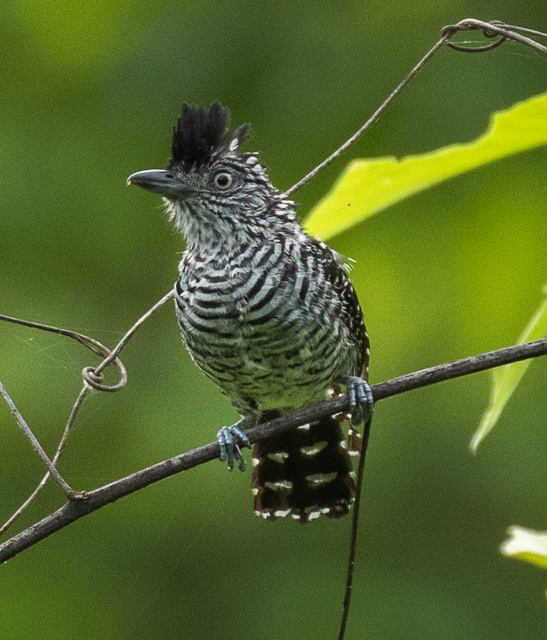 Barred AntshrikeThamnophilus doliatus
-
 Great AntshrikeTaraba major
-
 Black-crowned AntshrikeThamnophilus atrinucha
-
 Ocellated AntbirdPhaenostictus mcleannani
-
 Fasciated AntshrikeCymbilaimus lineatus
-
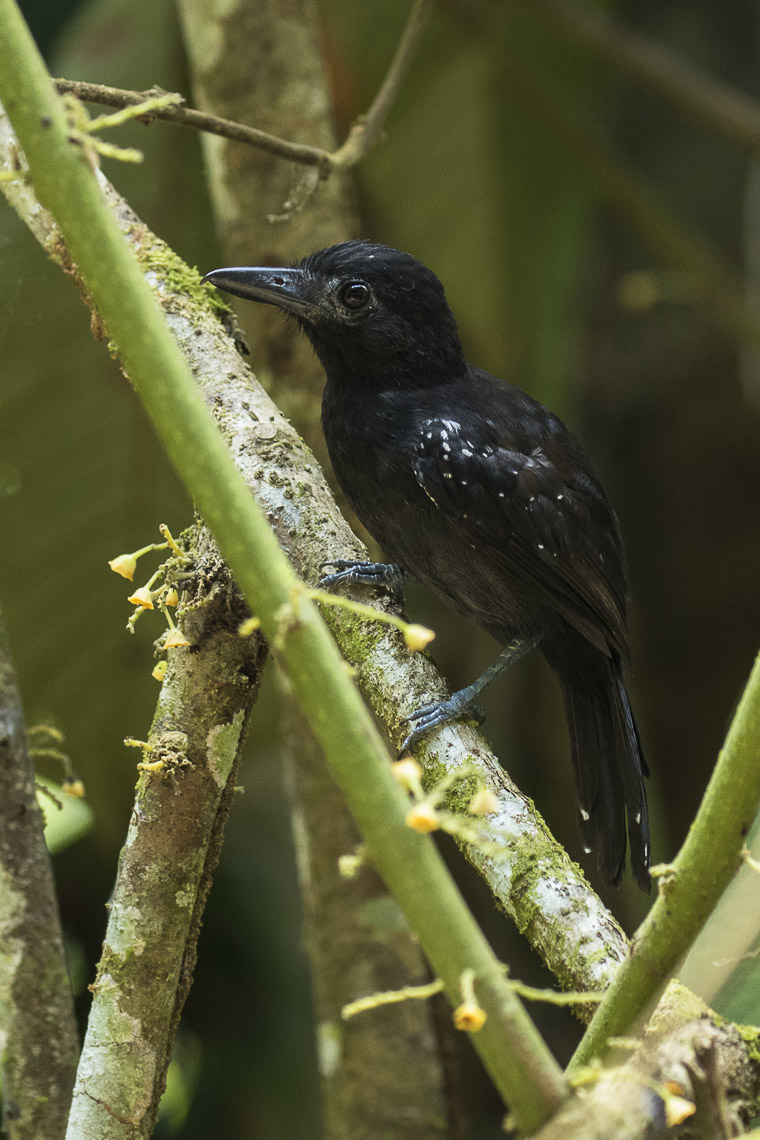 Black-hooded AntshrikeThamnophilus bridgesi
Compare
Questions and answers
What is the scientific name of the Rufous-throated Antbird?
The scientific name of the Rufous-throated Antbird is Gymnopithys rufigula. Written with its author, the full name is Gymnopithys rufigula (Boddaert, 1783).
Which family does the Rufous-throated Antbird belong to?
Gymnopithys rufigula belongs to the family Thamnophilidae, in the order Passeriformes and the class Aves.
Where is the Rufous-throated Antbird found?
Checklists and occurrence records place Gymnopithys rufigula in 5 countries: Brazil, Guyana, French Guiana, Venezuela and Suriname.
What is the conservation status of the Rufous-throated Antbird?
The IUCN Red List category recorded for Gymnopithys rufigula is Least Concern (LC).
Sources
Passages the profile rests on
- Adult males of the nominate subspecies have brownish-black foreheads and lores, olive-brown crowns and napes, and bare blue skin around the eyes. Source passage: “Adult males of the nominate subspecies have a brownish black forehead and lores, an olive-brown crown and nape, and bare blue skin around the eye.” — English Wikipedia
- Adult males have rufous-chestnut cheeks and upper throats, cinnamon lower throats and upper breasts, and olive-brown underparts. Source passage: “Their cheeks and upper throat are rufous-chestnut, their lower throat and upper breast cinnamon, and their sides, flanks, and belly olive-brown.” — English Wikipedia
- Adult females are duller in coloration than males and have cinnamon-colored intrascapular patches. Source passage: “Adult females are duller than males and their intrascapular patch is cinnamon.” — English Wikipedia
- The species measures between 11.5 and 14 cm in length. Source passage: “The rufous-throated antbird is 11.5 to 14 cm (4.5 to 5.5 in) long” — English Wikipedia
- The species weighs between 26 and 32 grams. Source passage: “weighs 26 to 32 g (0.92 to 1.1 oz).” — English Wikipedia
- The species primarily inhabits humid lowland and foothill terra firme evergreen forests. Source passage: “The rufous-throated antbird primarily inhabits humid lowland and foothill terra firme evergreen forest.” — English Wikipedia
- The species is primarily associated with rainforest understory. Source passage: “Medium-sized antbird of rainforest understory” — ebird.org
- The species generally occurs below 900 m elevation but locally reaches elevations of 1,200 m. Source passage: “In elevation it occurs below 900 m (3,000 ft) in most of its range but is found locally as high as 1,200 m (3,900 ft).” — English Wikipedia
- The species spends nearly all its time in forest understory and rarely enters open areas or crosses streams and roads. Source passage: “It almost entirely remains in the forest undergrowth and seldom enters open areas or crosses streams and roads.” — English Wikipedia
- The species feeds on arthropods escaping from foraging army ant swarms, particularly those of Eciton burchelli. Source passage: “feeds on a wide variety of arthropods that flee foraging army ant swarms, especially those of Eciton burchelli.” — English Wikipedia
- Small lizards are also part of the species' diet. Source passage: “Its diet also includes small lizards.” — English Wikipedia
- The species pursues insects flushed by army ant swarms. Source passage: “which it follows to pursue insects flushed by the ants.” — ebird.org
- The species is an obligate follower of army ants. Source passage: “The rufous-throated antbird is an obligate ant follower” — English Wikipedia
- As many as 20 individuals have been observed attending a single army ant swarm. Source passage: “Up to 20 birds have been noted at a swarm.” — English Wikipedia
- The species is almost always encountered near army ant swarms. Source passage: “almost always encountered near swarms of army ants” — ebird.org
- The species typically forages alone, in pairs, or in family groups. Source passage: “It typically forages individually, in pairs, and in family groups” — English Wikipedia
- While foraging, individuals usually perch within approximately one metre of the ground, although they sometimes perch as high as three metres. Source passage: “perching within about 1 m (3 ft) of the ground though as high as 3 m (10 ft)” — English Wikipedia
- The species captures prey by sallying or pouncing onto the ground. Source passage: “and sallying or pouncing to the ground after prey.” — English Wikipedia
- The species is not known to undertake migration. Source passage: “The rufous-throated antbird is not known to migrate.” — English Wikipedia
- Genetic analyses indicate that individuals within a population may disperse over longer distances than previously expected for antbirds. Source passage: “Within a population, we found a lack of genetic spatial autocorrelation, suggesting that genotypes are randomly distributed and that G. rufigula may disperse longer distances than expected for antbirds.” — pmc.ncbi.nlm.nih.gov
- In Brazil, the species may nest throughout the year, although its breeding season is concentrated between January and April. Source passage: “The rufous-throated antbird appears to nest at any time in Brazil but its season is concentrated between January and April.” — English Wikipedia
- The breeding season in Guyana extends from at least December through June. Source passage: “Its seasons span at least December to June in Guyana” — English Wikipedia
- The breeding season in French Guiana includes June and July as well as November and December. Source passage: “June/July and November/December in French Guiana” — English Wikipedia
- Known nests are small cups constructed from dead palm leaves, small twigs, and vine stems, with a sparse softer lining. Source passage: “The few known nests were small cups variously made from dead palm leaves, small twigs, and vine stems with a scanty softer lining.” — English Wikipedia
- Two documented nests were placed inside cavities in rotten tree stumps. Source passage: “Two were placed in cavities in rotten tree stumps.” — English Wikipedia
- The usual clutch contains two eggs. Source passage: “The usual clutch size is two eggs.” — English Wikipedia
- The female incubates alone at night, while both parents are believed to incubate during the day. Source passage: “The female alone incubates at night and both parents are believed to incubate during the day.” — English Wikipedia
- Both parents provide food to the nestlings. Source passage: “Both parents provision nestlings.” — English Wikipedia
- Young birds fledge approximately 13 to 14 days after hatching. Source passage: “fledging occurs 13 to 14 days after hatch.” — English Wikipedia
- The IUCN classifies the species as Least Concern. Source passage: “The IUCN has assessed the rufous-throated antbird as being of Least Concern.” — English Wikipedia
- The species has a very large geographic range, and its population is believed to be stable despite its unknown size. Source passage: “It has a very large range; its population size is not known and is believed to be stable.” — English Wikipedia
- No immediate threats to the species have been identified. Source passage: “No immediate threats have been identified.” — English Wikipedia
- The species occurs in numerous protected areas. Source passage: “It occurs in many protected areas” — English Wikipedia
- Recent urban expansion and habitat loss may be changing gene flow patterns and threatening populations in central Amazonia. Source passage: “recent urban expansion and habitat loss may be driving changes and threatening populations of Rufous‐throated Antbird in central Amazonia.” — pmc.ncbi.nlm.nih.gov
Data
- Catalogue of Life, 2026-10-16 XR cc by
- Global Biodiversity Information Facility CC BY 4.0
- Wikidata CC0
- GeoNames CC BY 4.0
- Wikimedia Commons per image; credit shown with each image
- Within the Catalogue of Life, this name comes from The Integrated Taxonomic Information System cc0
References
- Gill, Frank, & and Minturn Wright. (2006). Birds of the World: Recommended English Names.
This species in other databases
Page built on 27 November 2026. See how the catalog is made and all sources and licences.
Cite this page
ScientificNames.org. (2026). Gymnopithys rufigula (Rufous-throated Antbird). Retrieved November 27, 2026, from https://scientificnames.org/species/gymnopithys-rufigula
“Gymnopithys rufigula (Rufous-throated Antbird).” ScientificNames.org, 2026, scientificnames.org/species/gymnopithys-rufigula. Accessed 27 Nov. 2026.
ScientificNames.org. “Gymnopithys rufigula (Rufous-throated Antbird).” Accessed November 27, 2026. https://scientificnames.org/species/gymnopithys-rufigula.
@misc{scientificnames_gymnopithys_rufigula_rufous_throated_antbird,
  author = {{ScientificNames.org}},
  title = {Gymnopithys rufigula (Rufous-throated Antbird)},
  year = {2026},
  url = {https://scientificnames.org/species/gymnopithys-rufigula},
  note = {Accessed 2026-11-27}
}