Species · Birds
Zeledon's Antbird Hafferia zeledoni
The scientific name of the Zeledon's Antbird is Hafferia zeledoni. It is a species of bird in the family Thamnophilidae (antbird), order Passeriformes. The name dates from 1909.
- Scientific name
- Hafferia zeledoni (Ridgway, 1909)
- Common name
- Zeledon's Antbird
- Genus
- Hafferia
- Family
- Thamnophilidae (Antbird)
- Order
- Passeriformes
- Class
- Aves
- Red List category
- LC Least Concern
- Recorded in
- 4 countries
- Name status
- accepted in the Catalogue of Life

Overview
Hafferia zeledoni occurs in Colombia, Costa Rica, Ecuador, Nicaragua, and Panama. Both sexes have a broad pale-blue eye ring and a deep-red iris.
Written 27 November 2026 from the sources listed below. Each statement was checked against the passage it cites; statements that could not be supported were removed.
Appearance
Zeledon's Antbird measures 17–20 cm in length and weighs approximately 40–56 g. Both sexes have a broad pale-blue eye ring and a deep-red iris.[1][2][3]
Adult males of the nominate subspecies are predominantly black, with variable amounts of white on the wings and wing coverts. Adult females are mostly dark brown with paler underparts and black lores and faces.[4][5][6]
Males of Hafferia zeledoni berlepschi have more white on their wings than nominate males. Females of this subspecies are paler and brighter brown than nominate females.[7][8]
Immature males of both subspecies resemble adult females.[9]
Habitat
Zeledon's Antbird inhabits the understory and edges of humid evergreen forests and mature secondary forests in foothills. It occurs especially in regenerating landslides and tree-falls on steep hillsides and in ravines.[10][11]
In Central America, the species occurs at elevations of approximately 250–1,750 m. In Colombia, it occurs between 100 and 1,600 m, while in Ecuador it occurs mostly below 1,400 m, with local records reaching 2,000 m.[12][13][14]
In Costa Rica, the species occurs mostly above 500 m on the Caribbean slope and above 900 m on the Pacific slope. It is reported to occur at low levels in humid forests from Nicaragua southward.[15][16]
Diet
Zeledon's Antbird feeds mainly on arthropods and also consumes small vertebrates, including lizards and frogs.[17]
Behaviour
The species is believed to remain in its range throughout the year. It typically forages alone, in pairs, or in family groups within dense vegetation.[18][19]
It forages mainly on the ground and within approximately one metre above it. While foraging, it hops between short feeding stops and pumps its tail.[20][21]
The species captures prey by gleaning, reaching, pouncing from perches, making short sallies, and rummaging through leaf litter. It regularly follows army-ant swarms to capture prey fleeing from the ants.[22][23]
Groups of ten or more individuals have been observed at army-ant swarms. The species only occasionally joins mixed-species feeding flocks.[24][25]
The male's song consists of a rapid, loud, ringing series of clear, slightly descending whistled notes. Both sexes produce an explosive cheek call and a rapid scolding jee-jee-jit call.[26][27]
Reproduction and life cycle
The breeding season has not been described in detail and appears to vary geographically. The only documented nest was dome-shaped and constructed from dry leaves, small sticks, and dry grasses, with a lining of dry grasses.[28][29]
A documented clutch contained two white eggs with reddish blotches. Both parents incubate during the day, while only the female incubates at night.[30][31]
Both parents provision the nestlings. The documented incubation period lasted at least 17 days, and the documented nestlings fledged 14 days after hatching.[32][33][34]
Conservation
Zeledon's Antbird is classified as Least Concern by the IUCN and has an estimated population of at least 50,000 mature individuals. Its population is believed to be decreasing, but no immediate threats have been identified.[35][36][37][38]
The species is generally uncommon across most of its range. It is fairly uncommon on Costa Rica's Caribbean slope and rare on its Pacific slope, while it is considered common in Colombia.[39][40][41]
The species' range includes protected areas and extensive intact habitat outside formally protected areas. Most suitable habitat in Costa Rica and Panama has already been destroyed.[42][43]
Classification of the Zeledon's Antbird
| Kingdom | Animalia |
|---|---|
| Phylum | Chordata |
| Subphylum | Vertebrata |
| Infraphylum | Gnathostomata |
| Parvphylum | Osteichthyes |
| Megaclass | Tetrapoda |
| Class | Aves (Bird) |
| Order | Passeriformes (Passerine) |
| Family | Thamnophilidae (Antbird) |
| Genus | Hafferia (Immaculate and Sooty Antbirds) |
| Species | Hafferia zeledoni (Ridgway, 1909) |
Where the Zeledon's Antbird is found
Checklists and occurrence records place Hafferia zeledoni in 4 countries across North America and South America. GBIF holds 22,963 georeferenced records of it.
Countries
Regions and cities with the most records
- Pichincha, Ecuador 10,140
- Cartago Province, Costa Rica 2,853
- Turrialba, Costa Rica 2,459
- Alajuela Province, Costa Rica 1,735
- Paraíso, Costa Rica 1,647
- Nariño, Colombia 1,625
- Risaralda Department, Colombia 1,168
- Cartago, Costa Rica 1,156
- Valle del Cauca Department, Colombia 1,032
- Guanacaste Province, Costa Rica 897
- Puntarenas Province, Costa Rica 867
- Buenaventura, Colombia 440
- El Oro, Ecuador 373
- Piñas, Ecuador 369
- Buenaventura, Colombia 343
- Esmeraldas, Ecuador 332
- Chocó, Colombia 274
- Heredia Province, Costa Rica 251
- San José, Costa Rica 202
- Quesada, Costa Rica 198
- Darién, Panama 167
- Chimborazo Province, Ecuador 160
- Chiriquí Province, Panama 127
- San Isidro, Costa Rica 106
- Imbabura, Ecuador 101
- Santo Domingo de los Tsáchilas, Ecuador 87
- Limón Province, Costa Rica 80
- San Diego, Costa Rica 72
- Santo Domingo de los Colorados, Ecuador 71
- Carchi, Ecuador 64
- Guápiles, Costa Rica 60
- Antioquia, Colombia 56
- Curridabat, Costa Rica 49
- Patarrá, Costa Rica 43
- Canar, Ecuador 36
- San Miguel, Costa Rica 34
Range as the checklists state it
Middle America
South America
A number beside a place is its count of GBIF occurrence records. A place without a number comes from a checklist alone. Records show where a species has been observed or collected, which can include escapes and vagrants.
Common names
English
- Zeledon's Antbird
- Zeledón's Antbird
Names in 20 other languages
- Chinese
- 泽氏蚁鸟, 雷東氏蟻鳥
- Croatian
- obalna mravarica
- Danish
- Kystmyrefugl
- Dutch
- Zeledons Miervogel
- Esperanto
- zeledona formikulo
- Finnish
- panamanpillimuura
- French
- Alapi de Zeledon, Batara de Zeledon
- German
- Panamáameisenvogel
- Italian
- Mangiaformiche di Zeledon
- Japanese
- ゼレドンアリドリ
- Lithuanian
- Panaminė devynbalsė skruzdinukė
- Norwegian
- sambomaurfugl
- Polish
- czarnomrowik panamski
- Portuguese
- formigueiro-de-zeledón, formigueiro-escuro
- Russian
- Панамская муравьеловка, Панамская славковая муравьянка
- Slovak
- mravcovka Zeledónova
- Spanish
- Hormiguero de Zeledón
- Swedish
- chocómyrfågel, zeledónmyrfågel
- Turkish
- Zeledon Karıncakuşu
- Ukrainian
- покривник брунатний
Synonyms
3 other scientific names have been used for this species and are now treated as synonyms of Hafferia zeledoni.
- Myrmeciza immaculata zeledoni Ridgway, R, 1909
- Myrmeciza zeledoni Ridgway, 1909
- Percnostola zeledoni Ridgway, R, 1909
Subspecies and varieties
- Hafferia zeledoni berlepschi subspecies
- Hafferia zeledoni zeledoni subspecies
Related species
-
 Sooty AntbirdHafferia fortis
- Blue-lored AntbirdHafferia immaculata
-
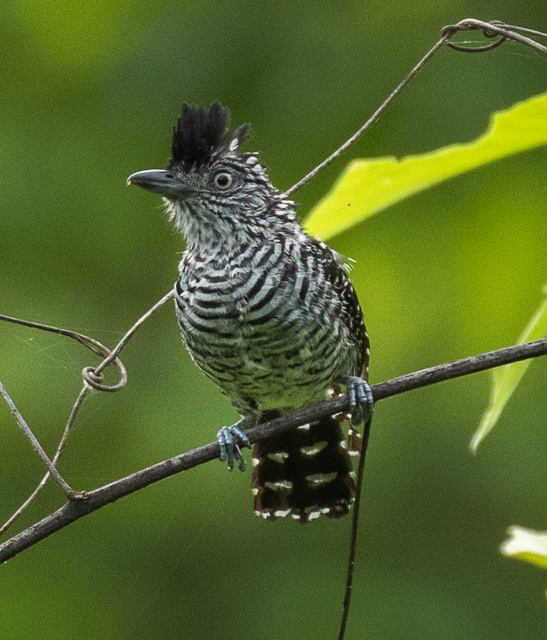 Barred AntshrikeThamnophilus doliatus
-
 Great AntshrikeTaraba major
-
 Black-crowned AntshrikeThamnophilus atrinucha
-
 Ocellated AntbirdPhaenostictus mcleannani
-
 Bicolored AntbirdGymnopithys bicolor
-
 Fasciated AntshrikeCymbilaimus lineatus
Compare
Questions and answers
What is the scientific name of the Zeledon's Antbird?
The scientific name of the Zeledon's Antbird is Hafferia zeledoni. Written with its author, the full name is Hafferia zeledoni (Ridgway, 1909).
Which family does the Zeledon's Antbird belong to?
Hafferia zeledoni belongs to the family Thamnophilidae, in the order Passeriformes and the class Aves.
Where is the Zeledon's Antbird found?
Checklists and occurrence records place Hafferia zeledoni in 4 countries: Ecuador, Costa Rica, Colombia and Panama.
What is the conservation status of the Zeledon's Antbird?
The IUCN Red List category recorded for Hafferia zeledoni is Least Concern (LC).
What other names does the Zeledon's Antbird have?
Hafferia zeledoni is also known in English as Zeledón's Antbird.
Where do the two subspecies occur?
The nominate subspecies ranges from Río San Juan Department in southern Nicaragua through Costa Rica to Coclé Province in Panama. Hafferia zeledoni berlepschi ranges from eastern Darién Province in Panama through Colombia to western Loja Province in southwestern Ecuador.[44][45]
What is the origin of the name Zeledon's Antbird?
The English name and scientific epithet honor Costa Rican ornithologist José Cástulo Zeledón.[46]
What is the Choco form of Zeledon's Antbird?
Hafferia zeledoni berlepschi is identified as the Choco form of Zeledon's Antbird.[47]
Sources
Passages the profile rests on
- The species measures 17–20 cm in length. Source passage: “Zeledon's antbird is 17 to 20 cm (6.7 to 7.9 in) long” — English Wikipedia
- The species weighs approximately 40–56 g. Source passage: “weighs about 40 to 56 g (1.4 to 2.0 oz).” — English Wikipedia
- Both sexes have a broad pale-blue eye ring and a deep-red iris. Source passage: “Both sexes have a wide pale blue ring around their eye and a deep red iris.” — English Wikipedia
- Adult males of the nominate subspecies are predominantly black, with variable amounts of white on the wings and wing coverts. Source passage: “Adult males of the nominate subspecies are mostly black with variable amounts of white on the wing and wing coverts” — English Wikipedia
- Adult females of the nominate subspecies are mostly dark brown, with paler underparts. Source passage: “Adult females are mostly dark brown that is paler on their underparts than above.” — English Wikipedia
- Females of the nominate subspecies have black lores and faces. Source passage: “Their lores and face are black.” — English Wikipedia
- Males of Hafferia zeledoni berlepschi have more white on their wings than nominate males. Source passage: “Males of subspecies H. z. berlepschi have more white on their wings than the nominate.” — English Wikipedia
- Females of Hafferia zeledoni berlepschi are paler and brighter brown than nominate females. Source passage: “Females are a paler and brighter brown than the nominate.” — English Wikipedia
- Immature males of both subspecies resemble adult females. Source passage: “In both subspecies the immature males look like adult females.” — English Wikipedia
- The species inhabits the understory and edges of humid evergreen forests and mature secondary forests in foothills. Source passage: “The species inhabits the understorey and edges of humid evergreen forest and mature secondary forest in the foothills.” — English Wikipedia
- The species occurs especially in regenerating landslides and tree-falls on steep hillsides and in ravines. Source passage: “It mostly occurs in regenerating landslides and tree-falls on steep hillsides and ravines.” — English Wikipedia
- In Central America, the species occurs at elevations of approximately 250–1,750 m. Source passage: “In elevation it ranges between about 250 and 1,750 m (800 and 5,700 ft) in Central America” — English Wikipedia
- In Colombia, the species occurs at elevations between 100 and 1,600 m. Source passage: “In Colombia it occurs between 100 and 1,600 m (300 and 5,200 ft)” — English Wikipedia
- In Ecuador, the species occurs mostly below 1,400 m, with local records reaching 2,000 m. Source passage: “in Ecuador mostly below 1,400 m (4,600 ft) but locally to 2,000 m (6,600 ft).” — English Wikipedia
- In Costa Rica, the species occurs mostly above 500 m on the Caribbean slope and above 900 m on the Pacific slope. Source passage: “in Costa Rica mostly above 500 m (1,600 ft) on the Caribbean side and 900 m (3,000 ft) on the Pacific side.” — English Wikipedia
- The species is reported to occur at low levels in humid forests from Nicaragua southward. Source passage: “It is found at low levels in humid forests from Nicaragua to ...” — inaturalist.org
- The species feeds mainly on arthropods and also consumes small vertebrates, including lizards and frogs. Source passage: “Zeledon's antbird feeds mostly on a variety of arthropods and also on small vertebrates like lizards and frogs.” — English Wikipedia
- The species is believed to remain in its range throughout the year. Source passage: “Zeledon's antbird is believed to be a year-round resident throughout its range.” — English Wikipedia
- The species typically forages alone, in pairs, or in family groups within dense vegetation. Source passage: “It typically forages singly, in pairs, or in family groups in dense vegetation” — English Wikipedia
- The species forages mainly on the ground and within approximately one metre above it. Source passage: “mostly on the ground and within about 1 m (3 ft) above it.” — English Wikipedia
- While foraging, the species hops between short feeding stops and pumps its tail. Source passage: “It hops between short feeding stops, pumping its tail.” — English Wikipedia
- The species captures prey by gleaning, reaching, pouncing from perches, making short sallies, and rummaging through leaf litter. Source passage: “It captures prey by gleaning, reaching, or pouncing to the ground from a perch, with short sallies to foliage and stems, and by rummaging in leaf litter” — English Wikipedia
- The species regularly follows army-ant swarms to capture prey fleeing from the ants. Source passage: “It regularly follows army ant swarms to capture prey fleeing the ants” — English Wikipedia
- Groups of ten or more individuals have been observed at army-ant swarms. Source passage: “10 or more individuals have been seen at a swarm.” — English Wikipedia
- The species only occasionally joins mixed-species feeding flocks. Source passage: “It only occasionally joins mixed-species feeding flocks.” — English Wikipedia
- The male's song consists of a rapid, loud, ringing series of clear, slightly descending whistled notes. Source passage: “rapidly delivered...loud ringing and slightly descending series of clear whistled notes” — English Wikipedia
- Both sexes produce an explosive cheek call and a rapid scolding jee-jee-jit call. Source passage: “Both sexes "give an explosive 'cheek!' call and a fast scolding 'jee-jee-jit' "” — English Wikipedia
- The breeding season has not been described in detail and appears to vary geographically. Source passage: “The breeding season of Zeledon's antbird has not been detailed but appears to vary geographically.” — English Wikipedia
- The only documented nest was dome-shaped and constructed from dry leaves, small sticks, and dry grasses, with a lining of dry grasses. Source passage: “Its only known nest was a dome of dry leaves, small sticks, and dry grasses lined with dry grasses.” — English Wikipedia
- A documented clutch contained two white eggs with reddish blotches. Source passage: “It held two eggs that were white with reddish blotches.” — English Wikipedia
- Both parents incubate during the day, while only the female incubates at night. Source passage: “Both parents incubated the clutch during the day and the female alone at night” — English Wikipedia
- Both parents provision the nestlings. Source passage: “both parents provisioned the nestlings.” — English Wikipedia
- The documented incubation period lasted at least 17 days. Source passage: “The incubation period was at least 17 days.” — English Wikipedia
- The documented nestlings fledged 14 days after hatching. Source passage: “Fledging occurred 14 days after hatch” — English Wikipedia
- The species is classified as Least Concern by the IUCN. Source passage: “The IUCN has assessed Zeledon's antbird as being of Least Concern.” — English Wikipedia
- The species has an estimated population of at least 50,000 mature individuals. Source passage: “an estimated population of at least 50,000 mature individuals” — English Wikipedia
- The species' population is believed to be decreasing. Source passage: “that is believed to be decreasing.” — English Wikipedia
- No immediate threats to the species have been identified. Source passage: “No immediate threats have been identified.” — English Wikipedia
- The species is generally uncommon across most of its range. Source passage: “It is not well known and appears to be generally uncommon in most of its range.” — English Wikipedia
- The species is considered fairly uncommon on Costa Rica's Caribbean slope and rare on its Pacific slope. Source passage: “In Costa Rica it is considered "fairly uncommon" on the Caribbean slope and rare on the Pacific slope.” — English Wikipedia
- The species is considered common in Colombia. Source passage: “It is considered common in Colombia.” — English Wikipedia
- The species' range includes protected areas and extensive intact habitat outside formally protected areas. Source passage: “Its range includes many protected areas and "also extensive intact habitat that is not formally protected".” — English Wikipedia
- Most suitable habitat in Costa Rica and Panama has already been destroyed. Source passage: “Most suitable habitat in Costa Rica and Panama has already been destroyed” — English Wikipedia
- The nominate subspecies ranges from Río San Juan Department in southern Nicaragua through Costa Rica to Coclé Province in Panama. Source passage: “The nominate subspecies is found from Río San Juan Department in far southern Nicaragua south through Costa Rica into Panama as far as Coclé Province.” — English Wikipedia
- The subspecies Hafferia zeledoni berlepschi ranges from eastern Darién Province in Panama through Colombia to western Loja Province in southwestern Ecuador. Source passage: “Subspecies H. z. berlepschi is found from eastern Darién Province in Panama south on the Pacific slope through Colombia to western Loja Province in southwestern Ecuador.” — English Wikipedia
- The species' English name and scientific epithet honor Costa Rican ornithologist José Cástulo Zeledón. Source passage: “The species' English name and specific epithet commemorate the Costa Rican ornithologist José Cástulo Zeledón.” — English Wikipedia
- The eBird entry identifies Hafferia zeledoni berlepschi as the Choco form of Zeledon's Antbird. Source passage: “Zeledon's Antbird (Choco)Hafferia zeledoni berlepschi” — ebird.org
Data
- Catalogue of Life, 2026-10-16 XR cc by
- Global Biodiversity Information Facility CC BY 4.0
- Wikidata CC0
- GeoNames CC BY 4.0
- Wikimedia Commons per image; credit shown with each image
- Within the Catalogue of Life, this name comes from The Integrated Taxonomic Information System cc0
This species in other databases
Page built on 28 November 2026. See how the catalog is made and all sources and licences.
Cite this page
ScientificNames.org. (2026). Hafferia zeledoni (Zeledon's Antbird). Retrieved November 28, 2026, from https://scientificnames.org/species/hafferia-zeledoni
“Hafferia zeledoni (Zeledon's Antbird).” ScientificNames.org, 2026, scientificnames.org/species/hafferia-zeledoni. Accessed 28 Nov. 2026.
ScientificNames.org. “Hafferia zeledoni (Zeledon's Antbird).” Accessed November 28, 2026. https://scientificnames.org/species/hafferia-zeledoni.
@misc{scientificnames_hafferia_zeledoni_zeledons_antbird,
  author = {{ScientificNames.org}},
  title = {Hafferia zeledoni (Zeledon's Antbird)},
  year = {2026},
  url = {https://scientificnames.org/species/hafferia-zeledoni},
  note = {Accessed 2026-11-28}
}