Species · Molluscs
Pourtale's Abalone Haliotis pourtalesii
The scientific name of the Pourtale's Abalone is Haliotis pourtalesii. It is a species of mollusc in the family Haliotidae (abalone), order Lepetellida. The name dates from 1881.
- Scientific name
- Haliotis pourtalesii Dall, 1881
- Common name
- Pourtale's Abalone
- Genus
- Haliotis
- Family
- Haliotidae (Abalone)
- Order
- Lepetellida
- Class
- Gastropoda
- Red List category
- DD Data Deficient
- Environment
- marine
- Recorded in
- 2 countries
- Name status
- accepted in the Catalogue of Life

Overview
The reported range extends from the coast of North Carolina to Florida in the United States, includes the Gulf of Mexico and the Caribbean coasts of Colombia, Venezuela and Suriname, and extends to the shores of Brazil. It has a waxy yellow to light-brown shell with irregular reddish-orange patches, wavy spiral cords and a pearly white inner surface.
Written 27 November 2026 from the sources listed below. Each statement was checked against the passage it cites; statements that could not be supported were removed.
Appearance
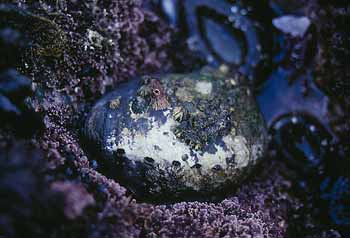
The shell is colored waxy yellow to light brown and has irregular reddish-orange patches. It has between 22 and 27 wavy spiral cords on its outer surface, and a light-orange band extends from each shell hole to the shell edge.[1][2][3]
The inner surface of the shell is pearly white. The shell has a relatively elevated spire consisting of approximately two and a half whorls and approximately twenty-five holes, of which five remain open.[4][5][6]
Habitat
The species has been collected at depths between 25 and 230 metres. It is usually collected on hard substrates.[7][8]
The minimum recorded collection depth is 36 metres, and the maximum recorded collection depth is 366 metres.[9][10]
Similar species
Haliotis dalli and Haliotis dalli roberti share the distinctive radular and tentacle characteristics described for Pourtale's abalone.[11][12][13]
Classification of the Pourtale's Abalone
| Kingdom | Animalia |
|---|---|
| Phylum | Mollusca |
| Class | Gastropoda (Gastropod) |
| Subclass | Vetigastropoda |
| Order | Lepetellida |
| Superfamily | Haliotoidea |
| Family | Haliotidae (Abalone) |
| Genus | Haliotis (Abalone) |
| Species | Haliotis pourtalesii Dall, 1881 |
Where the Pourtale's Abalone is found
Checklists and occurrence records place Haliotis pourtalesii in 2 countries. GBIF holds 68 georeferenced records of it.
Countries
Regions and cities with the most records
A number beside a place is its count of GBIF occurrence records. A place without a number comes from a checklist alone. Records show where a species has been observed or collected, which can include escapes and vagrants.
Common names
English
- Pourtale's Abalone
- Abalone
- Pourtales' Abalone
Names in 2 other languages
- Slovak
- ušo Pourtalesov
- Spanish
- Abulón, Oreja de mar
Synonyms
One other scientific name has been used for this species and is now treated as a synonym of Haliotis pourtalesii.
- Haliotis (Padollus) pourtalesii Dall, 1881
Subspecies and varieties
- Haliotis pourtalesii aurantium subspecies
- Haliotis pourtalesii pourtalesii subspecies
Related species
-
 Green OrmerHaliotis tuberculata
-
 Donkey's Ear AbaloneHaliotis asinina
-
 Red AbaloneHaliotis rufescens
-
 PauaHaliotis iris
-
 Black AbaloneHaliotis cracherodii
-
 PerlemoenHaliotis midae
-
 Northern AbaloneHaliotis kamtschatkana
-
 White AbaloneHaliotis sorenseni
Compare
Questions and answers
What is the scientific name of the Pourtale's Abalone?
The scientific name of the Pourtale's Abalone is Haliotis pourtalesii. Written with its author, the full name is Haliotis pourtalesii Dall, 1881.
Which family does the Pourtale's Abalone belong to?
Haliotis pourtalesii belongs to the family Haliotidae, in the order Lepetellida and the class Gastropoda.
Where is the Pourtale's Abalone found?
Checklists and occurrence records place Haliotis pourtalesii in 2 countries: United States and Brazil.
What is the conservation status of the Pourtale's Abalone?
The IUCN Red List category recorded for Haliotis pourtalesii is Data Deficient (DD).
What other names does the Pourtale's Abalone have?
Haliotis pourtalesii is also known in English as Abalone and Pourtales' Abalone.
Sources
Passages the profile rests on
- The shell is colored waxy yellow to light brown and has irregular reddish-orange patches. Source passage: “There are 22 to 27 to wavy, spiral cords on the outer surface which is colored a waxy yellow to light-brown, with a few irregular patches of reddish orange.” — English Wikipedia
- The shell has between 22 and 27 wavy spiral cords on its outer surface. Source passage: “There are 22 to 27 to wavy, spiral cords on the outer surface” — English Wikipedia
- A light-orange band extends from each shell hole to the shell edge. Source passage: “A light-orange band runs from each hole to the edge of the shell.” — English Wikipedia
- The inner surface of the shell is pearly white. Source passage: “The inside is pearly–white.” — English Wikipedia
- The shell has a relatively elevated spire consisting of approximately two and a half whorls. Source passage: “The spire is rather elevated, consisting of about two and a half whorls.” — English Wikipedia
- The shell has approximately twenty-five holes, of which five remain open. Source passage: “The shell contains about twenty-five holes, of which five remain open.” — English Wikipedia
- The species has been collected at depths between 25 and 230 metres. Source passage: “It has been collected in a bathymetric range between 25 and 230 meters depth” — English Wikipedia
- The species is usually collected on hard substrates. Source passage: “usually on hard substrates.” — English Wikipedia
- The minimum recorded collection depth is 36 metres. Source passage: “Minimum recorded depth is 36 m.” — English Wikipedia
- The maximum recorded collection depth is 366 metres. Source passage: “Maximum recorded depth is 366 m.” — English Wikipedia
- The species has a notably narrow lateral tooth in its radula. Source passage: “The radula of this species is peculiar in possessing a very narrow lateral tooth.” — English Wikipedia
- The cephalic tentacles have concentric rings. Source passage: “The cephakic tentacles show concentric rings.” — English Wikipedia
- Haliotis dalli and Haliotis dalli roberti share the distinctive radular and tentacle characteristics described for this species. Source passage: “Within Haliotis, these characteristics can only be found also in Haliotis dalli Henderson, 1915 and in Haliotis dalli roberti Mclean, 1970.” — English Wikipedia
Data
- Catalogue of Life, 2026-10-16 XR cc by
- Global Biodiversity Information Facility CC BY 4.0
- Wikidata CC0
- GeoNames CC BY 4.0
- Wikimedia Commons per image; credit shown with each image
- Within the Catalogue of Life, this name comes from World Register of Marine Species cc by
This species in other databases
Page built on 28 November 2026. See how the catalog is made and all sources and licences.
Cite this page
ScientificNames.org. (2026). Haliotis pourtalesii (Pourtale's Abalone). Retrieved November 28, 2026, from https://scientificnames.org/species/haliotis-pourtalesii
“Haliotis pourtalesii (Pourtale's Abalone).” ScientificNames.org, 2026, scientificnames.org/species/haliotis-pourtalesii. Accessed 28 Nov. 2026.
ScientificNames.org. “Haliotis pourtalesii (Pourtale's Abalone).” Accessed November 28, 2026. https://scientificnames.org/species/haliotis-pourtalesii.
@misc{scientificnames_haliotis_pourtalesii_pourtales_abalone,
  author = {{ScientificNames.org}},
  title = {Haliotis pourtalesii (Pourtale's Abalone)},
  year = {2026},
  url = {https://scientificnames.org/species/haliotis-pourtalesii},
  note = {Accessed 2026-11-28}
}