Species · Mammals
Highland Streaked Tenrec Hemicentetes nigriceps
The scientific name of the Highland Streaked Tenrec is Hemicentetes nigriceps. It is a species of mammal in the family Tenrecidae, order Afrosoricida. The name dates from 1875.
- Scientific name
- Hemicentetes nigriceps Günther, 1875
- Common name
- Highland Streaked Tenrec
- Genus
- Hemicentetes
- Family
- Tenrecidae
- Order
- Afrosoricida
- Class
- Mammalia
- Red List category
- LC Least Concern
- Recorded in
- 1 country
- Name status
- accepted in the Catalogue of Life

Overview
Hemicentetes nigriceps is distinguished by its black-and-white-striped, quilled body, long pointed snout, and specialized stridulating quills used for communication.
Written 26 November 2026 from the sources listed below. Each statement was checked against the passage it cites; statements that could not be supported were removed.
Appearance
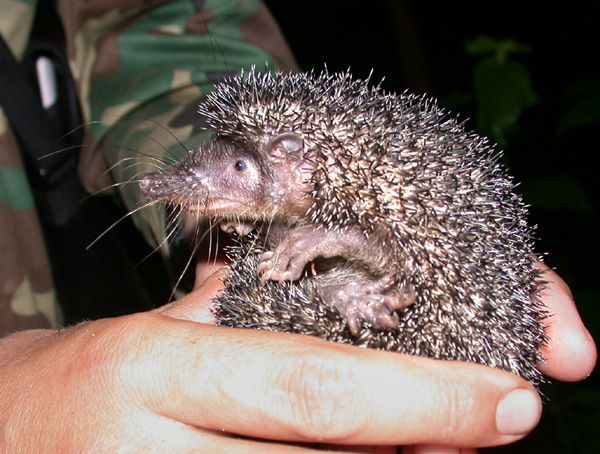
The Highland Streaked Tenrec has a black-and-white-striped body covered with quills. Its underparts are creamy-white and less spiny than the rest of its body, with thick fur between the quills.[1][2][3]
It has a long, pointed snout and no tail. Sensory hairs resembling whiskers run along its back.[4][5]
The species has a specialized stridulating organ on its rear attached to approximately 11 non-detachable quills.[6]
Its total body length is 120 to 160 mm. Adults weigh between 70 and 160 g, with an average weight of 100 g, while newborn individuals weigh approximately 8 g.[7][8][9]
Habitat
The Highland Streaked Tenrec occurs in both primary rainforests and introduced eucalyptus and pine forests. It is commonly found at forest fringes near cultivated fields and rice paddies.[10][11]
Diet
Earthworms are the Highland Streaked Tenrec's primary food. It also feeds on other soft-bodied invertebrates.[12][13]
The species searches for food in leaf litter where the soil is damp, soft, and shaded.[14]
Behaviour
Individuals may stomp the ground with both forepaws to stimulate earthworm activity. While feeding, they pivot their rumps from side to side to discourage other tenrecs from taking their worms.[15][16]
The species raises its quills when agitated. Its detachable spines can remain embedded in an inquisitive predator.[17][18]
Mothers use stridulation sounds to encourage dependent young to follow them. The species also emits a vocal buzz during defensive reactions.[19][20]
In laboratory experiments, the species used tongue clicks as a form of echolocation.[21]
Reproduction and life cycle
Reproduction generally takes place during the wet season from November to April. Gestation lasts between 55 and 63 days, and females produce litters of two to eight offspring.[22][23][24]
Newborn individuals open their eyes within seven to eight days of birth. Young are weaned between 18 and 25 days after birth, and females reach sexual maturity between 35 and 40 days of age.[25][26][27]
Females provide food, shelter, protection, and grooming for their altricial young.[28]
Similar species
The lowland streaked tenrec generally does not share its habitat with the Highland Streaked Tenrec. Where their ranges overlap, the Highland Streaked Tenrec occupies higher elevations.[29][30]
The lowland streaked tenrec has yellower streaks and a stripe extending from its crown to the tip of its snout.[31]
Uses
Humans occasionally hunt the Highland Streaked Tenrec for food.[32]
Classification of the Highland Streaked Tenrec
| Kingdom | Animalia |
|---|---|
| Phylum | Chordata |
| Subphylum | Vertebrata |
| Infraphylum | Gnathostomata |
| Parvphylum | Osteichthyes |
| Megaclass | Tetrapoda |
| Class | Mammalia (Mammal) |
| Subclass | Theria |
| Infraclass | Eutheria |
| Order | Afrosoricida (Tenrecs) |
| Suborder | Tenrecomorpha (Tenrecs) |
| Family | Tenrecidae |
| Subfamily | Tenrecinae (Spiny Tenrecs) |
| Genus | Hemicentetes (Streaked Tenrecs) |
| Species | Hemicentetes nigriceps Günther, 1875 |
Where the Highland Streaked Tenrec is found
Checklists and occurrence records place Hemicentetes nigriceps in 1 country across Africa. GBIF holds 62 georeferenced records of it.
Countries
Regions and cities with the most records
Range as the checklists state it
Africa
A number beside a place is its count of GBIF occurrence records. A place without a number comes from a checklist alone. Records show where a species has been observed or collected, which can include escapes and vagrants.
Common names
English
- Highland Streaked Tenrec
Names in 11 other languages
- Arabic
- طنرق المرتفعات المخطط
- Dutch
- Zwartkoptenrek
- French
- Tenrec zébré des terres hautes
- German
- Hochland-Streifentenrek, Schwarzkopftenrek
- Greek
- Μαυροκέφαλη Μυγαλή
- Italian
- Tenrec striato di montagna
- Japanese
- ズグロテンレック
- Polish
- tenrekowiec wyżynny
- Portuguese
- Tenrec-listrado-das-terras-altas
- Spanish
- Tenrec Listado de Tierras Altas
- Turkish
- Çizgili Dağ Tenreği
Related species
-
 Lowland Streaked TenrecHemicentetes semispinosus
-
 Lesser Hedgehog TenrecEchinops telfairi
-
 Tailless TenrecTenrec ecaudatus
-
 Greater Hedgehog TenrecSetifer setosus
- Large-eared TenrecGeogale aurita
-
 Mole-like Rice TenrecOryzorictes hova
- Short-tailed Shrew TenrecMicrogale brevicaudata
-
 Cowan's Shrew TenrecMicrogale cowani
Compare
Questions and answers
What is the scientific name of the Highland Streaked Tenrec?
The scientific name of the Highland Streaked Tenrec is Hemicentetes nigriceps. Written with its author, the full name is Hemicentetes nigriceps Günther, 1875.
Which family does the Highland Streaked Tenrec belong to?
Hemicentetes nigriceps belongs to the family Tenrecidae, in the order Afrosoricida and the class Mammalia.
Where is the Highland Streaked Tenrec found?
Checklists and occurrence records place Hemicentetes nigriceps in 1 country: Madagascar.
What is the conservation status of the Highland Streaked Tenrec?
The IUCN Red List category recorded for Hemicentetes nigriceps is Least Concern (LC).
What is one interesting fact about lowland streaked tenrec?
The lowland streaked tenrec has yellower streaks and a stripe extending from its crown to the tip of its snout.[31]
Sources
Passages the profile rests on
- The species has a black-and-white-striped body covered with quills. Source passage: “Its black-and-white-striped body is covered with quills” — English Wikipedia
- Its underparts are creamy-white and less spiny than the rest of its body. Source passage: “their underparts are creamy-white and less spiny.” — animaldiversity.org
- The species has thick fur between its quills. Source passage: “They have thick fur located between their quills” — animaldiversity.org
- The species has a long, pointed snout and no tail. Source passage: “They have a long, pointed snout and lack a tail.” — animaldiversity.org
- Sensory hairs resembling whiskers run along the species' back. Source passage: “Along the back of highland streaked tenrecs are sensory hairs similar to whiskers.” — animaldiversity.org
- The species has a specialized stridulating organ on its rear attached to approximately 11 non-detachable quills. Source passage: “There is a specialized area on their rear called the stridulating organ that is attached to approximately 11 non-detachable quills” — animaldiversity.org
- The species has a total body length of 120 to 160 mm. Source passage: “a total body length of 120 to 160 mm” — animaldiversity.org
- Adults weigh between 70 and 160 g, with an average weight of 100 g. Source passage: “a weight of 70 to 160 g (average 100 g).” — animaldiversity.org
- Newborn individuals weigh approximately 8 g. Source passage: “At birth, juveniles weigh around 8 g.” — animaldiversity.org
- The species occurs in both primary rainforests and introduced eucalyptus and pine forests. Source passage: “They occur both in primary rainforests and in introduced forests of eucalyptus and pine.” — animaldiversity.org
- The species is commonly found at forest fringes near cultivated fields and rice paddies. Source passage: “They are most commonly found at forest fringes on the central plateau edge and near cultivated fields and rice paddies.” — animaldiversity.org
- Earthworms are the species' primary food. Source passage: “searching for earthworms, its primary food.” — English Wikipedia
- The species feeds on earthworms and other soft-bodied invertebrates. Source passage: “for earthworms and other soft-bodied invertebrates.” — animaldiversity.org
- The species searches for food in leaf litter where the soil is damp, soft, and shaded. Source passage: “actively forage in leaf litter in areas where soil is damp, soft and shaded” — animaldiversity.org
- Individuals may stomp the ground with both forepaws to stimulate earthworm activity. Source passage: “may stomp with both forepaws on the ground to stimulate earthworm activity.” — animaldiversity.org
- While feeding, individuals pivot their rumps from side to side to discourage other tenrecs from taking their worms. Source passage: “they pivot their rumps from side to side to ward off other tenrecs” — animaldiversity.org
- The species raises its quills when agitated. Source passage: “which it raises when agitated.” — English Wikipedia
- The species' detachable spines can remain embedded in an inquisitive predator. Source passage: “The spines detach and remain in the body of an inquisitive predator.” — English Wikipedia
- Mothers use stridulation sounds to encourage dependent young to follow them. Source passage: “Mothers also use these sounds to encourage their dependent young to follow them.” — animaldiversity.org
- The species emits a vocal buzz during defensive reactions. Source passage: “During a defense reaction, a vocal buzz is emitted.” — animaldiversity.org
- In laboratory experiments, the species used tongue clicks as a form of echolocation. Source passage: “In lab experiments, highland streaked tenrecs used tongue clicks as a form of echolocation.” — animaldiversity.org
- Reproduction generally takes place during the wet season from November to April. Source passage: “generally take place during the wet season (November to April).” — animaldiversity.org
- Gestation lasts between 55 and 63 days. Source passage: “After a gestation period of 55 to 63 days” — animaldiversity.org
- Females produce litters of two to eight offspring. Source passage: “a litter of 2 to 8 is born.” — animaldiversity.org
- Newborn individuals open their eyes within seven to eight days of birth. Source passage: “their eyes open within 7 to 8 days of birth” — animaldiversity.org
- Young are weaned between 18 and 25 days after birth. Source passage: “they are weened within 18 to 25 days.” — animaldiversity.org
- Females reach sexual maturity between 35 and 40 days of age. Source passage: “Females reach sexual maturity at 35 to 40 days of age.” — animaldiversity.org
- Females provide food, shelter, protection, and grooming for their altricial young. Source passage: “females provide food, shelter, and protection and groom their young” — animaldiversity.org
- In areas where its range overlaps with the lowland streaked tenrec, the species occupies higher elevations. Source passage: “Hemicentetes nigriceps occupies higher elevations” — animaldiversity.org
- The lowland streaked tenrec generally does not share its habitat with the highland streaked tenrec. Source passage: “H. nigriceps and its close relative H. semispinosus , (lowland streaked tenrecs) generally do not live sympatrically.” — animaldiversity.org
- The lowland streaked tenrec has yellower streaks and a stripe extending from its crown to the tip of its snout. Source passage: “have yellower streaks, a stripe running from their crown to the tip of their snout” — animaldiversity.org
- Humans occasionally hunt the species for food. Source passage: “occasionally hunt highland streaked tenrecs for food.” — animaldiversity.org
Data
- Catalogue of Life, 2026-10-16 XR cc by
- Global Biodiversity Information Facility CC BY 4.0
- Wikidata CC0
- GeoNames CC BY 4.0
- Wikimedia Commons per image; credit shown with each image
- Within the Catalogue of Life, this name comes from The Integrated Taxonomic Information System cc0
References
- Ann. Mag. Nat. Hist., ser. 4 vol.16 p.125 where the name was published
- Wilson, Don E., and DeeAnn M. Reeder, eds. (2005). Mammal Species of the World: A Taxonomic and Geographic Reference, 3rd Ed., Vols. 1 & 2.
- Jenkins, P. D. / Don E. Wilson and Russell A. Mittermeier, eds. (2018). Family Tenrecidae (Tenrecs and Shrew Tenrecs). Handbook of the Mammals of the World. Vol. 8: Insectivores, Sloths and Colugos.
This species in other databases
Page built on 27 November 2026. See how the catalog is made and all sources and licences.
Cite this page
ScientificNames.org. (2026). Hemicentetes nigriceps (Highland Streaked Tenrec). Retrieved November 27, 2026, from https://scientificnames.org/species/hemicentetes-nigriceps
“Hemicentetes nigriceps (Highland Streaked Tenrec).” ScientificNames.org, 2026, scientificnames.org/species/hemicentetes-nigriceps. Accessed 27 Nov. 2026.
ScientificNames.org. “Hemicentetes nigriceps (Highland Streaked Tenrec).” Accessed November 27, 2026. https://scientificnames.org/species/hemicentetes-nigriceps.
@misc{scientificnames_hemicentetes_nigriceps_highland_streaked_tenrec,
  author = {{ScientificNames.org}},
  title = {Hemicentetes nigriceps (Highland Streaked Tenrec)},
  year = {2026},
  url = {https://scientificnames.org/species/hemicentetes-nigriceps},
  note = {Accessed 2026-11-27}
}