Species · Mammals
Lowland Streaked Tenrec Hemicentetes semispinosus
The scientific name of the Lowland Streaked Tenrec is Hemicentetes semispinosus. It is a species of mammal in the family Tenrecidae, order Afrosoricida. The name dates from 1798.
- Scientific name
- Hemicentetes semispinosus (G. Cuvier, 1798)
- Common name
- Lowland Streaked Tenrec
- Genus
- Hemicentetes
- Family
- Tenrecidae
- Order
- Afrosoricida
- Class
- Mammalia
- Red List category
- LC Least Concern
- Recorded in
- 2 countries
- Name status
- accepted in the Catalogue of Life

Overview
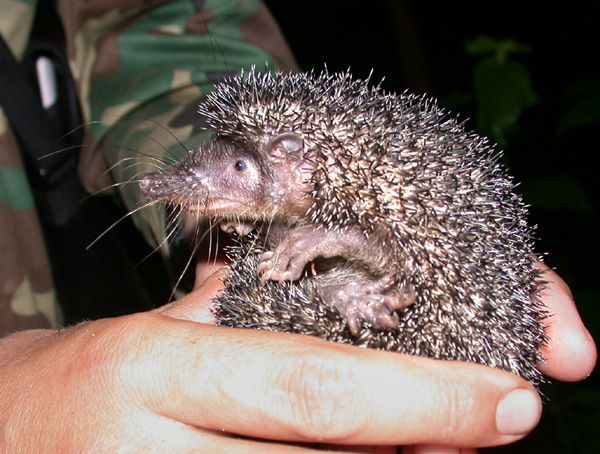
Hemicentetes semispinosus occurs in northern and eastern Madagascar. It has black, spiny fur with yellow or chestnut-brown longitudinal stripes, and its quills can detach as a defense mechanism.
Written 26 November 2026 from the sources listed below. Each statement was checked against the passage it cites; statements that could not be supported were removed.
Appearance
Its quills can detach as a defense mechanism, and a layer of woolly underfur lies beneath them. Its tail is absent.[1][2][3]
Its average body length is 140 mm, and adults can reach a maximum length of 172 mm. Its body weight ranges from 125 to 280 g.[4][5][6]
Habitat
The Lowland Streaked Tenrec inhabits tropical lowland rainforests in northern and eastern Madagascar. Its habitat includes primary and secondary tropical forests, shrubland, and agricultural land.[7][8]
The species occurs at elevations up to 1,550 m above sea level. Its burrows occur in primary or secondary forests and may accommodate between one and 23 individuals during the breeding season.[9][10][11]
Diet
Earthworms constitute the primary food source of the Lowland Streaked Tenrec. It sometimes feeds on other invertebrates and is capable of eating fruit.[12][13][14]
Behaviour
The Lowland Streaked Tenrec is active during both daytime and nighttime. It stamps its forefeet on the ground, apparently increasing earthworm activity and facilitating foraging.[15][16]
It raises its quills to deter potential predators. When confronting another animal, it may use a forceful headbutt in an attempt to immobilize it.[17][18]
The species can enter seasonal torpor, generally during June and July and winter. It sometimes emerges from torpor during winter to forage.[19][20]
Its burrows are typically long and shallow and are often occupied by family groups. During the breeding season, burrows may accommodate between one and 23 individuals.[11][21]
The species produces high-frequency sounds by rubbing specialized quills together. These sounds are too high in frequency for humans to hear, and its ultrasonic sounds may facilitate communication with its young in dense forest understory.[22][23][24]
Reproduction and life cycle
Breeding generally takes place between October and December, although its timing may vary with food availability and temperature. The gestation period lasts approximately 58 days.[25][26]
Females usually give birth to between five and eight offspring, and the average litter size is 6.3 offspring. Captive females have been recorded giving birth to as many as 11 offspring.[27][28][29]
Newborn offspring weigh approximately 11 g and measure between 55 and 67 mm in length. They begin developing spines within the first 24 hours after birth.[30][31][32]
Young are weaned between 18 and 25 days after birth. Females can become capable of conception at approximately 35 days of age on average and may reproduce during the same breeding season in which they were born.[33][34][35]
Conservation
Deforestation and the resulting loss of natural habitat are identified as primary threats to the Lowland Streaked Tenrec.[36]
Uses
The Lowland Streaked Tenrec is hunted for food.[37]
Similar species
The Lowland Streaked Tenrec is very closely related to the highland streaked tenrec.[38]
Classification of the Lowland Streaked Tenrec
| Kingdom | Animalia |
|---|---|
| Phylum | Chordata |
| Subphylum | Vertebrata |
| Infraphylum | Gnathostomata |
| Parvphylum | Osteichthyes |
| Megaclass | Tetrapoda |
| Class | Mammalia (Mammal) |
| Subclass | Theria |
| Infraclass | Eutheria |
| Order | Afrosoricida (Tenrecs) |
| Suborder | Tenrecomorpha (Tenrecs) |
| Family | Tenrecidae |
| Subfamily | Tenrecinae (Spiny Tenrecs) |
| Genus | Hemicentetes (Streaked Tenrecs) |
| Species | Hemicentetes semispinosus (G. Cuvier, 1798) |
Where the Lowland Streaked Tenrec is found
Checklists and occurrence records place Hemicentetes semispinosus in 2 countries across Africa. GBIF holds 729 georeferenced records of it.
Countries
Regions and cities with the most records
- Moramanga, Madagascar 97
- Manjakandriana, Madagascar 11
- Maroantsetra, Madagascar 11
- Alarobia, Madagascar 10
- Anjozorobe, Madagascar 10
- Didy, Madagascar 7
- Ifanadiana, Madagascar 7
- Ivohibe, Madagascar 6
- Ambatofinandrahana, Madagascar 5
Range as the checklists state it
Africa
A number beside a place is its count of GBIF occurrence records. A place without a number comes from a checklist alone. Records show where a species has been observed or collected, which can include escapes and vagrants.
Common names
English
- Lowland Streaked Tenrec
- Streaked Tenrec
Names in 15 other languages
- Arabic
- طنرق مخطط
- Czech
- bodlín páskovaný
- Dutch
- Gestreepte Tenrek
- Finnish
- juovatanrekki
- French
- Petit porc-épic, Tenrec zébré des terres basses
- German
- Eigentlicher Streifentenrek
- Greek
- Ημιαγκάθωτη Μυγαλή
- Italian
- Tenrec striato di pianura
- Japanese
- シマテンレック
- Malagasy
- Sora
- Polish
- Tenrek pręgowany, tenrekowiec pręgowany
- Portuguese
- Tenrec-listrado-das-planícies
- Russian
- Полосатый тенрек
- Spanish
- Tenrec Listado de Tierras Bajas
- Turkish
- Çizgili Ova Tenreği
Synonyms
One other scientific name has been used for this species and is now treated as a synonym of Hemicentetes semispinosus.
- Ericulus semispinosus G. Cuvier, 1798
Related species
-
 Highland Streaked TenrecHemicentetes nigriceps
-
 Lesser Hedgehog TenrecEchinops telfairi
-
 Tailless TenrecTenrec ecaudatus
-
 Greater Hedgehog TenrecSetifer setosus
- Large-eared TenrecGeogale aurita
-
 Mole-like Rice TenrecOryzorictes hova
- Short-tailed Shrew TenrecMicrogale brevicaudata
-
 Cowan's Shrew TenrecMicrogale cowani
Compare
Questions and answers
What is the scientific name of the Lowland Streaked Tenrec?
The scientific name of the Lowland Streaked Tenrec is Hemicentetes semispinosus. Written with its author, the full name is Hemicentetes semispinosus (G. Cuvier, 1798).
Which family does the Lowland Streaked Tenrec belong to?
Hemicentetes semispinosus belongs to the family Tenrecidae, in the order Afrosoricida and the class Mammalia.
Where is the Lowland Streaked Tenrec found?
Checklists and occurrence records place Hemicentetes semispinosus in 2 countries: Madagascar and Reunion.
What is the conservation status of the Lowland Streaked Tenrec?
The IUCN Red List category recorded for Hemicentetes semispinosus is Least Concern (LC).
What other names does the Lowland Streaked Tenrec have?
Hemicentetes semispinosus is also known in English as Streaked Tenrec.
What is one interesting fact about the lowland streaked tenrec?
The Lowland Streaked Tenrec produces ultrasonic sounds by rubbing specialized quills together. These sounds are too high in frequency for humans to hear and may facilitate communication with its young in dense forest understory.[22][23][24]
What does lowland streaked tenrec eat?
Earthworms are its primary food source. It sometimes eats other invertebrates and can also eat fruit.[12][13][14]
What is a tenrec habitat?
The Lowland Streaked Tenrec inhabits tropical lowland rainforests, primary and secondary tropical forests, shrubland, and agricultural land in northern and eastern Madagascar.[7][8]
Sources
Passages the profile rests on
- Its quills can detach as a defense mechanism. Source passage: “The ventral region contains few to no quills, but quills do have the ability to detach in predation defense.” — English Wikipedia
- Its tail is absent. Source passage: “A tail is absent in both species, and body lengths average 140 mm.” — animaldiversity.org
- The species has a woolly underfur beneath its detachable quills. Source passage: “Both species have barbed detachable quills to use as a defense mechanism; these quills cover a woolly underfur.” — animaldiversity.org
- Its average body length is approximately 140 mm. Source passage: “The average body size for H. semispinosus is a length of 140 mm (5.5 in)” — English Wikipedia
- Adult individuals can reach a maximum body length of 172 mm. Source passage: “adults have been recorded to grow up to a maximum of 172 mm (6.8 in).” — English Wikipedia
- Its body weight ranges from 125 to 280 g. Source passage: “Body weight of this species can range from 125 to 280 g (4.4 to 9.9 oz).” — English Wikipedia
- The species inhabits tropical lowland rainforests in northern and eastern Madagascar. Source passage: “Its natural habitats are in tropical lowland rain forests in northern and eastern parts of Madagascar.” — English Wikipedia
- Its habitat includes primary and secondary tropical forests, shrubland, and agricultural land. Source passage: “Its habitat includes primary and secondary tropical forests, shrubland, and agricultural land.” — English Wikipedia
- The species occurs at elevations up to 1,550 m above sea level. Source passage: “It lives at low elevations, up to 1,550 m (5,090 ft) above sea level.” — English Wikipedia
- Its burrows occur in primary or secondary forests. Source passage: “Burrows of lowland streaked tenrecs occur in primary or secondary forests” — animaldiversity.org
- Its burrows may accommodate between one and 23 individuals during the breeding season. Source passage: “and may be occupied by either one individual or as many as 23 during the breeding season.” — animaldiversity.org
- Earthworms constitute the primary food source of the species. Source passage: “Its diet is made up primarily of earthworms” — English Wikipedia
- The species sometimes feeds on other invertebrates. Source passage: “but it sometimes preys on other invertebrates, as well.” — English Wikipedia
- The species is capable of eating fruit. Source passage: “They are also capable of eating fruit.” — English Wikipedia
- The species is active during both daytime and nighttime. Source passage: “The lowland streaked tenrec is active both during the day and at night.” — English Wikipedia
- It stamps its forefeet on the ground, apparently increasing earthworm activity and facilitating foraging. Source passage: “It may be seen stamping its feet on the ground with its fore paws, an adaptation which is believed to increase earthworm activity for easier foraging.” — English Wikipedia
- The species raises its quills to deter potential predators. Source passage: “The lowland streaked tenrec flaunts its quills to scare away any possible predators.” — English Wikipedia
- When confronting another animal, it may use a forceful headbutt in an attempt to immobilize it. Source passage: “When forced to engage another species, it uses a rough headbutt in an attempt to immobilize its target.” — English Wikipedia
- The species can enter seasonal torpor, generally during June and July and winter. Source passage: “Torpor for this species generally occurs during June and July and during winter.” — English Wikipedia
- It sometimes emerges from torpor during winter to forage. Source passage: “However, H. semispinosus is a facultative hibernator and comes out of torpor during winter and forage.” — English Wikipedia
- Its burrows are typically long and shallow and are often occupied by family groups. Source passage: “The streaked tenrec lives in long, shallow burrows, which are usually occupied by family groups.” — English Wikipedia
- The species produces high-frequency sounds by rubbing specialized quills together. Source passage: “Movement of these quills causes the tips to rub together and create a high-frequency sound.” — English Wikipedia
- The sounds produced by its quills are too high in frequency for humans to hear. Source passage: “The sound produced is too high in frequency to be perceived by human ears.” — English Wikipedia
- It uses ultrasonic sounds that may facilitate communication with its young in dense forest understory. Source passage: “It’s thought that the tenrecs might be using these ultrasonic sounds to communicate with their young as they traverse the dense understory of their forest habitat.” — nhm.ac.uk
- Breeding generally takes place between October and December, although timing may vary with food availability and temperature. Source passage: “Breeding takes place during October to December and possibly at other times, depending upon local food supply and temperature.” — English Wikipedia
- The gestation period lasts approximately 58 days. Source passage: “The gestation period lasts 58 days” — English Wikipedia
- Females usually give birth to between five and eight offspring. Source passage: “and the female gives birth to usually between five and eight young.” — English Wikipedia
- The average litter size is 6.3 offspring. Source passage: “The average litter size is 6.3 for lowland streaked tenrecs ( H. semispinosus )” — animaldiversity.org
- Captive females have been recorded giving birth to as many as 11 offspring. Source passage: “Lowland streaked tenrecs have as many as 11 offspring in captivity” — animaldiversity.org
- Newborn offspring weigh approximately 11 g. Source passage: “Young streaked tenrecs weigh about 11 g” — animaldiversity.org
- Newborn offspring measure between 55 and 67 mm in length. Source passage: “and are 55 to 67 mm in length.” — animaldiversity.org
- Offspring begin developing spines within the first 24 hours after birth. Source passage: “Offspring are born without spines, but begin to develop them within the first 24 hours of life.” — animaldiversity.org
- Young are weaned between 18 and 25 days after birth. Source passage: “The young are weaned at 18 to 25 days.” — English Wikipedia
- Females can become capable of conception at approximately 35 days of age on average. Source passage: “These tenrecs on average attain the ability to conceive at about 35 days.” — English Wikipedia
- Females may reproduce during the same breeding season in which they were born. Source passage: “They have the ability to reproduce during the same season they were produced.” — English Wikipedia
- Deforestation and the resulting loss of natural habitat are identified as primary threats to the species. Source passage: “These tenrecs are threatened primarily by the loss of their natural habitat due to continuous deforestation” — English Wikipedia
- The species is hunted for food. Source passage: “This species is also hunted for food.” — English Wikipedia
- The lowland streaked tenrec is very closely related to the highland streaked tenrec. Source passage: “It is very closely related to the highland streaked tenrec.” — English Wikipedia
- The species occurs in northern and eastern Madagascar. Source passage: “The lowland streaked tenrec is found in the northern and eastern regions of Madagascar.” — English Wikipedia
- The species is restricted to Madagascar. Source passage: “There are two species in the genus Hemicentetes , H. semispinosus and H. nigriceps ; both are found only on Madagascar.” — animaldiversity.org
Data
- Catalogue of Life, 2026-10-16 XR cc by
- Global Biodiversity Information Facility CC BY 4.0
- Wikidata CC0
- GeoNames CC BY 4.0
- Wikimedia Commons per image; credit shown with each image
- Within the Catalogue of Life, this name comes from The Integrated Taxonomic Information System cc0
References
- Tableau élémentaire de l histoire naturelle des animaux p.108 where the name was published
- Wilson, Don E., and DeeAnn M. Reeder, eds. (1993). Mammal Species of the World: A Taxonomic and Geographic Reference, 2nd Ed., 3rd Printing.
- Wilson, Don E., and F. Russell Cole. (2000). Common Names of Mammals of the World.
- Wilson, Don E., and DeeAnn M. Reeder, eds. (2005). Mammal Species of the World: A Taxonomic and Geographic Reference, 3rd Ed., Vols. 1 & 2.
- Jenkins, P. D. / Don E. Wilson and Russell A. Mittermeier, eds. (2018). Family Tenrecidae (Tenrecs and Shrew Tenrecs). Handbook of the Mammals of the World. Vol. 8: Insectivores, Sloths and Colugos.
This species in other databases
Page built on 26 November 2026. See how the catalog is made and all sources and licences.
Cite this page
ScientificNames.org. (2026). Hemicentetes semispinosus (Lowland Streaked Tenrec). Retrieved November 26, 2026, from https://scientificnames.org/species/hemicentetes-semispinosus
“Hemicentetes semispinosus (Lowland Streaked Tenrec).” ScientificNames.org, 2026, scientificnames.org/species/hemicentetes-semispinosus. Accessed 26 Nov. 2026.
ScientificNames.org. “Hemicentetes semispinosus (Lowland Streaked Tenrec).” Accessed November 26, 2026. https://scientificnames.org/species/hemicentetes-semispinosus.
@misc{scientificnames_hemicentetes_semispinosus_lowland_streaked_tenrec,
  author = {{ScientificNames.org}},
  title = {Hemicentetes semispinosus (Lowland Streaked Tenrec)},
  year = {2026},
  url = {https://scientificnames.org/species/hemicentetes-semispinosus},
  note = {Accessed 2026-11-26}
}