Species · Flowering plants
Hoya calycina
Hoya calycina has no English name on record in the checklists used here. It is a species of flowering plant in the family Apocynaceae (dogbane family), order Gentianales.
- Scientific name
- Hoya calycina Schltr.
- Genus
- Hoya
- Family
- Apocynaceae (Dogbane Family)
- Order
- Gentianales
- Class
- Magnoliopsida
- Recorded in
- 1 country
- Name status
- accepted in the Catalogue of Life

Overview
Hoya calycina Schltr. is a climbing flowering plant. It typically grows in wet tropical environments and is native to New Guinea and the Bismarck Archipelago. It is cultivated as a houseplant for its fragrant flowers.
Written 27 November 2026 from the sources listed below. Each statement was checked against the passage it cites; statements that could not be supported were removed.
Appearance
Hoya calycina is a climbing plant.[1]
Habitat
Hoya calycina typically grows in wet tropical environments. It is native to New Guinea and the Bismarck Archipelago.[2][3]
Uses
Hoya calycina is cultivated as a houseplant for its fragrant flowers.[4]
Classification of Hoya calycina
| Kingdom | Plantae |
|---|---|
| Subkingdom | Pteridobiotina |
| Phylum | Tracheophyta |
| Class | Magnoliopsida |
| Order | Gentianales |
| Family | Apocynaceae (Dogbane Family) |
| Subfamily | Asclepiadoideae |
| Tribe | Marsdenieae |
| Genus | Hoya (Waxflowers) |
| Species | Hoya calycina Schltr. |
Where Hoya calycina is found
Checklists and occurrence records place Hoya calycina in 1 country across Oceania. GBIF holds 27 georeferenced records of it.
Countries
Regions and cities with the most records
1 more country has a few records outside this range
These countries hold a few records of Hoya calycina but lie outside the range the checklists give for it. Such records are often zoo or garden specimens, museum material or vagrants, so the species is not counted as occurring there.
A number beside a place is its count of GBIF occurrence records. A place without a number comes from a checklist alone. Records show where a species has been observed or collected, which can include escapes and vagrants.
Common names
Names in 1 other language
- Chinese
- 大萼球兰
Subspecies and varieties
- Hoya calycina subsp. calycina subspecies
- Hoya calycina subsp. glabrifolia subspecies
Related species
-
 Wax PlantHoya carnosa
-
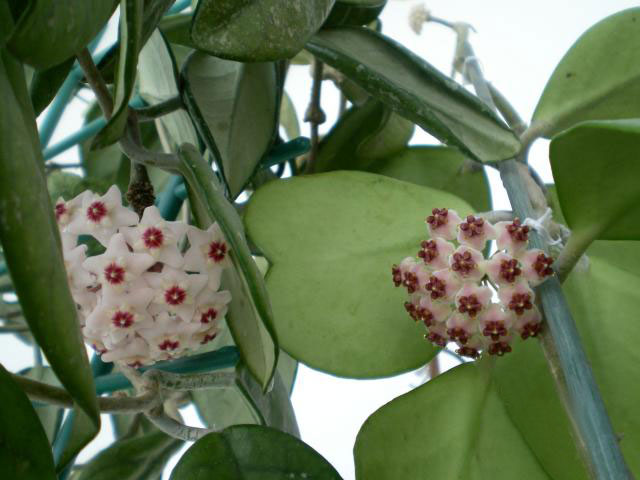 Heart HoyaHoya kerrii
-
 Common WaxflowerHoya australis
-
 Miniature Wax PlantHoya bella
-
 Hoya pubicalyx
-
 Hoya linearis
-
 Hoya imbricata
-
 Hoya multiflora
Compare
Questions and answers
Where do hoyas grow naturally?
Hoya calycina is native to New Guinea and the Bismarck Archipelago.[3]
Sources
Passages the profile rests on
- Hoya calycina is a climbing plant. Source passage: “A climber, it is typically found in the wet tropics.” — English Wikipedia
- Hoya calycina typically grows in wet tropical environments. Source passage: “it is typically found in the wet tropics.” — English Wikipedia
- Hoya calycina is native to New Guinea and the Bismarck Archipelago. Source passage: “It is native to New Guinea and the Bismarck Archipelago.” — English Wikipedia
- Hoya calycina is cultivated as a houseplant for its fragrant flowers. Source passage: “As a houseplant it is valued by Hoya enthusiasts for its fragrant flowers.” — English Wikipedia
Data
- Catalogue of Life, 2026-10-16 XR cc by
- Global Biodiversity Information Facility CC BY 4.0
- Wikidata CC0
- GeoNames CC BY 4.0
- Wikimedia Commons per image; credit shown with each image
- Within the Catalogue of Life, this name comes from Synonymic Checklists of the Vascular Plants of the World cc by
References
- Schltr. where the name was published
This species in other databases
Page built on 29 November 2026. See how the catalog is made and all sources and licences.
Cite this page
ScientificNames.org. (2026). Hoya calycina. Retrieved November 29, 2026, from https://scientificnames.org/species/hoya-calycina
“Hoya calycina.” ScientificNames.org, 2026, scientificnames.org/species/hoya-calycina. Accessed 29 Nov. 2026.
ScientificNames.org. “Hoya calycina.” Accessed November 29, 2026. https://scientificnames.org/species/hoya-calycina.
@misc{scientificnames_hoya_calycina,
  author = {{ScientificNames.org}},
  title = {Hoya calycina},
  year = {2026},
  url = {https://scientificnames.org/species/hoya-calycina},
  note = {Accessed 2026-11-29}
}