Species · Birds
Red-throated Caracara Ibycter americanus
The scientific name of the Red-throated Caracara is Ibycter americanus. It is a species of bird in the family Falconidae (falcons), order Falconiformes. The name dates from 1783.
- Scientific name
- Ibycter americanus (Boddaert, 1783)
- Common name
- Red-throated Caracara
- Genus
- Ibycter
- Family
- Falconidae (Falcons)
- Order
- Falconiformes
- Class
- Aves
- Red List category
- LC Least Concern
- Environment
- terrestrial
- Recorded in
- 15 countries
- Name status
- accepted in the Catalogue of Life

Overview
Ibycter americanus inhabits humid lowland forests, including subtropical and tropical moist lowland forests and moist montane forests. It is distinguished by predominantly black plumage, a white belly and tail feathers, and bare red facial and throat skin.
Written 26 November 2026 from the sources listed below. Each statement was checked against the passage it cites; statements that could not be supported were removed.
Appearance
The Red-throated Caracara has predominantly black plumage, with a white belly, tail feathers and undertail feathers. Its face and throat have bare red exposed skin, with a few scattered black throat feathers.[1][2]
Males and females have similar overall appearances. Adult males average 51 cm in length, while adult females average 56 cm.[3][4][5]
Male wing length averages 35.55 cm, tail length 24.96 cm, bill length 2.5 cm and tarsal length 5.41 cm. Female wing length averages 35.93 cm, tail length 25.31 cm, bill length 2.58 cm and tarsal length 5.62 cm.[6][7][8][9][10][11][12][13]
Habitat
The Red-throated Caracara inhabits humid lowland forests. Its natural habitats include subtropical and tropical moist lowland forests and moist montane forests.[14][15]
Its geographic range extends from southern Mexico through Central America into South America, reaching as far south as Peru, Bolivia and Brazil. Its documented range includes Brazil, Bolivia, Colombia, Costa Rica, El Salvador, Ecuador, French Guiana, Guatemala, Guyana, Honduras, Mexico, Nicaragua, Panama, Peru and Venezuela.[16][17]
The species hunts in both the canopy and understory of lowland jungle forests.[18]
Diet
The Red-throated Caracara feeds primarily on bee and wasp larvae. Its diet also includes adult insects, fruits and berries.[19][20]
When foraging, the species mainly searches for insect nests.[21]
Behaviour
The Red-throated Caracara is social and sometimes hunts in groups, typically containing four to eight individuals. During group hunting, one or two individuals watch for predators from the canopy while the others forage in the understory.[22][23][24]
The species is highly territorial. Its slow flight enables it to move through forest understories where vegetation is thin.[25][26]
The species uses aerial diving attacks to knock insect nests onto the forest floor. When attacking wasp nests, individuals repeatedly dive and scoop upward to disorient or drive away defending wasps.[27][28]
The species can evade most wasp stings while attacking nests.[29]
Conservation
Populations of the Red-throated Caracara have been extirpated or are experiencing serious declines throughout Middle America. Deforestation and intensive agriculture are identified as major pressures on its population.[30][31]
The species experienced rapid population and range declines after the 1950s in Costa Rica, Honduras, Panama, Ecuador and French Guiana. Following population and range declines, it was placed on the World Wildlife endangered list.[32][33]
The Red-throated Caracara was assessed for the IUCN Red List in 2019.[34]
Similar species
The Red-throated Caracara has historically been grouped taxonomically with the black caracara. It is larger than the black caracara.[35][36]
Classification of the Red-throated Caracara
| Kingdom | Animalia |
|---|---|
| Phylum | Chordata |
| Subphylum | Vertebrata |
| Infraphylum | Gnathostomata |
| Parvphylum | Osteichthyes |
| Megaclass | Tetrapoda |
| Class | Aves (Bird) |
| Order | Falconiformes (Falcons) |
| Family | Falconidae (Falcons) |
| Subfamily | Polyborinae |
| Genus | Ibycter (Red-throated Caracara) |
| Species | Ibycter americanus (Boddaert, 1783) |
Where the Red-throated Caracara is found
Checklists and occurrence records place Ibycter americanus in 15 countries across North America and South America. GBIF holds 29,015 georeferenced records of it.
Countries
- Bolivia 467
- Brazil 5,240
- Colombia 4,650
- Costa Rica 244
- Ecuador 3,710
- French Guiana 813
- Guatemala 11
- Guyana 1,257
- Honduras 43
- Mexico 14
- Nicaragua 30
- Panama 2,494
- Peru 8,383
- Suriname 984
- Venezuela 675
Regions and cities with the most records
- Madre de Dios, Peru 4,496
- Orellana Province, Ecuador 2,106
- Darién, Panama 2,012
- Loreto, Peru 1,588
- Mato Grosso, Brazil 1,453
- Amazonas, Brazil 1,446
- Pará, Brazil 1,179
- Sucumbíos, Ecuador 982
- Vaupés, Colombia 946
- Antioquia, Colombia 941
- Cuzco Department, Peru 831
- Mitú, Colombia 803
- Potaro-Siparuni, Guyana 718
- Sipaliwini District, Suriname 703
- Amazonas Department, Colombia 609
- Tambopata, Peru 607
- Puerto Maldonado, Peru 606
- Bolívar, Venezuela 534
- Pasco, Peru 474
- Putumayo Department, Colombia 460
- Napo, Ecuador 407
- San Martín Department, Peru 399
- Rondônia, Brazil 394
- Upper Takutu-Upper Essequibo, Guyana 382
- Córdoba, Colombia 247
- Brokopondo District, Suriname 219
- Acre, Brazil 212
- Boyacá, Colombia 197
- Embera, Panama 191
- La Banda, Peru 191
- La Paz Department, Bolivia 184
- Huánuco Department, Peru 183
- Panamá, Panama 173
- Chocó, Colombia 172
- Puntarenas Province, Costa Rica 168
- Bolívar, Colombia 165
1 more country has a few records outside this range
These countries hold a few records of Ibycter americanus but lie outside the range the checklists give for it. Such records are often zoo or garden specimens, museum material or vagrants, so the species is not counted as occurring there.
Range as the checklists state it
Middle America
South America
A number beside a place is its count of GBIF occurrence records. A place without a number comes from a checklist alone. Records show where a species has been observed or collected, which can include escapes and vagrants.
Common names
English
- Red-throated Caracara
Names in 26 other languages
- Arabic
- كاراكارا أحمر الحنجرة
- Catalan
- caracarà gola-roig
- Chinese
- 紅喉卡拉鷹, 红喉巨隼
- Croatian
- riđogrla karakara
- Czech
- čimango rudohrdlý
- Danish
- Rødstrubet Caracara
- Dutch
- Roodkeelcaracara
- Esperanto
- ruĝgorĝa karakaro
- Estonian
- herilasekarakaara
- Finnish
- naurukarakara
- French
- Caracara à gorge rouge
- German
- Rotkehl-Karakara, Rotkehlkarakara
- Hungarian
- pirostorkú karakara
- Italian
- Caracara golarossa
- Japanese
- アカノドカラカラ
- Lithuanian
- raudongurklė juodoji karakara
- Norwegian
- rødstrupekarakara
- Polish
- karakara białobrzucha
- Portuguese
- Gralhão, cancão, caracara-vespeiro
- Russian
- Красногорлая каракара, Красногорлая чёрная каракара
- Serbian
- Crvenogrla karakara
- Slovak
- karakara bielobruchá
- Spanish
- Cacao avispero, Caracara Avispera, Caracara comecacao, Caracara gorjirrojo
- Swedish
- rödstrupig karakara
- Turkish
- Kırmızı Boğazlı Karakara
- Ukrainian
- каракара червоногорла
Synonyms
9 other scientific names have been used for this species and are now treated as synonyms of Ibycter americanus.
- Daptrius americanus (Boddaert, 1783)
- Daptrius americanus americanus Sibley & Monroe (1990, 1993)
- Daptrius americanus americanus Stotz et al. (1996)
- Daptrius americanus pelzelni Camargo, EA; Pinto, OMO, 1948
- Deptrius americanus Boddaert, P, 1783
- Falco americanus Boddaert, 1783
- Falco aquilinus Gmelin, JF, 1788
- Ibycter americanus americanus Boddaert, P, 1783
- Ibycter americanus guatemalensis Swann, HK, 1921
Related species
-
 Peregrine FalconFalco peregrinus
-
 Common KestrelFalco tinnunculus
-
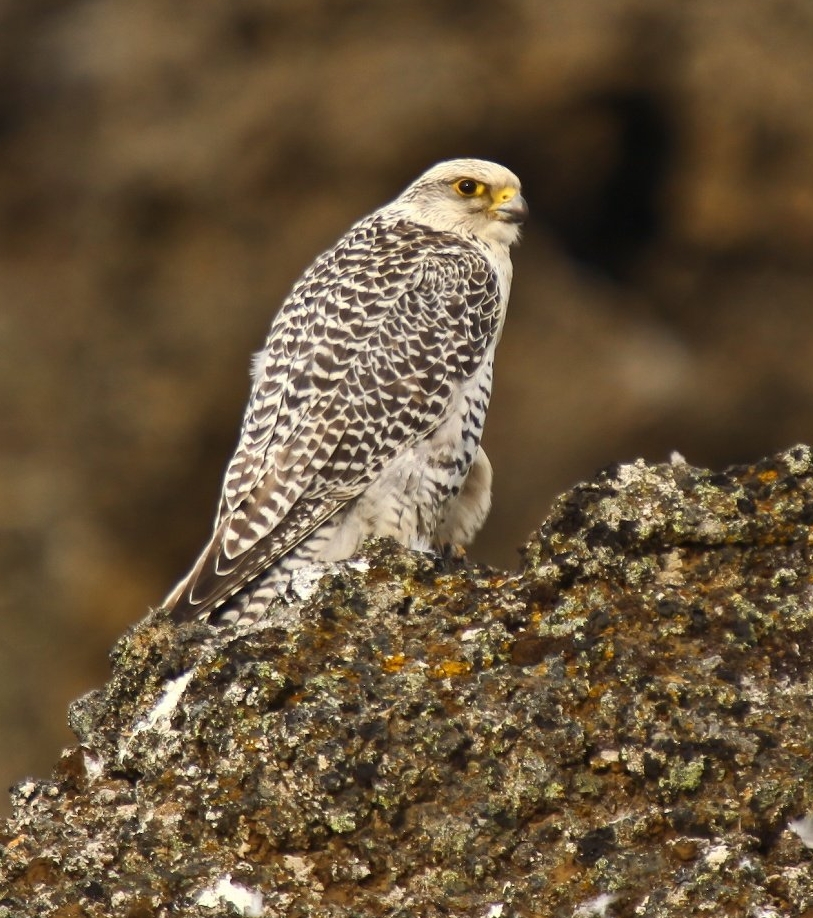 GyrfalconFalco rusticolus
-
 MerlinFalco columbarius
-
 American KestrelFalco sparverius
-
 Crested CaracaraCaracara plancus
-
 Saker FalconFalco cherrug
-
 Eurasian HobbyFalco subbuteo
Compare
Questions and answers
What is the scientific name of the Red-throated Caracara?
The scientific name of the Red-throated Caracara is Ibycter americanus. Written with its author, the full name is Ibycter americanus (Boddaert, 1783).
Which family does the Red-throated Caracara belong to?
Ibycter americanus belongs to the family Falconidae, in the order Falconiformes and the class Aves.
Where is the Red-throated Caracara found?
Checklists and occurrence records place Ibycter americanus in 15 countries, including Peru, Brazil, Colombia, Ecuador, Panama and Guyana.
What is the conservation status of the Red-throated Caracara?
The IUCN Red List category recorded for Ibycter americanus is Least Concern (LC).
Where do caracara birds live?
The Red-throated Caracara inhabits humid lowland forests, including subtropical and tropical moist lowland forests and moist montane forests. Its range extends from southern Mexico through Central America into South America, as far south as Peru, Bolivia and Brazil.[14][15][16]
Sources
Passages the profile rests on
- The species has predominantly black plumage, with a white belly, tail feathers, and undertail feathers. Source passage: “plumage that is mainly black, with the belly, tail feathers, and undertail feathers being white.” — English Wikipedia
- The face and throat are bare and have red exposed skin, with a few scattered black throat feathers. Source passage: “Both their faces and throats are bare, with a few black feathers scattered on the throat; the exposed skin is red.” — English Wikipedia
- Males and females have similar overall appearances. Source passage: “Both male and female red-throated caracaras are similar in appearance.” — English Wikipedia
- Adult males average 51 cm in length. Source passage: “Males average 20.1 in (51 cm) long” — English Wikipedia
- Adult females average 56 cm in length. Source passage: “females average 22.1 in (56 cm)” — English Wikipedia
- Male wing length averages 35.55 cm. Source passage: “Males have a wing length of 35.55 cm” — English Wikipedia
- Female wing length averages 35.93 cm. Source passage: “Females have a wing length of 35.93 cm” — English Wikipedia
- Male tail length averages 24.96 cm. Source passage: “a tail length of 24.96 cm” — English Wikipedia
- Female tail length averages 25.31 cm. Source passage: “a tail length of 25.31 cm” — English Wikipedia
- Male bill length averages 2.5 cm. Source passage: “a bill length of 2.5 cm” — English Wikipedia
- Female bill length averages 2.58 cm. Source passage: “a bill length of 2.58 cm” — English Wikipedia
- Male tarsal length averages 5.41 cm. Source passage: “a tarsal length of 5.41 cm.” — English Wikipedia
- Female tarsal length averages 5.62 cm. Source passage: “a tarsal length of 5.62 cm.” — English Wikipedia
- The species inhabits humid lowland forests. Source passage: “This species inhabits the humid lowland forests” — English Wikipedia
- Its natural habitats include subtropical and tropical moist lowland forests and moist montane forests. Source passage: “Its natural habitats are subtropical or tropical moist lowland forests and subtropical or tropical moist montane forests.” — English Wikipedia
- The species occurs from southern Mexico through Central America and into South America as far south as Peru, Bolivia, and Brazil. Source passage: “It is found from far southern Mexico through parts of Central and South America south to Peru, Bolivia, and Brazil.” — English Wikipedia
- Its documented range includes Brazil, Bolivia, Colombia, Costa Rica, El Salvador, Ecuador, French Guiana, Guatemala, Guyana, Honduras, Mexico, Nicaragua, Panama, Peru, and Venezuela. Source passage: “This species inhabits the humid lowland forests of Brazil, Bolivia, Colombia, Costa Rica, El Salvador, Ecuador, French Guiana, Guatemala, Guyana, Honduras, Mexico, Nicaragua, Panama, Peru, and Venezuela.” — English Wikipedia
- The species hunts in both the canopy and understory of lowland jungle forests. Source passage: “The red-throated caracara hunts in the canopy and the understory of the lowland jungle” — English Wikipedia
- The species feeds primarily on bee and wasp larvae. Source passage: “it mainly feeds on the larvae of bees and wasps” — English Wikipedia
- Its diet also includes adult insects, fruits, and berries. Source passage: “but also takes the adult insects and fruits and berries.” — English Wikipedia
- The species mainly searches for insect nests when foraging. Source passage: “foraging mainly for insect nests.” — English Wikipedia
- The species is social and sometimes hunts in groups. Source passage: “Most red-throated caracaras hunt silently, but occasionally make soft caws and sometimes hunt in groups.” — English Wikipedia
- Groups typically contain four to eight individuals. Source passage: “with four to eight individuals in a group.” — English Wikipedia
- During group hunting, one or two individuals watch for predators from the canopy while the others forage in the understory. Source passage: “one or two individuals scout for predators in the canopy, while the remaining flock hunts in the understory.” — English Wikipedia
- The species is highly territorial. Source passage: “The red-throated caracara is highly territorial” — English Wikipedia
- Its slow flight enables it to move through forest understories where vegetation is thin. Source passage: “The slow flight of the red-throated caracara makes it suited it to fly in the understory of the forest where the vegetation is thin.” — English Wikipedia
- The species uses aerial diving attacks to knock insect nests onto the forest floor. Source passage: “using a rapid-fire "fly-by" aerial-diving attack strategy to knock nests down onto the forest floor” — English Wikipedia
- During attacks on wasp nests, individuals repeatedly dive and scoop upward to disorient or drive away defending wasps. Source passage: “repeatedly diving then scooping upward, to drive off or confuse angry defender swarms around the hive.” — English Wikipedia
- The species can evade most wasp stings while attacking nests. Source passage: “while skillfully evading most wasp stings.” — English Wikipedia
- Populations of the species have been extirpated or are experiencing serious declines throughout Middle America. Source passage: “Populations of Red-throated Caracaras (Ibycter americanus) have been extirpated or are in serious decline throughout Middle America.” — academia.edu
- Deforestation and intensive agriculture are identified as major pressures on the species' population. Source passage: “Deforestation and intensive agriculture practices severely hamper the red-throated caracara's population” — English Wikipedia
- The species experienced rapid population and range declines after the 1950s in Costa Rica, Honduras, Panama, Ecuador, and French Guiana. Source passage: “After the 1950s, both its population and range rapidly declined in Costa Rica, Honduras, Panama, Ecuador, and French Guiana” — English Wikipedia
- The species was placed on the World Wildlife endangered list following population and range declines. Source passage: “causing the species to be placed on the World Wildlife endangered list.” — English Wikipedia
- The species was assessed for the IUCN Red List in 2019. Source passage: “Red-throated Caracara Ibycter americanus has most recently been assessed for The IUCN Red List of Threatened Species in 2019.” — iucnredlist.org
- The black caracara is a species with which the red-throated caracara has historically been grouped taxonomically. Source passage: “The red-throated caracara was for many years placed with the black caracara in the genus Daptrius” — English Wikipedia
- The red-throated caracara is larger than the black caracara. Source passage: “they are distinguished from the black caracara by larger size” — English Wikipedia
Data
- Catalogue of Life, 2026-10-16 XR cc by
- Global Biodiversity Information Facility CC BY 4.0
- Wikidata CC0
- GeoNames CC BY 4.0
- Wikimedia Commons per image; credit shown with each image
- Within the Catalogue of Life, this name comes from The Integrated Taxonomic Information System cc0
References
- Table Planches Enlum.: 25. 1783 where the name was published
- Dickinson, Edward C., ed. (2003). The Howard and Moore Complete Checklist of the Birds of the World, 3rd Edition.
- Gill, Frank, & and Minturn Wright. (2006). Birds of the World: Recommended English Names.
- Dickinson, E. C., and J. V. Remsen Jr., eds. (2013). The Howard and Moore Complete Checklist of the Birds of the World, 4th Edition, Vol. 1 Non-Passerines.
This species in other databases
Page built on 28 November 2026. See how the catalog is made and all sources and licences.
Cite this page
ScientificNames.org. (2026). Ibycter americanus (Red-throated Caracara). Retrieved November 28, 2026, from https://scientificnames.org/species/ibycter-americanus
“Ibycter americanus (Red-throated Caracara).” ScientificNames.org, 2026, scientificnames.org/species/ibycter-americanus. Accessed 28 Nov. 2026.
ScientificNames.org. “Ibycter americanus (Red-throated Caracara).” Accessed November 28, 2026. https://scientificnames.org/species/ibycter-americanus.
@misc{scientificnames_ibycter_americanus_red_throated_caracara,
  author = {{ScientificNames.org}},
  title = {Ibycter americanus (Red-throated Caracara)},
  year = {2026},
  url = {https://scientificnames.org/species/ibycter-americanus},
  note = {Accessed 2026-11-28}
}