Species · Fishes
Blue Catfish Ictalurus furcatus
The scientific name of the Blue Catfish is Ictalurus furcatus. It is a species of fish in the family Ictaluridae (bullhead catfishes), order Siluriformes. The name dates from 1840.
- Scientific name
- Ictalurus furcatus (Valenciennes, 1840)
- Common name
- Blue Catfish
- Genus
- Ictalurus
- Family
- Ictaluridae (Bullhead Catfishes)
- Order
- Siluriformes
- Class
- Teleostei
- Red List category
- LC Least Concern
- Environment
- brackish, freshwater
- Recorded in
- 5 countries
- Name status
- accepted in the Catalogue of Life
Overview
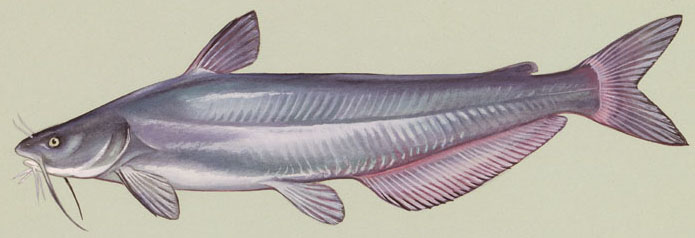
The Blue Catfish has a heavy-bodied shape, bluish-gray coloration, a dorsal hump, and a deeply forked tail.
Written 26 November 2026 from the sources listed below. Each statement was checked against the passage it cites; statements that could not be supported were removed.
Appearance
The Blue Catfish has a heavy-bodied shape and bluish-gray coloration. It has a dorsal hump, barbels, a deeply forked tail, and a protruding upper jaw.[1][2][3]
The species can reach approximately 170 cm in length and 65 kg in weight. Typical individuals measure 64–117 cm in length and weigh 14–32 kg.[4][5]
Adult Blue Catfish commonly grow to approximately 0.61 m in length. Some individuals have been recorded exceeding 1.5 m in length and 45 kg in weight.[6][7]
Diet
The Blue Catfish is an omnivorous predator and a generalist omnivore with a particularly broad diet. It occupies a mesopredator role and relatively low trophic levels.[8][9][10]
The species eats fish, including members of its own species, and can consume adult Asian carp. Its diet also includes insects, crawfish, crabs, freshwater mussels, clams, worms, and frogs.[11][12][13]
In Virginia's Chesapeake Bay region, the Blue Catfish diet consists largely of Hydrilla and Asian clams. In Chesapeake Bay, it primarily feeds on invasive aquatic vegetation and Asian clams and regularly consumes blue crab (Callinectes sapidus).[14][15][16][17]
Behaviour
The species feeds on injured fish beneath schools of striped bass in open-water reservoirs. It also feeds on wounded baitfish carried through dam spillways and power-generation turbines.[18][19]
Reproduction and life cycle
Blue Catfish spawn once annually between May and June. Females can produce 2,000–4,000 eggs per pound of body weight.[20][21]
A female weighing 20 pounds can produce more than 40,000 eggs.[22]
Conservation
The Blue Catfish is considered invasive in parts of its introduced range, including Albemarle Sound and Chesapeake Bay. It is considered a problematic invasive species in Virginia.[23][24]
High population densities may make the species' impact on imperiled native species substantial despite low per-capita effects.[25]
Classification of the Blue Catfish
| Kingdom | Animalia |
|---|---|
| Phylum | Chordata |
| Subphylum | Vertebrata |
| Infraphylum | Gnathostomata |
| Parvphylum | Osteichthyes |
| Gigaclass | Actinopterygii |
| Superclass | Actinopteri |
| Class | Teleostei (Teleost) |
| Order | Siluriformes (Catfish) |
| Family | Ictaluridae (Bullhead Catfishes) |
| Genus | Ictalurus (Channel Catfishes) |
| Species | Ictalurus furcatus (Valenciennes, 1840) |
Where the Blue Catfish is found
Checklists and occurrence records place Ictalurus furcatus in 5 countries. GBIF holds 120,426 georeferenced records of it.
Countries
Regions and cities with the most records
- Clinton, United States 94,885
- Greater Upper Marlboro, United States 94,575
- Camp Springs, United States 37,802
- Suitland-Silver Hill, United States 8,633
- Suitland, United States 8,632
- Bowie, United States 8,285
- Texas, United States 5,390
- South Carolina, United States 1,909
- Louisiana, United States 876
- Oklahoma, United States 797
- Goose Creek, United States 648
- Hanahan, United States 647
- North Charleston, United States 551
- Summerville, United States 503
- Georgia, United States 459
- Daphne, United States 452
- Mobile, United States 441
- Prichard, United States 440
- Lincolnia, United States 391
- Baileys Crossroads, United States 383
- Rose Hill, United States 381
- Alexandria, United States 379
- Annandale, United States 375
- Franconia, United States 375
- Arlington, United States 370
- Oxon Hill, United States 370
- Southwest Waterfront, United States 370
- Capitol Riverfront, United States 369
- Springfield, United States 369
- Glassmanor, United States 367
- Hybla Valley, United States 367
- Washington, United States 366
- West Falls Church, United States 366
- Adams Morgan, United States 365
- Downtown DC, United States 365
- Foggy Bottom, United States 365
A number beside a place is its count of GBIF occurrence records. A place without a number comes from a checklist alone. Records show where a species has been observed or collected, which can include escapes and vagrants.
Common names
English
- Blue Catfish
- Blue Cat
Names in 12 other languages
- Chinese
- 藍鲶魚
- Czech
- sumeček velký
- Danish
- Blå dværgmalle
- French
- Poisson-chat bleu
- German
- Blauer Katzenwels
- Hebrew
- שפמנון כחול
- Hungarian
- Kék harcsa
- Italian
- pesce gatto blu
- Polish
- Sumik błękitny
- Spanish
- bagre azul
- akz
- Katska
- mus
- okyvn-holatte
Synonyms
4 other scientific names have been used for this species and are now treated as synonyms of Ictalurus furcatus.
- Amiurus ponderosus Bean, 1880
- Pimelodus affinis Baird & Girard, 1854
- Pimelodus furcatus Valenciennes, 1840
- Silurus cerulescens Rafinesque, 1820
Related species
-
 Channel CatfishIctalurus punctatus
-
 Yaqui CatfishIctalurus pricei
-
 Headwater CatfishIctalurus lupus
- Panuco CatfishIctalurus australis
-
 Balsas CatfishIctalurus balsanus
- Lerma CatfishIctalurus dugesii
- Ictalurus nazas
- Rio Verde CatfishIctalurus mexicanus
Compare
Questions and answers
What is the scientific name of the Blue Catfish?
The scientific name of the Blue Catfish is Ictalurus furcatus. Written with its author, the full name is Ictalurus furcatus (Valenciennes, 1840).
Which family does the Blue Catfish belong to?
Ictalurus furcatus belongs to the family Ictaluridae, in the order Siluriformes and the class Teleostei.
Where is the Blue Catfish found?
Checklists and occurrence records place Ictalurus furcatus in 5 countries: United States, Mexico, Guatemala, Belize and Canada.
What is the conservation status of the Blue Catfish?
The IUCN Red List category recorded for Ictalurus furcatus is Least Concern (LC).
What other names does the Blue Catfish have?
Ictalurus furcatus is also known in English as Blue Cat.
What do the blue catfish eat?
Blue Catfish eat fish, including members of their own species, insects, crawfish, crabs, freshwater mussels, clams, worms, and frogs. They can also consume adult Asian carp. In Chesapeake Bay, their diet includes invasive aquatic vegetation, Asian clams, and blue crabs.[11][12][13][15][16][17]
Sources
Passages the profile rests on
- The blue catfish has a heavy-bodied shape and bluish-gray coloration. Source passage: “Blue catfish are heavy bodied, blueish gray in color, and have a dorsal hump.” — English Wikipedia
- The species has a dorsal hump. Source passage: “Blue catfish are heavy bodied, blueish gray in color, and have a dorsal hump.” — English Wikipedia
- The blue catfish has barbels, a deeply forked tail, and a protruding upper jaw. Source passage: “Blue catfish also have barbels, a deeply forked tail, and a protruding upper jaw.” — English Wikipedia
- The blue catfish can reach approximately 170 cm in length and 65 kg in weight. Source passage: “reaching a length of 65 in (170 cm) and a weight of 143 lb (65 kg).” — English Wikipedia
- Typical individuals measure 64–117 cm in length and weigh 14–32 kg. Source passage: “with a typical fish being between 25–46 in (64–117 cm) and 30–70 lb (14–32 kg).” — English Wikipedia
- Adult blue catfish commonly grow to approximately 0.61 m in length. Source passage: “While adult blue catfish usually only grow to around two feet (0.61 m)” — English Wikipedia
- Some individuals have been recorded exceeding 1.5 m in length and 45 kg in weight. Source passage: “they have been seen to grow up to at least five feet (1.5 m) in length and even weigh more than 100 pounds (45 kg).” — English Wikipedia
- The blue catfish is an omnivorous predator. Source passage: “An omnivorous predator” — English Wikipedia
- The blue catfish is classified as a generalist omnivore with a particularly broad diet. Source passage: “blue catfish are generalist omnivores with some of the highest diet breadths ever observed in an estuarine fish species” — hero.epa.gov
- The blue catfish occupies a mesopredator role and relatively low trophic levels. Source passage: “blue catfish are a mesopredator occupying lower trophic levels than previously claimed.” — hero.epa.gov
- The species eats fish, including members of its own species. Source passage: “eating any species of fish it can take (including cannibalism)” — English Wikipedia
- The blue catfish consumes insects, crawfish, crabs, freshwater mussels, clams, worms, and frogs. Source passage: “along with insects, crawfish, crabs, freshwater mussels, clams, worms, frogs” — English Wikipedia
- The species can consume adult Asian carp. Source passage: “It is one of the few species of fish in the Mississippi River basin able to eat adult Asian carp.” — English Wikipedia
- In Virginia's Chesapeake Bay region, the blue catfish diet consists largely of Hydrilla and Asian clams. Source passage: “with diets consisting largely of Hydrilla and Asian clams, both of which are invasive to the Chesapeake Bay.” — English Wikipedia
- Blue crabs are consumed regularly by blue catfish in the Chesapeake Bay. Source passage: “Blue crab, the most valuable species in the Chesapeake Bay, was also found in the diet with some regularity” — English Wikipedia
- The species primarily feeds on invasive aquatic vegetation and Asian clams in Chesapeake Bay. Source passage: “Blue catfish feed primarily on invasive aquatic vegetation and Asian clams” — hero.epa.gov
- The blue catfish regularly consumes blue crab (Callinectes sapidus). Source passage: “though the economically-valuable blue crab Callinectes sapidus is also consumed regularly.” — hero.epa.gov
- The species feeds on injured fish beneath schools of striped bass in open-water reservoirs. Source passage: “taking injured fish beneath marauding schools of striped bass in open water in reservoirs” — English Wikipedia
- The blue catfish feeds on wounded baitfish carried through dam spillways and power-generation turbines. Source passage: “feeding on wounded baitfish that have been washed through dam spillways or power-generation turbines.” — English Wikipedia
- Blue catfish spawn once annually between May and June. Source passage: “spawning once a year from May to June.” — English Wikipedia
- Females can produce 2,000–4,000 eggs per pound of body weight. Source passage: “Females can produce 2,000 to 4,000 eggs per pound (0.45 kg) of body weight” — English Wikipedia
- A female weighing 20 pounds can produce more than 40,000 eggs. Source passage: “meaning a 20-pound (9.1 kg) blue catfish can produce upwards of 40,000 eggs.” — English Wikipedia
- The blue catfish is considered invasive in parts of its introduced range, including Albemarle Sound and Chesapeake Bay. Source passage: “It is considered invasive in some areas, particularly the Albemarle Sound and Chesapeake Bay.” — English Wikipedia
- The species is considered a problematic invasive species in Virginia. Source passage: “has resulted in the blue catfish being considered a problematic invasive species in Virginia.” — English Wikipedia
- High population densities may make the blue catfish's impact on imperiled native species substantial despite low per-capita effects. Source passage: “While the per capita impact of blue catfish on imperiled native species appears to be low, this impact could still be substantial due to high population densities.” — hero.epa.gov
Data
- Catalogue of Life, 2026-10-16 XR cc by
- Global Biodiversity Information Facility CC BY 4.0
- Wikidata CC0
- GeoNames CC BY 4.0
- Wikimedia Commons per image; credit shown with each image
- Within the Catalogue of Life, this name comes from World Register of Marine Species cc by
References
- Cuvier and Valenciennes, 1840 where the name was published
This species in other databases
- Catalogue of Life 3PB7V
- Wikidata Q56606069
- iNaturalist 103276
- WoRMS urn:lsid:marinespecies.org:taxname:275329
- ITIS 163997
Page built on 29 November 2026. See how the catalog is made and all sources and licences.
Cite this page
ScientificNames.org. (2026). Ictalurus furcatus (Blue Catfish). Retrieved November 29, 2026, from https://scientificnames.org/species/ictalurus-furcatus
“Ictalurus furcatus (Blue Catfish).” ScientificNames.org, 2026, scientificnames.org/species/ictalurus-furcatus. Accessed 29 Nov. 2026.
ScientificNames.org. “Ictalurus furcatus (Blue Catfish).” Accessed November 29, 2026. https://scientificnames.org/species/ictalurus-furcatus.
@misc{scientificnames_ictalurus_furcatus_blue_catfish,
  author = {{ScientificNames.org}},
  title = {Ictalurus furcatus (Blue Catfish)},
  year = {2026},
  url = {https://scientificnames.org/species/ictalurus-furcatus},
  note = {Accessed 2026-11-29}
}