Species · Flowering plants
White Morning-glory Ipomoea lacunosa
The scientific name of the White Morning-glory is Ipomoea lacunosa. It is a species of flowering plant in the family Convolvulaceae (bindweed family), order Solanales.
- Scientific name
- Ipomoea lacunosa L.
- Common name
- White Morning-glory
- Genus
- Ipomoea
- Family
- Convolvulaceae (Bindweed Family)
- Order
- Solanales
- Class
- Magnoliopsida
- Red List category
- LC Least Concern
- Recorded in
- 10 countries
- Name status
- accepted in the Catalogue of Life

Overview
White Morning-glory is a flowering plant in the family Convolvulaceae, order Solanales, class Magnoliopsida, and genus Ipomoea. It is native to the United States and occurs in almost every state on the eastern coast, as well as in some Midwestern states and California. It is distinguished by its usually white flowers, which are smaller than those of most other morning glories.
Written 26 November 2026 from the sources listed below. Each statement was checked against the passage it cites; statements that could not be supported were removed.
Appearance
White Morning-glory has a slightly hairy, twisting, climbing and twining vine that can reach 2 metres in length. Its root system consists of fibrous roots and a small taproot.[1][2][3]
Mature plants have cordate leaves with pointed tips, sometimes divided into three deep lobes. Leaves of younger plants are usually ovate, and the leaves are arranged alternately along the stem.[4][5][6]
The leaf blades can reach 8 centimetres in width and 9.4 centimetres in length. Their margins are typically purple and smooth, the upper surfaces may bear a small amount of white hairs, and the slender leaf stalks are usually at least 3 centimetres long.[7][8][9][10]
The flower stalks are rough and usually bear between one and three flowers. The flowers are funnel-shaped and normally white, with occasional light purple or pink coloration.[11][12]
The flowers have five joined or shallowly lobed petals approximately 2.5 centimetres long. Their sepals are light green, lanceolate and leathery, and can reach 11.5 millimetres in length.[13][14][15]
The anthers are pinkish-purple and the filaments are white. Each flower has five stamens and a single white stigma and style, while the ovary is superior, green and cone-shaped.[16][17][18][19]
The flowers have no perceptible or obvious scent. The seed capsules are spherical and hairy, while the seeds are irregularly oblong, shiny and brown or black.[20][21][22]
The fruits are capsules that can reach 10 millimetres in width.[23]
Habitat
The species is native to the United States and occurs in almost every state on the eastern coast, as well as in some Midwestern states and California. It has been introduced to Canada and is established in Ontario.[24][25][26]
Behaviour
White Morning-glory grows rapidly. Its tendency to become invasive is relatively small compared with other members of its genus.[27][28]
The species relies on its vining growth habit for dispersal.[29]
Diet
The plume moth Emmelina monodactyla feeds on White Morning-glory foliage. The species also serves as a host plant for several tortoise beetles.[30][31]
Bees associated with the species include bumblebees, Melitoma taurea, Peponapis pruinosa and Cemolobus ipomoea.[32]
Other animals generally avoid eating the species because its high alkaloid content makes it unpalatable. Certain caterpillars are capable of digesting it.[33][34]
The alkaloid content of the species can make it toxic in some cases.[35]
Uses
The species' whitestar potato is traditionally consumed by several Native American tribes, including the Chiricahua Apaches.[36]
Classification of the White Morning-glory
| Kingdom | Plantae |
|---|---|
| Subkingdom | Pteridobiotina |
| Phylum | Tracheophyta |
| Class | Magnoliopsida |
| Order | Solanales |
| Family | Convolvulaceae (Bindweed Family) |
| Subfamily | Convolvuloideae |
| Tribe | Ipomoeeae |
| Genus | Ipomoea (Morning Glory) |
| Species | Ipomoea lacunosa L. |
Where the White Morning-glory is found
Checklists and occurrence records place Ipomoea lacunosa in 10 countries across Asia, Europe, North America and South America. GBIF holds 9,194 georeferenced records of it.
Countries where it is native or its origin is not stated
Countries where it has been introduced
Regions and cities with the most records
- Texas, United States 955
- Maryland, United States 473
- Arkansas, United States 469
- Virginia, United States 419
- Alabama, United States 388
- Georgia, United States 336
- North Carolina, United States 325
- Missouri, United States 306
- Tennessee, United States 243
- Mississippi, United States 189
- Mount Pleasant, United States 186
- Illinois, United States 181
- Adams Morgan, United States 180
- Central 14th Street / Spring Road, United States 180
- Columbia Heights, United States 180
- Pleasant Plains, United States 179
- Northwest One, United States 178
- Shaw, United States 178
- Brightwood, United States 177
- H Street NE, United States 177
- NoMa, United States 177
- Park View, United States 177
- Arlington, United States 176
- Foggy Bottom, United States 176
- Mount Vernon Triangle, United States 176
- Petworth, United States 176
- Golden Triangle, United States 175
- Washington, United States 174
- Capitol Riverfront, United States 172
- Downtown DC, United States 172
- Southwest Waterfront, United States 171
- Annandale, United States 170
- Kennedy Street, United States 170
- Baileys Crossroads, United States 169
- Bethesda, United States 169
- Silver Spring, United States 168
10 more countries have a few records outside this range
These countries hold a few records of Ipomoea lacunosa but lie outside the range the checklists give for it. Such records are often zoo or garden specimens, museum material or vagrants, so the species is not counted as occurring there.
Range as the checklists state it
Germany [I]; Russian Far East [I] (Primorye [I]); Northern Caucasus [I]; Azerbaijan [I]; China [I] (Zhejiang [I]); Volcano Isl. [I] (Iwojima [I]); Canada (Ontario); USA (Alabama, Arkansas, California, District of Columbia, Delaware, Florida, Georgia, Iowa, Illinois, Indiana, Kansas, Kentucky, Louisiana, Massachusetts, Maryland, Missouri, Mississippi, North Carolina, New Jersey, New York, Ohio, Oklahoma, Pennsylvania, South Carolina, Tennessee, Texas, Virginia, West Virginia); Jamaica [I]; Colombia [I]
A number beside a place is its count of GBIF occurrence records. A place without a number comes from a checklist alone. Records show where a species has been observed or collected, which can include escapes and vagrants.
Common names
English
- White Morning-Glory
- Whitestar Potato
- Pitted Morning Glory
- Small White Morning Glory
- White Morning Glory
- White-star
- Whitestar
Names in 11 other languages
- Chinese
- 瘤梗甘薯, 瘤梗番薯, 白星牽牛
- Finnish
- kaljuelämänlanka
- French
- ipomée, ipomée blanche
- Japanese
- ヒラミホシアサガオ, マメアサガオ
- Korean
- 애기나팔꽃
- Norwegian Bokmål
- hvit-praktvindel, hvitpraktvindel, kvit-praktvindel, kvitpraktvindel
- Russian
- Ипомея неполная
- Spanish
- Campanilla blanca
- Swedish
- vit praktvinda
- Ukrainian
- Кручені паничі ямчасті
- Welsh
- Tegwch-y-Bore Gwyn
Synonyms
6 other scientific names have been used for this species and are now treated as synonyms of Ipomoea lacunosa.
- Convolvulus lacunosus (L.) Spreng.
- Ipomoea lacunosa f. lacunosa
- Ipomoea triloba f. lacunosa (L.) Nishiyama
- Ipomoea verrucipes Ten. ex C.A.Mey.
- Quamoclita lacunosa Raf.
- Convolvulus micranthus Riddell ambiguous synonym
Related species
-
 Sweet PotatoIpomoea batatas
-
 Water SpinachIpomoea aquatica
-
 MoonflowerIpomoea alba
-
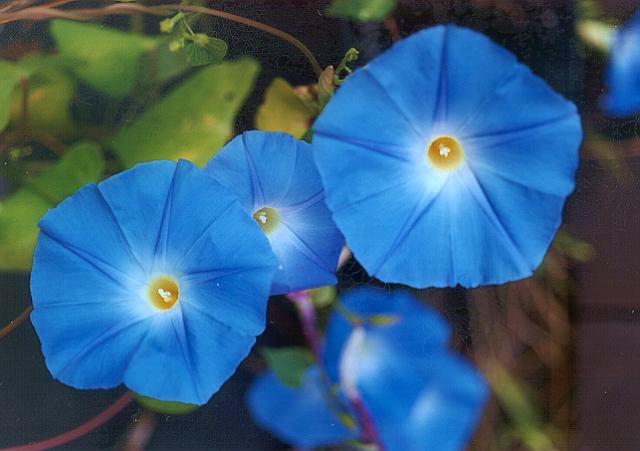 Mexican Morning GloryIpomoea tricolor
-
 Blue Morning GloryIpomoea indica
-
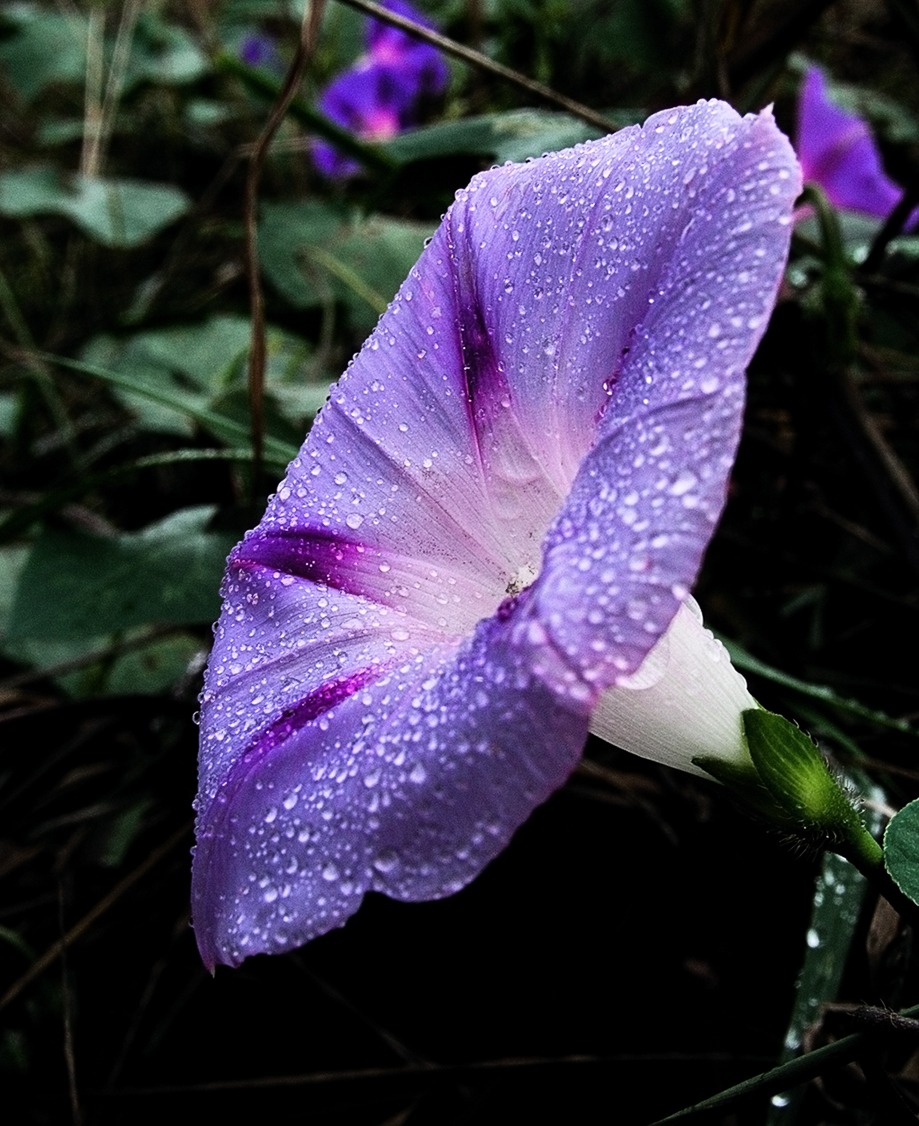 Common Morning-gloryIpomoea purpurea
-
 Cypress VineIpomoea quamoclit
-
 Beach Morning GloryIpomoea pes-caprae
Compare
Questions and answers
What is the scientific name of the White Morning-glory?
The scientific name of the White Morning-glory is Ipomoea lacunosa. Written with its author, the full name is Ipomoea lacunosa L..
Which family does the White Morning-glory belong to?
Ipomoea lacunosa belongs to the family Convolvulaceae, in the order Solanales and the class Magnoliopsida.
Where is the White Morning-glory found?
Checklists and occurrence records place Ipomoea lacunosa in 10 countries, including United States, Japan, South Korea, Mexico and Canada.
What is the conservation status of the White Morning-glory?
The IUCN Red List category recorded for Ipomoea lacunosa is Least Concern (LC).
What other names does the White Morning-glory have?
Ipomoea lacunosa is also known in English as Whitestar Potato, Pitted Morning Glory, Small White Morning Glory, White Morning Glory, White-star and Whitestar.
Is there a white morning-glory?
Yes. White Morning-glory is a species of flowering plant with flowers that are usually white and smaller than those of most other morning glories.[37]
How invasive is morning glory?
White Morning-glory grows rapidly, but its tendency to become invasive is relatively small compared with other members of its genus.[27][28]
Where are morning glory plants native to?
White Morning-glory is native to the United States. It occurs in almost every state on the eastern coast, as well as in some Midwestern states and California.[24][25]
What animals eat morning glories?
The plume moth Emmelina monodactyla feeds on White Morning-glory foliage, and several tortoise beetles use it as a host plant. Associated bees include bumblebees, Melitoma taurea, Peponapis pruinosa and Cemolobus ipomoea; certain caterpillars are also capable of digesting the species.[30][31][32][34]
Sources
Passages the profile rests on
- Its stem is a slightly hairy, twisting, climbing and twining vine. Source passage: “The stem of I. lacunosa is a slightly hairy (white hairs), twisting, climbing and twining vine with a small taproot.” — English Wikipedia
- Its vine can reach 2 metres in length. Source passage: “It can reach 2 meters in length.” — English Wikipedia
- Its root system consists of fibrous roots and a small taproot. Source passage: “The roots are fibrous and have a small taproot.” — English Wikipedia
- Mature plants have cordate leaves with pointed tips, sometimes divided into three deep lobes. Source passage: “In a mature plant, the leaves take on a cordate shape, with a pointed tip, although sometimes it may have 3 deep lobes.” — English Wikipedia
- The leaves of younger plants are usually ovate. Source passage: “The leaves of a less mature plant are usually ovate.” — English Wikipedia
- Its leaves are arranged alternately along the stem. Source passage: “They are arranged alternately on the stem of the plant.” — English Wikipedia
- Its leaf blades can reach 8 centimetres in width and 9.4 centimetres in length. Source passage: “The leaves themselves can be up to 8 cm wide and 9.4 cm long.” — English Wikipedia
- The leaf margins are typically purple and smooth. Source passage: “The margin of the leaf is typically purple and smooth.” — English Wikipedia
- The upper leaf surfaces may bear a small amount of white hairs. Source passage: “The upperside of the leaf may have a small amount of white hairs.” — English Wikipedia
- Its slender leaf stalks are usually at least 3 centimetres long. Source passage: “The slender petioles are usually at least 3 centimeters long” — English Wikipedia
- Its flower stalks are rough and usually bear between one and three flowers. Source passage: “The stalks of the plant that bears flowers is rough and usually has 1-3 flowers.” — English Wikipedia
- Its flowers are funnel-shaped and are normally white, with occasional light purple or pink coloration. Source passage: “The funnel-shaped flowers of the plant are normally white, but on rare occasion the flowers can be light purple or pink.” — English Wikipedia
- Its five joined or shallowly lobed petals are approximately 2.5 centimetres long. Source passage: “The five petals are joined (sympetalous) or shallowly lobed and are approximately 2.5 cm long.” — English Wikipedia
- Its sepals are light green, lanceolate and leathery. Source passage: “The sepals are light green, lanceolate, take on a leathery texture” — English Wikipedia
- Its sepals can reach 11.5 millimetres in length. Source passage: “can be up to 11.5 mm long.” — English Wikipedia
- Its anthers are pinkish-purple and its filaments are white. Source passage: “The anthers are a pinkish-purple and the filaments are white.” — English Wikipedia
- Its ovary is superior, green and cone-shaped. Source passage: “The ovary is superior, cone-like in shape, and green.” — English Wikipedia
- Its flowers have a single white stigma and style. Source passage: “There is a single white stigma and style.” — English Wikipedia
- Each flower has five stamens. Source passage: “There are five stamen.” — English Wikipedia
- Its flowers have no perceptible or obvious scent. Source passage: “The flowers have no perceptible or obvious scent.” — English Wikipedia
- Its seed capsules are spherical and hairy. Source passage: “There are large seed capsules in the flower that are spherical in shape and hairy.” — English Wikipedia
- Its seeds are irregularly oblong, shiny and brown or black. Source passage: “The seeds themselves are irregularly oblong, shiny, and brown or black.” — English Wikipedia
- Its fruits are capsules that can reach 10 millimetres in width. Source passage: “Fruit is seen in the form of a capsule that is slightly flattened or rounded in shape, and can be up to 10 millimetres (0.39 in) wide.” — English Wikipedia
- The species is native to the United States. Source passage: “Ipomoea lacunosa is native to the United States” — English Wikipedia
- The species occurs in almost every state on the eastern coast of the United States, as well as in some Midwestern states and California. Source passage: “Ipomoea lacunosa occurs in almost every state on the east coast, as well as some states in the Midwest, and California.” — English Wikipedia
- The species has been introduced to Canada and is established in Ontario. Source passage: “This species was also introduced to Canada and lives successfully in the province of Ontario.” — English Wikipedia
- The species grows rapidly. Source passage: “Although this plant grows rapidly” — English Wikipedia
- Its tendency to become invasive is relatively small compared with other members of its genus. Source passage: “its tendency to be invasive is rather small in comparison to other members of the genus.” — English Wikipedia
- The species relies on its vining growth habit for dispersal. Source passage: “I. lacunose depends on its vining habit for dispersal.” — English Wikipedia
- The plume moth Emmelina monodactyla feeds on the species' foliage. Source passage: “The larvae of the plume moth Emmelina monodactyla feeds on the foliage” — English Wikipedia
- The species serves as a host plant for several tortoise beetles. Source passage: “and it is host to several tortoise beetles.” — English Wikipedia
- Bees associated with the species include bumblebees, Melitoma taurea, Peponapis pruinosa and Cemolobus ipomoea. Source passage: “Insects associated with the plant include bees such as bumblebees, Melitoma taurea, Peponapis pruinosa, and Cemolobus ipomoea.” — English Wikipedia
- Other animals generally avoid eating the species because its high alkaloid content makes it unpalatable. Source passage: “Other animals usually avoid eating this plant due to the high alkaloid content which makes it unpalatable.” — English Wikipedia
- Certain caterpillars are capable of digesting the species. Source passage: “However certain caterpillars are capable of digesting the plant.” — English Wikipedia
- The alkaloid content of the species can make it toxic in some cases. Source passage: “In some cases the amount of alkaloid in the plant can make it toxic.” — English Wikipedia
- The species' whitestar potato is traditionally consumed by several Native American tribes, including the Chiricahua Apaches. Source passage: “The whitestar potato that it produces is traditionally consumed by a number of Native American tribes like the Chiricahua Apaches.” — English Wikipedia
- The species has flowers that are usually white and smaller than those of most other morning glories. Source passage: “The flowers of this species are usually white and smaller than most other morning glories.” — English Wikipedia
Data
- Catalogue of Life, 2026-10-16 XR cc by
- Global Biodiversity Information Facility CC BY 4.0
- Wikidata CC0
- GeoNames CC BY 4.0
- Wikimedia Commons per image; credit shown with each image
- Within the Catalogue of Life, this name comes from Synonymic Checklists of the Vascular Plants of the World cc by
References
- L. (1753). Sp. Pl. [Linnaeus] 1: 161 (1753). where the name was published
This species in other databases
- Catalogue of Life 3PWCQ
- Wikidata Q6065262
- iNaturalist 135262
- World Flora Online wfo-0001297936
- GRIN 20182
Page built on 26 November 2026. See how the catalog is made and all sources and licences.
Cite this page
ScientificNames.org. (2026). Ipomoea lacunosa (White Morning-glory). Retrieved November 26, 2026, from https://scientificnames.org/species/ipomoea-lacunosa
“Ipomoea lacunosa (White Morning-glory).” ScientificNames.org, 2026, scientificnames.org/species/ipomoea-lacunosa. Accessed 26 Nov. 2026.
ScientificNames.org. “Ipomoea lacunosa (White Morning-glory).” Accessed November 26, 2026. https://scientificnames.org/species/ipomoea-lacunosa.
@misc{scientificnames_ipomoea_lacunosa_white_morning_glory,
  author = {{ScientificNames.org}},
  title = {Ipomoea lacunosa (White Morning-glory)},
  year = {2026},
  url = {https://scientificnames.org/species/ipomoea-lacunosa},
  note = {Accessed 2026-11-26}
}