Species · Flowering plants
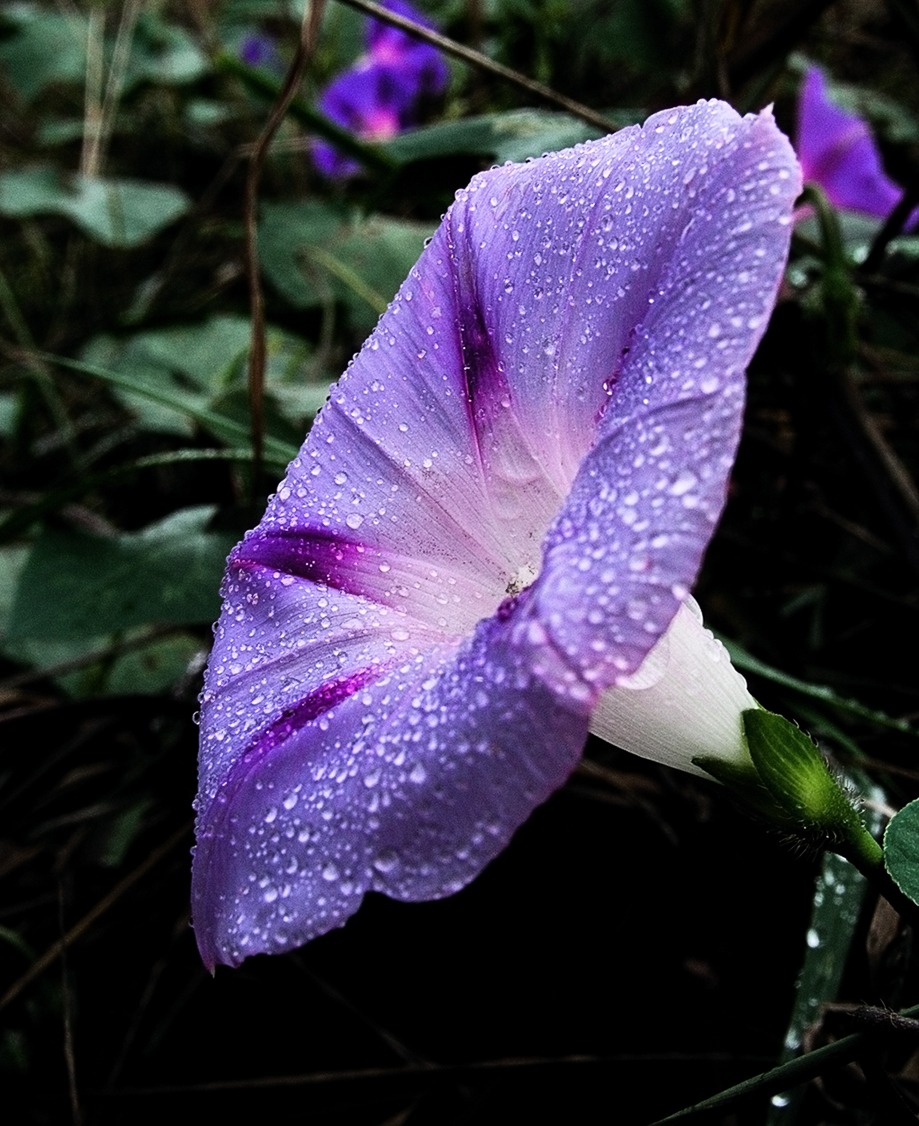
Lilac-bell Ipomoea muricata
The scientific name of the Lilac-bell is Ipomoea muricata. It is a species of flowering plant in the family Convolvulaceae (bindweed family), order Solanales.
- Scientific name
- Ipomoea muricata (L.) Jacq.
- Common name
- Lilac-bell
- Genus
- Ipomoea
- Family
- Convolvulaceae (Bindweed Family)
- Order
- Solanales
- Class
- Magnoliopsida
- Recorded in
- 44 countries
- Name status
- accepted in the Catalogue of Life
Overview
Ipomoea muricata, also called lavender moonvine, is a climbing vine in the genus Ipomoea, the same genus that contains the various morning glory species and sweet potato. It is native to Central America, but now distributed widely across the tropics and subtropics.
Classification of the Lilac-bell
| Kingdom | Plantae |
|---|---|
| Subkingdom | Pteridobiotina |
| Phylum | Tracheophyta |
| Class | Magnoliopsida |
| Order | Solanales |
| Family | Convolvulaceae (Bindweed Family) |
| Subfamily | Convolvuloideae |
| Tribe | Ipomoeeae |
| Genus | Ipomoea (Morning Glory) |
| Species | Ipomoea muricata (L.) Jacq. |
Where the Lilac-bell is found
Checklists and occurrence records place Ipomoea muricata in 44 countries across Africa, Asia, North America and South America. GBIF holds 940 georeferenced records of it.
Countries where it is native or its origin is not stated
- Argentina 3
- Bolivia 18
- Bonaire, Saint Eustatius and Saba 6
- Brazil 60
- Colombia 1
- Costa Rica 21
- Curacao 18
- Ecuador 13
- El Salvador 10
- Honduras 2
- Mexico 223
- Nicaragua 8
- Peru 3
- Venezuela 3
Countries where it has been introduced
- Angola 2
- Bangladesh 1
- Benin 50
- Bhutan 4
- Burkina Faso 5
- Cabo Verde 14
- Central African Republic
- Chad
- China 33
- Eritrea
- Gambia 1
- Guinea 4
- India 116
- Malawi 5
- Mali 2
- Mozambique 3
- Myanmar 5
- Nepal 15
- Nigeria 8
- Pakistan 10
- Philippines 3
- Senegal 11
- Sierra Leone 16
- South Sudan 1
- Sri Lanka 2
- Tanzania 9
- United States 226
- Vietnam
- Zambia 3
- Zimbabwe 2
Regions and cities with the most records
- Sinaloa, Mexico 34
- Sonora, Mexico 32
- Florida, United States 23
- Zou, Benin 19
- Gujarat, India 18
- Yucatán, Mexico 18
- Guanacaste Province, Costa Rica 17
- México, Mexico 14
- Abomey, Benin 12
- Jalisco, Mexico 12
- Santa Cruz Department, Bolivia 12
- Tallahassee, United States 12
- Guangxi, China 11
- Culiacán, Mexico 10
- Alabama, United States 9
- Praia, Cabo Verde 9
- Atakora, Benin 7
- Baja California Sur, Mexico 7
- Borgou, Benin 7
- Guerrero, Mexico 7
- Parakou, Benin 7
- Willemstad, Curacao 7
- Ahuachapan, El Salvador 6
- Georgia, United States 6
- Kouffo, Benin 6
- Mississippi, United States 6
- São Domingos, Cabo Verde 6
- Virginia, United States 6
- Yunnan, China 6
- Bahia, Brazil 5
- Bohicon, Benin 5
- Bonaire, Bonaire, Saint Eustatius and Saba 5
- Maharashtra, India 5
- Rio Grande do Norte, Brazil 5
- Valdosta, United States 5
- Chihuahua, Mexico 4
8 more countries have a few records outside this range
These countries hold a few records of Ipomoea muricata but lie outside the range the checklists give for it. Such records are often zoo or garden specimens, museum material or vagrants, so the species is not counted as occurring there.
Range as the checklists state it
Cape Verde Isl. [I]; Senegal [I]; Gambia [I]; Guinea [I]; Sierra Leone [I]; Mali [I]; Burkina Faso [I]; Benin [I]; Nigeria [I]; Central African Republic [I]; SW-Chad [I]; South Sudan [I]; Eritrea [I]; Tanzania [I]; Angola [I]; Zambia [I]; Malawi [I]; Zimbabwe [I]; Mozambique [I]; China [I] (Henan [I], Hubei [I], Hunan [I], S-Yunnan [I]); Pakistan [I]; Nepal [I]; Bhutan [I]; India [I] (throughout); Sri Lanka [I]; Bangladesh [I]; Myanmar [I] (Yangon [I]); Vietnam [I]; Philippines [I]; USA [I] (Arkansas [I], Florida [I], Georgia [I], Louisiana [I], Mississippi [I], North Carolina [I], South Carolina [I], Texas [I]); Mexico (Baja California Sur, Chihuahua, Coahuila, Colima, Ciudad de Mexico, Guanajuato, Jalisco, México State, San Luis Potosí, Sinaloa, Sonora, Yucatán); El Salvador; Honduras; Nicaragua; Costa Rica; St. Eustatius; Bonaire; Curacao; Colombia; Venezuela (Bolívar, Guárico); Ecuador; +Galápagos; Peru; Bolivia (Chuquisaca, Santa Cruz, Tarija); Argentina (Jujuy, Salta)
A number beside a place is its count of GBIF occurrence records. A place without a number comes from a checklist alone. Records show where a species has been observed or collected, which can include escapes and vagrants.
Common names
English
- Lilac-bell
- Purple Moonflower
Names in 2 other languages
- Papiamento
- Kabuya di Yuana
- Swedish
- skär månvinda
Synonyms
22 other scientific names have been used for this species and are now treated as synonyms of Ipomoea muricata.
- Bonanox muricata (L.) Raf.
- Calonyction muricatum (L.) G.Don
- Calonyction pseudomuricatum (Bernh. ex Link) G.Don
- Calonyction speciosum var. muricatum (L.) Choisy
- Convolvulus colubrinus Blanco
- Convolvulus petiolaris Kunth ex Spreng.
- Convolvulus petiolaris Kunth
- Convolvulus smilacifolius Salisb.
- Ipomoea bona-nox var. purpurascens Ker Gawl.
- Ipomoea calderonii Standl.
- Ipomoea kirkiana Britten
- Ipomoea petiolaris (Kunth) G.Don
- Ipomoea pseudomuricata Bernh. ex Link
- Ipomoea spinulosa Brandegee
- Ipomoea tubiflora Hook.fil.
- Ipomoea tubiflora Hook.
- Ipomoea turbinata Lag. ex Choisy
- Ipomoea turbinata Lag.
- Leptocallis quinata G.Don
- Convolvulus muricatus L. ambiguous synonym
- Diatrema muricata (L.) Raf. ambiguous synonym
- Ipomoea shirensis Baker ambiguous synonym
Related species
-
 Sweet PotatoIpomoea batatas
-
 Water Morning GloryIpomoea aquatica
-
 MoonflowerIpomoea alba
- Garden Morning GloryIpomoea tricolor
-
 Oceanblue Morning GloryIpomoea indica
-
 Common Morning-gloryIpomoea purpurea
-
 Star-gloryIpomoea quamoclit
-
 Goat's FootIpomoea pes-caprae
Compare
Questions and answers
What is the scientific name of the Lilac-bell?
The scientific name of the Lilac-bell is Ipomoea muricata. Written with its author, the full name is Ipomoea muricata (L.) Jacq..
Which family does the Lilac-bell belong to?
Ipomoea muricata belongs to the family Convolvulaceae, in the order Solanales and the class Magnoliopsida.
Where is the Lilac-bell found?
Checklists and occurrence records place Ipomoea muricata in 44 countries, including Mexico, Brazil, Costa Rica, Bolivia, Curacao and Ecuador.
What other names does the Lilac-bell have?
Ipomoea muricata is also known in English as Purple Moonflower.
Sources
Data
- Catalogue of Life, 2026-10-16 XR cc by
- Global Biodiversity Information Facility CC BY 4.0
- Wikidata CC0
- English Wikipedia CC BY-SA 4.0
- GeoNames CC BY 4.0
- Within the Catalogue of Life, this name comes from Synonymic Checklists of the Vascular Plants of the World cc by
References
- Jacq. (1798). Pl. Rar. Hort. Schoenbr. 3: 40, t. 323 (1798). where the name was published
This species in other databases
Page built on 25 November 2026. See how the catalog is made and all sources and licences.
Cite this page
ScientificNames.org. (2026). Ipomoea muricata (Lilac-bell). Retrieved November 25, 2026, from https://scientificnames.org/species/ipomoea-muricata
“Ipomoea muricata (Lilac-bell).” ScientificNames.org, 2026, scientificnames.org/species/ipomoea-muricata. Accessed 25 Nov. 2026.
ScientificNames.org. “Ipomoea muricata (Lilac-bell).” Accessed November 25, 2026. https://scientificnames.org/species/ipomoea-muricata.
@misc{scientificnames_ipomoea_muricata_lilac_bell,
  author = {{ScientificNames.org}},
  title = {Ipomoea muricata (Lilac-bell)},
  year = {2026},
  url = {https://scientificnames.org/species/ipomoea-muricata},
  note = {Accessed 2026-11-25}
}