Species · Flowering plants
Moonflower Ipomoea violacea
The scientific name of the Moonflower is Ipomoea violacea. It is a species of flowering plant in the family Convolvulaceae (bindweed family), order Solanales.
- Scientific name
- Ipomoea violacea L.
- Common name
- Moonflower
- Genus
- Ipomoea
- Family
- Convolvulaceae (Bindweed Family)
- Order
- Solanales
- Class
- Magnoliopsida
- Recorded in
- 85 countries
- Name status
- accepted in the Catalogue of Life

Overview
Ipomoea violacea is a perennial species of Ipomoea that occurs throughout the world with the exception of the European continent. It is most commonly called beach moonflower or sea moonflower as the flowers open at night.
Classification of the Moonflower
| Kingdom | Plantae |
|---|---|
| Subkingdom | Pteridobiotina |
| Phylum | Tracheophyta |
| Class | Magnoliopsida |
| Order | Solanales |
| Family | Convolvulaceae (Bindweed Family) |
| Subfamily | Convolvuloideae |
| Tribe | Ipomoeeae |
| Genus | Ipomoea (Morning Glory) |
| Species | Ipomoea violacea L. |
Where the Moonflower is found
Checklists and occurrence records place Ipomoea violacea in 85 countries across Africa, Asia, North America, Oceania and South America. GBIF holds 3,995 georeferenced records of it.
Countries where it is native or its origin is not stated
- American Samoa 20
- Argentina 3
- Aruba 6
- Australia 984
- Bahamas 60
- Bangladesh 1
- Barbados 1
- Belize 37
- Bonaire, Saint Eustatius and Saba 6
- Brazil 52
- British Indian Ocean Territory 40
- British Virgin Islands 4
- Cayman Islands 87
- China 8
- Christmas Island 11
- Cocos Islands 12
- Colombia 7
- Cook Islands 48
- Cuba 61
- Curacao 5
- Dominican Republic 24
- Ecuador 4
- Fiji 30
- French Guiana 3
- French Polynesia 201
- Ghana 6
- Guadeloupe 34
- Guam 15
- Guinea-Bissau
- Guyana 3
- Haiti 8
- Honduras 2
- India 167
- Indonesia 47
- Jamaica 38
- Japan 3
- Kenya 18
- Kiribati 133
- Madagascar 43
- Malaysia 10
- Maldives 26
- Marshall Islands 203
- Martinique 6
- Mauritius 12
- Mayotte 19
- Mexico 304
- Micronesia 66
- Mozambique 8
- Nauru 8
- New Caledonia 75
- New Zealand 3
- Niue 16
- Northern Mariana Islands 22
- Palau 22
- Panama 24
- Papua New Guinea 35
- Peru 15
- Philippines 26
- Pitcairn 28
- Puerto Rico 69
- Saint Kitts and Nevis 5
- Saint Martin 3
- Saint Vincent and the Grenadines 3
- Samoa 14
- Senegal 4
- Seychelles 122
- Singapore 1
- Solomon Islands 23
- Sri Lanka 18
- Suriname 14
- Taiwan 149
- Tanzania 27
- Thailand 37
- Tokelau 1
- Tonga 26
- Trinidad and Tobago 16
- Turks and Caicos Islands 11
- Tuvalu 5
- U.S. Virgin Islands 18
- United States Minor Outlying Islands 12
- Vanuatu 14
- Venezuela 5
- Vietnam 3
- Wallis and Futuna 5
Countries where it has been introduced
Regions and cities with the most records
- Queensland, Australia 259
- Northern Territory, Australia 166
- Kerala, India 113
- Kochi, India 110
- Maradu, India 109
- Cherthala, India 108
- Shertallai, India 108
- Tripunittura, India 106
- Quintana Roo, Mexico 105
- Kanayannur, India 79
- Florida, United States 75
- Yucatán, Mexico 67
- Campeche, Mexico 39
- Outer Islands, Seychelles 38
- Western Australia, Australia 32
- Darwin, Australia 23
- Tainan, Taiwan 20
- Taiwan, Taiwan 20
- Hawaii, United States 17
- Cancún, Mexico 16
- Fajardo, Puerto Rico 15
- Yongkang, Taiwan 15
- Maharashtra, India 14
- Rockhampton, Australia 14
- La Digue and Inner Islands, Seychelles 13
- Ciego de Ávila Province, Cuba 12
- Mamoudzou, Mayotte 12
- Donggang, Taiwan 11
- Eldoret, Kenya 11
- Nouméa, New Caledonia 11
- Uasin Gishu County, Kenya 11
- West Bay, Cayman Islands 11
- Fengshan, Taiwan 10
- Goa, India 10
- Kaohsiung, Taiwan 10
- Mormugao, India 10
1 more country has a few records outside this range
These countries hold a few records of Ipomoea violacea but lie outside the range the checklists give for it. Such records are often zoo or garden specimens, museum material or vagrants, so the species is not counted as occurring there.
Range as the checklists state it
Guinea-Bissau; Ghana; Kenya; Pemba Isl.; Tanzania; Zanzibar; Mozambique; Madagascar; Comores (Mayotte, etc.); Mozambique Channel Isl. [Îles Éparses] (Île Europa, Juan de Nova Isl.); Mauritius (incl. Cargados Carajos Isl.); Rodrigues; Îles Glorieuses; Aldabra (Aldabra Isl., Asuncio Isl., Cosmoledo Isl., Astove Isl., Providence Isl., Farquhar Isl.); Seychelles (incl. Desroches Isl., Coetivy Isl., Darros Isl.); Chagos Arch. (Diego Garcia); China (Guangdong, Hainan); Ogasawara Isl. (Minami-Iwojima); Taiwan; India (Bihar, Delhi, Karnataka, Madhya Pradesh, Maharashtra, Punjab, Rajasthan, West Bengal); Lakshadweep Isl. [Laccadives]; Maldives; Sri Lanka; Bangladesh; Andaman Isl. (North Andaman Isl., Middle Andaman Isl., South Andaman Isl., Little Andaman Isl.); Nicobar Isl. (Car Nicobar Isl., North Nicobar Isl., Central Nicobar Isl., Great Nicobar Isl., Little Nicobar Isl.); Thailand; Vietnam; South China Sea Isl.; peninsular Malaysia (Perlis, Langkawi Isl.); Singapore; Sumatera; Borneo (Sabah, etc.); Sulawesi; Philippines; Jawa; Lesser Sunda Isl.; Moluccas; Cocos [Keeling] Isl.; Christmas Isl. [Austr.]; New Guinea (Irian Jaya, Papua New Guinea); Bismarck Arch.; Solomon Isl.; Australia (Western Australia, Northern Territory, Queensland); Ashmore & Cartier Isl. (Ashmore Reef); New Caledonia; Vanuatu; Rotuma Isl.; Tonga ('Eua, Lifuka); Niue; Fiji; Wallis & Futuna (Alofi Isl., Futuna Isl., 'Uvea Isl. and islets [Wallis]); American Samoa (Tutuila, Aunu'u, Ta'u, Rose Atoll); [Western] Samoa (Aleipata Islands, 'Upolu, Savai'i); Tuvalu (Nui Atoll); Tokelau (Nukunonu, Fakaofo); Tokelau (Swains Isl.); Phoenix Isl. (Kanton, Orona, Enderbury, Nikumaroro, Manra); Gilbert Isl. (Tarawa, Nonouti, Tabiteuea, Onotoa); N-Line Isl. (Palmyra Atoll, Teraina, Tabueran); S-Line Isl. (Caroline Atoll); S-Line Isl. (Caroline Atoll); Cook Isl. (Rarotonga, Mangaia, Aitutaki, ?Manuae, Ngaputoru Group, Takatea, N-Cook Isl.); Marquesas Isl. (Nuku Hiva, Ua Huka, Ua Pou, Hiva Oa, Hatutaa, Eiao, Tahuata, Mohotani, Fatu Hiva); Society Isl. (Huahine, Maupiti, Moorea, Raiatea, Mopelia Atoll, Tetiaroa Atoll, Tupai); Tuamotu Arch. (Ahunui, Niau, Tikei); Tuamotu Arch. (Rangiroa Atoll); Austral Isl. (Rurutu, Raivavae); Pitcairn Isl.; Henderson Isl.; Palau (Koror, Ngeanges, Peleliu, Sonsorol); Northern Marianas (Saipan, Tinian, Rota); Guam; Fed. States of Micronesia (Yap, Ulithi, Eauripik, Woleai, Faraulep, Ifalik, Gaferut, Namonuito, Murilo, Truk, Moen, Piis, Lukunor, Satawan, Nukuoro, Kapingamarangi, Arn, Mokil, Pingelap, Pohnpei); Marshall Isl. (Bokak, Enewetok, Bikini, Ailinginae, Rongelap, Rongerik, Utirik, Ujelang, Ujae, Wotho, Lae, Kwajalein, Ailuk, Jemo, Likiep, Mejit, Aur, Ailinglapalap, Majuro, Arno, Kili, Jaluit); Wake Isl.; Hawaii [I] (Oahu [I], Molokai [I], Maui [I], Hawaii Isl. [I]); USA (Florida, Texas); Mexico (Campeche, Durango, Jalisco, Morelos, Quintana Roo, Yucatán, Veracruz, Zacatecas); Belize; Honduras; Panama; Bahamas; Turks & Caicos Isl.; Cuba; Cayman Isl.; Jamaica; Hispaniola; Puerto Rico; Virgin Isl. (Guana, St. Croix, St. John, St. Thomas, Tortola); Saba; St. Eustatius; St. Kitts; Guadeloupe; Martinique; St. Lucia; Grenadines; St. Vincent; Barbados; Tobago; Trinidad; Aruba; Curacao; San Andrés y Providencia (San Andrés, Providencia y Santa Catalina); Venezuela (Aragua, Delta Amacuro, Dependencias Federales, Venezuela Distrito Federal, Falcón); Guyana; Surinam; French Guiana
A number beside a place is its count of GBIF occurrence records. A place without a number comes from a checklist alone. Records show where a species has been observed or collected, which can include escapes and vagrants.
Common names
English
- Moonflower
- Sea Moonflower
- Beach Moonflower
Names in 2 other languages
- Chinese
- 圓萼天茄兒, 管花薯
- Spanish
- bejuco de luna, jabilla
Synonyms
32 other scientific names have been used for this species and are now treated as synonyms of Ipomoea violacea.
- Calonyction comespermum Bojer
- Calonyction comorensis Bojer ex Desjardins
- Calonyction comorensis Bojer
- Calonyction comospermum Bojer
- Calonyction grandiflorum (Jacq.) Choisy
- Calonyction jacquinii G.Don
- Calonyction longiflorum (R.Br.) Hassk.
- Calonyction macranthum (Schult.) Lem.
- Calonyction muticum Decne.
- Calonyction noctolucum G.Don
- Calonyction speciosum var. laeve Choisy
- Calonyction tuba (Schltdl.) Colla
- Convolvulus catharticus Blanco
- Convolvulus muticus (Decne.) Steud.
- Convolvulus tuba Schltdl.
- Ipomoea browniana F.Dietr.
- Ipomoea comosperma Drake
- Ipomoea glaberrima Bojer ex Bouton
- Ipomoea grandiflora (Jacq.) Hallier
- Ipomoea tuba (Schltdl.) G.Don
- Pharbitis violacea (L.) Bojer
- Tereietra violacea (L.) Raf.
- Convolvulus grandiflorus Jacq. ambiguous synonym
- Convolvulus grandiflorus Desr. ambiguous synonym
- Convolvulus longiflorus (R.Br.) Spreng. ambiguous synonym
- Convolvulus violaceus (L.) Spreng. ambiguous synonym
- Ipomoea grandiflora (Jacq.) Hallier fil. ambiguous synonym
- Ipomoea grandiflora (Jacq.) Roxb. ambiguous synonym
- Ipomoea longiflora R.Br. ambiguous synonym
- Ipomoea macrantha Roem. & Schult. ambiguous synonym
- Jacquemontia canescens Benth. ambiguous synonym
- Operculina grandiflora (Wall.) House ambiguous synonym
Related species
-
 Sweet PotatoIpomoea batatas
-
 Water Morning GloryIpomoea aquatica
-
 MoonflowerIpomoea alba
- Garden Morning GloryIpomoea tricolor
-
 Oceanblue Morning GloryIpomoea indica
-
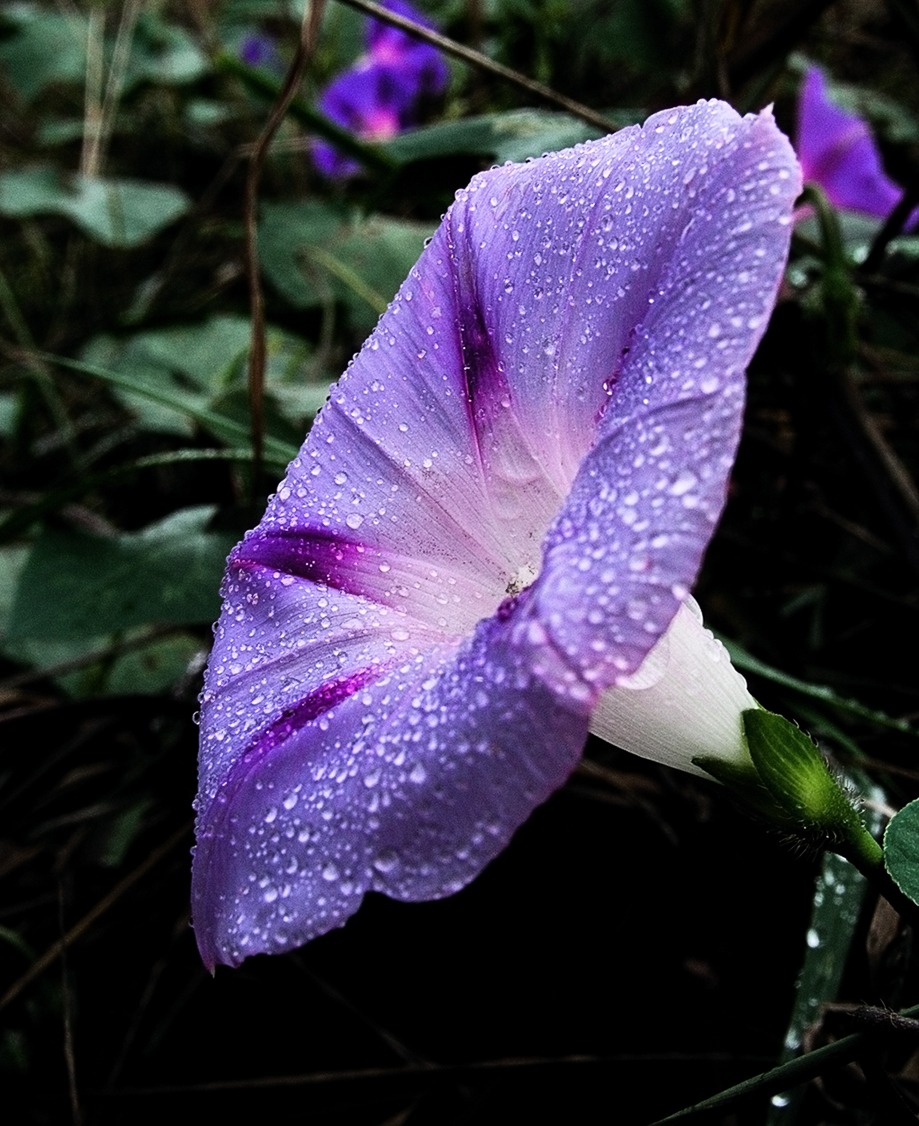 Common Morning-gloryIpomoea purpurea
-
 Star-gloryIpomoea quamoclit
-
 Goat's FootIpomoea pes-caprae
Compare
Questions and answers
What is the scientific name of the Moonflower?
The scientific name of the Moonflower is Ipomoea violacea. Written with its author, the full name is Ipomoea violacea L..
Which family does the Moonflower belong to?
Ipomoea violacea belongs to the family Convolvulaceae, in the order Solanales and the class Magnoliopsida.
Where is the Moonflower found?
Checklists and occurrence records place Ipomoea violacea in 85 countries, including Australia, Mexico, Marshall Islands, French Polynesia, India and Taiwan.
What other names does the Moonflower have?
Ipomoea violacea is also known in English as Sea Moonflower and Beach Moonflower.
Sources
Data
- Catalogue of Life, 2026-10-16 XR cc by
- Global Biodiversity Information Facility CC BY 4.0
- Wikidata CC0
- English Wikipedia CC BY-SA 4.0
- GeoNames CC BY 4.0
- Wikimedia Commons per image; credit shown with each image
- Within the Catalogue of Life, this name comes from Synonymic Checklists of the Vascular Plants of the World cc by
References
- L. (1753). Sp. Pl. [Linnaeus] 1: 161 (1753). where the name was published
This species in other databases
Page built on 24 November 2026. See how the catalog is made and all sources and licences.
Cite this page
ScientificNames.org. (2026). Ipomoea violacea (Moonflower). Retrieved November 24, 2026, from https://scientificnames.org/species/ipomoea-violacea
“Ipomoea violacea (Moonflower).” ScientificNames.org, 2026, scientificnames.org/species/ipomoea-violacea. Accessed 24 Nov. 2026.
ScientificNames.org. “Ipomoea violacea (Moonflower).” Accessed November 24, 2026. https://scientificnames.org/species/ipomoea-violacea.
@misc{scientificnames_ipomoea_violacea_moonflower,
  author = {{ScientificNames.org}},
  title = {Ipomoea violacea (Moonflower)},
  year = {2026},
  url = {https://scientificnames.org/species/ipomoea-violacea},
  note = {Accessed 2026-11-24}
}