Species · Birds
Rufous-bellied Antwren Isleria guttata
The scientific name of the Rufous-bellied Antwren is Isleria guttata. It is a species of bird in the family Thamnophilidae (antbird), order Passeriformes. The name dates from 1824.
- Scientific name
- Isleria guttata (Vieillot, 1824)
- Common name
- Rufous-bellied Antwren
- Genus
- Isleria
- Family
- Thamnophilidae (Antbird)
- Order
- Passeriformes
- Class
- Aves
- Red List category
- LC Least Concern
- Recorded in
- 5 countries
- Name status
- accepted in the Catalogue of Life

Overview
Isleria guttata occurs in Brazil, French Guiana, Guyana, Suriname, and Venezuela. It has a very short tail, predominantly gray adult males, and olive-gray upperparts in adult females.
Written 27 November 2026 from the sources listed below. Each statement was checked against the passage it cites; statements that could not be supported were removed.
Appearance
The Rufous-bellied Antwren measures 8.5–9.5 cm in length and weighs 8.5–11 g. It has a very short tail.[1][2][3]
Adult males are predominantly gray, with a white patch between their scapulars and pale cinnamon spots on their uppertail coverts. Their wings and tails are blackish-brown, with cinnamon edges on the flight feathers, and their throats are pale gray.[4][5][6][7][8]
Adult males have tawny lower bellies, flanks, and crissums. Adult females have olive-gray upperparts and a grayish-olive breast.[9][10]
Habitat
The Rufous-bellied Antwren primarily inhabits terra firme evergreen forest and is described as a tiny resident of tall rainforest. It favors shady undergrowth with abundant leaf litter.[11][12][13]
It particularly favors habitat near slow-moving streams and somewhat wet areas. It occurs from sea level to 600 m elevation.[14][15]
Diet
The Rufous-bellied Antwren feeds on insects and spiders.[16]
Behaviour
The Rufous-bellied Antwren is believed to remain in its range throughout the year. It usually forages alone or in pairs and also joins mixed-species feeding flocks passing through its territory.[17][18][19]
It typically forages from the ground to approximately 1 m above it, sometimes feeding as high as 2 m. It gleans food from leaves, stems, and branches.[20][21][22]
While foraging, it uses short jumps and upward movements along vertical stems and vines. It has been observed following army ant swarms in Brazil, Guyana, and Suriname.[23][24]
Its song is very high-pitched and nearly level, consisting of 15–20 separated notes. It has a low, rattling alarm call, also described as distinctive and sputtering.[25][26][27]
The Rufous-bellied Antwren is wary and difficult to observe clearly.[28]
Reproduction and life cycle
The breeding season includes at least August through December. The species builds a cup-shaped nest suspended approximately 1–1.5 m above the ground.[29][30]
The clutch consists of two eggs.[31]
Conservation
The Rufous-bellied Antwren is classified as Least Concern by the IUCN in the 2025 assessment. It has a very large geographic range and is considered uncommon to fairly common.[32][33][34][35]
Its population size is unknown and is believed to be stable. No immediate threats to the species have been identified.[36][37]
Its range includes several large protected areas and extensive intact habitat under little or no current development threat.[38]
Similar species
The plain-throated antwren (Isleria hauxwelli) shares the genus Isleria with the Rufous-bellied Antwren. The two species form a superspecies.[39]
Classification of the Rufous-bellied Antwren
| Kingdom | Animalia |
|---|---|
| Phylum | Chordata |
| Subphylum | Vertebrata |
| Infraphylum | Gnathostomata |
| Parvphylum | Osteichthyes |
| Megaclass | Tetrapoda |
| Class | Aves (Bird) |
| Order | Passeriformes (Passerine) |
| Family | Thamnophilidae (Antbird) |
| Genus | Isleria (Antwrens) |
| Species | Isleria guttata (Vieillot, 1824) |
Where the Rufous-bellied Antwren is found
Checklists and occurrence records place Isleria guttata in 5 countries across South America. GBIF holds 2,283 georeferenced records of it.
Countries
Regions and cities with the most records
- Amazonas, Brazil 293
- Potaro-Siparuni, Guyana 288
- Upper Takutu-Upper Essequibo, Guyana 213
- Sipaliwini District, Suriname 172
- Bolívar, Venezuela 147
- Amapá, Brazil 98
- Cuyuni-Mazaruni, Guyana 47
- Presidente Figueiredo, Brazil 46
- Roraima, Brazil 44
- Brokopondo District, Suriname 42
- Pará, Brazil 42
- Kourou, French Guiana 33
- Oiapoque, Brazil 29
- Pedra Branca do Amapari, Brazil 29
- Para District, Suriname 23
- Matoury, French Guiana 20
- Amazonas, Venezuela 18
- Saint-Laurent-du-Maroni, French Guiana 17
- Essequibo Islands-West Demerara, Guyana 15
- Rémire-Montjoly, French Guiana 15
- Caracaraí, Brazil 12
- Porto Grande, Brazil 11
- Upper Demerara-Berbice, Guyana 10
- Barima-Waini, Guyana 9
- Cayenne, French Guiana 8
- Laranjal do Jari, Brazil 6
- São Gabriel da Cachoeira, Brazil 6
- Óbidos, Brazil 5
- Novo Airão, Brazil 4
- East Berbice-Corentyne, Guyana 3
- Lelydorp, Suriname 3
- Paramaribo, Suriname 3
Range as the checklists state it
South America
A number beside a place is its count of GBIF occurrence records. A place without a number comes from a checklist alone. Records show where a species has been observed or collected, which can include escapes and vagrants.
Common names
English
- Rufous-bellied Antwren
Names in 22 other languages
- Catalan
- formigueret de ventre rogenc
- Chinese
- 棕腹蚁鹩, 棕腹蟻鷯
- Croatian
- sivo-smeđa mravarica
- Czech
- mravenčík rezavobřichý
- Danish
- Rødbuget Myresmutte
- Dutch
- Roodbuikmiersluiper
- Esperanto
- rufaventra formikulo
- Finnish
- punaperämuuranen
- French
- Batara à ventre roux, Myrmidon moucheté
- German
- Rostbauch-Ameisenschlüpfer
- Italian
- Scricciolo formichiero panciarossiccia
- Japanese
- アカハラヒメアリサザイ
- Lithuanian
- rusvapilvė karietaitinė skruzdlesė
- Norwegian
- rustbukmaursmett
- Polish
- kusomrówiaczek rudobrzuchy
- Portuguese
- choquinha-de-barriga-ruiva, formigueirinho-de-barriga-ruiva
- Russian
- Краснобрюхая крапивниковая муравьеловка, Рыжебрюхий эсперито
- Slovak
- batara hrdzavobruchá, pralesníček hrdzavobruchý
- Spanish
- Hormiguerito ventrirrufo
- Swedish
- rostbukig myrfågel, rostbukig myrsmyg
- Turkish
- Kızıl Karınlı Karıncakuşu
- Ukrainian
- кадук рудочеревий
Synonyms
2 other scientific names have been used for this species and are now treated as synonyms of Isleria guttata.
- Myrmothera guttata Vieillot, 1824
- Myrmotherula guttata (Vieillot, 1824)
Related species
-
 Plain-throated AntwrenIsleria hauxwelli
-
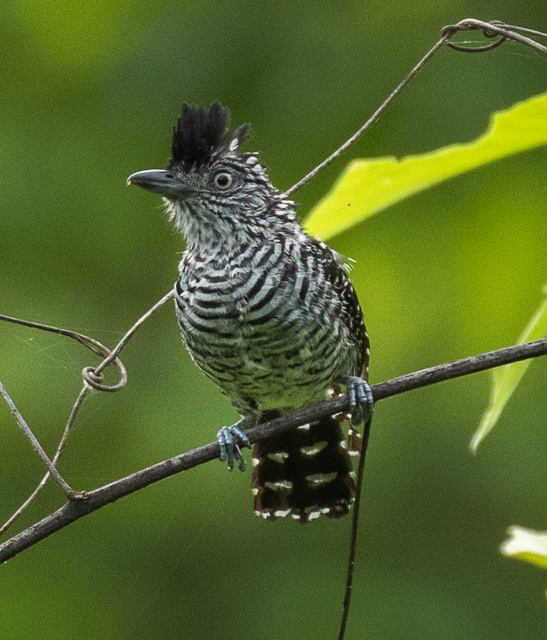 Barred AntshrikeThamnophilus doliatus
-
 Great AntshrikeTaraba major
-
 Black-crowned AntshrikeThamnophilus atrinucha
-
 Ocellated AntbirdPhaenostictus mcleannani
-
 Bicolored AntbirdGymnopithys bicolor
-
 Fasciated AntshrikeCymbilaimus lineatus
-
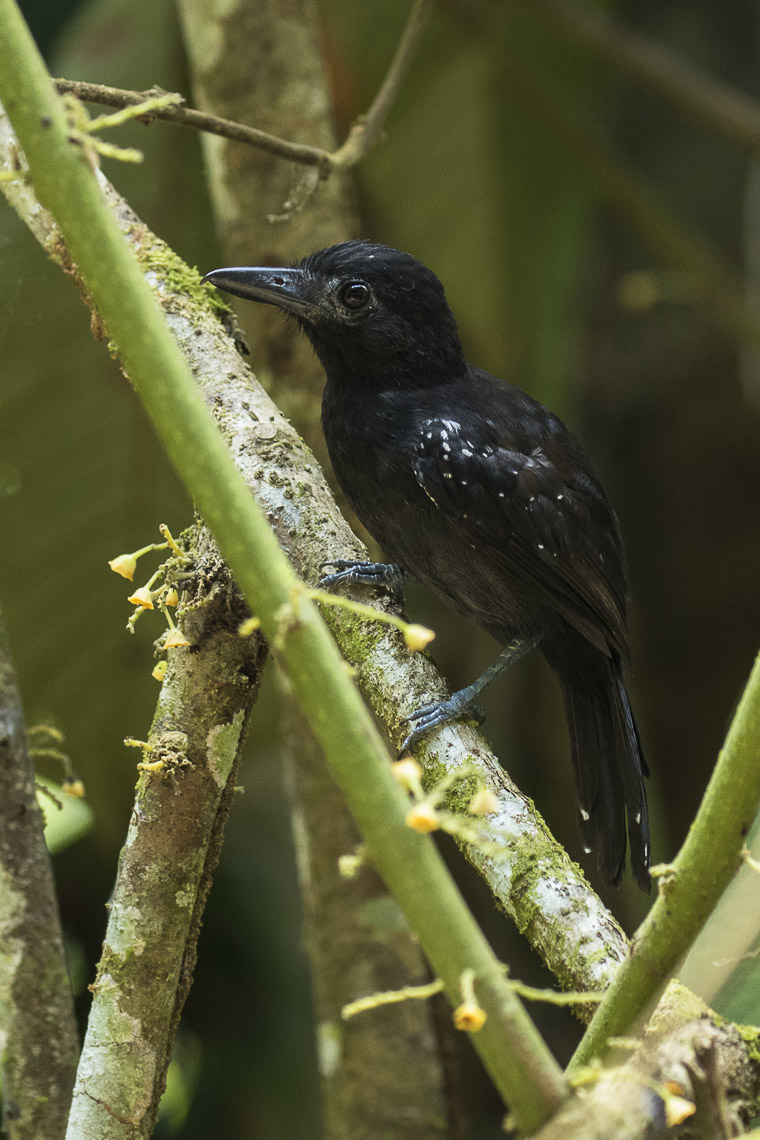 Black-hooded AntshrikeThamnophilus bridgesi
Compare
Questions and answers
What is the scientific name of the Rufous-bellied Antwren?
The scientific name of the Rufous-bellied Antwren is Isleria guttata. Written with its author, the full name is Isleria guttata (Vieillot, 1824).
Which family does the Rufous-bellied Antwren belong to?
Isleria guttata belongs to the family Thamnophilidae, in the order Passeriformes and the class Aves.
Where is the Rufous-bellied Antwren found?
Checklists and occurrence records place Isleria guttata in 5 countries: Brazil, Guyana, French Guiana, Suriname and Venezuela.
What is the conservation status of the Rufous-bellied Antwren?
The IUCN Red List category recorded for Isleria guttata is Least Concern (LC).
Where does the Rufous-bellied Antwren occur?
It occurs in Brazil, French Guiana, Guyana, Suriname, and Venezuela. In southern Venezuela, it occurs in the Bolívar and Amazonas states.[40][41]
What is the typical habitat of the Rufous-bellied Antwren?
It primarily inhabits terra firme evergreen forest, particularly shady undergrowth with abundant leaf litter near slow-moving streams and somewhat wet areas.[11][12][14]
What does the Rufous-bellied Antwren eat?
Its diet includes insects and spiders.[16]
How does the Rufous-bellied Antwren forage?
It usually forages alone or in pairs, typically from the ground to approximately 1 m above it, and sometimes as high as 2 m. It gleans food from leaves, stems, and branches.[18][20][21][22]
When does the Rufous-bellied Antwren breed?
Its breeding season includes at least August through December.[29]
Sources
Passages the profile rests on
- The species measures 8.5–9.5 cm in length. Source passage: “The rufous-bellied antwren is 8.5 to 9.5 cm (3.3 to 3.7 in) long” — English Wikipedia
- The species weighs 8.5–11 g. Source passage: “weighs 8.5 to 11 g (0.30 to 0.39 oz).” — English Wikipedia
- The species has a very short tail. Source passage: “It has a very short tail.” — English Wikipedia
- Adult males are predominantly gray. Source passage: “Adult males are mostly gray.” — English Wikipedia
- Adult males have a white patch between their scapulars. Source passage: “They have a white patch between their scapulars” — English Wikipedia
- Adult males have pale cinnamon spots on their uppertail coverts. Source passage: “pale cinnamon spots on their uppertail coverts.” — English Wikipedia
- Adult males have blackish-brown wings and tails with cinnamon edges on the flight feathers. Source passage: “Their wings and tail are blackish brown with cinnamon edges on the flight feathers” — English Wikipedia
- Adult males have a pale gray throat. Source passage: “Their throat is pale gray” — English Wikipedia
- Adult males have tawny lower bellies, flanks, and crissums. Source passage: “their lower belly, flanks, and crissum are tawny.” — English Wikipedia
- Adult females have olive-gray upperparts and a grayish-olive breast. Source passage: “Adult females have olive-gray upperparts and a grayish olive breast” — English Wikipedia
- The species primarily inhabits terra firme evergreen forest. Source passage: “It primarily inhabits terra firme evergreen forest.” — English Wikipedia
- The species favors shady undergrowth with abundant leaf litter. Source passage: “It favors areas with shady undergrowth and much leaf litter” — English Wikipedia
- The species is described as a tiny resident of tall rainforest. Source passage: “Tiny resident of tall rainforest.” — ebird.org
- The species particularly favors habitat near slow-moving streams and somewhat wet areas. Source passage: “especially near slow-moving streams and somewhat wet spots.” — English Wikipedia
- The species occurs from sea level to 600 m elevation. Source passage: “In elevation it occurs from sea level to 600 m (2,000 ft).” — English Wikipedia
- The species' diet includes insects and spiders. Source passage: “The rufous-bellied antwren's diet has not been detailed but includes insects and spiders.” — English Wikipedia
- The species is believed to remain in its range throughout the year. Source passage: “The rufous-bellied antwren is believed to be a year-round resident throughout its range.” — English Wikipedia
- The species usually forages alone or in pairs. Source passage: “It mostly forages singly or in pairs” — English Wikipedia
- The species joins mixed-species feeding flocks passing through its territory. Source passage: “and joins mixed-species feeding flocks while they pass through the antwren's territory.” — English Wikipedia
- The species typically forages from the ground to approximately 1 m above it. Source passage: “It typically forages from the ground up to within about 1 m (3 ft) above it” — English Wikipedia
- The species sometimes feeds as high as 2 m above the ground. Source passage: “but will feed as high as 2 m (7 ft).” — English Wikipedia
- The species gleans food from leaves, stems, and branches. Source passage: “It actively gleans from leaves, stems, and branches” — English Wikipedia
- The species uses short jumps and upward movements along vertical stems and vines while foraging. Source passage: “by reaching from a perch and making short jumps while hitching up vertical stems and vines.” — English Wikipedia
- The species has been observed following army ant swarms in Brazil, Guyana, and Suriname. Source passage: “It has been observed following army ant swarms in Brazil, Guyana, and Suriname.” — English Wikipedia
- The species produces a very high-pitched, nearly level song consisting of 15–20 separated notes. Source passage: “very/extr. high, almost level series of 15-20 piercing, well-separated 'tzeet' notes” — English Wikipedia
- The species has a low, rattling alarm call. Source passage: “Its alarm call is a "low, rattling 'trru' "” — English Wikipedia
- The species has a distinctive sputtering alarm call. Source passage: “note distinctive sputtering alarm call” — ebird.org
- The species is described as wary and difficult to observe clearly. Source passage: “Wary and can be difficult to see well;” — ebird.org
- The species' breeding season includes at least August through December. Source passage: “The rufous-bellied antwren's breeding season has not been defined but includes at least August to December.” — English Wikipedia
- The species builds a cup-shaped nest suspended approximately 1–1.5 m above the ground. Source passage: “Its nest is a cup suspended about 1 to 1.5 m (3 to 5 ft) above the ground.” — English Wikipedia
- The species lays a clutch of two eggs. Source passage: “The clutch size is two eggs.” — English Wikipedia
- The species is classified as Least Concern by the IUCN. Source passage: “The IUCN has assessed the rufous-bellied antwren as being of Least Concern.” — English Wikipedia
- The species has a very large geographic range. Source passage: “It has a very large range.” — English Wikipedia
- The species is considered uncommon to fairly common. Source passage: “It is considered uncommon to fairly common.” — English Wikipedia
- The species was listed as Least Concern in the IUCN assessment identified as the 2025 assessment. Source passage: “Rufous-bellied Antwren Isleria guttata has most recently been assessed for The IUCN 2025. Isleria guttata is listed as Least Concern.” — iucnredlist.org
- The species' population size is unknown and is believed to be stable. Source passage: “Its population size is not known and is believed to be stable.” — English Wikipedia
- No immediate threats to the species have been identified. Source passage: “No immediate threats have been identified.” — English Wikipedia
- The species' range includes several large protected areas and extensive intact habitat under little or no current development threat. Source passage: “Its range includes several large protected areas and "also encompasses vast contiguous areas of intact habitat which, although not formally protected, are under little or no current threat of development".” — English Wikipedia
- The plain-throated antwren (Isleria hauxwelli) shares the genus Isleria with this species, and the two form a superspecies. Source passage: “The rufous-bellied antwren and the plain-throated antwren (I. hauxwelli) share genus Isleria and the two form a superspecies.” — English Wikipedia
- The species occurs in Brazil, French Guiana, Guyana, Suriname, and Venezuela. Source passage: “It is found in Brazil, French Guiana, Guyana, Suriname, and Venezuela.” — English Wikipedia
- The species occurs in the Bolívar and Amazonas states of southern Venezuela. Source passage: “The rufous-bellied antwren is found in southern Venezuela's Bolívar and Amazonas states” — English Wikipedia
Data
- Catalogue of Life, 2026-10-16 XR cc by
- Global Biodiversity Information Facility CC BY 4.0
- Wikidata CC0
- GeoNames CC BY 4.0
- Wikimedia Commons per image; credit shown with each image
- Within the Catalogue of Life, this name comes from The Integrated Taxonomic Information System cc0
References
- Isler, Morton L., Phyllis R. Isler, and Bret M. Whitney. (1999). Species limits in antbirds (Passeriformes: Thamnophilidae): The Myrmotherula surinamensis complex. The Auk, Vol. 116, No. 1.
- Bravo, Gustavo A., R. Terry Chesser, and Robb T. Brumfield. (2012). Isleria, a new genus of antwren (Aves: Passeriformes: Thamnophilidae). Zootaxa, Issue 3195. Link
This species in other databases
Page built on 29 November 2026. See how the catalog is made and all sources and licences.
Cite this page
ScientificNames.org. (2026). Isleria guttata (Rufous-bellied Antwren). Retrieved November 29, 2026, from https://scientificnames.org/species/isleria-guttata
“Isleria guttata (Rufous-bellied Antwren).” ScientificNames.org, 2026, scientificnames.org/species/isleria-guttata. Accessed 29 Nov. 2026.
ScientificNames.org. “Isleria guttata (Rufous-bellied Antwren).” Accessed November 29, 2026. https://scientificnames.org/species/isleria-guttata.
@misc{scientificnames_isleria_guttata_rufous_bellied_antwren,
  author = {{ScientificNames.org}},
  title = {Isleria guttata (Rufous-bellied Antwren)},
  year = {2026},
  url = {https://scientificnames.org/species/isleria-guttata},
  note = {Accessed 2026-11-29}
}