Species · Amphibians
Ocellated Treefrog Itapotihyla langsdorffii
The scientific name of the Ocellated Treefrog is Itapotihyla langsdorffii. It is a species of amphibian in the family Hylidae (hylids), order Anura. The name dates from 1841.
- Scientific name
- Itapotihyla langsdorffii (Duméril & Bibron, 1841)
- Common name
- Ocellated Treefrog
- Genus
- Itapotihyla
- Family
- Hylidae (Hylids)
- Order
- Anura
- Class
- Amphibia
- Red List category
- LC Least Concern
- Recorded in
- 2 countries
- Name status
- accepted in the Catalogue of Life

Overview
The Ocellated Treefrog is an amphibian in the family Hylidae. It occurs in the Atlantic Forest biome of Brazil, with an isolated population in eastern Paraguay and adjacent Brazil, and extends into northeastern Argentina. It is an explosive breeder with a mean brood size exceeding 6,000 eggs.
Written 27 November 2026 from the sources listed below. Each statement was checked against the passage it cites; statements that could not be supported were removed.
Appearance
Females are larger than males, indicating sexual dimorphism in body size. Females have a mean snout–vent length of 103 mm.[1][2]
Habitat
The Ocellated Treefrog inhabits shrubs and trees within rainforest environments. It is restricted to pristine habitats.[3][4]
Reproduction and life cycle
Breeding occurs in both temporary and permanent pools within rainforest. The species is an explosive breeder, with a mean brood size exceeding 6,000 eggs.[5][6][7]
Behaviour
Male breeding activity is accompanied by intense vocalization. Males may engage in grabbing and pushing interactions with other males, including direct physical combat.[8][9][10]
Diet
Arthropods constitute the main component of the Ocellated Treefrog's diet. Grasshoppers and crickets are among its principal arthropod foods.[11][12]
Stomach contents can include remains of other vertebrates. Remains of Physalaemus crombiei and Scinax argyreornatus, as well as unidentified bird feathers, have been recorded.[13][14][15]
Conservation
The species is locally abundant in suitable habitats in Brazil and is not considered threatened at the species level.[16][17]
The Paraguayan population is presumed to be declining because of habitat loss and may be seriously threatened.[18][19]
Classification of the Ocellated Treefrog
| Kingdom | Animalia |
|---|---|
| Phylum | Chordata |
| Subphylum | Vertebrata |
| Infraphylum | Gnathostomata |
| Parvphylum | Osteichthyes |
| Megaclass | Tetrapoda |
| Class | Amphibia (Amphibians) |
| Order | Anura (Frogs) |
| Family | Hylidae (Hylids) |
| Genus | Itapotihyla |
| Species | Itapotihyla langsdorffii (Duméril & Bibron, 1841) |
Where the Ocellated Treefrog is found
Checklists and occurrence records place Itapotihyla langsdorffii in 2 countries. GBIF holds 1,047 georeferenced records of it.
Countries
Regions and cities with the most records
- São Paulo, Brazil 272
- Rio de Janeiro, Brazil 202
- Espírito Santo, Brazil 184
- Santa Teresa, Brazil 150
- Santa Maria de Jetibá, Brazil 96
- Rio Grande do Sul, Brazil 83
- Bahia, Brazil 65
- São Gonçalo, Brazil 63
- Barra da Tijuca, Brazil 62
- Niterói, Brazil 62
- Freguesia, Brazil 61
- Cordovil, Brazil 60
- Duque de Caxias, Brazil 60
- Acari, Brazil 59
- Botafogo, Brazil 58
- Catete, Brazil 58
- Estácio, Brazil 58
- Ipanema, Brazil 58
- Leblon, Brazil 58
- Rio de Janeiro, Brazil 58
- Rocinha, Brazil 58
- Santa Teresa, Brazil 58
- Vidigal, Brazil 58
- Fundão, Brazil 57
- Paraná, Brazil 54
- Cambuci, Brazil 45
- São Fidélis, Brazil 45
- Peruíbe, Brazil 37
- Puerto Iguazú, Argentina 36
- Araras, Brazil 32
- Cordeirópolis, Brazil 32
- Itariri, Brazil 32
- Rio Claro, Brazil 32
- Santa Gertrudes, Brazil 32
- Iracemápolis, Brazil 31
- Misiones, Argentina 27
A number beside a place is its count of GBIF occurrence records. A place without a number comes from a checklist alone. Records show where a species has been observed or collected, which can include escapes and vagrants.
Common names
English
- Ocellated Treefrog
Names in 3 other languages
- Czech
- rosnička Langsdorffova
- Portuguese
- Perereca-Castanhola
- Russian
- Костноголов Лангсдорфа
Synonyms
3 other scientific names have been used for this species and are now treated as synonyms of Itapotihyla langsdorffii.
- Hyla langsdorffii Duméril & Bibron, 1841
- Hypsiboas langsdorffii (Duméril & Bibron, 1841)
- Osteocephalus langsdorffii (Duméril & Bibron, 1841)
Related species
-
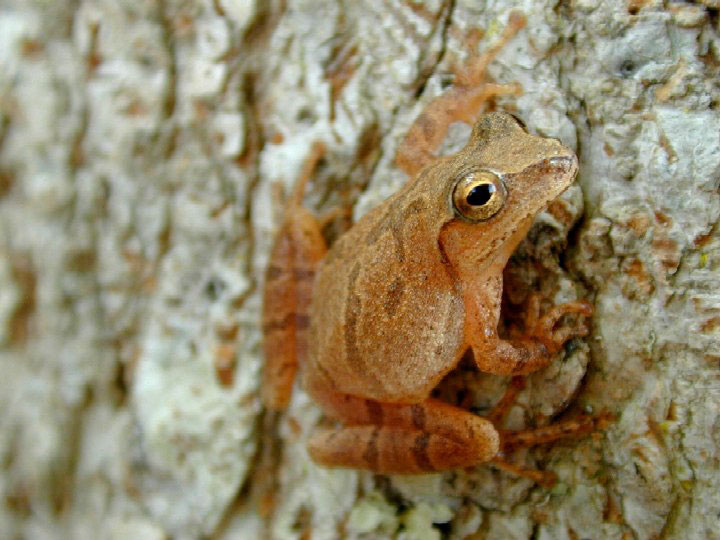 Spring PeeperPseudacris crucifer
-
 Cuban Tree FrogOsteopilus septentrionalis
-
 Pacific Tree FrogPseudacris regilla
-
 Rabbs' Fringe-limbed TreefrogEcnomiohyla rabborum
- European Tree FrogHyla arborea
-
 Mission Golden-eyed Tree FrogTrachycephalus resinifictrix
-
 Paradoxical FrogPseudis paradoxa
-
 Squirrel Tree FrogDryophytes squirellus
Compare
Questions and answers
What is the scientific name of the Ocellated Treefrog?
The scientific name of the Ocellated Treefrog is Itapotihyla langsdorffii. Written with its author, the full name is Itapotihyla langsdorffii (Duméril & Bibron, 1841).
Which family does the Ocellated Treefrog belong to?
Itapotihyla langsdorffii belongs to the family Hylidae, in the order Anura and the class Amphibia.
Where is the Ocellated Treefrog found?
Checklists and occurrence records place Itapotihyla langsdorffii in 2 countries: Brazil and Argentina.
What is the conservation status of the Ocellated Treefrog?
The IUCN Red List category recorded for Itapotihyla langsdorffii is Least Concern (LC).
Sources
Passages the profile rests on
- Females are larger than males, indicating sexual dimorphism in body size. Source passage: “They show sexual dimorphism, with females (mean snout–vent length 103 mm (4.1 in)) being larger than males (81 mm (3.2 in)).” — English Wikipedia
- Females have a mean snout–vent length of 103 mm. Source passage: “females (mean snout–vent length 103 mm (4.1 in))” — English Wikipedia
- This species inhabits shrubs and trees within rainforest environments. Source passage: “Itapotihyla langsdorffii is an arboreal frog occurring on shrubs and trees inside rainforest.” — English Wikipedia
- This species is restricted to pristine habitats. Source passage: “It is restricted to pristine habitats.” — English Wikipedia
- Breeding occurs in both temporary and permanent pools within rainforest. Source passage: “Reproduction takes place in temporary and permanent pools inside rainforest.” — English Wikipedia
- This species is an explosive breeder. Source passage: “It is an explosive breeder” — English Wikipedia
- The mean brood size exceeds 6,000 eggs. Source passage: “with a mean brood size of over 6000 eggs.” — English Wikipedia
- Male breeding activity is accompanied by intense vocalization. Source passage: “Breeding is associated with intense vocalization by males.” — English Wikipedia
- Males may engage in grabbing and pushing interactions with other males. Source passage: “male–male interactions may involve grabbing and pushing” — English Wikipedia
- Male interactions can include direct physical combat. Source passage: “and even direct physical combat.” — English Wikipedia
- Arthropods constitute the main component of this species' diet. Source passage: “Its diet mainly consists of arthropods” — English Wikipedia
- Grasshoppers and crickets are among the principal arthropod foods consumed by this species. Source passage: “in particular grasshoppers and crickets” — English Wikipedia
- The stomach contents of this species can include remains of other vertebrates. Source passage: “but also vertebrate remains” — English Wikipedia
- Remains of Physalaemus crombiei and Scinax argyreornatus have been found in this species' stomach contents. Source passage: “other frogs including Physalaemus crombiei and Scinax argyreornatus” — English Wikipedia
- Unidentified bird feathers have been recorded in this species' stomach contents. Source passage: “as well as unidentified bird feathers” — English Wikipedia
- The species is locally abundant in suitable habitats in Brazil. Source passage: “Itapotihyla langsdorffii is locally abundant in suitable habitats in Brazil.” — English Wikipedia
- The species is not considered threatened at the species level. Source passage: “however, at the species level it is not considered threatened.” — English Wikipedia
- The Paraguayan population is presumed to be declining because of habitat loss. Source passage: “The Paraguayan population is assumed to be in decline because of habitat loss” — English Wikipedia
- The Paraguayan population may be seriously threatened. Source passage: “and possibly seriously threatened;” — English Wikipedia
Data
- Catalogue of Life, 2026-10-16 XR cc by
- Global Biodiversity Information Facility CC BY 4.0
- Wikidata CC0
- GeoNames CC BY 4.0
- Wikimedia Commons per image; credit shown with each image
- Within the Catalogue of Life, this name comes from The Integrated Taxonomic Information System cc0
This species in other databases
Page built on 30 November 2026. See how the catalog is made and all sources and licences.
Cite this page
ScientificNames.org. (2026). Itapotihyla langsdorffii (Ocellated Treefrog). Retrieved November 30, 2026, from https://scientificnames.org/species/itapotihyla-langsdorffii
“Itapotihyla langsdorffii (Ocellated Treefrog).” ScientificNames.org, 2026, scientificnames.org/species/itapotihyla-langsdorffii. Accessed 30 Nov. 2026.
ScientificNames.org. “Itapotihyla langsdorffii (Ocellated Treefrog).” Accessed November 30, 2026. https://scientificnames.org/species/itapotihyla-langsdorffii.
@misc{scientificnames_itapotihyla_langsdorffii_ocellated_treefrog,
  author = {{ScientificNames.org}},
  title = {Itapotihyla langsdorffii (Ocellated Treefrog)},
  year = {2026},
  url = {https://scientificnames.org/species/itapotihyla-langsdorffii},
  note = {Accessed 2026-11-30}
}