Species · Mammals
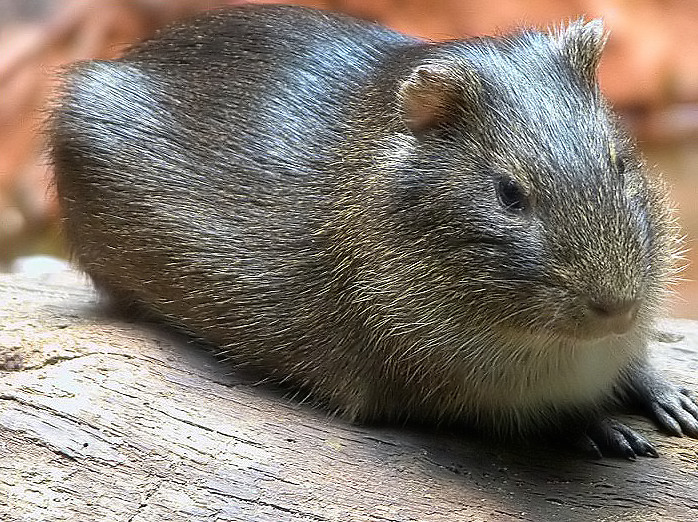
Acrobatic Cavy Kerodon acrobata
The scientific name of the Acrobatic Cavy is Kerodon acrobata. It is a species of mammal in the family Caviidae (maras), order Rodentia. The name dates from 1997.

Overview
The acrobatic cavy (Kerodon acrobata) also known as the acrobatic moco and climbing cavy is a cavy species native to Brazil. It is found from Goiás state to Tocantins state, west of the Espigão Mestre, Serra Geral de Goiás, and is also found in Terra Ronca State Park.
Classification of the Acrobatic Cavy
| Kingdom | Animalia |
|---|---|
| Phylum | Chordata |
| Subphylum | Vertebrata |
| Infraphylum | Gnathostomata |
| Parvphylum | Osteichthyes |
| Megaclass | Tetrapoda |
| Class | Mammalia (Mammal) |
| Subclass | Theria |
| Infraclass | Eutheria |
| Order | Rodentia (Rodent) |
| Suborder | Hystricomorpha |
| Infraorder | Hystricognathi (Hystricognath Rodents) |
| Family | Caviidae (Maras) |
| Subfamily | Hydrochoerinae (Capybaras) |
| Genus | Kerodon (Rock Cavies) |
| Species | Kerodon acrobata Moojen, Locks & Langguth, 1997 |
Where the Acrobatic Cavy is found
Checklists and occurrence records place Kerodon acrobata in 1 country across South America. GBIF holds 25 georeferenced records of it.
Countries
Regions and cities with the most records
Range as the checklists state it
South America
A number beside a place is its count of GBIF occurrence records. A place without a number comes from a checklist alone. Records show where a species has been observed or collected, which can include escapes and vagrants.
Common names
English
- Acrobatic Cavy
- Climbing Cavy
Names in 7 other languages
- Arabic
- كابياء بهلوانية
- German
- Klettermeerschweinchen
- Italian
- Cavia acrobatica
- Japanese
- トウハンモコ
- Korean
- 곡예사캐비
- Polish
- moko zwinny
- Portuguese
- Mocó-acrobata
Related species
-
 Rock CavyKerodon rupestris
-
 CapybaraHydrochoerus hydrochaeris
-
 Guinea PigCavia porcellus
-
 Patagonian MaraDolichotis patagonum
-
 Lesser CapybaraHydrochoerus isthmius
-
 Montane Guinea PigCavia tschudii
-
 Brazilian Guinea PigCavia aperea
-
 Greater Guinea PigCavia magna
Compare
Questions and answers
What is the scientific name of the Acrobatic Cavy?
The scientific name of the Acrobatic Cavy is Kerodon acrobata. Written with its author, the full name is Kerodon acrobata Moojen, Locks & Langguth, 1997.
Which family does the Acrobatic Cavy belong to?
Kerodon acrobata belongs to the family Caviidae, in the order Rodentia and the class Mammalia.
Where is the Acrobatic Cavy found?
Checklists and occurrence records place Kerodon acrobata in 1 country: Brazil.
What is the conservation status of the Acrobatic Cavy?
The IUCN Red List category recorded for Kerodon acrobata is Data Deficient (DD).
What other names does the Acrobatic Cavy have?
Kerodon acrobata is also known in English as Climbing Cavy.
Sources
Data
- Catalogue of Life, 2026-10-16 XR cc by
- Global Biodiversity Information Facility CC BY 4.0
- Wikidata CC0
- English Wikipedia CC BY-SA 4.0
- GeoNames CC BY 4.0
- Wikimedia Commons per image; credit shown with each image
- Within the Catalogue of Life, this name comes from The Integrated Taxonomic Information System cc0
References
- Bol. Mus. Nac. Rio Janeiro Zool. vol.377 p.1 where the name was published
- Woods, Charles A., and C. William Kilpatrick / Wilson, Don E., and DeeAnn M. Reeder, eds. (2005). Infraorder Hystricognathi Brandt, 1855. Mammal Species of the World: A Taxonomic and Geographic Reference, 3rd Ed., Vol. 2.
- Wilson, Don E., T. E. Lacher Jr., and R. A. Mittermeier, eds. (2016). Handbook of the Mammals of the World. Vol. 6: Lagomorphs and Rodents I.
This species in other databases
Page built on 25 November 2026. See how the catalog is made and all sources and licences.
Cite this page
ScientificNames.org. (2026). Kerodon acrobata (Acrobatic Cavy). Retrieved November 25, 2026, from https://scientificnames.org/species/kerodon-acrobata
“Kerodon acrobata (Acrobatic Cavy).” ScientificNames.org, 2026, scientificnames.org/species/kerodon-acrobata. Accessed 25 Nov. 2026.
ScientificNames.org. “Kerodon acrobata (Acrobatic Cavy).” Accessed November 25, 2026. https://scientificnames.org/species/kerodon-acrobata.
@misc{scientificnames_kerodon_acrobata_acrobatic_cavy,
  author = {{ScientificNames.org}},
  title = {Kerodon acrobata (Acrobatic Cavy)},
  year = {2026},
  url = {https://scientificnames.org/species/kerodon-acrobata},
  note = {Accessed 2026-11-25}
}