Species · Mammals
Waterbuck Kobus ellipsiprymnus
The scientific name of the Waterbuck is Kobus ellipsiprymnus. It is a species of mammal in the family Bovidae (goats), order Artiodactyla. The name dates from 1833.
- Scientific name
- Kobus ellipsiprymnus (Ogilby, 1833)
- Common name
- Waterbuck
- Genus
- Kobus
- Family
- Bovidae (Goats)
- Order
- Artiodactyla
- Class
- Mammalia
- Red List category
- LC Least Concern
- Recorded in
- 28 countries
- Name status
- accepted in the Catalogue of Life

Overview
Waterbucks occur widely throughout sub-Saharan Africa, from South Africa north to Ethiopia and South Sudan, and west to Senegal. The waterbuck has a shaggy coat, black lower legs with white rings above the hooves, and, in males, long spiral horns.
Written 26 November 2026 from the sources listed below. Each statement was checked against the passage it cites; statements that could not be supported were removed.
Appearance
Only male waterbucks develop horns. Their long spiral horns curve backward and then forward and measure between 55 and 99 cm long.[1][2]
When sexually excited, the waterbuck secretes a greasy substance with a musky smell from its skin.[3]
Adult waterbucks typically measure 177–235 cm in head-and-body length and stand 120–136 cm tall at the shoulder. Males typically weigh between 198 and 262 kg, while females weigh between 161 and 214 kg.[4][5][6][7]
The waterbuck's tail measures between 22 and 45 cm long. Newborn waterbucks typically weigh approximately 13.6 kg.[8][9]
Habitat
Waterbucks prefer grasslands close to water sources and commonly inhabit drainage lines and valleys. They occupy scrub and savanna areas near rivers, lakes, and valleys, favoring moist savanna ecosystems with permanent water supplies.[10][11][12][13]
Waterbucks prefer open habitats with short- to medium-height vegetation for grazing. They occupy plains during the dry season and woodlands during the wet season.[14][15]
Waterbucks occur widely throughout sub-Saharan Africa. The ellipsiprymnus group occurs throughout southeastern Africa, while the defassa group occurs in northeastern, central, and western Africa.[16][17][18]
The species occurs from South Africa north to Ethiopia and South Sudan, and west to Senegal. In Ethiopia, waterbucks occur west of the Great Rift Valley in areas containing major rivers, lakes, and wetlands.[19][20]
Diet
Waterbucks are predominantly grazers, with grasses accounting for approximately 70–95 percent of their diet. They consume reeds and rushes, including Typha and Phragmites, and regularly eat Panicum anabaptistum, Echinochloa stagnina, and Andropogon gayanus.[21][22][23]
In the Nechisar National Park study, annual grass, Leersia virginica, and Cynodon dactylon were the most frequently consumed food items. Young leaves constituted the largest proportion of plant parts consumed.[24][25]
Behaviour
Waterbucks are generally sedentary animals and may form herds containing six to thirty individuals. Female waterbucks may have home ranges that overlap with those of other females.[26][27][28]
Young male waterbucks begin developing horns and separating from female groups at approximately eight to nine months of age.[29]
Waterbucks are more likely to be active during daylight hours than at night. They spend more time feeding in the morning and late afternoon.[30][31]
Waterbucks may enter water to escape predators. They may migrate up to 1.8 km away from water sources while searching for food.[32][33]
Reproduction and life cycle
Female waterbucks reach sexual maturity at approximately two to three years of age, while males reach sexual maturity at approximately six years of age.[34][35]
Waterbuck gestation lasts approximately eight to eight and a half months. Females generally give birth to a single calf, and breeding occurs throughout the year in equatorial regions.[36][37][38]
Waterbuck mothers isolate themselves in thickets shortly before giving birth. Newborn calves remain hidden for two to four weeks after birth.[39][40]
Conservation
The waterbuck is classified as Least Concern by the IUCN. However, waterbuck populations are declining, particularly in the defassa group.[41][42]
Poaching and human disturbance have caused the elimination of large waterbuck populations from some habitats.[43]
Uses
Waterbucks are hunted for sport in Africa and are kept in zoos around the world.[44][45]
Classification of the Waterbuck
| Kingdom | Animalia |
|---|---|
| Phylum | Chordata |
| Subphylum | Vertebrata |
| Infraphylum | Gnathostomata |
| Parvphylum | Osteichthyes |
| Megaclass | Tetrapoda |
| Class | Mammalia (Mammal) |
| Subclass | Theria |
| Infraclass | Eutheria |
| Order | Artiodactyla (Artiodactyls) |
| Family | Bovidae (Goats) |
| Subfamily | Antilopinae |
| Tribe | Reduncini |
| Genus | Kobus (Kobs) |
| Species | Kobus ellipsiprymnus (Ogilby, 1833) |
Where the Waterbuck is found
Checklists and occurrence records place Kobus ellipsiprymnus in 28 countries across Africa. GBIF holds 10,816 georeferenced records of it.
Countries
- Angola 40
- Benin 406
- Botswana 606
- Burkina Faso 7
- Cameroon 12
- Central African Republic 16
- Chad 23
- Democratic Republic of the Congo 207
- Eswatini 36
- Ethiopia 27
- Ghana 5
- Guinea-Bissau 5
- Ivory Coast 6
- Kenya 1,205
- Malawi 193
- Mozambique 141
- Namibia 314
- Niger 6
- Nigeria 11
- Rwanda 21
- Senegal 42
- Somalia 5
- South Africa 5,163
- Sudan 47
- Tanzania 977
- Uganda 469
- Zambia 521
- Zimbabwe 305
Regions and cities with the most records
- Mpumalanga, South Africa 1,882
- Limpopo, South Africa 1,548
- KwaZulu-Natal, South Africa 784
- Manyara, Tanzania 431
- North West, South Africa 376
- Arusha, Tanzania 321
- Nakivale Refugee Camp, Uganda 299
- North-West, Botswana 297
- Chobe, Botswana 272
- Gauteng, South Africa 244
- Central Province, Zambia 237
- Taita Taveta, Kenya 208
- Usa River, Tanzania 206
- Atakora, Benin 203
- Kingori, Tanzania 196
- Nakuru County, Kenya 175
- Midstream, South Africa 148
- Centurion, South Africa 147
- Thembisa, South Africa 147
- Muchinga, Zambia 144
- Eastern Cape, South Africa 140
- Isiolo County, Kenya 139
- Matsulu, South Africa 127
- Borgou, Benin 124
- Matabeleland North, Zimbabwe 120
- Pèrèrè, Benin 113
- Kajiado County, Kenya 111
- Pretoria, South Africa 110
- Nikki, Benin 107
- Naivasha, Kenya 92
- Victoria Falls, Zimbabwe 88
- Livingstone, Zambia 87
- Sofala, Mozambique 84
- Mkhuhlu, South Africa 80
- Liwonde, Malawi 79
- Pwani, Tanzania 79
3 more countries have a few records outside this range
These countries hold a few records of Kobus ellipsiprymnus but lie outside the range the checklists give for it. Such records are often zoo or garden specimens, museum material or vagrants, so the species is not counted as occurring there.
Range as the checklists state it
Africa
A number beside a place is its count of GBIF occurrence records. A place without a number comes from a checklist alone. Records show where a species has been observed or collected, which can include escapes and vagrants.
Common names
English
- Waterbuck
- Common Waterbuck
- Crawshay Waterbuck
- Ellipsen Waterbuck
- Rhodesian Waterbuck
Names in 28 other languages
- Afrikaans
- Kringgat, Valentynsbok, Waterbok
- Arabic
- حتيت, ظبي الماء, ظبي الماء رودسيا, ظبي الماء كروشاي, كتمبور
- Asturian
- antílope acuáticu
- Catalan
- Antílop acuàtic
- Chinese
- 水羚, 水羚/非洲大羚羊
- Czech
- voduška velká
- Danish
- Vandbuk
- Dutch
- Gewone Waterbok
- Finnish
- vesiantilooppi
- French
- Antilope sing-sing, Cobe onctueux, Cobe à croissant
- German
- Ellipsen-Wasserbock, Hirschantilope, Wasserbock
- Greek
- Νεροαντιλόπη
- Hungarian
- gyűrűsfarkú víziantilop
- Italian
- Antilope d'Acqua, Cobo comune
- Japanese
- ウォーターバック
- Korean
- 물영양
- Lithuanian
- Vandeninis ožys
- Norwegian Bokmål
- Ellipsevannbukk
- Polish
- kob śniady
- Portuguese
- Cob-untuoso, Cobo-de-crescente
- Romanian
- Antilopă de apă
- Russian
- Обыкновенный водяной козёл
- Slovenian
- elipsasta obvodna antilopa
- Spanish
- Antilope de Agua, Antílope acuático
- Tswana
- Pitlhwa, leTemoga, leTimoga
- Zulu
- Iphiva, Phiva
- kck
- Isidumuka
- kth
- Dhumukwa
Synonyms
13 other scientific names have been used for this species and are now treated as synonyms of Kobus ellipsiprymnus.
- Antilope ellipsiprymnus Ogilby, 1833
- Kobus ellipsiprymnus adolfifriderici Matschie, 1910
- Kobus ellipsiprymnus annectens Schwarz, 1913
- Kobus ellipsiprymnus crawshayi (P. L. Sclater, 1894)
- Kobus ellipsiprymnus ellipsiprymnus (Ogilby, 1833)
- Kobus ellipsiprymnus harnieri (Murie, 1867)
- Kobus ellipsiprymnus kondensis Matschie, 1911
- Kobus ellipsiprymnus pallidus Matschie, 1910
- Kobus ellipsiprymnus penricei (Rothschild, 1895)
- Kobus ellipsiprymnus thikae Matschie, 1910
- Kobus ellipsiprymnus tjaederi (Lönnberg, 1907)
- Kobus ellipsiprymnus tschadensis Schwarz, 1913
- Kobus ellipsiprymnus unctuosus (Laurillard, 1842)
Related species
-
 LechweKobus leche
-
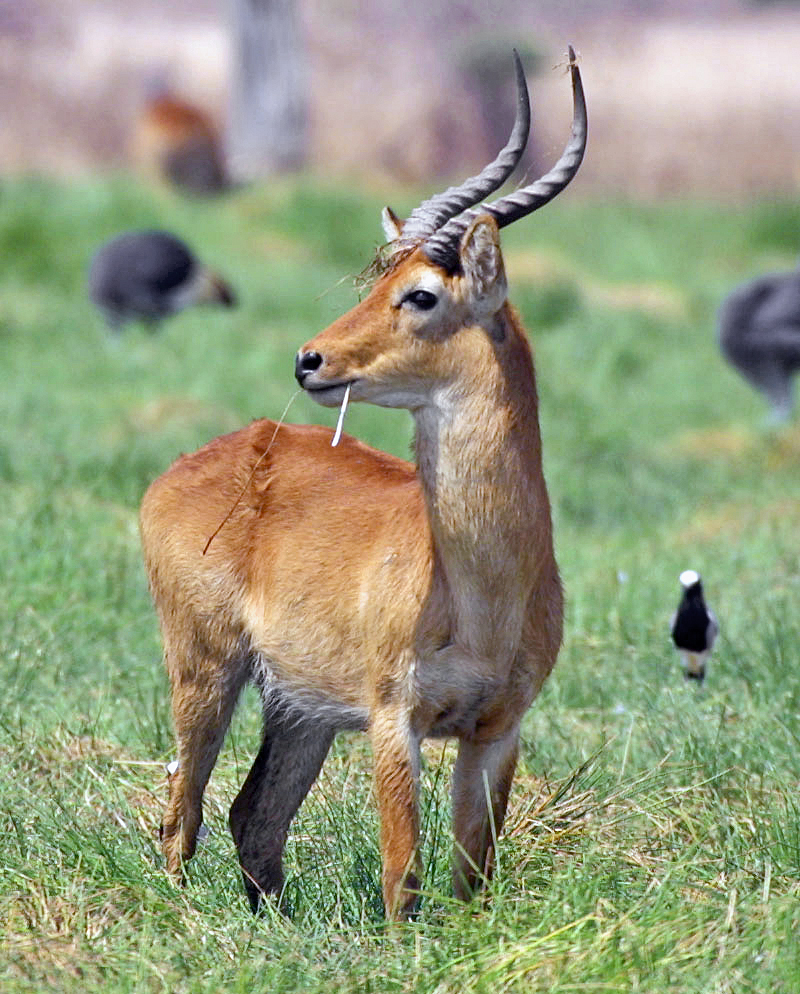 PukuKobus vardonii
-
 KobKobus kob
-
 Nile LechweKobus megaceros
- Upemba LechweKobus anselli
-
 White-eared KobKobus leucotis
- Defassa WaterbuckKobus defassa
- Uganda KobKobus thomasi
Compare
Questions and answers
What is the scientific name of the Waterbuck?
The scientific name of the Waterbuck is Kobus ellipsiprymnus. Written with its author, the full name is Kobus ellipsiprymnus (Ogilby, 1833).
Which family does the Waterbuck belong to?
Kobus ellipsiprymnus belongs to the family Bovidae, in the order Artiodactyla and the class Mammalia.
Where is the Waterbuck found?
Checklists and occurrence records place Kobus ellipsiprymnus in 28 countries, including South Africa, Kenya, Tanzania, Botswana, Zambia and Uganda.
What is the conservation status of the Waterbuck?
The IUCN Red List category recorded for Kobus ellipsiprymnus is Least Concern (LC).
What other names does the Waterbuck have?
Kobus ellipsiprymnus is also known in English as Common Waterbuck, Crawshay Waterbuck, Ellipsen Waterbuck and Rhodesian Waterbuck.
Why are they called waterbuck?
The common name waterbuck reflects the species' strong dependence on water compared with other antelopes.[46]
What is a fun fact about waterbuck?
When sexually excited, waterbucks secrete a greasy, musky-smelling substance from their skin.[3]
Sources
Passages the profile rests on
- Male waterbucks have long spiral horns that curve backward and then forward. Source passage: “The long, spiral horns curve backward, then forward.” — English Wikipedia
- Only male waterbucks develop horns, which measure between 55 and 99 cm long. Source passage: “Only male waterbuck have horns, which are curved forward and vary in length from 55 - 99 cm.” — animaldiversity.org
- The waterbuck secretes a greasy, musky-smelling substance from its skin when sexually excited. Source passage: “When sexually excited, the skin of the waterbuck secretes a greasy substance with the odour of musk (sebum)” — English Wikipedia
- Adult waterbucks typically measure 177–235 cm in head-and-body length. Source passage: “The head-and-body length is typically 177–235 cm (70–93 in)” — English Wikipedia
- Adult waterbucks typically stand 120–136 cm tall at the shoulder. Source passage: “shoulder height from 120 - 136 cm.” — animaldiversity.org
- Male waterbucks typically weigh between 198 and 262 kg. Source passage: “Males typically weigh 198–262 kg (437–578 lb)” — English Wikipedia
- Female waterbucks typically weigh between 161 and 214 kg. Source passage: “females 161–214 kg (355–472 lb).” — English Wikipedia
- The tail of a waterbuck measures between 22 and 45 cm long. Source passage: “The tail is 22–45 cm (8.7–17.7 in) long.” — English Wikipedia
- Newborn waterbucks typically weigh approximately 13.6 kg. Source passage: “A newborn typically weighs 13.6 kg (30 lb)” — English Wikipedia
- Waterbucks prefer grasslands located close to water sources. Source passage: “Waterbuck prefer grassland habitat that is close to water.” — animaldiversity.org
- Waterbucks commonly inhabit drainage lines and valleys. Source passage: “The best habitats are by draining lines and in valleys.” — animaldiversity.org
- Waterbucks inhabit scrub and savanna areas near rivers, lakes, and valleys. Source passage: “Waterbucks inhabit scrub and savanna areas along rivers, lakes, and valleys.” — English Wikipedia
- Waterbucks favor moist savanna ecosystems with permanent water supplies. Source passage: “they are adapted to moist savanna ecosystems with a permanent water supply” — pmc.ncbi.nlm.nih.gov
- Waterbucks prefer open habitats with short- to medium-height vegetation for grazing. Source passage: “also prefer open habitats with a short to medium height vegetations for grazing” — pmc.ncbi.nlm.nih.gov
- Waterbucks occupy plains during the dry season and woodlands during the wet season. Source passage: “They occupy the plains during the dry season and reside in woodlands during the wet season” — pmc.ncbi.nlm.nih.gov
- Waterbucks occur widely throughout sub-Saharan Africa. Source passage: “The waterbuck (Kobus ellipsiprymnus) is a large antelope found widely in sub-Saharan Africa.” — English Wikipedia
- The ellipsiprymnus group occurs throughout southeastern Africa. Source passage: “The ellipsiprymnus group is found throughout southeast Africa.” — animaldiversity.org
- The defassa group occurs in northeastern, central, and western Africa. Source passage: “The defassa group is found in northeastern, central, and western Africa (Kingdon, 1982).” — animaldiversity.org
- The species occurs from South Africa north to Ethiopia and South Sudan, and west to Senegal. Source passage: “They inhabit the savannah region of sub-Saharan Africa extending from South Africa north to Ethiopia and South Sudan, west to Senegal.” — pmc.ncbi.nlm.nih.gov
- In Ethiopia, waterbucks occur west of the Great Rift Valley in areas containing major rivers, lakes, and wetlands. Source passage: “In Ethiopia, they live in west of the Great Rift Valley where there are many major rivers, lakes, and wetlands.” — pmc.ncbi.nlm.nih.gov
- Waterbucks are predominantly grazers, with grasses accounting for approximately 70–95 percent of their diet. Source passage: “With grasses constituting a substantial 70 to 95 percent of the diet, the waterbuck is predominantly a grazer” — English Wikipedia
- Waterbucks consume reeds and rushes, including Typha and Phragmites. Source passage: “Reeds and rushes like Typha and Phragmites may also be preferred.” — English Wikipedia
- Waterbucks regularly consume Panicum anabaptistum, Echinochloa stagnina, and Andropogon gayanus. Source passage: “A study found regular consumption of three grass species round the year: Panicum anabaptistum, Echinochloa stagnina and Andropogon gayanus.” — English Wikipedia
- Annual grass, Leersia virginica, and Cynodon dactylon were the most frequently consumed food items in the Nechisar National Park study. Source passage: “annual grass (11.5%), Leersia virginica (8.4%), and Cynodon dactylon (8.4%) were the most frequently consumed food items” — pmc.ncbi.nlm.nih.gov
- Young leaves constituted the largest proportion of plant parts consumed by waterbucks in the Nechisar National Park study. Source passage: “Young leaves comprised the largest proportion of plant parts consumed by waterbucks compared to others.” — pmc.ncbi.nlm.nih.gov
- Waterbucks are generally sedentary animals. Source passage: “Waterbuck are rather sedentary in nature.” — English Wikipedia
- Waterbucks may form herds containing six to thirty individuals. Source passage: “A gregarious animal, the waterbuck may form herds consisting of six to 30 individuals.” — English Wikipedia
- Female waterbucks may have home ranges overlapping with those of other females. Source passage: “The home ranges of females may overlap, resulting in small herds that average 5 - 10 animals.” — animaldiversity.org
- Young male waterbucks begin developing horns and separating from female groups at approximately eight to nine months of age. Source passage: “Horns begin to form on males at 8 - 9 months, which marks their separation from the females.” — animaldiversity.org
- Waterbucks are more likely to be active during daylight hours than at night. Source passage: “While they have been found active at night, the waterbuck is more likely to be active in the daytime (Estes, 1991).” — animaldiversity.org
- Waterbucks spend more time feeding in the morning and late afternoon. Source passage: “Waterbucks spent more time on feeding in the morning and late afternoon during both seasons.” — pmc.ncbi.nlm.nih.gov
- Waterbucks may enter water to escape predators. Source passage: “Waterbuck often enter water to escape from predators” — English Wikipedia
- Waterbucks may migrate up to 1.8 km away from water sources while searching for food. Source passage: “They are territorial and migratory moving up to 1.8 km distance far from water sources for search of food.” — pmc.ncbi.nlm.nih.gov
- Female waterbucks reach sexual maturity at approximately two to three years of age. Source passage: “females reach maturity within two to three years.” — English Wikipedia
- Male waterbucks reach sexual maturity at approximately six years of age. Source passage: “Male waterbuck mature at six years of age” — animaldiversity.org
- Waterbuck gestation lasts approximately eight to eight and a half months. Source passage: “The gestation period is about eight to eight and a half months.” — animaldiversity.org
- Waterbucks generally give birth to a single calf. Source passage: “followed by the birth of a single calf.” — English Wikipedia
- Waterbuck breeding occurs throughout the year in equatorial regions. Source passage: “In equatorial regions, breeding takes place throughout the year” — English Wikipedia
- Waterbuck mothers isolate themselves in thickets shortly before giving birth. Source passage: “A few days before calving, mothers isolate themselves in thickets.” — animaldiversity.org
- Newborn waterbuck calves remain hidden for two to four weeks after birth. Source passage: “The young calves remain hidden for two to four weeks (Estes, 1991).” — animaldiversity.org
- The waterbuck is classified as Least Concern by the IUCN. Source passage: “The IUCN lists the waterbuck as being of least concern.” — English Wikipedia
- Waterbuck populations are declining, particularly in the defassa group. Source passage: “The population trend for both is downwards, especially that of the defassa” — English Wikipedia
- Poaching and human disturbance have caused the elimination of large waterbuck populations from some habitats. Source passage: “with large populations being eliminated from certain habitats because of poaching and human disturbance.” — English Wikipedia
- Waterbucks are hunted for sport in Africa. Source passage: “Waterbuck are hunted for sport in Africa” — animaldiversity.org
- Waterbucks are kept in zoos around the world. Source passage: “and are found in zoos throughout the world (Kingdon, 1982).” — animaldiversity.org
- The common name waterbuck reflects the species' strong dependence on water compared with other antelopes. Source passage: “The animal acquired the vernacular name "waterbuck" due to its heavy dependence on water as compared to other antelopes” — English Wikipedia
Data
- Catalogue of Life, 2026-10-16 XR cc by
- Global Biodiversity Information Facility CC BY 4.0
- Wikidata CC0
- GeoNames CC BY 4.0
- Wikimedia Commons per image; credit shown with each image
- Within the Catalogue of Life, this name comes from The Integrated Taxonomic Information System cc0
References
- Proc. Zool. Soc. Lond. vol.1833 p.47 where the name was published
- Wilson, Don E., and DeeAnn M. Reeder, eds. (1993). Mammal Species of the World: A Taxonomic and Geographic Reference, 2nd Ed., 3rd Printing.
- Wilson, Don E., and F. Russell Cole. (2000). Common Names of Mammals of the World.
- Wilson, Don E., and DeeAnn M. Reeder, eds. (2005). Mammal Species of the World: A Taxonomic and Geographic Reference, 3rd Ed., Vols. 1 & 2.
- Wilson, D. E., and R. A. Mittermeier, eds. (2011). Handbook of the Mammals of the World, Vol. 2: Hoofed Mammals.
- Burgin, Connor J., Don E. Wilson, Russell A. Mittermeier, Anthony B. Rylands, et al. (2020). Illustrated Checklist of the Mammals of the World. Vol. 2. Eulipotyphla to Carnivora.
This species in other databases
Page built on 27 November 2026. See how the catalog is made and all sources and licences.
Cite this page
ScientificNames.org. (2026). Kobus ellipsiprymnus (Waterbuck). Retrieved November 27, 2026, from https://scientificnames.org/species/kobus-ellipsiprymnus
“Kobus ellipsiprymnus (Waterbuck).” ScientificNames.org, 2026, scientificnames.org/species/kobus-ellipsiprymnus. Accessed 27 Nov. 2026.
ScientificNames.org. “Kobus ellipsiprymnus (Waterbuck).” Accessed November 27, 2026. https://scientificnames.org/species/kobus-ellipsiprymnus.
@misc{scientificnames_kobus_ellipsiprymnus_waterbuck,
  author = {{ScientificNames.org}},
  title = {Kobus ellipsiprymnus (Waterbuck)},
  year = {2026},
  url = {https://scientificnames.org/species/kobus-ellipsiprymnus},
  note = {Accessed 2026-11-27}
}