Species · Mammals
Nile Lechwe Kobus megaceros
The scientific name of the Nile Lechwe is Kobus megaceros. It is a species of mammal in the family Bovidae (goats), order Artiodactyla. The name dates from 1855.
- Scientific name
- Kobus megaceros (Fitzinger, 1855)
- Common name
- Nile Lechwe
- Genus
- Kobus
- Family
- Bovidae (Goats)
- Order
- Artiodactyla
- Class
- Mammalia
- Red List category
- EN Endangered
- Recorded in
- 2 countries
- Name status
- accepted in the Catalogue of Life

Overview
Kobus megaceros inhabits swamps, grass marshes, and steppes in South Sudan and Ethiopia.
Written 26 November 2026 from the sources listed below. Each statement was checked against the passage it cites; statements that could not be supported were removed.
Conservation
The Nile Lechwe is classified as Endangered by the International Union for Conservation of Nature. An aerial survey estimated the population at 30,000–40,000 individuals in 1983, while the Sudd population was estimated at 4,291 individuals in 2007.[1][2][3]
Uses
Nile lechwes have traditionally been hunted as a source of food. They are also valued as trophies by African hunters and may be exchanged for food or other resources.[4][5]
Nile lechwes can help reduce grass fires by trampling vegetation while grazing. They are also an important food source for crocodiles.[6][7]
Appearance
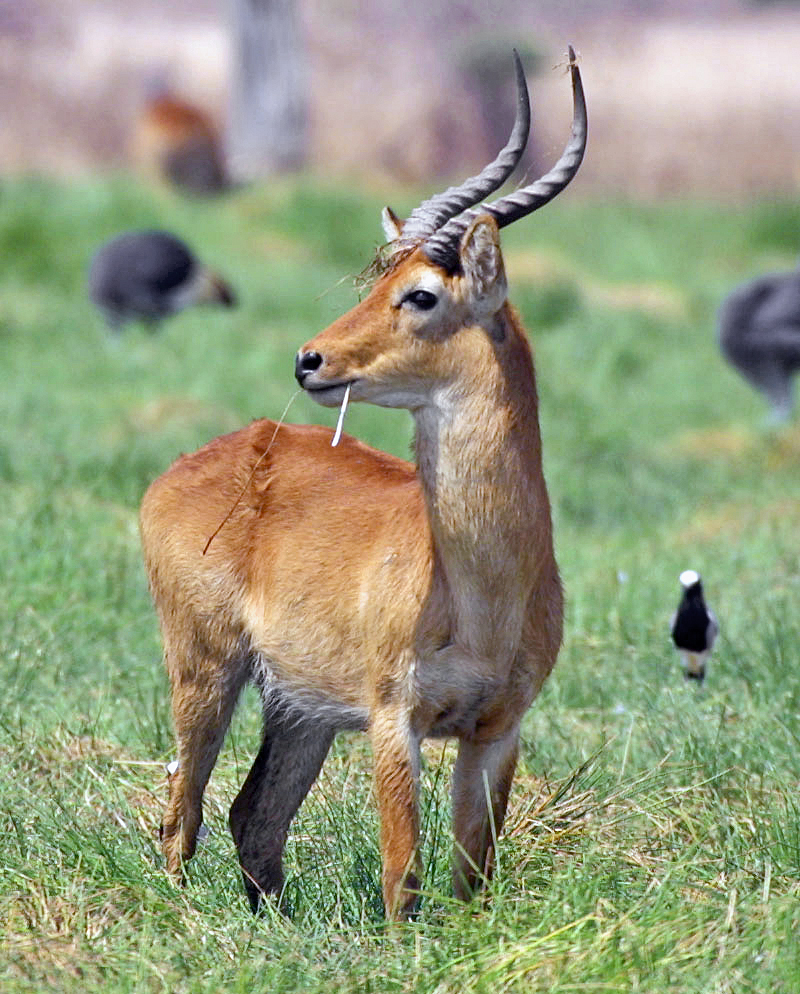
Both sexes have long, coarse hair, elongated narrow hooves, a short nose, and a long tail. Males have shaggy blackish-brown coats and a white marking behind the horns that extends into a band across the neck.[8][9]
Adult males have long, lyre-shaped horns, while females have pale yellow coats and lack horns. Young males retain female-like coloration until approximately two or three years of age, when their coats darken and their horns begin to grow.[10][11][12]
Adult males average 165 cm in length, 100–105 cm at the shoulder, and 90–120 kg in weight. Adult females average 135 cm in length, 80–85 cm at the shoulder, and 60–90 kg in weight.[13][14]
The tail measures approximately 40–50 cm in length. Adult male horns measure approximately 48–87 cm in length.[15][16]
Habitat
The Nile Lechwe inhabits swamps, dry and flooded grass marshes, and steppes. Its habitat includes short grass, tall reed vegetation, and cane thickets.[17][18]
The species typically occupies shallow water bordering deeper swamps, with water depths of approximately 10–40 cm. Individuals rest on dry banks, sandbanks, and islands above the water level.[19][20]
During the wet season, individuals spread across available water resources, whereas during the dry season they gather around remaining water sources.[21]
Diet
Nile lechwes are herbivores that consume grasses, herbs, and aquatic plants. Wild rice is considered a preferred food at the beginning of the flood season.[22][23]
Swamp grasses make up a larger proportion of the diet as floodwaters recede.[24]
Behaviour
Nile lechwes are social and territorial animals. Herds may contain between 50 and 500 individuals and comprise three distinct social classes: nursing females with their young, bachelor males, and territorial mature males.[25][26][27]
Nile lechwes communicate through visual displays and tactile signals. During displays, individuals rear up in front of opponents and turn their heads sideways.[28][29]
Males fight by lowering their heads and pushing against one another with their horns. Females defend their offspring against smaller predators by kicking them.[30][31]
Nile lechwes prefer wading in shallow water but are capable of swimming. When disturbed, they flee into the water.[32][33]
Females make loud, toad-like croaking sounds while moving.[34]
Reproduction and life cycle
Both sexes reach sexual maturity at approximately two years of age. The species has a harem mating system in which only the dominant male is sexually active.[35][36]
Mating occurs throughout the year, with a peak between February and May. The average gestation period is approximately 235.5 days.[37][38]
Females generally give birth to a single calf per pregnancy. Newborn calves weigh approximately 4.5–5.5 kg.[39][40]
Females can ovulate again approximately one month after giving birth. The mean interval between births is approximately 11.6 months.[41][42]
Wild calving takes place during the wet season. Females conceal their newborn calves in vegetation for approximately two to three weeks.[43][44]
Calves are weaned at approximately five to six months according to one source. Females nurse and protect their young until weaning.[45][46]
Classification of the Nile Lechwe
| Kingdom | Animalia |
|---|---|
| Phylum | Chordata |
| Subphylum | Vertebrata |
| Infraphylum | Gnathostomata |
| Parvphylum | Osteichthyes |
| Megaclass | Tetrapoda |
| Class | Mammalia (Mammal) |
| Subclass | Theria |
| Infraclass | Eutheria |
| Order | Artiodactyla (Artiodactyls) |
| Family | Bovidae (Goats) |
| Subfamily | Antilopinae |
| Tribe | Reduncini |
| Genus | Kobus (Kobs) |
| Species | Kobus megaceros (Fitzinger, 1855) |
Where the Nile Lechwe is found
Checklists and occurrence records place Kobus megaceros in 2 countries across Africa. GBIF holds 124 georeferenced records of it.
Countries
Regions and cities with the most records
2 more countries have a few records outside this range
These countries hold a few records of Kobus megaceros but lie outside the range the checklists give for it. Such records are often zoo or garden specimens, museum material or vagrants, so the species is not counted as occurring there.
Range as the checklists state it
Africa
A number beside a place is its count of GBIF occurrence records. A place without a number comes from a checklist alone. Records show where a species has been observed or collected, which can include escapes and vagrants.
Common names
English
- Nile Lechwe
Names in 18 other languages
- Arabic
- أبو عق, تيل النيل
- Chinese
- 大角驢羚
- Czech
- voduška abok
- Dutch
- Basterdwaterbok
- Finnish
- niilinliki
- French
- Cobe de Madame Gray, Mrs. Gray's Lechwe
- German
- Nil-Lechwe, Weißnacken-Moorantilope, Weißnackenmoorantilope
- Hungarian
- Nagyszarvú mocsáriantilop
- Italian
- Lichi del Nilo
- Japanese
- ナイルリーチュエ
- Korean
- 나일리추에
- Norwegian Bokmål
- Hvitnakkerørbukk
- Polish
- Kob nilowy
- Portuguese
- Cobo-do-Nilo
- Russian
- Нильский личи, Суданский козёл
- Slovenian
- nilski kob
- Spanish
- Cobo del Nilo
- din
- Abuɔɔk
Synonyms
One other scientific name has been used for this species and is now treated as a synonym of Kobus megaceros.
- Adenota megaceros Fitzinger, 1855
Related species
-
 WaterbuckKobus ellipsiprymnus
-
 LechweKobus leche
-
 PukuKobus vardonii
-
 KobKobus kob
- Upemba LechweKobus anselli
-
 White-eared KobKobus leucotis
- Defassa WaterbuckKobus defassa
- Uganda KobKobus thomasi
Compare
Questions and answers
What is the scientific name of the Nile Lechwe?
The scientific name of the Nile Lechwe is Kobus megaceros. Written with its author, the full name is Kobus megaceros (Fitzinger, 1855).
Which family does the Nile Lechwe belong to?
Kobus megaceros belongs to the family Bovidae, in the order Artiodactyla and the class Mammalia.
Where is the Nile Lechwe found?
Checklists and occurrence records place Kobus megaceros in 2 countries: South Sudan and Sudan.
What is the conservation status of the Nile Lechwe?
The IUCN Red List category recorded for Kobus megaceros is Endangered (EN).
What is a Nile lechwe?
The Nile Lechwe (Kobus megaceros) is a mammal in the family Bovidae, order Artiodactyla, and class Mammalia. It is social and territorial, and males have long, lyre-shaped horns.[8][10][25]
Where are lechwe found?
Nile lechwes are endemic to South Sudan and Ethiopia. In South Sudan, the largest population occurs in the Sudd swamps, with smaller numbers in the Machars near the Ethiopian border. In Ethiopia, the species occurs in the southwest, including Gambela National Park.[47][48][49]
Sources
Passages the profile rests on
- The Nile lechwe is classified as Endangered by the International Union for Conservation of Nature. Source passage: “The Nile lechwe has been classified under the Endangered category by the International Union for Conservation of Nature and Natural Resources (IUCN).” — English Wikipedia
- An aerial survey estimated the population at 30,000–40,000 individuals in 1983. Source passage: “In 1983, aerial surveys gave a total population estimate of 30,000-40,000 individuals” — English Wikipedia
- The Sudd population was estimated at 4,291 individuals in 2007. Source passage: “In 2007, the population of the Sudd region was estimated to be of 4,291 animals” — English Wikipedia
- Nile lechwes have traditionally been hunted as a source of food. Source passage: “They were also traditionally hunted as a source of food.” — animaldiversity.org
- Nile lechwes are valued as trophies by African hunters and may be exchanged for food or other resources. Source passage: “Nile lechwes are a highly prized trophy to an African hunter and may be traded for food or other resources.” — animaldiversity.org
- Nile lechwes can help reduce grass fires by trampling vegetation while grazing. Source passage: “Nile lechwes may help reduce grass fires by trampling the grass when grazing, making a natural firewall.” — animaldiversity.org
- Nile lechwes are an important food source for crocodiles. Source passage: “They are also an important source of food for crocodiles because of the amount of time these animals spend in the water.” — animaldiversity.org
- Both sexes have long, coarse hair, elongated narrow hooves, a short nose, and a long tail. Source passage: “However, both sexes have long, coarse hair; elongated, narrow hooves; a short nose; and a long tail (with a length between 40 and 50 cm).” — animaldiversity.org
- Males have shaggy blackish-brown coats and a white marking behind the horns that extends into a band across the neck. Source passage: “Older males are blackish-brown, with a white spot behind the horns. This white spot connects to a white band on the neck, which broadens on the withers.” — animaldiversity.org
- Adult males have long, lyre-shaped horns. Source passage: “Males have long, lyre-shaped horns that are 48 to 87 cm in length.” — animaldiversity.org
- Females have pale yellow coats and lack horns. Source passage: “Females are pale yellow, and lack horns.” — animaldiversity.org
- Young males retain female-like coloration until approximately two or three years of age, when their coats darken and their horns begin to grow. Source passage: “Young males look like females until they reach 2 or 3 years of age. At this time, the color of the pelage changes and the horns begin to grow.” — animaldiversity.org
- Adult males average 165 cm in length, 100–105 cm at the shoulder, and 90–120 kg in weight. Source passage: “Males are an average of 165 cm (65 in) long and 100–105 cm (39–41 in) tall at the shoulders, and weigh between 90 and 120 kg (200 and 260 lb)” — English Wikipedia
- Adult females average 135 cm in length, 80–85 cm at the shoulder, and 60–90 kg in weight. Source passage: “females are an average of 135 cm (53 in) long, 80–85 cm (31–33 in) tall at the shoulders, and weigh 60–90 kg (130–200 lb).” — English Wikipedia
- The tail measures approximately 40–50 cm in length. Source passage: “a long tail (with a length between 40 and 50 cm).” — animaldiversity.org
- Adult male horns measure approximately 48–87 cm in length. Source passage: “Males have long, lyre-shaped horns that are 48 to 87 cm in length.” — animaldiversity.org
- The species inhabits swamps, dry and flooded grass marshes, and steppes. Source passage: “Nile lechwes are found in swamps, dry and flooded grass marshes, and steppes.” — animaldiversity.org
- Its habitat includes short grass, tall reed vegetation, and cane thickets. Source passage: “The species is known to inhabit short grass, high reed, and cane thickets.” — animaldiversity.org
- The species typically occupies shallow water bordering deeper swamps, with water depths of approximately 10–40 cm. Source passage: “The Nile lechwe typically occur in shallow waters bordering deeper swamps, where the water is 10–40 cm (3.9–15.7 in) deep.” — English Wikipedia
- Individuals rest on dry banks, sandbanks, and islands above the water level. Source passage: “They will rest in areas above the water level such as dry banks, sandbanks, and islands” — animaldiversity.org
- During the wet season, individuals spread across available water resources, whereas during the dry season they gather around remaining water sources. Source passage: “Nile lechwes are attracted to water and wetlands, so during the wet season the population is spread out over water resources. During the dry season, these animals gather around the few water resources left.” — animaldiversity.org
- Nile lechwes are herbivores that consume grasses, herbs, and aquatic plants. Source passage: “Nile lechwes are herbivorous, eating grasses, herbs, and waterplants.” — animaldiversity.org
- Wild rice is considered a preferred food at the beginning of the flood season. Source passage: “Wild rice is thought to be a preferred food at the start of the flood season” — English Wikipedia
- Swamp grasses make up a larger proportion of the diet as floodwaters recede. Source passage: “while a larger proportion of swamp grasses are consumed when the waters recede.” — English Wikipedia
- Nile lechwes are social and territorial animals. Source passage: “Nile lechwes are diurnal and social. They are gregarious, but territorial, animals.” — animaldiversity.org
- Herds may contain between 50 and 500 individuals. Source passage: “They forms herds of 50 to 500 individuals.” — animaldiversity.org
- Herds contain nursing females with their young, bachelor males, and territorial mature males as three distinct social classes. Source passage: “Within a herd, there form three social classes: nursing-females and their young, bachelor males, and mature males with territory.” — animaldiversity.org
- Nile lechwes communicate through visual displays and tactile signals. Source passage: “There is a mixture of visual signaling and tactile communication.” — animaldiversity.org
- During displays, individuals rear up in front of opponents and turn their heads sideways. Source passage: “They rear high in the air in front of their opponents and turn their heads to the side while displaying.” — English Wikipedia
- Males fight by lowering their heads and pushing against one another with their horns. Source passage: “When fighting, males duck their heads and use their horns to push against each other.” — English Wikipedia
- Females defend their offspring against smaller predators by kicking them. Source passage: “females defend their offspring from smaller predators by direct attack, mainly kicking” — English Wikipedia
- Nile lechwes prefer wading in shallow water but are capable of swimming. Source passage: “They are good swimmers, but prefer to wade in shallow water.” — animaldiversity.org
- When disturbed, Nile lechwes flee into the water. Source passage: “They flee to water if disturbed” — English Wikipedia
- Females make loud, toad-like croaking sounds while moving. Source passage: “Females are quite loud, making a toad-like croaking when moving.” — English Wikipedia
- Both sexes reach sexual maturity at approximately two years of age. Source passage: “Both sexes are sexually mature at 2 years of age.” — animaldiversity.org
- The species has a harem mating system in which only the dominant male is sexually active. Source passage: “Kobus megaceros has a harem mating system where only the dominant male is sexually active.” — animaldiversity.org
- Mating occurs throughout the year, with a peak between February and May. Source passage: “Mating occurs throughout the year, but peaks between February and May.” — English Wikipedia
- The average gestation period is approximately 235.5 days. Source passage: “The gestation period averages 235.5 days, after which a single calf is born.” — animaldiversity.org
- Females generally give birth to a single calf per pregnancy. Source passage: “after which a single calf is born.” — animaldiversity.org
- Newborn calves weigh approximately 4.5–5.5 kg. Source passage: “newborns weigh about 4.5 to 5.5 kg.” — animaldiversity.org
- Females can ovulate again approximately one month after giving birth. Source passage: “Female can ovulate again approximately one month after giving birth” — animaldiversity.org
- The mean interval between births is approximately 11.6 months. Source passage: “leading to a mean interbirth interval of 11.6 months.” — animaldiversity.org
- Wild calving takes place during the wet season. Source passage: “Calving takes place in the wet season in the wild” — animaldiversity.org
- Females conceal their newborn calves in vegetation for approximately two to three weeks. Source passage: “After its birth, the calf is kept hidden in thick vegetation for two to three weeks, where the mother nurses it.” — English Wikipedia
- Calves are weaned at approximately five to six months according to one source. Source passage: “It is weaned at five to six months” — English Wikipedia
- Females nurse and protect their young until weaning. Source passage: “Females care for their young, nursing them, and protecting them.” — animaldiversity.org
- Nile lechwes are endemic to South Sudan and Ethiopia. Source passage: “Nile lechwe are endemic to South Sudan and Ethiopia.” — English Wikipedia
- In South Sudan, the largest population occurs in the Sudd swamps, with smaller numbers in the Machars near the Ethiopian border. Source passage: “In South Sudan, the majority of the population occurs in the Sudd swamps, and in the Machars near the Ethiopian border in smaller numbers.” — English Wikipedia
- In Ethiopia, the species occurs in the southwest, including Gambela National Park. Source passage: “In Ethiopia occurs in the southwest, in Gambela National Park” — English Wikipedia
Data
- Catalogue of Life, 2026-10-16 XR cc by
- Global Biodiversity Information Facility CC BY 4.0
- Wikidata CC0
- GeoNames CC BY 4.0
- Wikimedia Commons per image; credit shown with each image
- iNaturalist per image; credit shown with each image
- Within the Catalogue of Life, this name comes from The Integrated Taxonomic Information System cc0
References
- Sitzb. K. Akad. Wiss. Wien vol.17 p.247 where the name was published
- Wilson, Don E., and DeeAnn M. Reeder, eds. (1993). Mammal Species of the World: A Taxonomic and Geographic Reference, 2nd Ed., 3rd Printing.
- Wilson, Don E., and F. Russell Cole. (2000). Common Names of Mammals of the World.
- Wilson, Don E., and DeeAnn M. Reeder, eds. (2005). Mammal Species of the World: A Taxonomic and Geographic Reference, 3rd Ed., Vols. 1 & 2.
- Wilson, D. E., and R. A. Mittermeier, eds. (2011). Handbook of the Mammals of the World, Vol. 2: Hoofed Mammals.
- Burgin, Connor J., Don E. Wilson, Russell A. Mittermeier, Anthony B. Rylands, et al. (2020). Illustrated Checklist of the Mammals of the World. Vol. 2. Eulipotyphla to Carnivora.
This species in other databases
Page built on 27 November 2026. See how the catalog is made and all sources and licences.
Cite this page
ScientificNames.org. (2026). Kobus megaceros (Nile Lechwe). Retrieved November 27, 2026, from https://scientificnames.org/species/kobus-megaceros
“Kobus megaceros (Nile Lechwe).” ScientificNames.org, 2026, scientificnames.org/species/kobus-megaceros. Accessed 27 Nov. 2026.
ScientificNames.org. “Kobus megaceros (Nile Lechwe).” Accessed November 27, 2026. https://scientificnames.org/species/kobus-megaceros.
@misc{scientificnames_kobus_megaceros_nile_lechwe,
  author = {{ScientificNames.org}},
  title = {Kobus megaceros (Nile Lechwe)},
  year = {2026},
  url = {https://scientificnames.org/species/kobus-megaceros},
  note = {Accessed 2026-11-27}
}