Species · Fishes
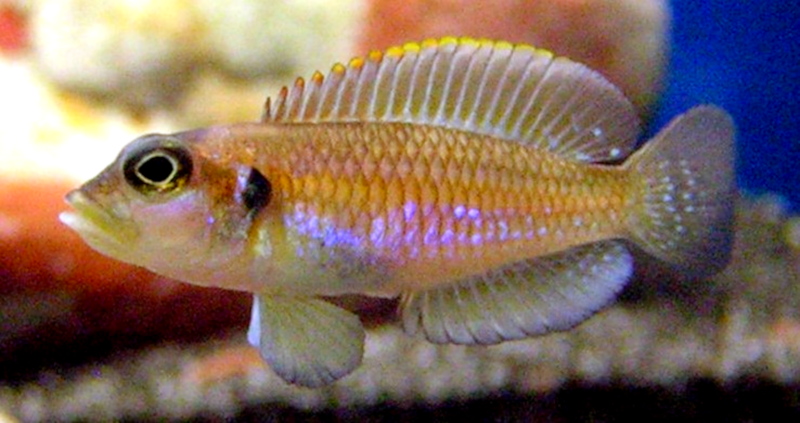
Neolamprologus Callipterus Lamprologus callipterus
The scientific name of the Neolamprologus Callipterus is Lamprologus callipterus. It is a species of fish in the family Cichlidae (cichlid), order Cichliformes. The name dates from 1906.
- Scientific name
- Lamprologus callipterus Boulenger, 1906
- Common name
- Neolamprologus Callipterus
- Genus
- Lamprologus
- Family
- Cichlidae (Cichlid)
- Order
- Cichliformes
- Class
- Teleostei
- Red List category
- LC Least Concern
- Environment
- freshwater
- Recorded in
- 5 countries
- Name status
- accepted in the Catalogue of Life

Overview
The species is endemic to Lake Tanganyika. The species exhibits strong sexual dimorphism, with males significantly larger than females.
Written 27 November 2026 from the sources listed below. Each statement was checked against the passage it cites; statements that could not be supported were removed.
Appearance
The species exhibits strong sexual dimorphism, with males significantly larger than females. Males can reach a total length of 12.4 centimetres, while females can reach a total length of 4.5 centimetres.[1][2][3]
Habitat
Neolamprologus callipterus is endemic to Lake Tanganyika.[4]
Behaviour
The fish actively move around while searching for crustaceans and other invertebrates.[5]
Immature males form schools that can contain more than 100 individuals. These schools roam while feeding on insect larvae, crustaceans and juvenile cichlids.[6][7]
Males collect empty snail shells for females.[8]
Diet
The species feeds on crustaceans and other invertebrates. Immature males also feed on insect larvae and juvenile cichlids.[9][10]
Reproduction and life cycle
Females use empty snail shells as breeding sites. Males collect empty snail shells for females.[11][8]
Uses
The species is traded in the aquarium industry and is considered poorly suited for captivity.[12][13]
Classification of the Neolamprologus Callipterus
| Kingdom | Animalia |
|---|---|
| Phylum | Chordata |
| Subphylum | Vertebrata |
| Infraphylum | Gnathostomata |
| Parvphylum | Osteichthyes |
| Gigaclass | Actinopterygii |
| Superclass | Actinopteri |
| Class | Teleostei (Teleost) |
| Order | Cichliformes |
| Family | Cichlidae (Cichlid) |
| Subfamily | Pseudocrenilabrinae |
| Genus | Lamprologus |
| Species | Lamprologus callipterus Boulenger, 1906 |
Where the Neolamprologus Callipterus is found
Checklists and occurrence records place Lamprologus callipterus in 5 countries. GBIF holds 1,440 georeferenced records of it.
Countries
Regions and cities with the most records
- Northern Province, Zambia 78
- Kigoma, Tanzania 75
- Rukwa, Tanzania 63
- Tanganyika, Democratic Republic of the Congo 52
- Mpulungu, Zambia 47
- Kirando, Tanzania 40
- Uvira, Democratic Republic of the Congo 29
- Gatumba, Burundi 28
- Kigoma, Tanzania 27
- Mwandiga, Tanzania 27
- Bururi, Burundi 22
- Rumonge, Burundi 21
- Baudhuinville, Democratic Republic of the Congo 10
- Makamba, Burundi 9
- Bujumbura Rural, Burundi 6
- Bujumbura, Burundi 5
- Bujumbura Mairie, Burundi 3
A number beside a place is its count of GBIF occurrence records. A place without a number comes from a checklist alone. Records show where a species has been observed or collected, which can include escapes and vagrants.
Common names
English
- Neolamprologus Callipterus
Names in 1 other language
- Afrikaans
- Nnjekeca
Synonyms
8 other scientific names have been used for this species and are now treated as synonyms of Lamprologus callipterus.
- Julidochromis elongatus Steindachner, 1909
- Lamprologus modestus nyassae Borodin, 1936
- Lamprologus reticulatus Boulenger, 1906
- Lamprologus steindachneri Boulenger, 1915
- Neolamprologus callipterus (Boulenger, 1906)
- Neolamprologus elongatus (Steindachner, 1909)
- Neolamprologus elongatus (Linke & Staeck, 1981)
- Tilapia steindachneri Boulenger, 1913
Related species
- Lamprologus lethops
-
 Neolamprologus OcellatusLamprologus ocellatus
-
 Lamprologus congoensis
- Neolamprologus KungweensisLamprologus kungweensis
- Neolamprologus OrnatipinnisLamprologus ornatipinnis
- Neolamprologus SignatusLamprologus signatus
-
 Neolamprologus LemairiiLamprologus lemairii
- Neolamprologus FinalimusLamprologus finalimus
Compare
Questions and answers
What is the scientific name of the Neolamprologus Callipterus?
The scientific name of the Neolamprologus Callipterus is Lamprologus callipterus. Written with its author, the full name is Lamprologus callipterus Boulenger, 1906.
Which family does the Neolamprologus Callipterus belong to?
Lamprologus callipterus belongs to the family Cichlidae, in the order Cichliformes and the class Teleostei.
Where is the Neolamprologus Callipterus found?
Checklists and occurrence records place Lamprologus callipterus in 5 countries: Zambia, Democratic Republic of the Congo, Tanzania, Burundi and Republic of the Congo.
What is the conservation status of the Neolamprologus Callipterus?
The IUCN Red List category recorded for Lamprologus callipterus is Least Concern (LC).
Sources
Passages the profile rests on
- Males can reach a total length of 12.4 centimetres. Source passage: “Males of this species can reach a length of 12.4 centimetres (4.9 in) TL” — English Wikipedia
- Females can reach a total length of 4.5 centimetres. Source passage: “while the females only grow to 4.5 centimetres (1.8 in) TL” — English Wikipedia
- The species exhibits strong sexual dimorphism, with males significantly larger than females. Source passage: “These fish exhibit strong sexual dimorphism. Its males are significantly larger than females” — English Wikipedia
- The species is endemic to Lake Tanganyika. Source passage: “Neolamprologus callipterus is a species of cichlid endemic to Lake Tanganyika” — English Wikipedia
- The fish actively move around while searching for crustaceans and other invertebrates. Source passage: “where it very actively moves about in search of crustaceans and other invertebrates.” — English Wikipedia
- Immature males form schools that can contain more than 100 individuals. Source passage: “Immature males will form schools that may exceed 100 individuals.” — English Wikipedia
- Schools of immature males roam while feeding on insect larvae, crustaceans, and juvenile cichlids. Source passage: “These schools roam around, leaving a trail of destruction as they feed on insect larvae, crustaceans, and juvenile cichlids.” — English Wikipedia
- Males collect empty snail shells for females. Source passage: “males of the species collect empty snail shells for the females to breed in.” — English Wikipedia
- The species feeds on crustaceans and other invertebrates. Source passage: “moves about in search of crustaceans and other invertebrates.” — English Wikipedia
- Immature males feed on insect larvae, crustaceans, and juvenile cichlids. Source passage: “they feed on insect larvae, crustaceans, and juvenile cichlids.” — English Wikipedia
- Females use empty snail shells as breeding sites. Source passage: “males of the species collect empty snail shells for the females to breed in.” — English Wikipedia
- The species is traded in the aquarium industry. Source passage: “This fish can also be found in the aquarium trade” — English Wikipedia
- The species is considered poorly suited for captivity. Source passage: “though it is considered to be poorly suited for captivity.” — English Wikipedia
Data
- Catalogue of Life, 2026-10-16 XR cc by
- Global Biodiversity Information Facility CC BY 4.0
- Wikidata CC0
- GeoNames CC BY 4.0
- Wikimedia Commons per image; credit shown with each image
- Within the Catalogue of Life, this name comes from World Register of Marine Species cc by
References
- Boulenger, G. A. (1906). Fourth contribution to the ichthyology of Lake Tanganyika.--Report on the collection of fishes made by Dr. W. A. Cunnington during the Third Tanganyika Expedition, 1904-1905. Transactions of the Zoological Society of London, v. 17 (pt 6, no. 1): 537–601, Pls. 30–41. https://doi.org/10.1111/j.1469-7998.1906.tb07891.x Link where the name was published
This species in other databases
Page built on 29 November 2026. See how the catalog is made and all sources and licences.
Cite this page
ScientificNames.org. (2026). Lamprologus callipterus (Neolamprologus Callipterus). Retrieved November 29, 2026, from https://scientificnames.org/species/lamprologus-callipterus
“Lamprologus callipterus (Neolamprologus Callipterus).” ScientificNames.org, 2026, scientificnames.org/species/lamprologus-callipterus. Accessed 29 Nov. 2026.
ScientificNames.org. “Lamprologus callipterus (Neolamprologus Callipterus).” Accessed November 29, 2026. https://scientificnames.org/species/lamprologus-callipterus.
@misc{scientificnames_lamprologus_callipterus_neolamprologus_callipterus,
  author = {{ScientificNames.org}},
  title = {Lamprologus callipterus (Neolamprologus Callipterus)},
  year = {2026},
  url = {https://scientificnames.org/species/lamprologus-callipterus},
  note = {Accessed 2026-11-29}
}