Species · Fishes
Neolamprologus Ocellatus Lamprologus ocellatus
The scientific name of the Neolamprologus Ocellatus is Lamprologus ocellatus. It is a species of fish in the family Cichlidae (cichlid), order Cichliformes. The name dates from 1909.
- Scientific name
- Lamprologus ocellatus (Steindachner, 1909)
- Common name
- Neolamprologus Ocellatus
- Genus
- Lamprologus
- Family
- Cichlidae (Cichlid)
- Order
- Cichliformes
- Class
- Teleostei
- Red List category
- LC Least Concern
- Environment
- freshwater
- Recorded in
- 4 countries
- Name status
- accepted in the Catalogue of Life
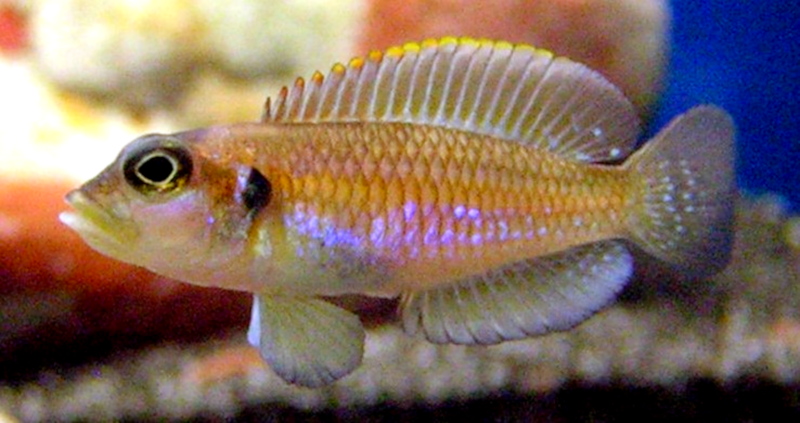
Overview
The species is endemic to Lake Tanganyika, where it inhabits snail shells. Individuals live in colonies and use tail movements to bury their occupied shells.
Written 26 November 2026 from the sources listed below. Each statement was checked against the passage it cites; statements that could not be supported were removed.
Habitat
Neolamprologus ocellatus inhabits snail shells in Lake Tanganyika. The species is endemic to the lake.[1][2]
Behaviour
Individuals live in colonies and occupy snail shells. They use tail movements to bury their occupied shells.[3][4]
Appearance
Individuals range in coloration from light brown to gold or yellow. Males are larger than females and have a yellow edge along the dorsal fin.[5][6]
Diet
Neolamprologus ocellatus is omnivorous. In captivity, it accepts prepared flake foods, small pellets, frozen foods, live brine shrimp and daphnia.[7][8]
Reproduction and life cycle
Males can spawn with multiple females simultaneously. Spawning takes place in or near the females' shells, where females lay their eggs.[9][10][11]
Eggs take approximately three days to hatch. Fry become free-swimming approximately one week after hatching.[12][13]
Uses
Neolamprologus ocellatus is kept in the aquarium trade.[14]
Classification of the Neolamprologus Ocellatus
| Kingdom | Animalia |
|---|---|
| Phylum | Chordata |
| Subphylum | Vertebrata |
| Infraphylum | Gnathostomata |
| Parvphylum | Osteichthyes |
| Gigaclass | Actinopterygii |
| Superclass | Actinopteri |
| Class | Teleostei (Teleost) |
| Order | Cichliformes |
| Family | Cichlidae (Cichlid) |
| Subfamily | Pseudocrenilabrinae |
| Genus | Lamprologus |
| Species | Lamprologus ocellatus (Steindachner, 1909) |
Where the Neolamprologus Ocellatus is found
Checklists and occurrence records place Lamprologus ocellatus in 4 countries. GBIF holds 110 georeferenced records of it.
Countries
Regions and cities with the most records
A number beside a place is its count of GBIF occurrence records. A place without a number comes from a checklist alone. Records show where a species has been observed or collected, which can include escapes and vagrants.
Common names
English
- Neolamprologus Ocellatus
Synonyms
3 other scientific names have been used for this species and are now treated as synonyms of Lamprologus ocellatus.
- Julidochromis ocellatus Steindachner, 1909
- Lamprologus lestradei Poll, 1943
- Neolamprolagus ocellatus (Steindachner, 1909)
Related species
- Lamprologus lethops
-
 Lamprologus congoensis
-
 Neolamprologus CallipterusLamprologus callipterus
- Neolamprologus KungweensisLamprologus kungweensis
- Neolamprologus OrnatipinnisLamprologus ornatipinnis
- Neolamprologus SignatusLamprologus signatus
-
 Neolamprologus LemairiiLamprologus lemairii
- Neolamprologus FinalimusLamprologus finalimus
Compare
Questions and answers
What is the scientific name of the Neolamprologus Ocellatus?
The scientific name of the Neolamprologus Ocellatus is Lamprologus ocellatus. Written with its author, the full name is Lamprologus ocellatus (Steindachner, 1909).
Which family does the Neolamprologus Ocellatus belong to?
Lamprologus ocellatus belongs to the family Cichlidae, in the order Cichliformes and the class Teleostei.
Where is the Neolamprologus Ocellatus found?
Checklists and occurrence records place Lamprologus ocellatus in 4 countries: Zambia, Democratic Republic of the Congo, Burundi and Tanzania.
What is the conservation status of the Neolamprologus Ocellatus?
The IUCN Red List category recorded for Lamprologus ocellatus is Least Concern (LC).
Sources
Passages the profile rests on
- The species inhabits snail shells in Lake Tanganyika. Source passage: “They live in colonies amongst each other and raise their young in the shells.” — English Wikipedia
- The species is endemic to Lake Tanganyika. Source passage: “Neolamprologus ocellatus is a species of shell dwelling cichlid endemic to Lake Tanganyika.” — English Wikipedia
- Individuals live in colonies and occupy snail shells. Source passage: “They live in colonies amongst each other and raise their young in the shells.” — English Wikipedia
- Individuals use tail movements to bury their occupied shells. Source passage: “Neolamprologus ocellatus use propeller-like motions of the tail to bury the shells that they reside in.” — English Wikipedia
- Individuals range in coloration from light brown to gold or yellow. Source passage: “They range in color from a light brownish color to a gold/yellow color.” — English Wikipedia
- Males are larger than females and have a yellow edge along the dorsal fin. Source passage: “Male Neolamprologus ocellatus are larger, and have a yellow edge on the dorsal fin.” — English Wikipedia
- The species is omnivorous. Source passage: “N. ocellatus are omnivorous” — English Wikipedia
- In captivity, the species accepts prepared flake foods, small pellets, frozen foods, live brine shrimp and daphnia. Source passage: “including: flake, small pellets, frozen foods and live brine shrimp or daphnia.” — English Wikipedia
- Males can spawn with multiple females simultaneously. Source passage: “Males of this species spawn with more than one female at a time” — English Wikipedia
- Spawning takes place in or near the females' shells. Source passage: “and do so in or near the females' shells.” — English Wikipedia
- Females lay their eggs inside shells. Source passage: “Eggs are laid inside the shell” — English Wikipedia
- Eggs take approximately three days to hatch. Source passage: “and take approximately three days to hatch.” — English Wikipedia
- Fry become free-swimming approximately one week after hatching. Source passage: “The fry are free swimming in one week.” — English Wikipedia
- The species is kept in the aquarium trade. Source passage: “It is a popular aquarium fish due to its small size, appearance, and intelligence.” — English Wikipedia
Data
- Catalogue of Life, 2026-10-16 XR cc by
- Global Biodiversity Information Facility CC BY 4.0
- Wikidata CC0
- GeoNames CC BY 4.0
- Wikimedia Commons per image; credit shown with each image
- Within the Catalogue of Life, this name comes from World Register of Marine Species cc by
This species in other databases
Page built on 29 November 2026. See how the catalog is made and all sources and licences.
Cite this page
ScientificNames.org. (2026). Lamprologus ocellatus (Neolamprologus Ocellatus). Retrieved November 29, 2026, from https://scientificnames.org/species/lamprologus-ocellatus
“Lamprologus ocellatus (Neolamprologus Ocellatus).” ScientificNames.org, 2026, scientificnames.org/species/lamprologus-ocellatus. Accessed 29 Nov. 2026.
ScientificNames.org. “Lamprologus ocellatus (Neolamprologus Ocellatus).” Accessed November 29, 2026. https://scientificnames.org/species/lamprologus-ocellatus.
@misc{scientificnames_lamprologus_ocellatus_neolamprologus_ocellatus,
  author = {{ScientificNames.org}},
  title = {Lamprologus ocellatus (Neolamprologus Ocellatus)},
  year = {2026},
  url = {https://scientificnames.org/species/lamprologus-ocellatus},
  note = {Accessed 2026-11-29}
}