Species · Fishes
Lamprologus congoensis
Lamprologus congoensis has no English name on record in the checklists used here. It is a species of fish in the family Cichlidae (cichlid), order Cichliformes. The name dates from 1891.
- Scientific name
- Lamprologus congoensis Schilthuis, 1891
- Genus
- Lamprologus
- Family
- Cichlidae (Cichlid)
- Order
- Cichliformes
- Class
- Teleostei
- Red List category
- LC Least Concern
- Environment
- freshwater
- Recorded in
- 2 countries
- Name status
- accepted in the Catalogue of Life

Overview
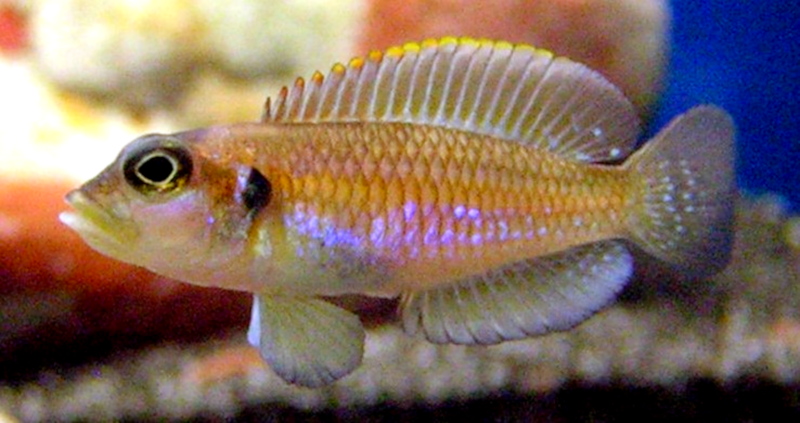
The species occurs in the Congo River basin between Pool Malebo and Monsembe in the Republic of Congo and the Democratic Republic of the Congo, and in the upper Sangha River in the Central African Republic. It is distinguished by a greyish lavender body, dark vertical flank bars and a chain-mail-like pattern formed by dark pigmentation around the scale edges.
Written 26 November 2026 from the sources listed below. Each statement was checked against the passage it cites; statements that could not be supported were removed.
Appearance
The species has a relatively deep body, with an average body depth equal to 25.2% of its standard length. Its head is approximately one-third of its standard length.[1][2]
Younger individuals have a more steeply angled forehead than mature individuals. The species is sexually dimorphic, with males developing a fat-filled nuchal hump and relatively longer fins than females.[3][4]
Dark pigmentation around the exposed edges of flank scales creates a chain-mail-like pattern. Most flank scales have iridescent spots near their posterior points, adjacent to the overlapping edges of neighbouring scales.[5][6]
Small whitish spots form lines along the membranes between the fin rays of the dorsal, anal and caudal fins. These fins also display oblique black striations.[7][8]
Male individuals grow to approximately 15 cm in total length.[9]
Habitat
The species is benthopelagic and occurs in areas of river rapids.[10]
Diet
The species appears to feed on invertebrates. Examined gut contents included insect and spider remains.[11][12]
Behaviour
Males are territorial and generally guard territories containing several females.[13]
Reproduction and life cycle
Females lay approximately 80 eggs in sheltered locations such as caves. They attach their eggs to the ceilings of caves.[14][15]
The eggs hatch approximately 54 hours after being laid. Females guard the eggs and young fish until the fry become free-swimming.[16][17]
The fry become free-swimming approximately eight days after hatching.[18]
Uses
The species is harvested by fisheries as a quarry species and is used for human consumption.[19][20]
The species is reported to be common and easy to breed in aquariums.[21]
Classification of Lamprologus congoensis
| Kingdom | Animalia |
|---|---|
| Phylum | Chordata |
| Subphylum | Vertebrata |
| Infraphylum | Gnathostomata |
| Parvphylum | Osteichthyes |
| Gigaclass | Actinopterygii |
| Superclass | Actinopteri |
| Class | Teleostei (Teleost) |
| Order | Cichliformes |
| Family | Cichlidae (Cichlid) |
| Subfamily | Pseudocrenilabrinae |
| Genus | Lamprologus |
| Species | Lamprologus congoensis Schilthuis, 1891 |
Where Lamprologus congoensis is found
Checklists and occurrence records place Lamprologus congoensis in 2 countries. GBIF holds 77 georeferenced records of it.
Countries
Regions and cities with the most records
- Brazzaville, Republic of the Congo 32
- Kinshasa, Democratic Republic of the Congo 30
- Masina, Democratic Republic of the Congo 30
- Kinshasa, Democratic Republic of the Congo 28
- Pool, Republic of the Congo 10
- Mai-Ndombe, Democratic Republic of the Congo 5
- Kwilu, Democratic Republic of the Congo 4
- Bolobo, Democratic Republic of the Congo 3
A number beside a place is its count of GBIF occurrence records. A place without a number comes from a checklist alone. Records show where a species has been observed or collected, which can include escapes and vagrants.
Common names
Names in 2 other languages
- Czech
- pestřenec konžský
- German
- Kongo-Grundcichlide
Synonyms
4 other scientific names have been used for this species and are now treated as synonyms of Lamprologus congoensis.
- Acanthochromis seminudus Vaillant, 1886
- Lamprologus congolensis Schilthuis, 1891
- Lamprologus congolensis Boulenger, 1901
- Lamprologus fuscus Pellegrin, 1927
Related species
- Lamprologus lethops
-
 Neolamprologus OcellatusLamprologus ocellatus
-
 Neolamprologus CallipterusLamprologus callipterus
- Neolamprologus KungweensisLamprologus kungweensis
- Neolamprologus OrnatipinnisLamprologus ornatipinnis
- Neolamprologus SignatusLamprologus signatus
-
 Neolamprologus LemairiiLamprologus lemairii
- Neolamprologus FinalimusLamprologus finalimus
Compare
Questions and answers
What is the type species of the genus Lamprologus?
Lamprologus congoensis is the type species of the genus Lamprologus.[22]
How large do males grow?
Male individuals grow to approximately 15 cm in total length.[9]
What does the species eat?
The species appears to feed on invertebrates. Examined gut contents included insect and spider remains.[11][12]
How many eggs do females lay?
Females lay approximately 80 eggs in sheltered locations such as caves.[14]
How long does it take for the eggs to hatch?
The eggs hatch approximately 54 hours after being laid.[16]
When do the fry become free-swimming?
The fry become free-swimming approximately eight days after hatching.[18]
Sources
Passages the profile rests on
- The Congo lionhead cichlid has a relatively deep body, with an average body depth equal to 25.2% of its standard length. Source passage: “the mean body depth being 25.2% of the standard length” — English Wikipedia
- The species' head is approximately one-third of its standard length. Source passage: “the head is roughly one third of the standard length.” — English Wikipedia
- Younger individuals have a more steeply angled forehead than mature individuals. Source passage: “Smaller fish have the forehead at a steeper angle than more mature fish.” — English Wikipedia
- The species is sexually dimorphic, with males developing a fat-filled nuchal hump and relatively longer fins than females. Source passage: “It is a sexually dimorphic species in which the males attain a larger size than the females and develop a fat-filled nuchal hump on the head, and have relatively longer fins than the females.” — English Wikipedia
- Dark pigmentation around the exposed edges of flank scales creates a chain-mail-like pattern. Source passage: “Each flank scales has dark pigment distributed uniformly around exposed rare edde and these intersect to create a pattern reminiscent of chain mail.” — English Wikipedia
- Most flank scales have iridescent spots near their posterior points, adjacent to the overlapping edges of neighbouring scales. Source passage: “There are iridescent spots in towards the posterior point of most of the flank scales, next to the overlapping edge of the scale in front of it.” — English Wikipedia
- Small whitish spots form lines along the membranes between the fin rays of the dorsal, anal and caudal fins. Source passage: “Small, whitish spots form lines along the membranes between the rays of the dorsal, anal and caudal fins.” — English Wikipedia
- The dorsal, anal and caudal fins display oblique black striations. Source passage: “These three fins also show oblique black striations.” — English Wikipedia
- Male individuals grow to approximately 15 cm in total length. Source passage: “Males grow to around 15 cm in total length” — English Wikipedia
- The species is benthopelagic and occurs in areas of river rapids. Source passage: “Lamprolgus congoensis is a benthopelagic species which is found in areas of rapids” — English Wikipedia
- The species appears to feed on invertebrates. Source passage: “It appears to feed on invertebrates” — English Wikipedia
- Examined gut contents included insect and spider remains. Source passage: “a gut examined contains the remains of insects and spider” — English Wikipedia
- Males are territorial and generally guard territories containing several females. Source passage: “They males are territorial and usually have a number of females within the territory he guards” — English Wikipedia
- Females lay approximately 80 eggs in sheltered locations such as caves. Source passage: “the female lays 80 or so eggs in a sheltered spot such as a cave” — English Wikipedia
- Females attach their eggs to the ceilings of caves. Source passage: “laying the eggs onto the ceiling of the cave.” — English Wikipedia
- The eggs hatch approximately 54 hours after being laid. Source passage: “The eggs hatch after around 54 hours” — English Wikipedia
- Females guard the eggs and young fish until the fry become free-swimming. Source passage: “the eggs and young fish are guarded by the female until the fry become free swimming at eight days old.” — English Wikipedia
- The fry become free-swimming approximately eight days after hatching. Source passage: “the fry become free swimming at eight days old.” — English Wikipedia
- The species is harvested by fisheries as a quarry species. Source passage: “Lamprolgus congoensis is a quarry species for fisheries” — English Wikipedia
- The species is used for human consumption. Source passage: “is a species used for human consumption.” — English Wikipedia
- The species is reported to be common and easy to breed in aquariums. Source passage: “It is common and easy to breed in the aquarium.” — English Wikipedia
- Lamprologus congoensis is the type species of the genus Lamprologus. Source passage: “it is the type species of the genus Lamprologus.” — English Wikipedia
- The species occurs in the Congo River basin between Pool Malebo and Monsembe in the Republic of Congo and the Democratic Republic of the Congo. Source passage: “from the Pool Malebo to Monsembe in the Republic of Congo and the Democratic Republic of the Congo” — English Wikipedia
- Its documented distribution includes the upper Sangha River in the Central African Republic. Source passage: “in the upper Sangha in the Central African Republic.” — English Wikipedia
Data
- Catalogue of Life, 2026-10-16 XR cc by
- Global Biodiversity Information Facility CC BY 4.0
- Wikidata CC0
- GeoNames CC BY 4.0
- Wikimedia Commons per image; credit shown with each image
- Within the Catalogue of Life, this name comes from World Register of Marine Species cc by
References
- Schilthuis, L. (1891). On a collection of fishes from the Congo; with description of some new species. Tijdschrift Der Nederlandsche Dierkundige Vereeniging, Ser., 2 v. 3: 83–92, Pl.6. where the name was published
This species in other databases
- Catalogue of Life 3S4PB
- Wikidata Q5686479
- iNaturalist 103990
- WoRMS urn:lsid:marinespecies.org:taxname:1016221
- ITIS 648691
Page built on 27 November 2026. See how the catalog is made and all sources and licences.
Cite this page
ScientificNames.org. (2026). Lamprologus congoensis. Retrieved November 27, 2026, from https://scientificnames.org/species/lamprologus-congoensis
“Lamprologus congoensis.” ScientificNames.org, 2026, scientificnames.org/species/lamprologus-congoensis. Accessed 27 Nov. 2026.
ScientificNames.org. “Lamprologus congoensis.” Accessed November 27, 2026. https://scientificnames.org/species/lamprologus-congoensis.
@misc{scientificnames_lamprologus_congoensis,
  author = {{ScientificNames.org}},
  title = {Lamprologus congoensis},
  year = {2026},
  url = {https://scientificnames.org/species/lamprologus-congoensis},
  note = {Accessed 2026-11-27}
}