Species · Flowering plants
Bay Laurel Laurus nobilis
The scientific name of the Bay Laurel is Laurus nobilis. It is a species of flowering plant in the family Lauraceae (laurel family), order Laurales.
- Scientific name
- Laurus nobilis L.
- Common name
- Bay Laurel
- Genus
- Laurus
- Family
- Lauraceae (Laurel Family)
- Order
- Laurales
- Class
- Magnoliopsida
- Red List category
- LC Least Concern
- Recorded in
- 69 countries
- Name status
- accepted in the Catalogue of Life

Overview
Bay laurel is an aromatic evergreen tree or large shrub with smooth, green leaves. The species is native to the Mediterranean region and southern Europe. Its male and female flowers grow on separate individual plants.
Written 26 November 2026 from the sources listed below. Each statement was checked against the passage it cites; statements that could not be supported were removed.
Appearance
Bay laurel has smooth, green leaves with untoothed margins, although some leaves have undulating edges. The leaves are between 6 and 12 cm long and 2 and 4 cm wide.[1][2][3]
The flowers are pale yellow-green, approximately 1 cm in diameter, and grow in pairs beside the leaves. The species has separate male and female flowers on different plants.[4][5][6]
The fruit is a shiny black, berry-like drupe approximately 1 cm long and containing one seed.[7][8]
The plant can reach heights of 7–18 metres, and its stem can reach 1 metre in diameter.[9][10]
Habitat
Bay laurel is native to the Mediterranean region and southern Europe. Its recorded growing range includes Greece, Portugal, France, Turkey, Spain, Algeria, Morocco, and the Canary Islands.[11][12][13][14]
The species is cultivated in India, Pakistan, Southeast Asia, Pacific islands, Australia, Mediterranean coastal regions, and southern Europe. It is also cultivated in Belgium, Central America, Mexico, and the southern United States.[15][16]
The species grows in Mediterranean or oceanic climatic regions as an ornamental plant. Moist sandy soils and humid atmospheric conditions near ocean shores are suitable for vigorous growth.[17][18]
Partial shade and well-drained sandy soil with some moisture are preferred growing conditions. The preferred soil pH range is 4.5–8.2.[19][20]
Behaviour
Bay laurel is slow-growing and may require several years to attain its intended ornamental height.[21]
Reproduction and life cycle
Male and female flowers occur on separate individual plants. Each fruit contains a single seed.[22][8]
Uses
Bay leaves are commonly used as seasoning in cooking. Whole leaves are primarily used to add flavour during food preparation and are generally removed from prepared dishes before serving.[23][24][25]
Ground bay leaves can be consumed safely and are commonly added to soups and stocks. Dried fruits and pressed leaf oil are also used as spices.[26][27]
The wood can be burned to produce a strong smoke flavour.[28]
The species is cultivated ornamentally as a houseplant or greenhouse plant in colder regions. It is also used in topiary to create shaped crowns and single upright stems.[29][30]
Extracts of the leaves have been used in traditional herbal medicine as astringents and salves for open wounds. A poultice prepared with boiled bay leaves has been used as a folk remedy for rashes caused by poison ivy, poison oak, and stinging nettle.[31][32]
Bay laurel extracts are used in massage therapy and aromatherapy. The species is also used in industrial applications involving food, cosmetics, and pharmaceutical products.[33][34]
Classification of the Bay Laurel
| Kingdom | Plantae |
|---|---|
| Subkingdom | Pteridobiotina |
| Phylum | Tracheophyta |
| Class | Magnoliopsida |
| Order | Laurales |
| Family | Lauraceae (Laurel Family) |
| Tribe | Laureae |
| Genus | Laurus (Laurel) |
| Species | Laurus nobilis L. |
Where the Bay Laurel is found
Checklists and occurrence records place Laurus nobilis in 69 countries across Africa, Asia, Europe, North America, Oceania and South America. GBIF holds 73,057 georeferenced records of it.
Countries where it is native or its origin is not stated
- Albania 20
- Algeria 51
- Argentina 159
- Austria 16
- Azerbaijan 3
- Belgium 187
- Bolivia 4
- Bosnia and Herzegovina 5
- Brazil 313
- Bulgaria 4
- Chile 39
- Colombia 45
- Croatia 1,292
- Cyprus 69
- Ecuador 8
- Egypt 9
- Estonia 3
- France 36,157
- Georgia 52
- Greece 566
- Hungary 4
- India 17
- Iraq 3
- Isle of Man 15
- Israel 818
- Italy 10,047
- Japan 123
- Jordan 3
- Kosovo
- Lebanon 169
- Libya 9
- Luxembourg 5
- Monaco 8
- Montenegro 92
- Morocco 49
- North Macedonia 8
- Palestinian Territory 8
- Paraguay 5
- Reunion 3
- Russia 120
- Serbia 2
- Slovenia 87
- South Africa 96
- Sweden 7
- Switzerland 888
- Syria 34
- Tanzania 3
- The Netherlands 20
- Tunisia 13
- Turkey 870
- Ukraine 61
- Uruguay 40
Countries where it has been introduced
- China 40
- Germany 91
- Gibraltar 2
- Guernsey 9
- Ireland 63
- Jersey 9
- Malta 22
- New Zealand 639
- Pakistan 1
- Portugal 3,013
- San Marino 2
- South Korea 65
- Spain 10,915
- Taiwan
- United Kingdom 5,299
- United States 258
- Vietnam
Regions and cities with the most records
- Occitanie, France 6,755
- Provence-Alpes-Côte d'Azur, France 5,701
- England, United Kingdom 4,430
- Île-de-France, France 2,919
- Auvergne-Rhône-Alpes, France 2,858
- Catalonia, Spain 2,813
- Pays de la Loire, France 2,704
- Vence, France 2,425
- Nice, France 2,412
- Saint-Laurent-du-Var, France 2,257
- Cagnes-sur-Mer, France 2,232
- Tuscany, Italy 2,050
- Montrouge, France 1,644
- Malakoff, France 1,628
- Paris 05 Panthéon, France 1,627
- Paris 14 Observatoire, France 1,627
- Gentilly, France 1,626
- Salpêtrière, France 1,622
- Maison Blanche, France 1,618
- Paris 06 Luxembourg, France 1,618
- Paris 13 Gobelins, France 1,618
- Vanves, France 1,614
- Croulebarbe, France 1,613
- Gare, France 1,611
- Le Kremlin-Bicêtre, France 1,609
- Quinze-Vingts, France 1,607
- Paris, France 1,606
- Châtillon, France 1,605
- Paris 15 Vaugirard, France 1,604
- Ivry-sur-Seine, France 1,600
- Arcueil, France 1,593
- Bagneux, France 1,593
- Paris 01 Louvre, France 1,590
- Issy-les-Moulineaux, France 1,588
- Paris 12 Reuilly, France 1,587
- Paris 07 Palais-Bourbon, France 1,585
7 more countries have a few records outside this range
These countries hold a few records of Laurus nobilis but lie outside the range the checklists give for it. Such records are often zoo or garden specimens, museum material or vagrants, so the species is not counted as occurring there.
Range as the checklists state it
England [I] (England [I], Wales [I], Scotland [I]); Ireland [I] (Ireland [I], Northern Ireland [I]); Germany [I]; Portugal [I]; Spain [I]; Gibraltar [I]; Baleares [I]; France; Channel Isl. [I] (Alderney [I], Jersey [I], Guernsey [I]); Corsica; Sardinia; Italy; Sicily; Isole Pelagie (Lampedusa); Malta [I]; San Marino [I]; Slovenia; Croatia; Bosnia & Hercegovina; Montenegro; Serbia; Kosovo; North Macedonia; Bulgaria; European Turkey; Greece (lowlands, incl. Kerkyra, Ionian Isl., Thasos, Samothraki, Evvoia, Andros, Tinos, Kithira); Crete; Crimea; Morocco; Algeria; Tunisia; Libya; Azores [I] (Sao Miguel Isl. [I], Terceira [I], Graciosa [I]); Northern Caucasus; +Georgia [Caucasus] (+Samegrelo, +Imereti); East Aegaean Isl. (Lesvos, Chios, Ikaria, Samos, Leros, Kos, Nisyros, Tilos, Rhodos); Turkey (widespread in coastal regions); Cyprus (C-Mountains, N-Cyprus, S-Cyprus, W-Cyprus); Lebanon (C-Lebanon, coastal W-Lebanon); Syria (coastal W-Syria, W-Syrian Mountains); Israel (Rift Valley, N-Israel); China [I] (Fujian [I], Jiangsu [I], Sichuan [I], Yunnan [I], Zhejiang [I]); South Korea [I]; Ryukyu Isl. [I]; Taiwan [I]; Pakistan [I]; Vietnam [I]; Jawa [I]; New Zealand [I]; USA [I] (California [I]); Bolivia [c]
A number beside a place is its count of GBIF occurrence records. A place without a number comes from a checklist alone. Records show where a species has been observed or collected, which can include escapes and vagrants.
Common names
English
- Bay Laurel
- Bay
- Bay Leaf Tree
- Grecian Laurel
- Laurel
- Sweet Laurel
- Sweetbal-Tree
- Bay-leaf Laurel
- Royal Bay
- Sweet Bay
- True Laurel
Names in 35 other languages
- Arabic
- الغار النبيل
- Asturian
- lloréu
- Basque
- Ereinotza
- Catalan
- Llor, Llorer
- Chinese
- yue gui, 月桂, 月桂叶, 月桂子, 月桂樱子
- Croatian
- Lovor
- Czech
- vavřín vznešený
- Danish
- Ægte Laurbær
- Dutch
- Laurierboom
- Esperanto
- Laŭro
- Estonian
- harilik loorberipuu
- Finnish
- välimerenlaakeri
- French
- Laurier sauce, Laurier-sauce, laurier
- German
- Echter Lorbeer, Edler Lorbeer, Gewürzlorbeer, Lorbeer, Lorbeerbaum, Lorbeerstrauch
- Greek
- Δάφνη, Δάφνη η ευγενής, Κοινή Δάφνη
- Hebrew
- דפנה, ער אציל
- Italian
- Alloro
- Japanese
- gekkeiju, ゲッケイジュ
- Lithuanian
- Kilnusis lauramedis, Kilnusis lauremedis
- Norwegian Bokmål
- laurbær
- Polish
- wawrzyn szlachetny
- Portuguese
- Loureiro, Louro, louro-comum, louro-de-apolônio, louro-europeu
- Russian
- Лавр благородный
- Serbian
- Ловор / Lovor
- Slovak
- vavrín vznešený
- Slovenian
- navadni lovor
- Spanish
- Laurel de Castilla
- Swedish
- lager, lagerträd
- Turkish
- Akdeniz Defnesi, Defne
- Ukrainian
- Лавр благородний
- Vietnamese
- Nguyệt quế
- Welsh
- Arel, Dail y Cwrw, Diawdwydd, Diodwyd, Llawrwydd, Llawrwydden, Llawryfen, Llorwydden
- arg
- Laurelero
- frr
- (Echt) loorbeer
- srd
- Laru
Synonyms
20 other scientific names have been used for this species and are now treated as synonyms of Laurus nobilis.
- Laurus angusta Raf.
- Laurus magnoliifolia Cav.
- Laurus nobilis f. lanceolata Meisn.
- Laurus nobilis f. latifolia (Risso) Maire
- Laurus nobilis var. angustifolia Hayne
- Laurus nobilis var. angustifolia Nees
- Laurus nobilis var. floribunda Meisn.
- Laurus nobilis var. flos-pleno Radogizky
- Laurus nobilis var. lanceolata Meisn.
- Laurus nobilis var. latifolia Nees
- Laurus nobilis var. latifolia C.Bauhin ex Hayne
- Laurus nobilis var. latifolia Risso
- Laurus nobilis var. longifolia Risso
- Laurus nobilis var. rotundifolia Emb. & Maire
- Laurus nobilis var. undulata Hayne
- Laurus nobilis var. variegata Radogizky
- Laurus papillosa Demoly
- Laurus salicifolia Nees
- Laurus tenuifolia Mill.
- Laurus undulata Mill.
Related species
-
 Azores LaurelLaurus azorica
-
 Canary LaurelLaurus novocanariensis
-
 AvocadoPersea americana
-
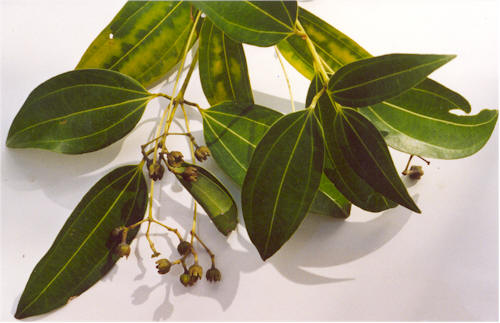 Ceylon CinnamonCinnamomum verum
-
 SassafrasSassafras albidum
-
 SpicebushLindera benzoin
-
 Indian Bay LeafCinnamomum tamala
-
 Phoebe zhennan
Compare
Questions and answers
What is the scientific name of the Bay Laurel?
The scientific name of the Bay Laurel is Laurus nobilis. Written with its author, the full name is Laurus nobilis L..
Which family does the Bay Laurel belong to?
Laurus nobilis belongs to the family Lauraceae, in the order Laurales and the class Magnoliopsida.
Where is the Bay Laurel found?
Checklists and occurrence records place Laurus nobilis in 69 countries, including France, Italy, Croatia, Switzerland, Turkey and Israel.
What is the conservation status of the Bay Laurel?
The IUCN Red List category recorded for Laurus nobilis is Least Concern (LC).
What other names does the Bay Laurel have?
Laurus nobilis is also known in English as Bay, Bay Leaf Tree, Grecian Laurel, Laurel, Sweet Laurel and Sweetbal-Tree.
Sources
Passages the profile rests on
- Laurus nobilis is an aromatic evergreen tree or large shrub with smooth, green leaves. Source passage: “Laurus nobilis () is an aromatic evergreen tree or large shrub with green, glabrous (smooth) leaves.” — English Wikipedia
- The leaves have smooth, untoothed margins, although some leaves have undulating edges. Source passage: “with an entire (untoothed) margin. On some leaves the margin undulates.” — English Wikipedia
- The leaves are between 6 and 12 cm long and 2 and 4 cm wide. Source passage: “The leaves are glabrous, 6–12 cm (2–5 in) long and 2–4 cm (3⁄4–1+5⁄8 in) broad” — English Wikipedia
- The flowers are pale yellow-green and approximately 1 cm in diameter. Source passage: “Each flower is pale yellow-green, about 1 cm (3⁄8 in) diameter” — English Wikipedia
- The flowers grow in pairs beside the leaves. Source passage: “they are borne in pairs beside a leaf.” — English Wikipedia
- The species has separate male and female flowers on different plants. Source passage: “The bay laurel is dioecious (unisexual), with male and female flowers on separate plants.” — English Wikipedia
- The fruit is a shiny black, berry-like drupe approximately 1 cm long and containing one seed. Source passage: “The fruit is a small, shiny black drupe-like berry about 1 cm (3⁄8 in) long that contains one seed.” — English Wikipedia
- Each fruit contains a single seed. Source passage: “that contains one seed.” — English Wikipedia
- The plant can reach heights of 7–18 metres. Source passage: “variable in size and sometimes reaching 7–18 m (23–59 ft) tall.” — English Wikipedia
- The stem can reach 1 metre in diameter. Source passage: “The stem can be 1 metre in diameter” — English Wikipedia
- The species is native to the Mediterranean region. Source passage: “Native to the Mediterranean region” — English Wikipedia
- The species is native to southern Europe. Source passage: “Bay leaf is native to South Europe (Patrakar et al., 2012).” — pmc.ncbi.nlm.nih.gov
- Its recorded growing range includes Greece, Portugal, France, Turkey, Spain, Algeria, and Morocco. Source passage: “Greece, Portugal, France, Turkey, Spain, Algeria, Morocco” — pmc.ncbi.nlm.nih.gov
- The Canary Islands are included in its recorded growing range. Source passage: “and the Canary Islands” — pmc.ncbi.nlm.nih.gov
- The species is cultivated in India, Pakistan, Southeast Asia, Pacific islands, Australia, Mediterranean coastal regions, and southern Europe. Source passage: “Bay is widely growing in the following countries: India, Pakistan, other Southeast Asian countries, some Pacific islands, Australia, around the coast of the Mediterranean and Southern Europe” — pmc.ncbi.nlm.nih.gov
- The species is also cultivated in Belgium, Central America, Mexico, and the southern United States. Source passage: “Belgium, Central America, Mexico, Southern United States” — pmc.ncbi.nlm.nih.gov
- The species grows in Mediterranean or oceanic climatic regions as an ornamental plant. Source passage: “widely cultivated as an ornamental plant in regions with Mediterranean or oceanic climates” — English Wikipedia
- Moist sandy soils and humid atmospheric conditions near ocean shores are suitable for vigorous growth. Source passage: “Wet, sandy soil that has a large quantity of water or some moist atmospheric conditions close to the ocean shore are optimum and the best conditions for rapid luxuriant growth” — pmc.ncbi.nlm.nih.gov
- Partial shade and well-drained sandy soil with some moisture are preferred growing conditions. Source passage: “partial sun shade, well-drained sandy soil that has some moisture” — pmc.ncbi.nlm.nih.gov
- The preferred soil pH range is 4.5–8.2. Source passage: “and a pH range of 4.5–8.2 are preferred.” — pmc.ncbi.nlm.nih.gov
- The species is slow-growing and may require several years to attain its intended ornamental height. Source passage: “However, it is slow-growing and may take several years to reach the desired height.” — English Wikipedia
- Male and female flowers occur on separate individual plants. Source passage: “with male and female flowers on separate plants.” — English Wikipedia
- Bay leaves are commonly used as seasoning in cooking. Source passage: “Bay leaves are widely used as seasoning in cooking.” — English Wikipedia
- Whole bay leaves are generally removed from prepared dishes before serving. Source passage: “They are typically removed from dishes before serving” — English Wikipedia
- Whole bay leaves are used primarily to add flavour during food preparation. Source passage: “Whole bay leaves are used almost exclusively as flavor agents during the food preparation stage.” — English Wikipedia
- Ground bay leaves can be consumed safely and are commonly added to soups and stocks. Source passage: “Ground bay leaves, however, can be ingested safely and are often used in soups and stocks” — English Wikipedia
- Dried fruits and pressed leaf oil are used as spices. Source passage: “Dried laurel berries and pressed leaf oil can both be used as robust spices” — English Wikipedia
- The wood can be burned to produce a strong smoke flavour. Source passage: “the wood can be burnt for strong smoke flavoring.” — English Wikipedia
- The species is cultivated ornamentally as a houseplant or greenhouse plant in colder regions. Source passage: “as a house plant or greenhouse plant in colder regions.” — English Wikipedia
- The species is used in topiary to create shaped crowns and single upright stems. Source passage: “It is used in topiary to create single erect stems with ball-shaped, box-shaped or twisted crowns” — English Wikipedia
- Extracts of the leaves have been used in traditional herbal medicine as astringents and salves for open wounds. Source passage: “aqueous extracts of bay laurel have been used as an astringent and salve for open wounds.” — English Wikipedia
- A poultice prepared with boiled bay leaves has been used as a folk remedy for rashes caused by poison ivy, poison oak, and stinging nettle. Source passage: “A folk remedy for rashes caused by poison ivy, poison oak, and stinging nettle is a poultice soaked in boiled bay leaves.” — English Wikipedia
- Bay laurel extracts are used in massage therapy and aromatherapy. Source passage: “It is also used in massage therapy and aromatherapy.” — English Wikipedia
- The species is used in industrial applications involving food, cosmetics, and pharmaceutical products. Source passage: “Bay is an essential component of several industrial applications that range from food to cosmetics to pharmaceutical products.” — pmc.ncbi.nlm.nih.gov
Data
- Catalogue of Life, 2026-10-16 XR cc by
- Global Biodiversity Information Facility CC BY 4.0
- Wikidata CC0
- GeoNames CC BY 4.0
- Wikimedia Commons per image; credit shown with each image
- Within the Catalogue of Life, this name comes from Synonymic Checklists of the Vascular Plants of the World cc by
References
- L. (1753). Sp. Pl. [Linnaeus] 1: 369 (1753). where the name was published
This species in other databases
Page built on 26 November 2026. See how the catalog is made and all sources and licences.
Cite this page
ScientificNames.org. (2026). Laurus nobilis (Bay Laurel). Retrieved November 26, 2026, from https://scientificnames.org/species/laurus-nobilis
“Laurus nobilis (Bay Laurel).” ScientificNames.org, 2026, scientificnames.org/species/laurus-nobilis. Accessed 26 Nov. 2026.
ScientificNames.org. “Laurus nobilis (Bay Laurel).” Accessed November 26, 2026. https://scientificnames.org/species/laurus-nobilis.
@misc{scientificnames_laurus_nobilis_bay_laurel,
  author = {{ScientificNames.org}},
  title = {Laurus nobilis (Bay Laurel)},
  year = {2026},
  url = {https://scientificnames.org/species/laurus-nobilis},
  note = {Accessed 2026-11-26}
}