Species · Flowering plants
Spicebush Lindera benzoin
The scientific name of the Spicebush is Lindera benzoin. It is a species of flowering plant in the family Lauraceae (laurel family), order Laurales.
- Scientific name
- Lindera benzoin (L.) Blume
- Common name
- Spicebush
- Genus
- Lindera
- Family
- Lauraceae (Laurel Family)
- Order
- Laurales
- Class
- Magnoliopsida
- Red List category
- LC Least Concern
- Recorded in
- 2 countries
- Name status
- accepted in the Catalogue of Life

Overview
Lindera benzoin is native to eastern North America, including Pennsylvania. It is distinguished by yellow flowers that appear before the leaves and stems that produce a spicy, sweet fragrance when bruised.
Written 26 November 2026 from the sources listed below. Each statement was checked against the passage it cites; statements that could not be supported were removed.
Appearance
The foliage turns yellow in autumn. The yellow flowers have six sepals and grow in clusters that appear before the leaves emerge.[1][2][3]
Habitat
Spicebush grows in the understory of moist, rich woods in eastern North America. It grows particularly well in woodland sites with exposed limestone and on moist, calcium-rich sites.[4][5][6]
It tolerates light conditions ranging from full sun to deep shade. It grows best in rich, well-draining soils.[7][8]
Diet
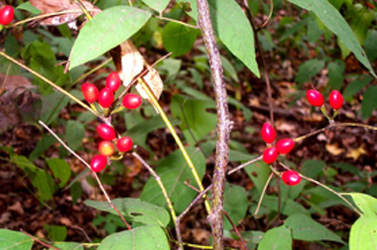
Several bird species consume the fruits, and wood thrushes are particularly fond of them. The fruits contain nearly 50% fat.[9][10][11]
White-tailed deer, eastern cottontail rabbits, and opossums feed on the plant. Eastern cottontails consume its leaves, twigs, and berries.[12][13]
Behaviour
Spicebush commonly forms clumps or thickets through root sprouting. The aromatic fragrance of its stems and foliage may deter animal browsing.[14][15]
Reproduction and life cycle
Spicebush is dioecious, with male and female flowers occurring on separate plants. Female flowers develop into clusters of single-seeded drupes in autumn.[16][17]
Most plants reproduce asexually through root suckers. Both male and female plants are required to produce drupes containing viable seeds.[18][19]
Female plants have higher reproductive costs than male plants.[20]
Uses
The leaves, buds, and young twigs can be prepared as tea. Dried and ground fruits can serve as an allspice substitute.[21][22]
All parts of the plant have historical uses in food flavoring, teas, and medicine. Native American peoples including the Cherokee, Muscogee, and Haudenosaunee have traditionally used the plant medicinally.[23][24]
Early land surveyors used spicebush as an indicator of fertile agricultural land. The species is also cultivated as an ornamental garden shrub.[25][26]
Classification of the Spicebush
| Kingdom | Plantae |
|---|---|
| Subkingdom | Pteridobiotina |
| Phylum | Tracheophyta |
| Class | Magnoliopsida |
| Order | Laurales |
| Family | Lauraceae (Laurel Family) |
| Tribe | Laureae |
| Genus | Lindera (Spicebush) |
| Species | Lindera benzoin (L.) Blume |
Where the Spicebush is found
Checklists and occurrence records place Lindera benzoin in 2 countries across North America. GBIF holds 48,226 georeferenced records of it.
Countries
Regions and cities with the most records
- Pennsylvania, United States 5,504
- New York, United States 4,160
- Virginia, United States 4,024
- Ohio, United States 3,880
- Maryland, United States 3,679
- Bethesda, United States 2,791
- McLean, United States 2,739
- Massachusetts, United States 2,653
- Potomac, United States 2,598
- Silver Spring, United States 2,598
- North Bethesda, United States 2,596
- Brightwood, United States 2,550
- Arlington, United States 2,528
- Tysons, United States 2,501
- Idylwood, United States 2,492
- Wheaton, United States 2,477
- Takoma Park, United States 2,460
- Kennedy Street, United States 2,453
- Langley Park, United States 2,453
- Mount Pleasant, United States 2,448
- Chillum, United States 2,445
- Adams Morgan, United States 2,408
- Central 14th Street / Spring Road, United States 2,402
- Foggy Bottom, United States 2,401
- Petworth, United States 2,393
- Pleasant Plains, United States 2,376
- Columbia Heights, United States 2,374
- Golden Triangle, United States 2,370
- Park View, United States 2,356
- West Falls Church, United States 2,351
- Shaw, United States 2,349
- Downtown DC, United States 2,348
- Mount Vernon Triangle, United States 2,342
- Washington, United States 2,341
- Merrifield, United States 2,330
- Northwest One, United States 2,327
5 more countries have a few records outside this range
These countries hold a few records of Lindera benzoin but lie outside the range the checklists give for it. Such records are often zoo or garden specimens, museum material or vagrants, so the species is not counted as occurring there.
Range as the checklists state it
Canada (Ontario); USA (Arkansas, Connecticut, District of Columbia, Delaware, Georgia, Illinois, Indiana, Kansas, Kentucky, Massachusetts, Maryland, Maine, Michigan, Missouri, North Carolina, New Hampshire, New Jersey, New York, Ohio, Oklahoma, Pennsylvania, Rhode Island, South Carolina, Tennessee, Virginia, Vermont, West Virginia)
A number beside a place is its count of GBIF occurrence records. A place without a number comes from a checklist alone. Records show where a species has been observed or collected, which can include escapes and vagrants.
Common names
English
- Spicebush
- Benjamin Bush
- Allspice
- Benjamin-bush
- Northern Spicebush
- Wild Allspice
Names in 4 other languages
- Chinese
- 北方山胡椒, 北美山胡椒
- French
- arbre à fièvre, arbre à épice, benjoin, benjoin odoriférant, laurier benzoin, laurier faux-benjoin, lindéra benzoin
- German
- Fieberstrauch
- Swedish
- feberbuske
Synonyms
30 other scientific names have been used for this species and are now treated as synonyms of Lindera benzoin.
- Benzoin aestivale f. xanthocarpum G.S.Torr.
- Benzoin benzoin (L.) J.M.Coult.
- Benzoin geniculatum (Nutt.) G.Don
- Benzoin odoriferum Nees
- Calosmon acstivale Kostel.
- Calosmon aestivale Kostel.
- Calosmon benzoin (L.) J.Presl
- Euosmus benzoin (L.) Nutt.
- Euosmus geniculata Nutt.
- Laurus axillaris Lam.
- Laurus fragrans Salisb.
- Laurus glomerata Lam.
- Laurus pseudobenzoin Michx.
- Lindera aestivalis f. xanthocarpa (G.S.Torr.) Rehder
- Lindera benzoin (L.) Meisn.
- Lindera benzoin f. benzoin
- Lindera benzoin f. rubra Champlin
- Lindera benzoin f. xanthocarpa (G.S.Torr.) Rehder
- Lindera benzoin var. benzoin
- Lindera benzoin var. verna Meisn.
- Malapoenna glomerata (Lam.) Kuntze
- Ozanthes benzoin (L.) Raf.
- Tetranthera floridana Shuttlew. ex Meisn.
- Tetranthera geniculata var. grandiflora Nees
- Benzoin aestivale Nees ambiguous synonym
- Euosmus aestivalis Nutt. ambiguous synonym
- Laurus aestivalis Lam. ambiguous synonym
- Laurus benzoin L. ambiguous synonym
- Malapoenna geniculata Coult. ambiguous synonym
- Tetranthera aestivalis Spreng. ambiguous synonym
Subspecies and varieties
- Lindera benzoin var. pubescens variety
Related species
-
 Blunt-lobe SpicebushLindera obtusiloba
-
 PondberryLindera melissifolia
-
 Lindera aggregata
-
 Lindera triloba
-
 Lindera praecox
-
 Lindera subcoriacea
- Lindera lucida
- Taiwan SpicebushLindera akoensis
Compare
Questions and answers
What is the scientific name of the Spicebush?
The scientific name of the Spicebush is Lindera benzoin. Written with its author, the full name is Lindera benzoin (L.) Blume.
Which family does the Spicebush belong to?
Lindera benzoin belongs to the family Lauraceae, in the order Laurales and the class Magnoliopsida.
Where is the Spicebush found?
Checklists and occurrence records place Lindera benzoin in 2 countries: United States and Canada.
What is the conservation status of the Spicebush?
The IUCN Red List category recorded for Lindera benzoin is Least Concern (LC).
What other names does the Spicebush have?
Lindera benzoin is also known in English as Benjamin Bush, Allspice, Benjamin-bush, Northern Spicebush and Wild Allspice.
Do you need two spicebush?
Both male and female plants are required to produce drupes containing viable seeds.[16][19]
Sources
Passages the profile rests on
- The foliage turns yellow in autumn. Source passage: “In the fall the leaves turn bright yellow.” — English Wikipedia
- The flowers are yellow and have six sepals. Source passage: “The flowers have six sepals and a very sweet odor.” — English Wikipedia
- The flowers grow in clusters that appear before the leaves emerge. Source passage: “The yellow flowers grow in showy clusters which appear in early spring, before the leaves begin to grow.” — English Wikipedia
- The species grows in the understory of moist, rich woods in eastern North America. Source passage: “growing in the understory in moist, rich woods.” — English Wikipedia
- It grows particularly well in woodland sites with exposed limestone. Source passage: “especially those with exposed limestone.” — English Wikipedia
- The species grows best on moist, calcium-rich sites. Source passage: “Spicebush grows best on moist, calcium-rich sites” — extension.psu.edu
- It tolerates light conditions ranging from full sun to deep shade. Source passage: “can tolerate a range of light conditions from full sun to deep shade.” — extension.psu.edu
- It grows best in rich, well-draining soils. Source passage: “grows best in rich, well-draining soils.” — extension.psu.edu
- The fruits are consumed by several bird species. Source passage: “The ripe fruit is a red, ellipsoidal, berrylike drupe, rich in lipids, about 1 cm (1⁄2 in) long and is eaten by several bird species.” — English Wikipedia
- Wood thrushes are particularly fond of the fruits. Source passage: “The berries are a favorite food of wood thrushes.” — English Wikipedia
- The fruits contain nearly 50% fat. Source passage: “Spicebush fruit composition is nearly 50% fat” — extension.psu.edu
- White-tailed deer, eastern cottontail rabbits, and opossums feed on the plant. Source passage: “Some mammals include whitetail deer, Eastern cottontail rabbit, opossums.” — English Wikipedia
- Eastern cottontails feed on the leaves, twigs, and berries. Source passage: “Eastern cottontail (Sylvilagus floridanus) and other small mammals may feed on the leaves, twigs, and berries of spicebush.” — extension.psu.edu
- The species commonly forms clumps or thickets through root sprouting. Source passage: “It has a colonial nature and often reproduces by root sprouting, forming clumps or thickets.” — English Wikipedia
- The aromatic fragrance of its stems and foliage may deter animal browsing. Source passage: “The spicy, sweet fragrance produced by the stems and foliage may provide some deterrence to animal browsing.” — extension.psu.edu
- The species is dioecious, with male and female flowers occurring on separate plants. Source passage: “Spicebush isdioecious,meaning that male and female flowers are found on different plants” — extension.psu.edu
- Female flowers develop into clusters of single-seeded drupes in autumn. Source passage: “In the fall, red, shiny, elliptical fruits with a single seed, called drupes, will replace female flowers in clusters along nodes.” — extension.psu.edu
- Most plants reproduce asexually through root suckers. Source passage: “Most plants reproduce asexually by root suckers.” — extension.psu.edu
- Both male and female plants are required to produce drupes containing viable seeds. Source passage: “so that both sexes are needed in a garden if one wants drupes with viable seeds.” — English Wikipedia
- The female plants have higher reproductive costs than male plants. Source passage: “the female plants have a greater cost of reproduction compared to the male plants.” — English Wikipedia
- The leaves, buds, and young twigs can be prepared as tea. Source passage: “The leaves, buds, and new growth twigs can be made into a tea.” — English Wikipedia
- Dried and ground fruits can serve as an allspice substitute. Source passage: “The fruits can be dried, ground, and used as an allspice substitute.” — English Wikipedia
- All parts of the plant have historical uses in food flavoring, teas, and medicine. Source passage: “All parts of the plant are edible, with a historical use for flavoring foods, teas, and as medicine.” — extension.psu.edu
- Native American peoples including the Cherokee, Muscogee, and Haudenosaunee have traditionally used the plant medicinally. Source passage: “Native Americans, including the Cherokee, Muscogee, and Haudenosaunee, traditionally use the plant for treatments in multiple ailments.” — English Wikipedia
- Early land surveyors used the species as an indicator of fertile agricultural land. Source passage: “early land surveyors used spicebush as an indicator of good agricultural land.” — English Wikipedia
- The species is cultivated as an ornamental garden shrub. Source passage: “Spicebush is often cultivated in gardens or edges of gardens.” — English Wikipedia
Data
- Catalogue of Life, 2026-10-16 XR cc by
- Global Biodiversity Information Facility CC BY 4.0
- Wikidata CC0
- GeoNames CC BY 4.0
- Wikimedia Commons per image; credit shown with each image
- Within the Catalogue of Life, this name comes from Synonymic Checklists of the Vascular Plants of the World cc by
References
- Blume. (1851). Ann. Mus. Bot. Lugduno-Batavi 1: 324 (1851). where the name was published
This species in other databases
Page built on 26 November 2026. See how the catalog is made and all sources and licences.
Cite this page
ScientificNames.org. (2026). Lindera benzoin (Spicebush). Retrieved November 26, 2026, from https://scientificnames.org/species/lindera-benzoin
“Lindera benzoin (Spicebush).” ScientificNames.org, 2026, scientificnames.org/species/lindera-benzoin. Accessed 26 Nov. 2026.
ScientificNames.org. “Lindera benzoin (Spicebush).” Accessed November 26, 2026. https://scientificnames.org/species/lindera-benzoin.
@misc{scientificnames_lindera_benzoin_spicebush,
  author = {{ScientificNames.org}},
  title = {Lindera benzoin (Spicebush)},
  year = {2026},
  url = {https://scientificnames.org/species/lindera-benzoin},
  note = {Accessed 2026-11-26}
}