Species · Mammals
Canadian Lemming Lemmus trimucronatus
The scientific name of the Canadian Lemming is Lemmus trimucronatus. It is a species of mammal in the family Cricetidae (new world mice and rats), order Rodentia. The name dates from 1825.
- Scientific name
- Lemmus trimucronatus (Richardson, 1825)
- Common name
- Canadian Lemming
- Genus
- Lemmus
- Family
- Cricetidae (New World Mice and Rats)
- Order
- Rodentia
- Class
- Mammalia
- Red List category
- LC Least Concern
- Recorded in
- 2 countries
- Name status
- accepted in the Catalogue of Life

Overview
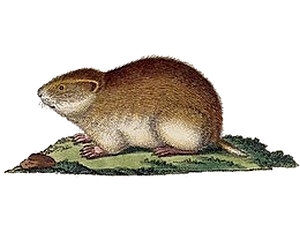
Lemmus trimucronatus inhabits tundra regions of northern Canada and southern Alaska south of the Alaska Range. It has a reddish-brown back and rump, a grey head and shoulders, and small ears, short legs and a very short tail.
Written 26 November 2026 from the sources listed below. Each statement was checked against the passage it cites; statements that could not be supported were removed.
Appearance
The Canadian Lemming has a reddish-brown back and rump, with a grey head and shoulders. Its winter coat becomes longer and greyer.[1][2]
It has small ears, short legs and a very short tail. Its feet have bristles covering both the soles and toes, which are adapted for burrowing.[3][4]
Adult females average 12.5 cm in length and weigh 58 g. Adult males average 13 cm in length and weigh 68 g.[5][6]
Habitat
The Canadian Lemming inhabits tundra regions of northern Canada and southern Alaska south of the Alaska Range. Its recorded range includes the west coast of British Columbia, extending almost as far south as Vancouver Island.[7][8]
On Bylot Island, the species mainly occupies wetlands in the southern plain, particularly polygon fens. During snowmelt, it uses wet tundra sites with rugged topography dominated by hummocks more frequently.[9][10]
Diet
The Canadian Lemming feeds mainly on grass shoots. Its recorded foods also include tundra grass, sedge, moss, bark, berries, lichens and roots.[11][12]
Behaviour
The Canadian Lemming lives underground in colonies and is non-migratory. Individuals fight among themselves during periods of overpopulation and during mating season.[13][14][15]
During winter, individuals occupy insulated underground burrows constructed from sedges and grasses. They build underground nests in confined burrows, which provide insulation and permit winter reproduction.[16][17]
On Bylot Island, individuals prefer burrowing beneath greater snow depths rather than in areas with denser snow. Deeper snow cover protects individuals and their nests from avian predators.[18][19]
During summer, the species occupies more widespread territories across Bylot Island than during winter. It avoids slopes, including mild slopes, throughout summer.[20][21]
Hydrology and topography are the principal factors associated with the species' fine-scale habitat use on Bylot Island. No clear association was found between its density and the tested vegetation or soil variables.[22][23]
The presence of brown lemmings negatively affects the density of collared lemmings in the latter species' preferred habitat.[24]
Reproduction and life cycle
Females may produce as many as three litters per year and may reproduce during winter beneath the snow. The gestation period lasts 23 days.[25][26][27]
Females give birth to between four and nine young per litter.[28]
Classification of the Canadian Lemming
| Kingdom | Animalia |
|---|---|
| Phylum | Chordata |
| Subphylum | Vertebrata |
| Infraphylum | Gnathostomata |
| Parvphylum | Osteichthyes |
| Megaclass | Tetrapoda |
| Class | Mammalia (Mammal) |
| Subclass | Theria |
| Infraclass | Eutheria |
| Order | Rodentia (Rodent) |
| Suborder | Myomorpha (Mice) |
| Superfamily | Muroidea |
| Family | Cricetidae (New World Mice and Rats) |
| Subfamily | Arvicolinae (Arvicoline Rodents) |
| Genus | Lemmus (True Lemming) |
| Species | Lemmus trimucronatus (Richardson, 1825) |
Where the Canadian Lemming is found
Checklists and occurrence records place Lemmus trimucronatus in 2 countries across North America. GBIF holds 8,163 georeferenced records of it.
Countries
Regions and cities with the most records
- Nunavut, Canada 2,790
- Alaska, United States 1,796
- British Columbia, Canada 172
- Yukon, Canada 162
- Northwest Territories, Canada 94
- Manitoba, Canada 6
- Alberta, Canada 3
4 more countries have a few records outside this range
These countries hold a few records of Lemmus trimucronatus but lie outside the range the checklists give for it. Such records are often zoo or garden specimens, museum material or vagrants, so the species is not counted as occurring there.
Range as the checklists state it
Europe & Northern Asia (excluding China)
North America
A number beside a place is its count of GBIF occurrence records. A place without a number comes from a checklist alone. Records show where a species has been observed or collected, which can include escapes and vagrants.
Common names
English
- Canadian Lemming
- Brown Lemming
- Nearctic Brown Lemming
Names in 9 other languages
- Danish
- Brun lemming
- French
- lemming brun
- Italian
- Lemming bruno, Lemming canadese
- Japanese
- カナダレミング
- Norwegian Bokmål
- Brunlemen
- Polish
- leming nearktyczny
- Russian
- Бурый лемминг
- Spanish
- Lemming Pardo Norteamericano
- Swedish
- brun lämmel
Synonyms
10 other scientific names have been used for this species and are now treated as synonyms of Lemmus trimucronatus.
- Arvicola helvolus Richardson, 1828
- Arvicola trimucronatus Richardson, 1825
- Lemmus alascensis Merriam, 1900
- Lemmus harroldi Swarth, 1931
- Lemmus minusculus Osgood, 1904
- Lemmus nigripes (True, 1894)
- Lemmus trimucronatus phaiocephalus Manning & Macpherson, 1958
- Lemmus trimucronatus subarticus Bee & Hall, 1956
- Lemmus yukonensis Merriam, 1900
- Myodes nigripes True, 1894
Related species
-
 Norway LemmingLemmus lemmus
-
 West Siberian LemmingLemmus sibiricus
- Amur LemmingLemmus amurensis
-
 Wrangel Island LemmingLemmus portenkoi
-
 MuskratOndatra zibethicus
-
 European HamsterCricetus cricetus
-
 Golden HamsterMesocricetus auratus
-
 Winter White Dwarf HamsterPhodopus sungorus
Compare
Questions and answers
What is the scientific name of the Canadian Lemming?
The scientific name of the Canadian Lemming is Lemmus trimucronatus. Written with its author, the full name is Lemmus trimucronatus (Richardson, 1825).
Which family does the Canadian Lemming belong to?
Lemmus trimucronatus belongs to the family Cricetidae, in the order Rodentia and the class Mammalia.
Where is the Canadian Lemming found?
Checklists and occurrence records place Lemmus trimucronatus in 2 countries: Canada and United States.
What is the conservation status of the Canadian Lemming?
The IUCN Red List category recorded for Lemmus trimucronatus is Least Concern (LC).
What other names does the Canadian Lemming have?
Lemmus trimucronatus is also known in English as Brown Lemming and Nearctic Brown Lemming.
Are there lemmings in the USA?
Yes. The Canadian Lemming inhabits southern Alaska south of the Alaska Range.[7]
What habitat does a lemming live in?
The Canadian Lemming inhabits tundra regions. On Bylot Island, it mainly occupies wetlands in the southern plain, particularly polygon fens, and uses poorly drained areas of mesic tundra during summer.[7][9][29]
Sources
Passages the profile rests on
- The species has a reddish-brown back and rump, with a grey head and shoulders. Source passage: “with a reddish-brown back and rump, while the head and shoulders are grey.” — English Wikipedia
- Its winter coat becomes longer and greyer. Source passage: “In the winter, the coat becomes longer and greyer.” — English Wikipedia
- The species has small ears, short legs and a very short tail. Source passage: “it has small ears, short legs and a very short tail.” — English Wikipedia
- Its feet have bristles covering both the soles and toes, which are adapted for burrowing. Source passage: “The feet, both the soles and toes, are covered with bristles and are adapted for burrowing.” — English Wikipedia
- Adult females average 12.5 cm in length and weigh 58 g. Source passage: “The female averages 12.5 cm (4.9 in) in length and weighs 58 g (2.0 oz)” — English Wikipedia
- Adult males average 13 cm in length and weigh 68 g. Source passage: “the male averages 13 cm (5.1 in) and weighs 68 g (2.4 oz).” — English Wikipedia
- The species inhabits tundra regions of northern Canada and southern Alaska south of the Alaska Range. Source passage: “found in the tundra areas of northern Canada (Nunavut, Northwest Territories, Yukon), and southern Alaska south of the Alaska Range.” — English Wikipedia
- Its recorded range includes the west coast of British Columbia, extending almost as far south as Vancouver Island. Source passage: “It is also found on the west coast of British Columbia almost as far south as Vancouver Island.” — English Wikipedia
- On Bylot Island, the species mainly occupies wetlands in the island's southern plain, particularly polygon fens. Source passage: “On Bylot Island they prefer to live in the South plain of the island and mostly live in the polygon fen” — English Wikipedia
- On Bylot Island, the species uses wet tundra sites with rugged topography dominated by hummocks more frequently during snowmelt. Source passage: “In wet tundra, lemming densities were higher at sites with a rugged topography dominated by hummocks, but only during snow melt.” — pmc.ncbi.nlm.nih.gov
- The species feeds mainly on grass shoots. Source passage: “They feed mainly on grass shoots” — English Wikipedia
- Its recorded foods also include tundra grass, sedge, moss, bark, berries, lichens and roots. Source passage: “will also eat tundra grass, sedge, moss, bark, berries, lichens, and roots.” — English Wikipedia
- The species lives underground in colonies. Source passage: “They live underground, in colonies” — English Wikipedia
- The species is non-migratory. Source passage: “The brown lemming is not migratory” — English Wikipedia
- Individuals fight among themselves during periods of overpopulation and during mating season. Source passage: “when overpopulated (and during mating season), they will fight amongst themselves.” — English Wikipedia
- During winter, individuals occupy insulated underground burrows constructed from sedges and grasses. Source passage: “During winter brown lemmings live in insulated burrows in the ground made out of sedges and grasses” — English Wikipedia
- The species builds underground nests in confined burrows, which provide insulation and permit winter reproduction. Source passage: “They make their nests in these confined burrows underground because it increases insulation and allows them to reproduce during winter” — English Wikipedia
- On Bylot Island, individuals prefer burrowing beneath greater snow depths rather than in areas with denser snow. Source passage: “brown lemmings prefer to burrow under increasing snow depth rather than more dense.” — English Wikipedia
- On Bylot Island, deeper snow cover protects individuals and their nests from avian predators. Source passage: “Deeper snow cover also protected lemmings and their nests from avian predators” — English Wikipedia
- During summer, the species occupies more widespread territories across Bylot Island than during winter. Source passage: “During summer, brown lemmings do not have the cover of snow and their territories become a lot more widespread across Bylot Island” — English Wikipedia
- The species avoids slopes, including mild slopes, throughout summer. Source passage: “Lemmings avoided slopes, even mild ones, all summer long” — pmc.ncbi.nlm.nih.gov
- Hydrology and topography are the principal factors associated with the species' fine-scale habitat use on Bylot Island. Source passage: “Overall, hydrology and topography appear to play a dominant role in small-scale space use of brown lemmings” — pmc.ncbi.nlm.nih.gov
- The study found no clear association between the species' density and the tested vegetation or soil variables. Source passage: “We found no clear association between lemming densities and any tested vegetation or soil variables.” — pmc.ncbi.nlm.nih.gov
- The presence of brown lemmings negatively affects the density of collared lemmings in the latter species' preferred habitat. Source passage: “the presence of the former species negatively affects the density of the latter in its preferred habitat” — pmc.ncbi.nlm.nih.gov
- Females may produce as many as three litters per year. Source passage: “may produce up to three litters each year” — English Wikipedia
- Females may reproduce during winter beneath the snow. Source passage: “including under the snow in winter.” — English Wikipedia
- The gestation period lasts 23 days. Source passage: “With a gestation period of 23 days” — English Wikipedia
- Females give birth to between four and nine young per litter. Source passage: “the female will give birth from four to nine young.” — English Wikipedia
- In mesic tundra on Bylot Island, the species occurs at higher densities in poorly drained areas throughout summer. Source passage: “In both mesic tundra sites, lemming densities were higher in sites with poor drainage and low aspect throughout the summer.” — pmc.ncbi.nlm.nih.gov
Data
- Catalogue of Life, 2026-10-16 XR cc by
- Global Biodiversity Information Facility CC BY 4.0
- Wikidata CC0
- GeoNames CC BY 4.0
- Wikimedia Commons per image; credit shown with each image
- Within the Catalogue of Life, this name comes from The Integrated Taxonomic Information System cc0
References
- InParry, Journal of a second voyage vol.App. p.309 where the name was published
- Wilson, Don E., and DeeAnn M. Reeder, eds. (1993). Mammal Species of the World: A Taxonomic and Geographic Reference, 2nd Ed., 3rd Printing.
- Musser, Guy G., and Michael D. Carleton / Wilson, Don E., and DeeAnn M. Reeder, eds. (2005). Superfamily Muroidea. Mammal Species of the World: A Taxonomic and Geographic Reference, 3rd Ed., Vol. 2.
This species in other databases
Page built on 28 November 2026. See how the catalog is made and all sources and licences.
Cite this page
ScientificNames.org. (2026). Lemmus trimucronatus (Canadian Lemming). Retrieved November 28, 2026, from https://scientificnames.org/species/lemmus-trimucronatus
“Lemmus trimucronatus (Canadian Lemming).” ScientificNames.org, 2026, scientificnames.org/species/lemmus-trimucronatus. Accessed 28 Nov. 2026.
ScientificNames.org. “Lemmus trimucronatus (Canadian Lemming).” Accessed November 28, 2026. https://scientificnames.org/species/lemmus-trimucronatus.
@misc{scientificnames_lemmus_trimucronatus_canadian_lemming,
  author = {{ScientificNames.org}},
  title = {Lemmus trimucronatus (Canadian Lemming)},
  year = {2026},
  url = {https://scientificnames.org/species/lemmus-trimucronatus},
  note = {Accessed 2026-11-28}
}