Species · Insects
Lemurpediculus verruculosus
Lemurpediculus verruculosus has no English name on record in the checklists used here. It is a species of insect in the family Polyplacidae (spiny rat lice), order Psocodea. The name dates from 1951.
- Scientific name
- Lemurpediculus verruculosus (Ward, 1951)
- Genus
- Lemurpediculus
- Family
- Polyplacidae (Spiny Rat Lice)
- Order
- Psocodea
- Class
- Insecta
- Environment
- terrestrial
- Recorded in
- 1 country
- Name status
- accepted in the Catalogue of Life
Overview
Lemurpediculus verruculosus is distinguished by the absence of paratergal plates in adults and nymphs, which possess sternal and tergal abdominal plates.
Written 27 November 2026 from the sources listed below. Each statement was checked against the passage it cites; statements that could not be supported were removed.
Appearance
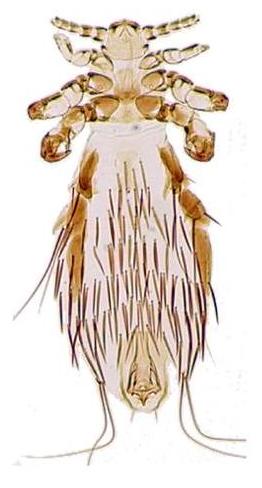
The total body length ranges from 0.870 to 0.945 millimetres. Both adult sexes and nymphs lack paratergal plates and possess sternal and tergal abdominal plates.[1][2]
Adult males and females have a strongly hardened anterior head with broadly curved front margins. Their antennae consist of five segments, with the first segment substantially larger than the others.[3][4]
The nymph has a broadly rounded anterior head margin and lacks a lateral notch in front of the antennae. Its thorax is slightly wider than its head and has gently convex lateral margins.[5][6]
The nymph has subtriangular coxae. Its abdomen has nine rows of paired dorsal central abdominal setae and relatively long dorsal lateral abdominal setae.[7][8][9]
Habitat
The species is recorded on mouse lemurs in southeastern Madagascar.[10]
Behaviour
Transfers between hosts require direct contact between individual hosts. This sucking louse can survive away from its host for only a few hours.[11][12]
Reproduction and life cycle
The species has three reported developmental or sexual forms: male, female and an instar nymph. The nymph is morphologically and reproductively different from both adult sexes.[13][14]
Classification of Lemurpediculus verruculosus
| Kingdom | Animalia |
|---|---|
| Phylum | Arthropoda |
| Subphylum | Hexapoda |
| Class | Insecta (Insect) |
| Order | Psocodea |
| Suborder | Troctomorpha |
| Infraorder | Phthiraptera |
| Parvorder | Anoplura |
| Family | Polyplacidae (Spiny Rat Lice) |
| Genus | Lemurpediculus |
| Species | Lemurpediculus verruculosus (Ward, 1951) |
Where Lemurpediculus verruculosus is found
Checklists and occurrence records place Lemurpediculus verruculosus in 1 country across Africa. GBIF holds 1 georeferenced records of it.
Countries
A number beside a place is its count of GBIF occurrence records. A place without a number comes from a checklist alone. Records show where a species has been observed or collected, which can include escapes and vagrants.
Synonyms
One other scientific name has been used for this species and is now treated as a synonym of Lemurpediculus verruculosus.
- Lemurphthirus verruculosus Ward, 1951
Related species
- Lemurpediculus robbinsi
- Lemurpediculus petterorum
- Lemurpediculus claytoni
- Lemurpediculus gerpi
- Lemurpediculus madagascariensis
- Lemurpediculus tsimanampesotsae
- Lemurpediculus zimmermanni
-
 Fahrenholzia pinnata
Compare
Sources
Passages the profile rests on
- The total body length of this louse ranges from 0.870 to 0.945 millimetres. Source passage: “The total body length is 0.870–0.945 millimetres (0.03–0.04 in)” — English Wikipedia
- Both adult sexes and nymphs lack paratergal plates and possess sternal and tergal abdominal plates. Source passage: “The general body shape, lack of paratergal plates, sternal and tergal abdominal plates, and wide separation of the leg coxae, are shared by both sexes and the nymph.” — English Wikipedia
- Adult males and females have a strongly hardened anterior head with broadly curved front margins. Source passage: “a head that is well sclerotised, or hardened, anteriorly with broadly curved anterior margins.” — English Wikipedia
- The antennae of adult males and females consist of five segments, with the first segment substantially larger than the others. Source passage: “They have antennae that are segmented into five parts, with the first segment much larger than the other segments.” — English Wikipedia
- The nymph has a broadly rounded anterior head margin and lacks a lateral notch in front of the antennae. Source passage: “Nymphs have a head that has a broadly rounded anterior margin and lacks a lateral notch anterior to the antennae.” — English Wikipedia
- The nymph's thorax is slightly wider than its head and has gently convex lateral margins. Source passage: “Its thorax is slightly wider than its head, with gently convex lateral margins.” — English Wikipedia
- The nymph has subtriangular coxae. Source passage: “The most basal segment, or coxae, are subtriangular.” — English Wikipedia
- The nymph's abdomen has nine rows of paired dorsal central abdominal setae. Source passage: “Their abdomen has nine rows of two-dorsal central abdominal seta” — English Wikipedia
- The nymph possesses relatively long dorsal lateral abdominal setae. Source passage: “one fairly long dorsal lateral abdominal seta.” — English Wikipedia
- Lemurpediculus verruculosus is recorded on mouse lemurs in southeastern Madagascar. Source passage: “a mouse lemur of southeastern Madagascar.” — English Wikipedia
- Transfers of this louse between hosts require direct contact between individual hosts. Source passage: “parasites that require direct host-host contact to be transferred” — pmc.ncbi.nlm.nih.gov
- This sucking louse can survive away from its host for only a few hours. Source passage: “it also restricts the amount of time lice can spend off a host to just a few hours” — pmc.ncbi.nlm.nih.gov
- The species has three reported developmental or sexual forms: male, female, and an instar nymph. Source passage: “there are three sexes of this ectoparasite: male, female and an instar nymph” — English Wikipedia
- The nymph is morphologically and reproductively different from both adult sexes. Source passage: “which is morphologically and reproductively different from either male or female.” — English Wikipedia
Data
- Catalogue of Life, 2026-10-16 XR cc by
- Global Biodiversity Information Facility CC BY 4.0
- Wikidata CC0
- GeoNames CC BY 4.0
- Within the Catalogue of Life, this name comes from Psocodea Species File cc by
References
- Ward, R.A. (1951) Description of a new species of Anoplura (Lemurphthirus verruculosus) from a Madagascar lemur. 62, 190–192. where the name was published
This species in other databases
Page built on 27 November 2026. See how the catalog is made and all sources and licences.
Cite this page
ScientificNames.org. (2026). Lemurpediculus verruculosus. Retrieved November 27, 2026, from https://scientificnames.org/species/lemurpediculus-verruculosus
“Lemurpediculus verruculosus.” ScientificNames.org, 2026, scientificnames.org/species/lemurpediculus-verruculosus. Accessed 27 Nov. 2026.
ScientificNames.org. “Lemurpediculus verruculosus.” Accessed November 27, 2026. https://scientificnames.org/species/lemurpediculus-verruculosus.
@misc{scientificnames_lemurpediculus_verruculosus,
  author = {{ScientificNames.org}},
  title = {Lemurpediculus verruculosus},
  year = {2026},
  url = {https://scientificnames.org/species/lemurpediculus-verruculosus},
  note = {Accessed 2026-11-27}
}