Species · Reptiles
Cloud Forest Parrot Snake Leptophis modestus
The scientific name of the Cloud Forest Parrot Snake is Leptophis modestus. It is a species of reptile in the family Colubridae (colubrid), order Squamata. The name dates from 1872.
- Scientific name
- Leptophis modestus (Günther, 1872)
- Common name
- Cloud Forest Parrot Snake
- Genus
- Leptophis
- Family
- Colubridae (Colubrid)
- Order
- Squamata
- Class
- Reptilia
- Red List category
- VU Vulnerable
- Recorded in
- 4 countries
- Name status
- accepted in the Catalogue of Life
Overview
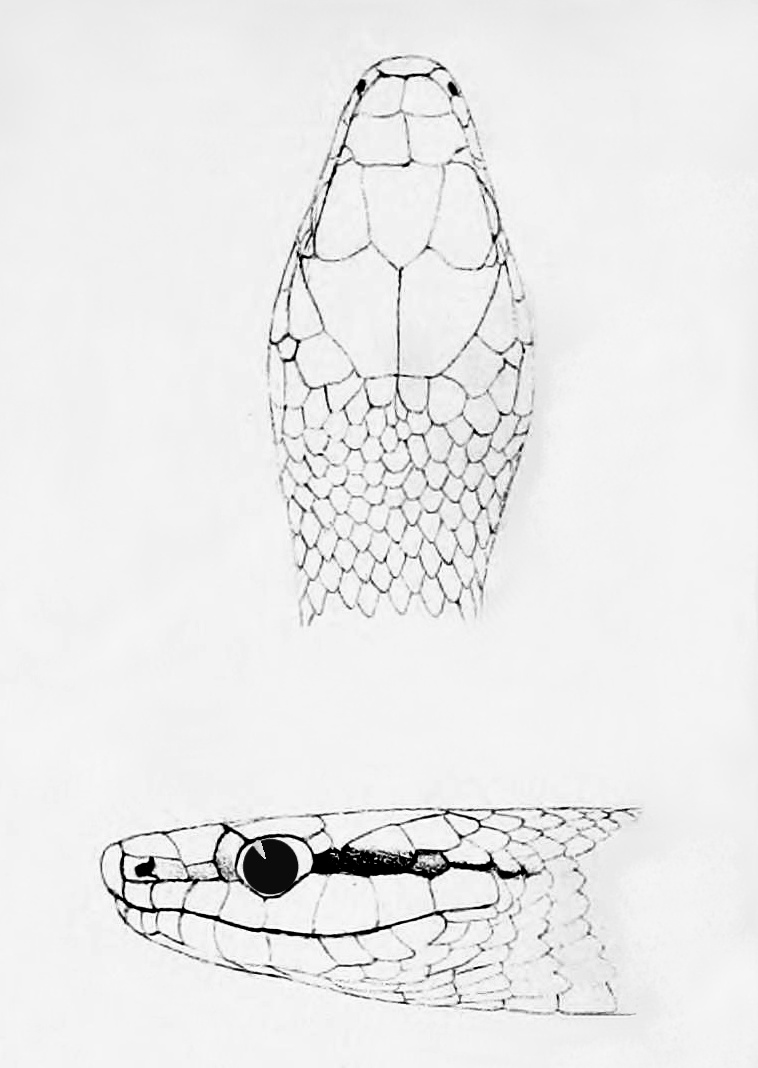
Leptophis modestus occurs in southern Mexico, northwestern El Salvador, and southwestern Honduras. It has olive-green dorsal coloration, blackish streaks behind the eyes, yellowish lips and throat, and pale-green ventral coloration.
Written 27 November 2026 from the sources listed below. Each statement was checked against the passage it cites; statements that could not be supported were removed.
Appearance
The Cloud Forest Parrot Snake is a medium-sized, slender snake. Its dorsal coloration is olive-green, with a blackish streak behind each eye, yellowish lips and throat, and pale-green ventral coloration.[1][2][3][4][5]
The dorsal scales are arranged in 15 rows at midbody and are strongly keeled, except for the first row adjacent to the ventrals and those on the tail. The anal plate is divided.[6][7][8]
The type specimen measures 130 cm in total length, with a tail measuring 54 cm. Males can reach a total length of 175.5 cm.[9][10][11]
Males have between 168 and 178 ventral scales and between 171 and 186 subcaudal scales. Females have between 173 and 183 ventral scales and between 166 and 179 subcaudal scales.[12][13][14][15]
The specific epithet modestus means moderate in Latin. The reason Günther selected this name is uncertain, although it may refer to the species' moderate eye size.[16][17]
Habitat
The Cloud Forest Parrot Snake inhabits mountain forests, rainforests, humid oak and pine forests, evergreen cloud forests, and hardwood cloud forests.[18][19][20][21][22]
It has been recorded at elevations between 1,335 and 2,590 metres.[23]
The species occurs in southern Mexico, northwestern El Salvador, and southwestern Honduras. It is endemic to Mesoamerica.[24][25][26][27]
Conservation
The Cloud Forest Parrot Snake is considered threatened. Habitat loss caused by deforestation has contributed to declining population numbers.[28][29]
Classification of the Cloud Forest Parrot Snake
| Kingdom | Animalia |
|---|---|
| Phylum | Chordata |
| Subphylum | Vertebrata |
| Infraphylum | Gnathostomata |
| Parvphylum | Osteichthyes |
| Megaclass | Tetrapoda |
| Class | Reptilia (Reptile) |
| Order | Squamata (Snakes) |
| Suborder | Serpentes (Snakes) |
| Infraorder | Alethinophidia |
| Family | Colubridae (Colubrid) |
| Subfamily | Colubrinae |
| Genus | Leptophis (Parrot Snakes) |
| Species | Leptophis modestus (Günther, 1872) |
Where the Cloud Forest Parrot Snake is found
Checklists and occurrence records place Leptophis modestus in 4 countries across North America. GBIF holds 82 georeferenced records of it.
Countries
Regions and cities with the most records
- Baja Verapaz, Guatemala 8
- Metapán, El Salvador 7
- Santa Ana Department, El Salvador 7
- Alta Verapaz, Guatemala 5
- Esquipulas, Guatemala 5
- San Pedro Carchá, Guatemala 5
- Cortés Department, Honduras 4
- Salamá, Guatemala 4
- Chiapas, Mexico 3
- Cobán, Guatemala 3
- San Cristóbal Verapaz, Guatemala 3
Range as the checklists state it
SE Mexico (Chiapas), Guatemala, Honduras (elevation 1890-2020 m), El Salvador
A number beside a place is its count of GBIF occurrence records. A place without a number comes from a checklist alone. Records show where a species has been observed or collected, which can include escapes and vagrants.
Common names
English
- Cloud Forest Parrot Snake
Names in 2 other languages
- Russian
- Скромная попугайная змея
- Spanish
- Culebra-perico de niebla, Ranera de Niebla, culebra perico de niebla
Synonyms
One other scientific name has been used for this species and is now treated as a synonym of Leptophis modestus.
- Ahaetulla modesta Günther, 1872
Related species
-
 Parrot SnakeLeptophis ahaetulla
- Grey LoraLeptophis stimsoni
-
 Mexican Parrot SnakeLeptophis mexicanus
- Leptophis mystacinus
- Cope's Parrot SnakeLeptophis depressirostris
-
 Pacific Coast Parrot SnakeLeptophis diplotropis
-
 Oliver's Parrot SnakeLeptophis coeruleodorsus
- Oliver's Parrot SnakeLeptophis nebulosus
Compare
Questions and answers
What is the scientific name of the Cloud Forest Parrot Snake?
The scientific name of the Cloud Forest Parrot Snake is Leptophis modestus. Written with its author, the full name is Leptophis modestus (Günther, 1872).
Which family does the Cloud Forest Parrot Snake belong to?
Leptophis modestus belongs to the family Colubridae, in the order Squamata and the class Reptilia.
Where is the Cloud Forest Parrot Snake found?
Checklists and occurrence records place Leptophis modestus in 4 countries: Guatemala, Honduras, El Salvador and Mexico.
What is the conservation status of the Cloud Forest Parrot Snake?
The IUCN Red List category recorded for Leptophis modestus is Vulnerable (VU).
Sources
Passages the profile rests on
- The species is described as a medium-sized, slender snake. Source passage: “Leptophis modestus, commonly known as the cloud forest parrot snake, is a species of medium-sized slender snake” — inaturalist.org
- The species has an olive-green dorsal coloration. Source passage: “Dorsally, it is olive-green.” — English Wikipedia
- The species has a blackish streak behind each eye. Source passage: “There is a blackish streak behind each eye” — English Wikipedia
- Its lips and throat are yellowish. Source passage: “the lips and throat are yellowish.” — English Wikipedia
- Its ventral coloration is pale green. Source passage: “Ventrally, it is pale green.” — English Wikipedia
- The dorsal scales are arranged in 15 rows at midbody. Source passage: “The dorsal scales are arranged in 15 rows at midbody” — English Wikipedia
- The dorsal scales are strongly keeled except for the first row adjacent to the ventrals and those on the tail. Source passage: “strongly keeled except for the first row (adjacent to the ventrals) and on the tail.” — English Wikipedia
- The anal plate is divided. Source passage: “The snake's anal plate is divided.” — English Wikipedia
- The type specimen measures 130 cm in total length. Source passage: “The type specimen of Leptophis modestus is 130 cm (51 in) in total length” — English Wikipedia
- The type specimen has a tail measuring 54 cm. Source passage: “and has a 54 cm (21 in) tail.” — English Wikipedia
- Males can reach a total length of 175.5 cm. Source passage: “Males of the species can reach lengths of up to 175.5 cm (69.1 in).” — English Wikipedia
- Males have between 168 and 178 ventral scales. Source passage: “Males have 168–178 ventral scales” — English Wikipedia
- Males have between 171 and 186 subcaudal scales. Source passage: “171–186 subcaudal scales” — English Wikipedia
- Females have between 173 and 183 ventral scales. Source passage: “females have 173–183 ventral scales” — English Wikipedia
- Females have between 166 and 179 subcaudal scales. Source passage: “166–179 subcaudal scales.” — English Wikipedia
- The specific epithet modestus means moderate in Latin. Source passage: “The name modestus means moderate in Latin.” — English Wikipedia
- The reason Günther selected the name modestus is uncertain, although it may refer to the species' moderate eye size. Source passage: “According to James R. McCranie, it's uncertain why Günther choose this name, but that it may be referring to the moderate eye size of the species” — English Wikipedia
- The species inhabits mountain forests. Source passage: “where it lives in mountain forests.” — English Wikipedia
- The species occurs in rainforests. Source passage: “The types of forest the snake inhabits include rainforests” — English Wikipedia
- The species inhabits humid oak and pine forests. Source passage: “humid oak and pine forests” — English Wikipedia
- The species inhabits evergreen cloud forests. Source passage: “evergreen cloud forests” — English Wikipedia
- The species inhabits hardwood cloud forests. Source passage: “and hardwood cloud forests.” — English Wikipedia
- The species has been recorded at elevations between 1,335 and 2,590 metres. Source passage: “at elevations of 1,335–2,590 metres (4,380–8,497 ft)” — English Wikipedia
- The species occurs in southern Mexico. Source passage: “mountain forests of southern Mexico” — English Wikipedia
- The species occurs in northwestern El Salvador. Source passage: “northwestern El Salvador” — English Wikipedia
- The species occurs in southwestern Honduras. Source passage: “and southwestern Honduras” — English Wikipedia
- The species is endemic to Mesoamerica. Source passage: “It is endemic to Mesoamerica” — English Wikipedia
- The species is considered threatened. Source passage: “It is currently considered a threatened species.” — English Wikipedia
- Habitat loss caused by deforestation has contributed to declining population numbers. Source passage: “Habitat loss due to deforestation has led to a decrease in population numbers.” — English Wikipedia
Data
- Catalogue of Life, 2026-10-16 XR cc by
- Global Biodiversity Information Facility CC BY 4.0
- Wikidata CC0
- GeoNames CC BY 4.0
- Wikimedia Commons per image; credit shown with each image
- Within the Catalogue of Life, this name comes from The Reptile Database cc by
References
- Günther, A. (1872). Seventh account of new species of snakes in the collection of the British Museum. Ann. Mag. Nat. Hist. (4) 9: 13-37 [OCR Errors].
- Boulenger, George A. (1894). Catalogue of the snakes in the British Museum (Natural History). Volume II., Containing the Conclusion of the Colubridæ Aglyphæ. British Mus. (Nat. Hist.), London, Xi, 382 Pp.
- Hoyt, D. L. (1964). The rediscovery of the snake Leptophis modestus. Copeia 1964 (1): 214-215.
- Williams, Kenneth L. (1966). A record of the snake Leptophis modestus from Mexico. Journal of the Ohio Herpetological Society 5 (3): 103-104.
- Mertens, R. (1973). Bemerkenswerte Schlanknattern der neotropischen Gattung Leptophis. Stud. Neotrop. Fauna 8: 141-154.
- Wilson, L. D. (1978). Two SNAKES, LEPTOPHIS MODESTUS AND PELAMIS PLATURUS, NEW TO THE HERPETOFAUNA OF HONDURAS. Herpetological Review 9 (2): 63-64.
- Wilson, L. D., & MEYER, J. R. (1985). The Snakes of Honduras. 2d ed. Milwaukee Publ. Mus. Contrib. Biol. & Geol. No. 6, 150 Pp.
- McCranie J R, & Wilson L D. (1993). Leptophis modestus (Gunther). Catalogue of American Amphibians and Reptiles 578: 1-2.
- Holm, & Peter. (1995). Leptophis modestus. Morphology. Herpetological Review 26 (1): 39.
- Wilson, L. D., & McCranie, J. R. (2003). The herpetofauna of the cloud forests of Honduras. Amphibian & Reptile Conservation 3 (1): 34-48.
- Liner, Ernest A. (2007). A CHECKLIST OF THE AMPHIBIANS AND REPTILES OF MEXICO. Louisiana State University Occasional Papers of the Museum of Natural Science 80: 1-60.
- McCranie J R. (2011). The snakes of Honduras. SSAR, Salt Lake City, 725 Pp.
- Wallach, Van; Kenneth L. Williams, Jeff Boundy. (2014). Snakes of the World: A Catalogue of Living and Extinct Species. [type catalogue]. Taylor and Francis, CRC Press, 1237 Pp.
- Solís, J. M., L. D. Wilson, and J. H. Townsend. (2014). An updated list of the amphibians and reptiles of Honduras, with comments on their nomenclature. Mesoamerican Herpetology 1: 123–144.
- Johnson, Jerry D.; Vicente Mata-Silva, Elí García Padilla, and Larry David Wilson. (2015). The Herpetofauna of Chiapas, Mexico: composition, distribution, and conservation. Mesoamerican Herpetology 2 (3): 272–329.
- McCranie, James R. (2015). A checklist of the amphibians and reptiles of Honduras, with additions, comments on taxonomy, some recent taxonomic decisions, and areas of further studies needed. Zootaxa 3931 (3): 352–386.
- Heimes, P. (2016). Snakes of Mexico. Chimaira, Frankfurt, 572 Pp.
- Harrington, Sean M; Jordyn M de Haan, Lindsey Shapiro, Sara Ruane. (2018). Habits and characteristics of arboreal snakes worldwide: arboreality constrains body size but does not affect lineage diversification. Biological Journal of the Linnean Society 125 (1): 61–71.
- Laking AE, Solís JM, Brown T, Maddock ST, Burdekin O, Taylor P, Lonsdale G, Green SEW, Martin TE, Galdamez JR, Kolby JE, Erens J, & Jocque M. (2024). The amphibians and reptiles of Cusuco National Park, Northwest Honduras: updates from a long-term conservation programme. In: Lipińska M, Lopez-Selva MM, Sierra JM (Eds) Biodiversity research in Central America. Neotropical Biology and Conservation 19(2): 37-62.
This species in other databases
Page built on 27 November 2026. See how the catalog is made and all sources and licences.
Cite this page
ScientificNames.org. (2026). Leptophis modestus (Cloud Forest Parrot Snake). Retrieved November 27, 2026, from https://scientificnames.org/species/leptophis-modestus
“Leptophis modestus (Cloud Forest Parrot Snake).” ScientificNames.org, 2026, scientificnames.org/species/leptophis-modestus. Accessed 27 Nov. 2026.
ScientificNames.org. “Leptophis modestus (Cloud Forest Parrot Snake).” Accessed November 27, 2026. https://scientificnames.org/species/leptophis-modestus.
@misc{scientificnames_leptophis_modestus_cloud_forest_parrot_snake,
  author = {{ScientificNames.org}},
  title = {Leptophis modestus (Cloud Forest Parrot Snake)},
  year = {2026},
  url = {https://scientificnames.org/species/leptophis-modestus},
  note = {Accessed 2026-11-27}
}