Species · Flowering plants
Flats Conebush Leucadendron floridum
The scientific name of the Flats Conebush is Leucadendron floridum. It is a species of flowering plant in the family Proteaceae (protea family), order Proteales.
- Scientific name
- Leucadendron floridum R.Br.
- Common name
- Flats Conebush
- Genus
- Leucadendron
- Family
- Proteaceae (Protea Family)
- Order
- Proteales
- Class
- Magnoliopsida
- Red List category
- EN Endangered
- Recorded in
- 1 country
- Name status
- accepted in the Catalogue of Life

Overview
Flats Conebush is a flower-bearing shrub belonging to the genus Leucadendron. The species occurs in the Cape Flats between Rondebosch and Kuils River and around most wetlands on the Cape Peninsula. The species has separate male and female plants, and its seeds are stored on the female plant.
Written 27 November 2026 from the sources listed below. Each statement was checked against the passage it cites; statements that could not be supported were removed.
Appearance
Flats Conebush is a flower-bearing shrub that grows to a height of 2 metres.[1][2]
Habitat
The species grows mainly in water-saturated soil and is part of the fynbos vegetation.[3][4]
Reproduction and life cycle
Flats Conebush has separate male and female plants. Pollination occurs through wind.[5][6]
Seeds are stored in a structure on the female plant and fall from this structure to the ground. They can be dispersed by wind.[7][8][9]
The species produces flowers between September and October.[10]
Behaviour
Fire destroys the plant, while its seeds survive.[11]
Classification of the Flats Conebush
| Kingdom | Plantae |
|---|---|
| Subkingdom | Pteridobiotina |
| Phylum | Tracheophyta |
| Class | Magnoliopsida |
| Order | Proteales |
| Family | Proteaceae (Protea Family) |
| Subfamily | Proteoideae |
| Tribe | Leucadendreae |
| Subtribe | Leucadendrinae |
| Genus | Leucadendron |
| Species | Leucadendron floridum R.Br. |
Where the Flats Conebush is found
Checklists and occurrence records place Leucadendron floridum in 1 country across Africa. GBIF holds 251 georeferenced records of it.
Countries
Regions and cities with the most records
- Western Cape, South Africa 188
- Muizenberg, South Africa 173
- Retreat, South Africa 167
- Rondebosch, South Africa 112
- Cape Town, South Africa 110
- Durbanville, South Africa 11
- Kuils River, South Africa 11
- Kraaifontein, South Africa 6
Range as the checklists state it
South Africa (W-Cape Prov.)
A number beside a place is its count of GBIF occurrence records. A place without a number comes from a checklist alone. Records show where a species has been observed or collected, which can include escapes and vagrants.
Common names
English
- Flats Conebush
Synonyms
2 other scientific names have been used for this species and are now treated as synonyms of Leucadendron floridum.
- Protea florida (R.Br.) Kuntze ambiguous synonym
- Protea saligna Andrews ambiguous synonym
Related species
-
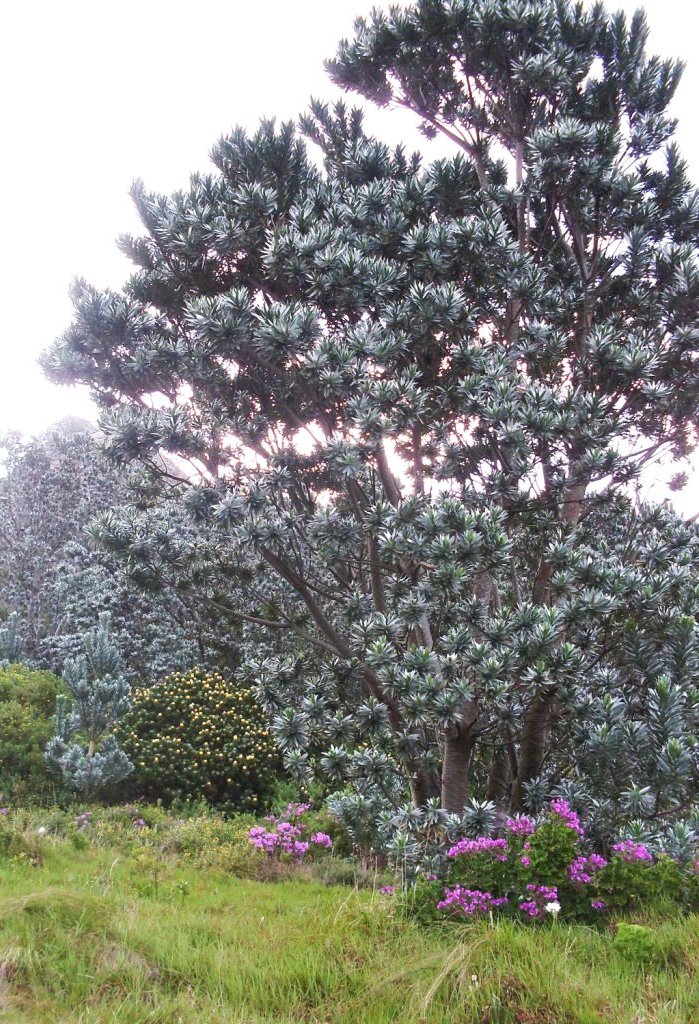 Silver TreeLeucadendron argenteum
-
 Common Sunshine ConebushLeucadendron salignum
-
 Piketberg ConebushLeucadendron discolor
-
 Spinning-top ConebushLeucadendron rubrum
-
 Golden SunshinebushLeucadendron laureolum
-
 Woolly ConebushLeucadendron sorocephalodes
-
 Peninsula ConebushLeucadendron strobilinum
-
 Grey ConebushLeucadendron pubescens
Compare
Questions and answers
What is the scientific name of the Flats Conebush?
The scientific name of the Flats Conebush is Leucadendron floridum. Written with its author, the full name is Leucadendron floridum R.Br..
Which family does the Flats Conebush belong to?
Leucadendron floridum belongs to the family Proteaceae, in the order Proteales and the class Magnoliopsida.
Where is the Flats Conebush found?
Checklists and occurrence records place Leucadendron floridum in 1 country: South Africa.
What is the conservation status of the Flats Conebush?
The IUCN Red List category recorded for Leucadendron floridum is Endangered (EN).
Sources
Passages the profile rests on
- Leucadendron floridum is a flower-bearing shrub belonging to the genus Leucadendron. Source passage: “Leucadendron floridum, the flats conebush, is a flower-bearing shrub belonging to the genus Leucadendron” — English Wikipedia
- The shrub grows to a height of 2 metres. Source passage: “The shrub grows 2 m tall” — English Wikipedia
- The species grows mainly in water-saturated soil. Source passage: “The plant grows mainly in water-saturated soil at 10–200 m.” — English Wikipedia
- The species is part of the fynbos vegetation. Source passage: “forms part of the fynbos.” — English Wikipedia
- The species has separate male and female plants. Source passage: “The plant is unisexual and there are male and female plants.” — English Wikipedia
- Pollination occurs through wind. Source passage: “Pollination finds through the wind.” — English Wikipedia
- Seeds are stored in a structure on the female plant. Source passage: “The seeds are stored in a toll on the female plant” — English Wikipedia
- Seeds fall from the female plant's storage structure to the ground. Source passage: “and fall from the toll to the ground” — English Wikipedia
- Seeds can be dispersed by wind. Source passage: “and can be spread by the wind.” — English Wikipedia
- The species produces flowers between September and October. Source passage: “bears flowers from September to October.” — English Wikipedia
- Fire destroys the plant, while its seeds survive. Source passage: “Fire destroys the plant but the seeds survive.” — English Wikipedia
Data
- Catalogue of Life, 2026-10-16 XR cc by
- Global Biodiversity Information Facility CC BY 4.0
- Wikidata CC0
- GeoNames CC BY 4.0
- Wikimedia Commons per image; credit shown with each image
- Within the Catalogue of Life, this name comes from Synonymic Checklists of the Vascular Plants of the World cc by
References
- R.Br. (1810). Trans. Linn. Soc. London 10: 63 (1810). where the name was published
This species in other databases
Page built on 28 November 2026. See how the catalog is made and all sources and licences.
Cite this page
ScientificNames.org. (2026). Leucadendron floridum (Flats Conebush). Retrieved November 28, 2026, from https://scientificnames.org/species/leucadendron-floridum
“Leucadendron floridum (Flats Conebush).” ScientificNames.org, 2026, scientificnames.org/species/leucadendron-floridum. Accessed 28 Nov. 2026.
ScientificNames.org. “Leucadendron floridum (Flats Conebush).” Accessed November 28, 2026. https://scientificnames.org/species/leucadendron-floridum.
@misc{scientificnames_leucadendron_floridum_flats_conebush,
  author = {{ScientificNames.org}},
  title = {Leucadendron floridum (Flats Conebush)},
  year = {2026},
  url = {https://scientificnames.org/species/leucadendron-floridum},
  note = {Accessed 2026-11-28}
}