Species · Flowering plants
Star Conebush Leucadendron stellare
The scientific name of the Star Conebush is Leucadendron stellare. It is a species of flowering plant in the family Proteaceae (protea family), order Proteales.
- Scientific name
- Leucadendron stellare (Sims) Steud.
- Common name
- Star Conebush
- Genus
- Leucadendron
- Family
- Proteaceae (Protea Family)
- Order
- Proteales
- Class
- Magnoliopsida
- Red List category
- EN Endangered
- Recorded in
- 1 country
- Name status
- accepted in the Catalogue of Life

Overview
Leucadendron stellare occurs in the fynbos biome, mainly on level ground in dry sand over clay soil, at elevations between 30 and 170 metres. It has separate male and female plants, and its seeds are stored in a structure called a toll on female plants.
Written 27 November 2026 from the sources listed below. Each statement was checked against the passage it cites; statements that could not be supported were removed.
Appearance
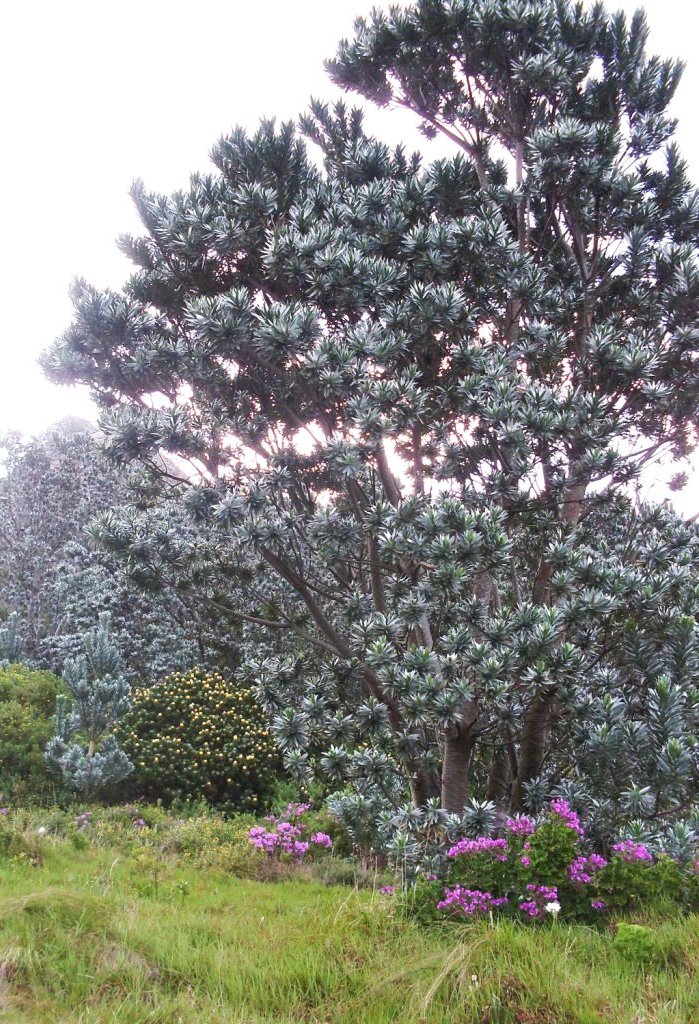
Star Conebush is a flower-bearing shrub classified in the genus Leucadendron. It reaches a height of 2 metres.[1][2][3]
Habitat
Star Conebush occurs in the fynbos biome. It grows mainly on level ground in dry sand over clay soil.[4][5][6]
The species occurs at elevations between 30 and 170 metres. It is native to South Africa's Western Cape.[7][8]
Its documented range extends from the Cape Flats to the Berg River Valley and the plains at Aurora.[9]
Behaviour
Star Conebush sprouts again following a fire.[10]
Reproduction and life cycle
Star Conebush has separate male and female plants. Insects pollinate its flowers.[11][12]
Seeds are stored in a structure called a toll on female plants. They fall from the toll to the ground after two months.[13][14]
The species flowers between September and October.[15]
Classification of the Star Conebush
| Kingdom | Plantae |
|---|---|
| Subkingdom | Pteridobiotina |
| Phylum | Tracheophyta |
| Class | Magnoliopsida |
| Order | Proteales |
| Family | Proteaceae (Protea Family) |
| Subfamily | Proteoideae |
| Tribe | Leucadendreae |
| Subtribe | Leucadendrinae |
| Genus | Leucadendron |
| Species | Leucadendron stellare (Sims) Steud. |
Where the Star Conebush is found
Checklists and occurrence records place Leucadendron stellare in 1 country across Africa. GBIF holds 203 georeferenced records of it.
Countries
Regions and cities with the most records
- Western Cape, South Africa 145
- Wellington, South Africa 41
- Paarl, South Africa 39
- Kraaifontein, South Africa 28
- Durbanville, South Africa 13
Range as the checklists state it
South Africa (W-Cape Prov.)
A number beside a place is its count of GBIF occurrence records. A place without a number comes from a checklist alone. Records show where a species has been observed or collected, which can include escapes and vagrants.
Common names
English
- Star Conebush
- Gnidia-Leaf Protea
- Sweet Star Conebush
Names in 1 other language
- Afrikaans
- Stertolbos
Synonyms
11 other scientific names have been used for this species and are now treated as synonyms of Leucadendron stellare.
- Leucadendron empetrifolium Gand.
- Leucadendron imbricatum R.Br.
- Leucadendron imbricatum var. imbricatum
- Leucadendron polygaloides Link
- Protea gnidiifolia Knight
- Protea levisana Meisn.
- Protea stellaris Sims
- Leucadendron angustatum Drège ex Meisn. ambiguous synonym
- Protea cinerea Willd. ex Meisn. ambiguous synonym
- Protea imbricata (R.Br.) Kuntze ambiguous synonym
- Protea polygaloides Willd. ex Meisn. ambiguous synonym
Related species
-
 Silver TreeLeucadendron argenteum
-
 Common Sunshine ConebushLeucadendron salignum
-
 Piketberg ConebushLeucadendron discolor
-
 Spinning-top ConebushLeucadendron rubrum
-
 Golden SunshinebushLeucadendron laureolum
-
 Woolly ConebushLeucadendron sorocephalodes
-
 Peninsula ConebushLeucadendron strobilinum
-
 Grey ConebushLeucadendron pubescens
Compare
Questions and answers
What is the scientific name of the Star Conebush?
The scientific name of the Star Conebush is Leucadendron stellare. Written with its author, the full name is Leucadendron stellare (Sims) Steud..
Which family does the Star Conebush belong to?
Leucadendron stellare belongs to the family Proteaceae, in the order Proteales and the class Magnoliopsida.
Where is the Star Conebush found?
Checklists and occurrence records place Leucadendron stellare in 1 country: South Africa.
What is the conservation status of the Star Conebush?
The IUCN Red List category recorded for Leucadendron stellare is Endangered (EN).
What other names does the Star Conebush have?
Leucadendron stellare is also known in English as Gnidia-Leaf Protea and Sweet Star Conebush.
What is the common name for leucadendron?
The common name for Leucadendron stellare is Star Conebush.[1]
What is Leucadendron cone bush?
Star Conebush is a flower-bearing shrub in the genus Leucadendron.[1][3]
How tall does leucadendron grow?
Star Conebush reaches a height of 2 metres.[2]
Sources
Passages the profile rests on
- Leucadendron stellare is a flower-bearing shrub. Source passage: “Leucadendron stellare, the star conebush, is a flower-bearing shrub belonging to the genus Leucadendron.” — English Wikipedia
- The shrub reaches a height of 2 metres. Source passage: “The shrub grows 2 m tall” — English Wikipedia
- Leucadendron stellare is classified as a flower-bearing shrub in the genus Leucadendron. Source passage: “Leucadendron stellare, the star conebush, is a flower-bearing shrub belonging to the genus Leucadendron.” — inaturalist.org
- The species occurs in the fynbos biome. Source passage: “It forms part of the fynbos biome.” — English Wikipedia
- The species grows mainly on level ground in dry sand over clay soil. Source passage: “The plant grows mainly on level areas, in dry sand over clay soil” — English Wikipedia
- Leucadendron stellare is associated with the fynbos biome. Source passage: “It forms part of the fynbos biome.” — inaturalist.org
- The species occurs at elevations between 30 and 170 metres. Source passage: “at heights of 30 – 170 m.” — English Wikipedia
- The species is native to South Africa's Western Cape. Source passage: “The plant is native to the Western Cape” — English Wikipedia
- Its documented range extends from the Cape Flats to the Berg River Valley and the plains at Aurora. Source passage: “where it occurs from the Cape Flats to the Berg River Valley and plains at Aurora.” — English Wikipedia
- The plant sprouts again following a fire. Source passage: “The plant sprouts again after a fire.” — English Wikipedia
- The species has separate male and female plants. Source passage: “The plant is unisexual and there are separate plants with male and female flowers” — English Wikipedia
- Insects pollinate the flowers of the species. Source passage: “which are pollinated by insects.” — English Wikipedia
- Seeds are stored in a structure called a toll on female plants. Source passage: “The seeds are stored in a toll on the female plant” — English Wikipedia
- Seeds fall from the toll to the ground after two months. Source passage: “fall from the toll to the ground after two months.” — English Wikipedia
- The species flowers between September and October. Source passage: “flowers from September to October.” — English Wikipedia
Data
- Catalogue of Life, 2026-10-16 XR cc by
- Global Biodiversity Information Facility CC BY 4.0
- Wikidata CC0
- GeoNames CC BY 4.0
- Wikimedia Commons per image; credit shown with each image
- Within the Catalogue of Life, this name comes from Synonymic Checklists of the Vascular Plants of the World cc by
References
- Steud. (1821). Nomencl. Bot. [Steudel], ed. 1, 1: 475 (1821). where the name was published
This species in other databases
- Catalogue of Life 6PSL6
- Wikidata Q15584754
- iNaturalist 589094
- World Flora Online wfo-0001107046
- GRIN 493102
Page built on 27 November 2026. See how the catalog is made and all sources and licences.
Cite this page
ScientificNames.org. (2026). Leucadendron stellare (Star Conebush). Retrieved November 27, 2026, from https://scientificnames.org/species/leucadendron-stellare
“Leucadendron stellare (Star Conebush).” ScientificNames.org, 2026, scientificnames.org/species/leucadendron-stellare. Accessed 27 Nov. 2026.
ScientificNames.org. “Leucadendron stellare (Star Conebush).” Accessed November 27, 2026. https://scientificnames.org/species/leucadendron-stellare.
@misc{scientificnames_leucadendron_stellare_star_conebush,
  author = {{ScientificNames.org}},
  title = {Leucadendron stellare (Star Conebush)},
  year = {2026},
  url = {https://scientificnames.org/species/leucadendron-stellare},
  note = {Accessed 2026-11-27}
}