Species · Amphibians
Mindoro Fanged Frog Limnonectes beloncioi
The scientific name of the Mindoro Fanged Frog is Limnonectes beloncioi. It is a species of amphibian in the family Dicroglossidae (forked tongued frogs), order Anura. The name dates from 2021.
- Scientific name
- Limnonectes beloncioi Herr, Vallejos, Meneses, Abraham, Otterholt, Siler, Rico & Brown, 2021
- Common name
- Mindoro Fanged Frog
- Genus
- Limnonectes
- Family
- Dicroglossidae (Forked Tongued Frogs)
- Order
- Anura
- Class
- Amphibia
- Recorded in
- 1 country
- Name status
- accepted in the Catalogue of Life
Overview
The Mindoro Fanged Frog (Limnonectes beloncioi) is an amphibian in the family Dicroglossidae, order Anura, and class Amphibia. It is endemic to the Philippines and is currently known from Mindoro and Semirara Islands.
Written 27 November 2026 from the sources listed below. Each statement was checked against the passage it cites; statements that could not be supported were removed.
Appearance
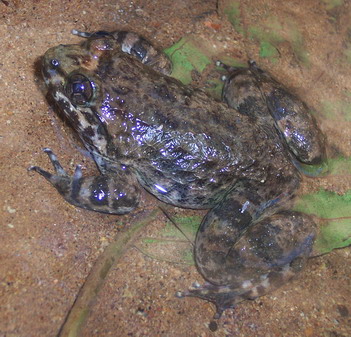
The Mindoro Fanged Frog has a robust body and a head wider than its body. It has a rounded snout, visible tympanum, and thick supratympanic fold.[1][2]
Its fingers have weakly developed lateral dermal flanges and lack webbing. Their tips have small discs no wider than the tips, while its fully webbed toes have slightly expanded discs.[3][4][5]
Its skin ranges from smooth to slightly shagreened and has several dorsolateral tubercular ridges. Adult males measure 54–83 mm in snout–vent length, while adult females measure 55–80 mm.[6][7][8][9]
Light-gray individuals can have a dense network of dark-gray markings concentrated into hindlimb bars and forearm blotches. The ventral body surfaces are generally white and become more yellowish white toward the rear.[10][11]
Habitat
The Mindoro Fanged Frog commonly inhabits riparian areas and locations near moving water in gallery forests. It occurs in coastal lowlands just above sea level and in low- and mid-elevation interior forests on Mindoro.[12][13]
The species has been recorded at elevations of at least 830 m above sea level.[14]
Similar species
The Mindoro Fanged Frog is morphologically similar to and closely related to Limnonectes acanthi. It is physically nearly indistinguishable from Acanth's Fanged Frog.[15][16]
Conservation
The Mindoro Fanged Frog had not been evaluated for the IUCN Red List as of late 2022. Its discoverers suggested that it could qualify for the least-concern conservation category.[17][18]
The species is among the most common frogs on Mindoro and persists in heavily disturbed and highly degraded riparian habitats. Forest loss is considered a threat to the species.[19][20][21]
Uses
The Mindoro Fanged Frog is heavily hunted for human consumption and is sometimes hunted by people for food.[22][23]
Behaviour
Individuals are wary of human presence and flee when exposed to flashlights or human voices. Its tadpoles appear able to tolerate poor water quality.[24][25]
Classification of the Mindoro Fanged Frog
| Kingdom | Animalia |
|---|---|
| Phylum | Chordata |
| Subphylum | Vertebrata |
| Infraphylum | Gnathostomata |
| Parvphylum | Osteichthyes |
| Megaclass | Tetrapoda |
| Class | Amphibia (Amphibians) |
| Order | Anura (Frogs) |
| Family | Dicroglossidae (Forked Tongued Frogs) |
| Subfamily | Dicroglossinae |
| Genus | Limnonectes (Fanged Frogs) |
| Species | Limnonectes beloncioi Herr, Vallejos, Meneses, Abraham, Otterholt, Siler, Rico & Brown, 2021 |
Origin of the name. Etymology. - We derive the specific epithet, a patronym, to honor the Philippine army scout and freedom fighter Esteban Beloncio, who contributed substantially to the armed resistance against the Japanese WWII occupation of Mindoro Island, 1942 - 1945. Suggested common name ¼ Mindoro Fanged Frog.
Where the Mindoro Fanged Frog is found
Checklists and occurrence records place Limnonectes beloncioi in 1 country. GBIF holds 288 georeferenced records of it.
Countries
Regions and cities with the most records
A number beside a place is its count of GBIF occurrence records. A place without a number comes from a checklist alone. Records show where a species has been observed or collected, which can include escapes and vagrants.
Common names
English
- Mindoro Fanged Frog
Synonyms
One other scientific name has been used for this species and is now treated as a synonym of Limnonectes beloncioi.
- Limnonectes acanthi Dubois, 1987
Related species
-
 Sulawesi Wart FrogLimnonectes larvaepartus
-
 Blyth's River FrogLimnonectes blythii
-
 Giant Philippine FrogLimnonectes magnus
-
 Luzon Fanged FrogLimnonectes macrocephalus
-
 Fanged River FrogLimnonectes macrodon
-
 Kuhl's Creek FrogLimnonectes kuhlii
-
 Masked Swamp FrogLimnonectes paramacrodon
-
 Giant River FrogLimnonectes leporinus
Compare
Questions and answers
What is the scientific name of the Mindoro Fanged Frog?
The scientific name of the Mindoro Fanged Frog is Limnonectes beloncioi. Written with its author, the full name is Limnonectes beloncioi Herr, Vallejos, Meneses, Abraham, Otterholt, Siler, Rico & Brown, 2021.
Which family does the Mindoro Fanged Frog belong to?
Limnonectes beloncioi belongs to the family Dicroglossidae, in the order Anura and the class Amphibia.
Where is the Mindoro Fanged Frog found?
Checklists and occurrence records place Limnonectes beloncioi in 1 country: Philippines.
What is Mindoro frog?
The Mindoro Fanged Frog (Limnonectes beloncioi) is an amphibian in the family Dicroglossidae. It is endemic to the Philippines and is currently known from Mindoro and Semirara Islands.[26]
Sources
Passages the profile rests on
- The species has a robust overall body shape and a head wider than its body. Source passage: “The overall appearance is robust. The head is wider than the body.” — English Wikipedia
- The species has a rounded snout, visible tympanum, and thick supratympanic fold. Source passage: “The snout is rounded. The tympanum is visible and the supratympanic fold is thick.” — English Wikipedia
- Its fingers have weakly developed lateral dermal flanges and lack webbing. Source passage: “The fingers have weakly developed lateral dermal flanges but no webbing.” — English Wikipedia
- Its finger tips have small discs that are no wider than the tips. Source passage: “The finger tips bear small discs that are not wider than the tips.” — English Wikipedia
- Its toes are fully webbed and have slightly expanded discs. Source passage: “The toes are fully webbed and bear discs that are slightly expanded.” — English Wikipedia
- Adult males measure 54–83 mm in snout–vent length. Source passage: “Adult males measure 54–83 mm (2.1–3.3 in)” — English Wikipedia
- Adult females measure 55–80 mm in snout–vent length. Source passage: “adult females 55–80 mm (2.2–3.1 in) in snout–vent length.” — English Wikipedia
- Its skin ranges from smooth to slightly shagreened. Source passage: “Skin is smooth to slightly shagreened.” — English Wikipedia
- The species has several dorsolateral tubercular ridges. Source passage: “There are several dorsolateral tubercular ridges.” — English Wikipedia
- Light-gray individuals can have a dense network of dark-gray markings concentrated into hindlimb bars and forearm blotches. Source passage: “light gray, with a dense network or reticulum of dark gray, densely congregated into hindlimb bars, forearm blotches” — English Wikipedia
- Its ventral body surfaces are generally white and become more yellowish white toward the rear. Source passage: “The ventral body surfaces are generally white, becoming more yellowish white posteriorly.” — English Wikipedia
- The species commonly inhabits riparian areas and locations near moving water in gallery forests. Source passage: “Limnonectes beloncioi is a common species in riparian habitats and in the vicinity of moving water in gallery forests.” — English Wikipedia
- It occurs in coastal lowlands just above sea level and in low- and mid-elevation interior forests on Mindoro. Source passage: “It has been found from coastal lowland habitats just above sea level to low and mid-elevation forests in the interior of Mindoro” — English Wikipedia
- The species has been recorded at elevations of at least 830 m above sea level. Source passage: “up to at least 830 m (2,720 ft) above sea level.” — English Wikipedia
- The Mindoro Fanged Frog is morphologically similar to and closely related to Limnonectes acanthi. Source passage: “It is morphologically similar, previously confused with, and closely related to Limnonectes acanthi.” — English Wikipedia
- The Mindoro Fanged Frog is physically nearly indistinguishable from Acanth's Fanged Frog. Source passage: “Because of its nearly identical physical similarity to a fanged frog on the island of Palawan, called Acanth’s Fanged Frog” — news.ku.edu
- The species had not been evaluated for the IUCN Red List as of late 2022. Source passage: “As of late 2022, this species has not been evaluated for the IUCN Red List of Threatened Species.” — English Wikipedia
- Its discoverers suggested that the species could qualify for the least-concern conservation category. Source passage: “Herr and colleagues suggest that it could be classified as a "least-concern species".” — English Wikipedia
- The species is among the most common frogs on Mindoro. Source passage: “It is one of the most common frogs in Mindoro” — English Wikipedia
- The species persists in heavily disturbed and highly degraded riparian habitats. Source passage: “persists in heavily disturbed and highly degraded riparian habitats” — English Wikipedia
- Forest loss is considered a threat to the species. Source passage: “forest loss should still be considered a threat.” — English Wikipedia
- The species is heavily hunted for human consumption. Source passage: “It is also heavily hunted for human consumption.” — English Wikipedia
- The species is sometimes hunted by people for food. Source passage: “The Mindoro Fanged Frog, a stream frog, is sometimes hunted by people for food.” — news.ku.edu
- The species' tadpoles appear able to tolerate poor water quality. Source passage: “The tadpoles appear to tolerate poor water quality.” — English Wikipedia
- Individuals are wary of human presence and flee when exposed to flashlights or human voices. Source passage: “the second a flashlight or human voice wanders into the equation they’re just going to take off” — news.ku.edu
- The Mindoro Fanged Frog is endemic to the Philippines and is currently known from Mindoro and Semirara Islands. Source passage: “It is endemic to the Philippines and currently known from Mindoro and Semirara Islands.” — English Wikipedia
Data
- Catalogue of Life, 2026-10-16 XR cc by
- Global Biodiversity Information Facility CC BY 4.0
- Wikidata CC0
- GeoNames CC BY 4.0
- Within the Catalogue of Life, this name comes from The Integrated Taxonomic Information System cc0
References
- Herr, Mark W., Johana G. Vallejos, Camila G. Meneses, Robin K. Abraham, Rayanna Otterholt, Cameron D. Siler, Edmund L. B. Rico & Rafe M. Brown. 2021. A New, Morphologically Cryptic Species of Fanged Frog, Genus Limnonectes (Amphibia: Anura: Dicroglossidae), from Mindoro Island, Central Philippines. Ichthyology & Herpetology 109(1): 188–210. Link where the name was published
This species in other databases
Page built on 29 November 2026. See how the catalog is made and all sources and licences.
Cite this page
ScientificNames.org. (2026). Limnonectes beloncioi (Mindoro Fanged Frog). Retrieved November 29, 2026, from https://scientificnames.org/species/limnonectes-beloncioi
“Limnonectes beloncioi (Mindoro Fanged Frog).” ScientificNames.org, 2026, scientificnames.org/species/limnonectes-beloncioi. Accessed 29 Nov. 2026.
ScientificNames.org. “Limnonectes beloncioi (Mindoro Fanged Frog).” Accessed November 29, 2026. https://scientificnames.org/species/limnonectes-beloncioi.
@misc{scientificnames_limnonectes_beloncioi_mindoro_fanged_frog,
  author = {{ScientificNames.org}},
  title = {Limnonectes beloncioi (Mindoro Fanged Frog)},
  year = {2026},
  url = {https://scientificnames.org/species/limnonectes-beloncioi},
  note = {Accessed 2026-11-29}
}