Species · Amphibians
Nguyen's Fanged Frog Limnonectes nguyenorum
The scientific name of the Nguyen's Fanged Frog is Limnonectes nguyenorum. It is a species of amphibian in the family Dicroglossidae (forked tongued frogs), order Anura. The name dates from 2015.
- Scientific name
- Limnonectes nguyenorum McLeod, Kurlbaum & Hoang, 2015
- Common name
- Nguyen's Fanged Frog
- Genus
- Limnonectes
- Family
- Dicroglossidae (Forked Tongued Frogs)
- Order
- Anura
- Class
- Amphibia
- Red List category
- NT Near Threatened
- Recorded in
- 1 country
- Name status
- accepted in the Catalogue of Life
Overview
The species is endemic to northern Vietnam and is known only from its type locality in Vi Xuyen District, northwestern Ha Giang Province. Males possess fang-like odontoid processes on their lower jaws, and the species has a slender body and a slightly enlarged head.
Written 27 November 2026 from the sources listed below. Each statement was checked against the passage it cites; statements that could not be supported were removed.
Similar species
Nguyen's Fanged Frog belongs to the Limnonectes kuhlii species complex. It occurs in sympatry with Limnonectes bannaensis.[1][2]
Appearance
Adult males in the type series measure approximately 44 mm in snout–vent length. Adult females in the type series measure 37 and 43 mm in snout–vent length.[3][4]
The tympanum is concealed and the supratympanic fold is indistinct. The tips of the fingers and toes are rounded and lack expanded discs.[5][6]
The fingers lack webbing, while the toes are fully webbed.[7]
Preserved specimens have a light brown dorsal surface with dark brown markings and blotches. A prominent white bar runs from the nostrils to the insertion of the arm.[8][9]
The upper lip has distinct white spots and dark brown bars. The throat is mottled, while the ventral surface is immaculate.[10][11]
Habitat
Nguyen's Fanged Frog inhabits streams in submontane evergreen forests.[12]
The species occurs at elevations of approximately 600–900 m above sea level.[13]
Conservation
As of May 2018, Nguyen's Fanged Frog had not been included in the IUCN Red List of Threatened Species.[14]
Classification of the Nguyen's Fanged Frog
| Kingdom | Animalia |
|---|---|
| Phylum | Chordata |
| Subphylum | Vertebrata |
| Infraphylum | Gnathostomata |
| Parvphylum | Osteichthyes |
| Megaclass | Tetrapoda |
| Class | Amphibia (Amphibians) |
| Order | Anura (Frogs) |
| Family | Dicroglossidae (Forked Tongued Frogs) |
| Subfamily | Dicroglossinae |
| Genus | Limnonectes (Fanged Frogs) |
| Species | Limnonectes nguyenorum McLeod, Kurlbaum & Hoang, 2015 |
Origin of the name. Etymology. The specific name, nguyenorum, is the plural possessive form of the family name Nguyen. This species is named in honor of two herpetologists who have contributed greatly to our understanding of Vietnamese herpetology and biodiversity, Truong Quang Nguyen and Tao Thien Nguyen. It is rare to find siblings working together in herpetological research, and more so to find brothers as productive as these. We commend them for their efforts and recognize that without them this and many other amphibians and reptiles in Vietnam would remain undescribed. Comparisons. As noted previously, there is a great deal of morphological similarity among the frogs of the genus Limnonectes, and in particular, within the L. kuhlii Complex (Emerson et al. 2000; McLeod 2008, 2010; McLeod et al. 2011, 2012). Based the phylogenetic hypothesis presented here and elsewhere (McLeod 2008, 2010; McLeod et al. 2011, 2012) in which true L. kuhlii is restricted to the island of Java, we have elected to limit morphological comparisons to those taxa to which it is (1) most closely related (Fig. 1), and (2) geographically proximate. Comparisons are presented below. The most notable difference between Limnonectes nguyenorum and all other known members of the L. kuhlii complex is its diminutive size. Based on combined male-female SVL (41.8 mm), Limnonectes nguyenorum is the smallest known member of the L. kuhlii complex (size class 1). It is considerably smaller than all other members of the Indochinese clade to which it belongs: Limnonectes megastomias (class 4, mean SVL = 77.2 mm, McLeod et al. 2012), L. isanensis (class 3, 65.3 mm, McLeod et al. 2012), L. taylori (class 2, 57.7 mm, McLeod et al. 2012), and L. jarujini (presumably class 4, males = 73.3 mm, females = 62.0 mm, Matsui et al. 2010 b). Similarly, the new species differs L. bannaensis (class 3, 60.4 mm, n = 64). It is worth noting that the mean SVL for specimens of L. bannaensis collected at the same site as the new species is slightly smaller (class 2, 54.6 mm, n = 18) than the entire series examined the 54.6 mm (31.3 - 86.6 mm, n = 18). Based on current understanding of systematics, taxonomy, and species distributions in Indochina, L. nguyenorum and L. bannaensis are the only sympatric species of the L. kuhlii Complex in Vietnam. The only other geographically proximate and closely related taxon with which L. nguyenorum could be confused based on size and general appearance is Limnonectes taylori, which is known from northwestern Thailand, northwestern Laos, and eastern Myanmar (McLeod 2010 as " Lineage 12 ", Matsui 2010 b). Comparisons of uncorrected pair-wise distance data were consistent with the results of other recent studies of the L. kuhlii complex where intraspecific differences are small (L. nguyenorum = 0.24 %) and interspecific distances are considerably larger, ranging from 6.5 % to 16.9 % (McLeod 2010, McLeod et al. 2012). All remaining comparisons of the new species are thus restricted to L. taylori and L. bannaensis, the latter of which it is syntopic with (but not most closely related). A noteworthy difference in the new species is the similar SVL of males and females (both males and one female slightly larger than 43.5 mm, the other female 36.5 mm). This stands in contrast to a general assumption that among the " fanged frogs " males are larger than females (Emerson et al. 2000). This pattern is exemplified by several species, including L. taylori where males are, on average considerably larger (61.3 mm) than females (53.0 mm). Interestingly, in this study, the opposite is also true of L. bannensis, where the females sampled are, on average, larger (62.0 mm) than males (59.5 mm), but male maximum size still slightly exceeds that of females (90.8 and 87.4 mm, respectively; Table 2). TABLE 1. Morphological measurements of the type series. VMNH A. 2015.1 * IEBR A. 2015.3 AMNH A 163944 VNMN A. 2015.3 Sex SVL ED male 43.8 4.2 male 43.5 3.8 female 43.6 4.4 female 36.5 3.7 EN RL FEL 3.6 6.8 18.7 3.8 6.5 19.6 3.8 6.2 18.5 3.2 5.4 16.8 FOL HL HW 25.3 18.8 17.9 28.2 18.4 16.4 26.9 17.1 16.0 22.4 14.4 12.4 IN IO LAL 3.4 3.4 7.7 3.4 3.4 7.5 2.9 3.2 7.6 3.3 2.4 6.2 MN PAL 16.4 10.1 16.2 8.9 14.5 9.3 12.9 7.1 RFL IV - V - III - II IV - V - III - II IV - V - III - II IV - V - III - II RTL TBL Visible Tympanum IV - III - V - II - I 20.3 1 IV - III - V - II - I 19.3 1 IV - III - V - II - I 19.7 1 IV - III - V - II - I 16.6 1 TD UEW OL - 2.6 2.5 - 2.8 2.4 - 2.4 1.4 - 2.6 1.4 MD PAL / LAL PAL / SVL 1.2 1.31 0.23 1.0 1.19 0.20 0.9 1.23 0.21 0.7 1.16 0.19 OL-MD / HL ED / HL HW / HL 0.07 0.22 1.05 0.08 0.20 1.12 0.03 0.26 1.07 0.05 0.25 1.16 SVL-HL / SVL (body prop.) 0.57 IN / IO 0.99 IN / SVL 0.08 0.58 1.00 0.08 0.61 0.88 0.07 0.61 1.37 0.09 EN / IN 1.08 UEW / IO 0.76 EN / RL 0.54 1.11 0.82 0.59 1.32 0.75 0.61 0.95 1.09 0.58 TBL / SVL 0.46 FEL / SVL 0.43 LAL / SVL 0.18 0.44 0.45 0.17 0.45 0.42 0.17 0.45 0.46 0.17 FOL / SVL 0.58 0.65 0.62 0.61 See text for character definitions. Presence (0) or absence (1) of a tympanum visible through the overlying skin is indicated. Measurements of tympanum diameter (TD) only taken if visible tympanum was present. * Holotype FIGURE 2. Two syntopic species of Limnonectes from northern Vietnam. Holotype of Limnonectes nguyenorum (VMNH A. 2015.1; adult male; SVL = 43.81 mm): (A) dorsal, (B) ventral, (C) plantar view of foot, (D) Palmar view of hand, (E) lateral view of head, (F) magnified view of tubercles on leg (reference in image A). Mature ova from female paratype (VMNH A. 2015.3). Specimen of L. bannaensis from type locality of L. nguyenorum (IEBR A. 2015.38; adult male; SVL = 64.50 mm): (H) lateral view of head, (I) magnified view of tubercles on leg (reference in image J), (J) dorsal, (K) ventral. All specimens imaged as they appear in alcohol. TABLE 2. Morphological measurements and rations of specimens examined in this study. Ranges of values are presented for each character followed by the mean and standard deviation in parentheses. Character Limnonectes nguyenorum Limnonectes bannaensis Limnonectes taylori Male (n = 2) Female (n = 2) Male (n = 39) Female (n = 25) Male (n = 13) Female (n = 10) SVL 43.5 - 43.8 36.5 - 43.6 (43.7 ± 0.2) (40.0 ± 5.0) 26.8 - 90.8 39.4 - 87.4 (59.5 ± 18.8) (62.0 ± 13.4) 35.3 - 75.5 45.3 - 65.2 (61.3 ± 14.9) (53.0 ± 6.6) ED 3.8 - 4.2 3.7 - 4.4 (4.0 ± 0.3) (4.0 ± 0.5) 3.2 - 9.5 4.0 - 9.3 (6.0 ± 1.6) (6.5 ± 1.4) 3.6 - 7.4 4.8 - 6.1 (5.9 ± 1.5) (5.3 ± 0.4) EN 3.6 - 3.8 3.2 - 3.8 (3.7 ± 0.1) (3.5 ± 0.4) 2.0 - 7.1 2.9 - 6.9 (4.4 ± 1.4) (4.3 ± 0.9) 2.5 - 5.9 3.2 - 4.7 (4.7 ± 1.2) (4.0 ± 0.5) RL 6.5 - 6.8 5.4 - 6.2 (6.6 ± 0.2) (5.8 ± 0.5) 3.9 - 12.8 5.0 - 12.9 (8.3 ± 2.7) (8.3 ± 1.9) 4.9 - 11.2 5.5 - 8.2 (8.8 ± 2.2) (7.2 ± 0.9) FEL 18.7 - 19.6 16.8 - 18.5 (19.2 ± 0.6) (17.6 ± 1.2) 13.0 - 46.1 16.3 - 46.1 (28.1 ± 9.4) (28.9 ± 7.8) 15.8 - 34.0 19.0 - 27.7 (27.1 ± 8.2) (24.2 ± 2.9) FOL 25.3 - 28.2 22.4 - 26.9 (26.7 ± 2.1) (24.7 ± 3.1) 19.0 - 60.4 25.8 - 63.1 (39.7 ± 12.5) (41.6 ± 9.5) 23.4 - 47.1 26.9 - 38.4 (39.0 ± 10.0) (33.4 ± 3.8) HL 18.4 - 18.8 14.4 - 17.1 (18.6 ± 0.3) (15.8 ± 1.9) 11.9 - 41.9 15.4 - 36.5 (25.5 ± 9.2) (25 ± 5.5) 14.2 - 39.7 18.3 - 26.9 (29.0 ± 7.8) (21.6 ± 3.0) HW 16.4 - 17.9 12.4 - 16.0 (17.1 ± 1.1) (14.2 ± 2.5) 10.7 - 40.2 13.7 - 34.5 (23.9 ± 9) (23.5 ± 5.4) 12.3 - 35.3 17.2 - 25.0 (26.8 ± 7.2) (20.3 ± 2.8) IN 3.4 - 3.4 2.9 - 3.3 (3.4 ± 0) (3.1 ± 0.3) 2.1 - 6.8 2.8 - 7.2 (4.0 ± 1.3) (4.3 ± 1.1) 3.0 - 5.9 3.4 - 5.4 (4.6 ± 1.2) (4.1 ± 0.6) IO 3.4 - 3.4 2.4 - 3.2 (3.4 ± 0) (2.8 ± 0.6) 2.1 - 7.8 2.1 - 7.0 (4.3 ± 1.5) (4.2 ± 1.1) 1.8 - 7.2 2.8 - 4.5 (4.5 ± 1.5) (3.5 ± 0.7) LAL 7.5 - 7.7 6.1 - 7.6 (7.6 ± 0.2) (6.9 ± 1) 4.8 - 18.8 5.7 - 16.9 (11.1 ± 3.6) (11.3 ± 2.8) 5.8 - 14.6 7.7 - 11.5 (11.5 ± 3.1) (9.5 ± 1.2) MN 16.2 - 16.4 12.9 - 14.5 (16.3 ± 0.1) (13.7 ± 1.1) 10.2 - 38.3 13.6 - 31.7 (22.8 ± 8.5) (21.8 ± 4.7) 12.3 - 35.5 15.6 - 23.4 (25.9 ± 7.1) (19.1 ± 2.8) PAL 8.9 - 10.1 7.1 - 9.3 (9.5 ± 0.8) (8.2 ± 1.6) 6.5 - 22.0 9.0 - 23.2 (14.2 ± 4.9) (14.8 ± 3.7) 9.0 - 18.0 9.8 - 14.7 (14.4 ± 3.8) (12.6 ± 1.6) RFL IV - V - III - II IV - V - III - II IV - V - III - II IV - V - III - II IV - V - III - II IV - V - III - II RTL IV - III - V - II - I IV - III - V - II - I IV - III - V - II - I IV - III - V - II - I IV - III - V - II - I IV - III - V - II - I TBL 19.3 - 20.3 16.6 - 19.7 (19.8 ± 0.7) (18.1 ± 2.2) 13 - 41.9 18.1 - 44.3 (28.1 ± 8.8) (29.7 ± 7.3) 16.5 - 32.9 19.3 - 27.1 (26.8 ± 7.3) (23.1 ± 2.7) TD - - - - 3.9 - 4.9 3.7 - 4.9 (4.5 ± 0.5) (4.2 ± 0.5) UEW 2.6 - 2.8 2.4 - 2.6 (2.7 ± 0.1) (2.5 ± 0.1) 1.9 - 6.0 2.2 - 8.2 (3.6 ± 1.1) (4.1 ± 1.3) 2.7 - 5.1 3.3 - 4.7 (4.1 ± 1.3) (3.9 ± 0.4) OL 2.4 - 2.5 1.4 - 1.4 (2.5 ± 0) (1.4 ± 0) 0.9 - 5.6 1.4 - 4.4 (3.0 ± 1.5) (2.5 ± 0.8) 1.3 - 6.5 1.8 - 3.0 (4.1 ± 1.4) (2.2 ± 0.4) MD 1.0 - 1.2 0.7 - 0.9 (1.1 ± 0.2) (0.8 ± 0.1) 0.5 - 3.2 0.7 - 2.4 (1.6 ± 0.8) (1.4 ± 0.4) 0.7 - 3.1 0.9 - 1.5 (1.9 ± 0.7) (1.2 ± 0.2) PAL / LAL 1.19 - 1.31 1.16 - 1.23 1.07 - 1.56 1.13 - 1.58 1.14 - 1.54 1.19 - 1.44 PAL / SVL 0.20 - 0.23 0.19 - 0.21 0.21 - 0.26 0.22 - 0.28 0.20 - 0.26 0.22 - 0.27 OL-MD / HL 0.07 - 0.08 0.03 - 0.05 0.02 - 0.07 0.01 - 0.06 0.04 - 0.09 0.04 - 0.06 ED / HL 0.20 - 0.22 0.25 - 0.26 0.18 - 0.31 0.20 - 0.30 0.14 - 0.28 0.21 - 0.30 HW / HL 1.05 - 1.12 1.07 - 1.16 1.00 - 1.21 0.96 - 1.32 1.00 - 1.16 1.00 - 1.17 HL / SVL 0.42 - 0.43 0.39 - 0.39 0.37 - 0.49 0.35 - 0.51 0.40 - 0.53 0.37 - 0.46 SVL-HL / SVL 0.57 - 0.58 0.61 - 0.61 0.51 - 0.63 0.49 - 0.65 0.47 - 0.60 0.54 - 0.63 ...... continued on the next page Size and pattern of tubercules on the leg and foot are visibly different and seem to be one of the most reliable characters for distinguishing species one from another within this complex. Among the three species being compared here, L. taylori has the largest (relatively) and most closely clustered tubercles giving the leg a rough appearance, L. nguyenorum having slightly smaller and heterogeneously sized tubercles, and L. bannaensis has still smaller and homogenously sized tubercles giving the leg a relatively smooth appearance (Fig. 2 F & I). TABLE 2. (Continued) Character Limnonectes nguyenorum Limnonectes bannaensis Limnonectes taylori Male (n = 2) Female (n = 2) Male (n = 39) Female (n = 25) Male (n = 13) Female (n = 10) IN / IO 0.99 - 1.00 0.88 - 1.37 0.73 - 1.31 0.72 - 1.62 0.81 - 1.69 0.92 - 1.35 IN / SVL 0.08 - 0.08 0.07 - 0.09 0.05 - 0.08 0.06 - 0.09 0.06 - 0.08 0.07 - 0.09 EN / IN 1.08 - 1.11 0.95 - 1.32 0.75 - 1.62 0.69 - 1.37 0.81 - 1.36 0.85 - 1.06 UEW / IO 0.76 - 0.82 0.75 - 1.09 0.56 - 1.32 0.5 - 1.39 0.65 - 1.59 0.97 - 1.3 EN / RL 0.54 - 0.59 0.58 - 0.61 0.41 - 0.65 0.42 - 0.62 0.47 - 0.6 0.51 - 0.61 TBL / SVL 0.44 - 0.46 0.45 - 0.45 0.43 - 0.52 0.44 - 0.54 0.41 - 0.47 0.42 - 0.47 FEL / SVL 0.43 - 0.45 0.42 - 0.46 0.41 - 0.55 0.38 - 0.54 0.39 - 0.51 0.42 - 0.52 LAL / SVL 0.17 - 0.18 0.17 - 0.17 0.15 - 0.21 0.15 - 0.2 0.17 - 0.21 0.17 - 0.19 FOL / SVL 0.58 - 0.65 0.61 - 0.62 0.6 - 0.76 0.62 - 0.76 0.55 - 0.71 0.56 - 0.72 Coloration is another character that appears to facilitate easy identification of species however this study is limited to describing color from preserved specimens. In preservative, the four specimens of L. nguyenorum are lighter colored than either L. bannaensis or L. taylori (even in juvenile examples). Prominent white spots on the upper lip, and the light brown bar passing from snout to insertion of the arm in L. nguyenorum distinguish it from L. bannaensis which is uniformly darker colored and has fewer small faint spots visible. The interorbital bar extends farther posteriorly in L. nguyenorum than in L. bannaensis. The new species has more mottling on the chin and ventral surface of the hind limbs than L. taylori and L. bannensis. Both L. nguyenorum and L. taylori have immaculate venters whereas the venter of L. bannaensis is mottled. The new species appears to have smaller hands (PAL) relative to SVL (♂ = 22 %, ♀ = 20 %) than either L. bannaensis or L. taylori, for which hands of both sexes and both species are 24 % of SVL. Limnonectes nguyenorum also appears to have relatively short hind limbs (FOL) relative to SVL (♂ = 61 %, ♀ = 62 %) when compared to L. taylori (♂ = 64 %, ♀ = 63 %) and L. bannensis (67 % both sexes). In L. nguyenorum the nares are slightly more dorsally oriented and the internarial distance is small relative to the eye - nostril distance (EN / IN: ♂ = 109 %, ♀ = 114 %) than in either L. bannenensis or L. taylori where EN / IN is nearly equal (Table 2). Between L. nguyenorum and L bannaensis, head shapes differ subtly, but reliably, with L. nguyenorum having a slightly more rounded snout in lateral perspective and L. bannaensis having a relatively blunt snout that extends slightly beyond, and slopes towards the lower jaw. Both males in our sample have nuptial pads on the first and second fingers, but most male L. bannaensis (30 of 39) and L. taylori (10 of 13) have nuptial pads only on the first finger. Relative finger length is consistent in the new species (IV - V - III - II), but shows slight variation in both sexes of L. bannaensis and L. taylori where Finger II may be longer than, or equal to, Finger III.
Where the Nguyen's Fanged Frog is found
Checklists and occurrence records place Limnonectes nguyenorum in 1 country. GBIF holds 9 georeferenced records of it.
Countries
Regions and cities with the most records
A number beside a place is its count of GBIF occurrence records. A place without a number comes from a checklist alone. Records show where a species has been observed or collected, which can include escapes and vagrants.
Common names
English
- Nguyen's Fanged Frog
- Nguyen's Wart Frog
- Vi Xuyen Wart Frog
Names in 1 other language
- Chinese
- 阮氏大头娃, 阮氏大頭蛙
Related species
-
 Sulawesi Wart FrogLimnonectes larvaepartus
-
 Blyth's River FrogLimnonectes blythii
-
 Giant Philippine FrogLimnonectes magnus
-
 Luzon Fanged FrogLimnonectes macrocephalus
-
 Fanged River FrogLimnonectes macrodon
-
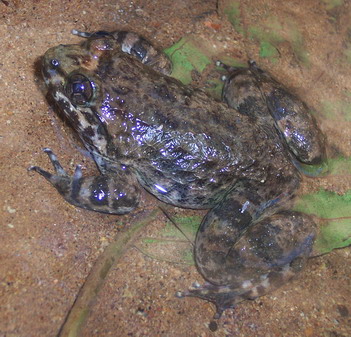 Kuhl's Creek FrogLimnonectes kuhlii
-
 Masked Swamp FrogLimnonectes paramacrodon
-
 Giant River FrogLimnonectes leporinus
Compare
Questions and answers
What is the scientific name of the Nguyen's Fanged Frog?
The scientific name of the Nguyen's Fanged Frog is Limnonectes nguyenorum. Written with its author, the full name is Limnonectes nguyenorum McLeod, Kurlbaum & Hoang, 2015.
Which family does the Nguyen's Fanged Frog belong to?
Limnonectes nguyenorum belongs to the family Dicroglossidae, in the order Anura and the class Amphibia.
Where is the Nguyen's Fanged Frog found?
Checklists and occurrence records place Limnonectes nguyenorum in 1 country: Vietnam.
What is the conservation status of the Nguyen's Fanged Frog?
The IUCN Red List category recorded for Limnonectes nguyenorum is Near Threatened (NT).
What other names does the Nguyen's Fanged Frog have?
Limnonectes nguyenorum is also known in English as Nguyen's Wart Frog and Vi Xuyen Wart Frog.
Sources
Passages the profile rests on
- The species belongs to the Limnonectes kuhlii species complex. Source passage: “It is part of the Limnonectes kuhlii species complex.” — English Wikipedia
- The species occurs in sympatry with Limnonectes bannaensis. Source passage: “It occurs in sympatry with Limnonectes bannaensis.” — English Wikipedia
- Adult males in the type series measure approximately 44 mm in snout–vent length. Source passage: “the males measure about 44 mm (1.7 in)” — English Wikipedia
- Adult females in the type series measure 37 and 43 mm in snout–vent length. Source passage: “the females 37 and 43 mm (1.5 and 1.7 in) in snout–vent length.” — English Wikipedia
- The tympanum is concealed and the supratympanic fold is indistinct. Source passage: “The tympanum is hidden and the supratympanic fold is indistinct.” — English Wikipedia
- The tips of the fingers and toes are rounded and lack expanded discs. Source passage: “The finger and toe tips are rounded but not expanded into discs.” — English Wikipedia
- The fingers lack webbing, while the toes are fully webbed. Source passage: “The fingers have no webbing whereas the toes are fully webbed.” — English Wikipedia
- Preserved specimens have a light brown dorsal surface with dark brown markings and blotches. Source passage: “Preserved specimens have light brown dorsum with some dark brown marking and blotches.” — English Wikipedia
- A prominent white bar runs from the nostrils to the insertion of the arm. Source passage: “A prominent white bar extends from the nares to the arm insertion.” — English Wikipedia
- The upper lip has distinct white spots and dark brown bars. Source passage: “The upper lip has distinct white spots and dark brown bars.” — English Wikipedia
- The throat is mottled, while the ventral surface is immaculate. Source passage: “The throat is mottled and venter is immaculate.” — English Wikipedia
- The species inhabits streams in submontane evergreen forests. Source passage: “Limnonectes nguyenorum occurs along streams in submontane evergreen forests” — English Wikipedia
- The species occurs at elevations of approximately 600–900 m above sea level. Source passage: “at elevations of about 600–900 m (2,000–3,000 ft) above sea level.” — English Wikipedia
- As of May 2018, the species had not been included in the IUCN Red List of Threatened Species. Source passage: “As of May 2018, this species has not been included the IUCN Red List of Threatened Species.” — English Wikipedia
Data
- Catalogue of Life, 2026-10-16 XR cc by
- Global Biodiversity Information Facility CC BY 4.0
- Wikidata CC0
- GeoNames CC BY 4.0
- Within the Catalogue of Life, this name comes from The Integrated Taxonomic Information System cc0
References
- More of the same: a diminutive new species of the Limnonectes kuhlii complex from northern Vietnam (Anura: Dicroglossidae). (2015). Zootaxa, 3947(2), 201–214. https://doi.org/10.11646/zootaxa.3947.2.4 Link where the name was published
This species in other databases
Page built on 28 November 2026. See how the catalog is made and all sources and licences.
Cite this page
ScientificNames.org. (2026). Limnonectes nguyenorum (Nguyen's Fanged Frog). Retrieved November 28, 2026, from https://scientificnames.org/species/limnonectes-nguyenorum
“Limnonectes nguyenorum (Nguyen's Fanged Frog).” ScientificNames.org, 2026, scientificnames.org/species/limnonectes-nguyenorum. Accessed 28 Nov. 2026.
ScientificNames.org. “Limnonectes nguyenorum (Nguyen's Fanged Frog).” Accessed November 28, 2026. https://scientificnames.org/species/limnonectes-nguyenorum.
@misc{scientificnames_limnonectes_nguyenorum_nguyens_fanged_frog,
  author = {{ScientificNames.org}},
  title = {Limnonectes nguyenorum (Nguyen's Fanged Frog)},
  year = {2026},
  url = {https://scientificnames.org/species/limnonectes-nguyenorum},
  note = {Accessed 2026-11-28}
}