Species · Flowering plants
Blunt-lobe Spicebush Lindera obtusiloba
The scientific name of the Blunt-lobe Spicebush is Lindera obtusiloba. It is a species of flowering plant in the family Lauraceae (laurel family), order Laurales.
- Scientific name
- Lindera obtusiloba Blume
- Common name
- Blunt-lobe Spicebush
- Genus
- Lindera
- Family
- Lauraceae (Laurel Family)
- Order
- Laurales
- Class
- Magnoliopsida
- Red List category
- LC Least Concern
- Recorded in
- 9 countries
- Name status
- accepted in the Catalogue of Life

Overview
Blunt-lobe spicebush is a spreading deciduous shrub or small tree. It is native to the Himalayas, northeastern India, Myanmar, China, Korea and Japan. It has glossy, aromatic leaves, deep yellow flowers and juvenile leaves that are lobed and deep purple.
Written 26 November 2026 from the sources listed below. Each statement was checked against the passage it cites; statements that could not be supported were removed.
Appearance
Blunt-lobe spicebush has glossy, aromatic leaves and deep yellow flowers. Its juvenile leaves are lobed and deep purple.[1][2]
The leaves often turn yellow during autumn.[3]
The species grows to approximately 6 metres in both height and width.[4]
Habitat
Blunt-lobe spicebush is a spreading deciduous shrub or small tree. It is native to the Himalayas, northeastern India, Myanmar, China, Korea and Japan.[5][6]
Reproduction and life cycle
The species produces deep yellow flowers in spring before its leaves appear.[7]
Uses
Blunt-lobe spicebush has received the Royal Horticultural Society's Award of Garden Merit.[8]
A water extract of the species inhibited mast-cell-derived allergic inflammation in laboratory and in vivo studies. The extract has been suggested as a potential source for treatments of allergic rhinitis, asthma and atopic dermatitis.[9][10]
Classification of the Blunt-lobe Spicebush
| Kingdom | Plantae |
|---|---|
| Subkingdom | Pteridobiotina |
| Phylum | Tracheophyta |
| Class | Magnoliopsida |
| Order | Laurales |
| Family | Lauraceae (Laurel Family) |
| Tribe | Laureae |
| Genus | Lindera (Spicebush) |
| Species | Lindera obtusiloba Blume |
Where the Blunt-lobe Spicebush is found
Checklists and occurrence records place Lindera obtusiloba in 9 countries across Asia. GBIF holds 14,733 georeferenced records of it.
Countries
- Bhutan 20
- China 1,957
- India 26
- Japan 2,861
- Myanmar 1
- Nepal 24
- North Korea 42
- South Korea 9,795
- Taiwan 7
Regions and cities with the most records
- Gangwon-do, South Korea 1,957
- Gyeongsangbuk-do, South Korea 1,236
- Gyeonggi-do, South Korea 1,183
- Seongnam-si, South Korea 851
- Gwangju, South Korea 809
- Hanam, South Korea 705
- Uiwang, South Korea 596
- Gunpo, South Korea 595
- Suwon, South Korea 593
- Jeollabuk-do, South Korea 585
- Anyang-si, South Korea 502
- Chungcheongnam-do, South Korea 463
- Gyeongsangnam-do, South Korea 440
- Nagano, Japan 435
- Guri-si, South Korea 375
- Seoul, South Korea 349
- Jeollanam-do, South Korea 340
- Wabu, South Korea 323
- Chongqing, China 289
- Gwangmyeong, South Korea 277
- Yŏnmu, South Korea 266
- Nonsan, South Korea 263
- T’aebaek, South Korea 242
- Namyangju, South Korea 231
- Hubei, China 219
- Hwacheon, South Korea 200
- Shaanxi, China 192
- Yanggu, South Korea 185
- Chuncheon, South Korea 175
- Sichuan, China 159
- Yunnan, China 153
- Daegu, South Korea 151
- Yamanashi, Japan 150
- Tibet, China 133
- Incheon, South Korea 132
- Gunma, Japan 130
2 more countries have a few records outside this range
These countries hold a few records of Lindera obtusiloba but lie outside the range the checklists give for it. Such records are often zoo or garden specimens, museum material or vagrants, so the species is not counted as occurring there.
Range as the checklists state it
China (Anhui, Fujian, Gansu, Henan, Hubei, Hunan, Jiangsu, Jiangxi, Liaoning, Shaanxi, Shandong, Sichuan, Yunnan, Zhejiang); Tibet; North Korea; South Korea (incl. Cheju Isl.); Japan (Honshu, Shikoku, Kyushu); Myanmar (Kachin)
A number beside a place is its count of GBIF occurrence records. A place without a number comes from a checklist alone. Records show where a species has been observed or collected, which can include escapes and vagrants.
Common names
English
- Blunt-lobe Spicebush
Names in 9 other languages
- Chinese
- san ya wu yao, 三桠乌药, 三椏烏藥, 三钻七, 三钻风
- Czech
- lindera tupolaločná
- Finnish
- koreanryytilaakeri
- German
- stumpflappiger Fieberstrauch
- Japanese
- dan-kōbai, ダンコウバイ
- Korean
- saenggangnamu, 생강나무
- Russian
- Линдера туполопастная
- Slovak
- lindera tupolaločnatá
- Swedish
- japansk feberbuske
Synonyms
23 other scientific names have been used for this species and are now treated as synonyms of Lindera obtusiloba.
- Benzoin cercidifolium (Hemsl.) Rehder
- Benzoin obtusilobum (Blume) Kuntze
- Benzoin obtusilobum f. ovatum Nakai
- Benzoin obtusilobum f. quinqelobum Uyeki
- Benzoin obtusilobum f. quinquelobum Uyeki
- Benzoin obtusilobum f. villosum (Blume) Nakai
- Benzoin obtusilobum var. ovatum Nakai ex T.Mori
- Lindera cercidifolia Hemsl.
- Lindera mollis Oliv.
- Lindera obtusiloba f. obtusiloba
- Lindera obtusiloba f. ovata (Nakai) C.M.Pak
- Lindera obtusiloba f. ovata (Nakai) T. B. Lee
- Lindera obtusiloba f. quinqueloba (Uyeki) T.B.Lee
- Lindera obtusiloba f. quinqueloba (Uyeki) C.M.Pak
- Lindera obtusiloba f. velutina T. B. Lee
- Lindera obtusiloba f. villosa (Blume) T.B.Lee
- Lindera obtusiloba f. villosa (Blume) Kitag.
- Lindera obtusiloba f. villosa (Blume) Kosterm.
- Lindera obtusiloba var. praetermissa (Grierson & D.G.Long) H.P.Tsui
- Lindera obtusiloba var. tomentosa Miq.
- Lindera obtusiloba var. villosa Blume
- Lindera praetermissa Grierson & D.G.Long
- TLindera mollis Oliv.
Subspecies and varieties
Related species
-
 SpicebushLindera benzoin
-
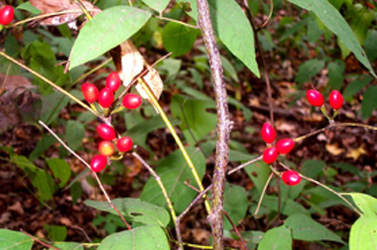 PondberryLindera melissifolia
-
 Lindera aggregata
-
 Lindera triloba
-
 Lindera praecox
-
 Lindera subcoriacea
- Lindera lucida
- Taiwan SpicebushLindera akoensis
Compare
Questions and answers
What is the scientific name of the Blunt-lobe Spicebush?
The scientific name of the Blunt-lobe Spicebush is Lindera obtusiloba. Written with its author, the full name is Lindera obtusiloba Blume.
Which family does the Blunt-lobe Spicebush belong to?
Lindera obtusiloba belongs to the family Lauraceae, in the order Laurales and the class Magnoliopsida.
Where is the Blunt-lobe Spicebush found?
Checklists and occurrence records place Lindera obtusiloba in 9 countries, including South Korea, Japan, China, North Korea, India and Nepal.
What is the conservation status of the Blunt-lobe Spicebush?
The IUCN Red List category recorded for Lindera obtusiloba is Least Concern (LC).
Is spicebush deciduous?
Yes. Blunt-lobe spicebush is described as a spreading deciduous shrub or small tree.[5]
Sources
Passages the profile rests on
- The species has glossy, aromatic leaves and deep yellow flowers. Source passage: “with glossy aromatic leaves and deep yellow flowers” — English Wikipedia
- Juvenile leaves are lobed and deep purple. Source passage: “Juvenile leaves are lobed (as the name suggests) and are deep purple.” — English Wikipedia
- The leaves often turn yellow during autumn. Source passage: “The leaves often turn yellow in autumn.” — English Wikipedia
- The species grows to approximately 6 metres in both height and width. Source passage: “growing to 6 m (20 ft) tall and wide” — English Wikipedia
- The species is described as a spreading deciduous shrub or small tree. Source passage: “It is a spreading deciduous shrub or small tree” — English Wikipedia
- The species is native to the Himalayas, northeastern India, Myanmar, China, Korea and Japan. Source passage: “It is native to the Himalayas, northeastern India, Myanmar, China, Korea and Japan.” — English Wikipedia
- The species produces deep yellow flowers in spring before its leaves appear. Source passage: “deep yellow flowers which appear in spring before the leaves.” — English Wikipedia
- The species has received the Royal Horticultural Society's Award of Garden Merit. Source passage: “This plant has gained the Royal Horticultural Society's Award of Garden Merit.” — English Wikipedia
- A water extract of the species inhibited mast-cell-derived allergic inflammation in laboratory and in vivo studies. Source passage: “A Lindera obtusiloba water extract inhibited mast-cell-derived allergic inflammation in vitro and vivo” — English Wikipedia
- The water extract has been suggested as a potential source for treatments of allergic rhinitis, asthma and atopic dermatitis. Source passage: “suggesting it may have possible uses in allergic diseases such as allergic rhinitis, asthma and atopic dermatitis.” — English Wikipedia
Data
- Catalogue of Life, 2026-10-16 XR cc by
- Global Biodiversity Information Facility CC BY 4.0
- Wikidata CC0
- GeoNames CC BY 4.0
- Wikimedia Commons per image; credit shown with each image
- Within the Catalogue of Life, this name comes from Synonymic Checklists of the Vascular Plants of the World cc by
References
- Blume. (1851). Ann. Mus. Bot. Lugduno-Batavi 1: 325 (1851). where the name was published
This species in other databases
- Catalogue of Life 6QFPM
- Wikidata Q909285
- iNaturalist 448339
- World Flora Online wfo-0001070367
- GRIN 22300
Page built on 28 November 2026. See how the catalog is made and all sources and licences.
Cite this page
ScientificNames.org. (2026). Lindera obtusiloba (Blunt-lobe Spicebush). Retrieved November 28, 2026, from https://scientificnames.org/species/lindera-obtusiloba
“Lindera obtusiloba (Blunt-lobe Spicebush).” ScientificNames.org, 2026, scientificnames.org/species/lindera-obtusiloba. Accessed 28 Nov. 2026.
ScientificNames.org. “Lindera obtusiloba (Blunt-lobe Spicebush).” Accessed November 28, 2026. https://scientificnames.org/species/lindera-obtusiloba.
@misc{scientificnames_lindera_obtusiloba_blunt_lobe_spicebush,
  author = {{ScientificNames.org}},
  title = {Lindera obtusiloba (Blunt-lobe Spicebush)},
  year = {2026},
  url = {https://scientificnames.org/species/lindera-obtusiloba},
  note = {Accessed 2026-11-28}
}