Species · Flowering plants
Pondberry Lindera melissifolia
The scientific name of the Pondberry is Lindera melissifolia. It is a species of flowering plant in the family Lauraceae (laurel family), order Laurales.
- Scientific name
- Lindera melissifolia (Walter) Blume
- Common name
- Pondberry
- Genus
- Lindera
- Family
- Lauraceae (Laurel Family)
- Order
- Laurales
- Class
- Magnoliopsida
- Recorded in
- 1 country
- Name status
- accepted in the Catalogue of Life
Overview
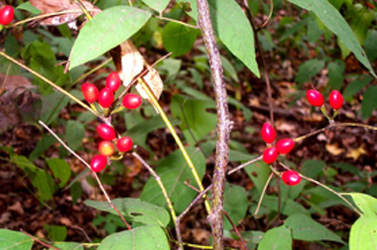
Lindera melissifolia occurs in wetland habitats, including bottomland hardwood forests and the margins of ponds and depressions. It is distinguished by its drooping foliage, conspicuous leaf venation, and bright red, single-seeded fruits.
Written 26 November 2026 from the sources listed below. Each statement was checked against the passage it cites; statements that could not be supported were removed.
Appearance
Its leaves are drooping, alternate, and oblong-elliptic to narrowly ovate. They measure 5–16 cm long and 2–6 cm wide, with strongly net-veined undersides covered in short, soft hairs.[1][2][3]
Crushed leaves have a fragrance resembling sassafras. Pondberry produces pale to bright yellow flowers with oblong tepals, measuring approximately 5–6 mm across.[4][5][6]
Its fruits are bright red, ellipsoid, and single-seeded, measuring 10–12 mm in length.[7][8]
Habitat
Pondberry occurs in shallow depression ponds with hydric wetland soils, along the margins of cypress ponds, and in seasonally wet, low-lying areas among bottomland hardwoods. Its colonies generally grow in light shade beneath forest canopies, although some occur in nearly full sunlight.[9][10][11][12]
In Mississippi, pondberry occurs in bottomland hardwood forests. In South Carolina, it grows around sinkhole edges in areas with karst topography, and in Georgia, it occurs along sphagnum bog borders.[13][14][15]
Reproduction and life cycle
Pondberry reproduces primarily vegetatively through underground stolons, forming clones containing numerous stems. It is dioecious, with male and female flowers produced on separate plants.[16][17][18]
Stems generally begin flowering after two to four years of growth. Flowers appear before the leaves from February to mid-March.[19][20]
Pondberry flowers are thought to be pollinated by insects. Fruits mature from August to early October, and mature fruits can be found on plants in October.[21][22][23]
Pondberry seeds with their pulp removed can float in water for a day or longer. Seeds have been observed germinating over multiple years under field conditions, although they remain viable for only a short period.[24][25][26]
Individual pondberry stems usually live for six or seven years.[27]
Conservation
Pondberry is federally listed as endangered, with the listing dated July 31, 1986.[28][29]
Drainage ditching and subsequent conversion of wetland habitat are major threats to pondberry. Domestic hogs, cattle grazing, and timber harvesting have affected populations at some sites.[30][31]
Pondberry may be susceptible to laurel wilt, a fungal disease.[32]
Uses
Pondberry fruits were historically used as projectiles in toy pop guns made from hollowed elderberry stems.[33]
Similar species
Pondberry is distinguished from Lindera benzoin and Lindera subcoriacea by its drooping foliage, rounded or obtuse leaf base, conspicuous venation, and arrangement of lateral leaf nerves.[34]
Diet
Spicebush swallowtail larvae feed on pondberry leaves and roll themselves inside a leaf to form a tent. Leaf cutter bees remove circular sections from pondberry leaf margins, and swamp rabbits have been observed browsing on pondberry stems.[35][36][37]
Classification of the Pondberry
| Kingdom | Plantae |
|---|---|
| Subkingdom | Pteridobiotina |
| Phylum | Tracheophyta |
| Class | Magnoliopsida |
| Order | Laurales |
| Family | Lauraceae (Laurel Family) |
| Tribe | Laureae |
| Genus | Lindera (Spicebush) |
| Species | Lindera melissifolia (Walter) Blume |
Where the Pondberry is found
Checklists and occurrence records place Lindera melissifolia in 1 country across North America. GBIF holds 608 georeferenced records of it.
Countries
Regions and cities with the most records
- Missouri, United States 38
- Arkansas, United States 37
- North Carolina, United States 22
- South Carolina, United States 19
- Mississippi, United States 9
- North Charleston, United States 8
- Hanahan, United States 7
- Georgia, United States 6
- Goose Creek, United States 6
- Carrboro, United States 5
- Chapel Hill, United States 5
- Durham, United States 5
- Mount Pleasant, United States 5
- Alabama, United States 4
- Charleston, United States 4
- Jonesboro, United States 4
- Florida, United States
- Louisiana, United States
Range as the checklists state it
USA (Alabama, Arkansas, Florida, Georgia, Louisiana, Missouri, Mississippi, North Carolina, South Carolina)
A number beside a place is its count of GBIF occurrence records. A place without a number comes from a checklist alone. Records show where a species has been observed or collected, which can include escapes and vagrants.
Common names
English
- Pondberry
Names in 1 other language
- Chinese
- 美南山胡椒
Synonyms
8 other scientific names have been used for this species and are now treated as synonyms of Lindera melissifolia.
- Benzoin diospyrus (Pursh) Sweet
- Benzoin melissifolium (Walter) Nees
- Euosmus diospyros (Pursh) Nutt.
- Evelyna diospyros (Pursh) Raf.
- Laurus diospyroides Michx.
- Laurus diospyros Pursh
- Laurus melissifolia Walter
- Tetranthera diospyros (Pursh) Spreng.
Related species
-
 SpicebushLindera benzoin
-
 Blunt-lobe SpicebushLindera obtusiloba
-
 Lindera aggregata
-
 Lindera triloba
-
 Lindera praecox
-
 Lindera subcoriacea
- Lindera lucida
- Taiwan SpicebushLindera akoensis
Compare
Questions and answers
What is the scientific name of the Pondberry?
The scientific name of the Pondberry is Lindera melissifolia. Written with its author, the full name is Lindera melissifolia (Walter) Blume.
Which family does the Pondberry belong to?
Lindera melissifolia belongs to the family Lauraceae, in the order Laurales and the class Magnoliopsida.
Where is the Pondberry found?
Checklists and occurrence records place Lindera melissifolia in 1 country: United States.
Sources
Passages the profile rests on
- Pondberry has drooping, alternate, oblong-elliptic to narrowly ovate leaves. Source passage: “The drooping, alternate leaves are oblong-elliptic to narrowly ovate” — English Wikipedia
- Pondberry leaves have strongly net-veined undersides covered with short, soft hairs. Source passage: “Undersides are strongly net-veined and covered with short, soft hairs.” — English Wikipedia
- Pondberry leaves measure 5–16 cm long and 2–6 cm wide. Source passage: “5–16 cm (2.0–6.3 in) long, 2–6 cm (0.8–2.4 in) wide” — English Wikipedia
- Crushed pondberry leaves have a fragrance resembling sassafras. Source passage: “When crushed, the leaves strongly resemble sassafras (Sassafras albidum) in fragrance.” — English Wikipedia
- Pondberry produces pale to bright yellow flowers with oblong tepals. Source passage: “The petal-like tepals are pale to bright yellow, oblong, and 2 mm (0.08 in) long.” — English Wikipedia
- Pondberry flowers measure approximately 5–6 mm across. Source passage: “Male and female flowers, each 5–6 mm (0.20–0.24 in) across” — English Wikipedia
- Pondberry produces bright red, ellipsoid, single-seeded fruits. Source passage: “A bright red, single-seeded drupe, ellipsoid, 10–12 mm (0.4–0.5 in) long” — English Wikipedia
- Pondberry fruits measure 10–12 mm in length. Source passage: “10–12 mm (0.4–0.5 in) long” — English Wikipedia
- Pondberry occurs in shallow depression ponds with hydric wetland soils. Source passage: “Pondberry occurs in shallow depression ponds in wetland habitats with hydric soils” — English Wikipedia
- Pondberry grows along the margins of cypress ponds. Source passage: “along margins of cypress ponds” — English Wikipedia
- Pondberry occurs in seasonally wet, low-lying areas among bottomland hardwoods. Source passage: “in seasonally wet, low areas among bottomland hardwoods.” — English Wikipedia
- Pondberry colonies generally grow in light shade beneath forest canopies, although some occur in nearly full sunlight. Source passage: “Most pondberry colonies occur in light shade beneath a forest canopy, but a few grow in almost full sunlight.” — English Wikipedia
- Pondberry occurs in bottomland hardwood forests in Mississippi. Source passage: “In Mississippi, pondberry occurs in bottomland hardwood forests.” — English Wikipedia
- Pondberry grows around sinkhole edges in areas with karst topography in South Carolina. Source passage: “In South Carolina the species occurs in areas with karst topography, around the edges of sinkholes” — English Wikipedia
- Pondberry occurs along sphagnum bog borders in Georgia. Source passage: “in Georgia it occurs along the borders of sphagnum bogs.” — English Wikipedia
- Pondberry reproduces vegetatively through underground stolons. Source passage: “Clones expand vegetatively through stolons, and this mechanism of vegetative reproduction is the principal way that colonies develop.” — English Wikipedia
- Pondberry is dioecious, with male and female flowers produced on separate plants. Source passage: “Male and female flowers, each 5–6 mm (0.20–0.24 in) across, are produced on different plants (dioecious).” — English Wikipedia
- Pondberry reproduction occurs primarily through stolons, with plants forming clones containing numerous stems. Source passage: “Reproduction is primarily vegetative by means of stolons, a creeping horizontal stem or runner that takes root at points along its length to form new plants.” — fws.gov
- Pondberry stems generally begin flowering after two to four years of growth. Source passage: “Stems flower after two to four years of growth.” — English Wikipedia
- Pondberry flowers appear before the leaves from February to mid-March. Source passage: “Flowers appear before the leaves (February to mid-March)” — English Wikipedia
- Pondberry flowers are thought to be pollinated by insects. Source passage: “Flowers are thought to be insect pollinated.” — English Wikipedia
- Pondberry fruits mature from August to early October. Source passage: “matures in late summer or fall (August to early October).” — English Wikipedia
- Pondberry mature fruits can be found on plants in October. Source passage: “Mature fruits can be found on the plants in October.” — fws.gov
- Pondberry seeds with their pulp removed can float in water for a day or longer. Source passage: “the seed with the pulp removed will float for a day or sometimes longer.” — English Wikipedia
- Pondberry seeds have been observed germinating over multiple years under field conditions. Source passage: “Under field conditions, germination of sown seeds has been observed to occur over a number of years suggesting some form of dormancy.” — English Wikipedia
- Pondberry seeds remain viable for only a short period. Source passage: “Seeds are only viable for a short period of time.” — fws.gov
- Individual pondberry stems usually live for six or seven years. Source passage: “Stems usually live 6 or 7 years” — English Wikipedia
- Pondberry was listed as endangered in 1986. Source passage: “Pondberry was listed as endangered in 1986.” — English Wikipedia
- Pondberry is federally listed as endangered, with the listing dated July 31, 1986. Source passage: “Federal Status: Endangered, listed July 31, 1986” — fws.gov
- Drainage ditching and subsequent conversion of wetland habitat are major threats to pondberry. Source passage: “The most significant threats are drainage ditching and subsequent conversion of its habitat to other uses.” — fws.gov
- Domestic hogs, cattle grazing, and timber harvesting have affected pondberry populations at some sites. Source passage: “Domestic hogs, cattle grazing, and timber harvesting have also impacted the plants at some sites.” — fws.gov
- Pondberry may be susceptible to laurel wilt, a fungal disease. Source passage: “There are indications that pondberry, which is in the Laurel family, is susceptible to laurel wilt (Raffaelea lauricola).” — English Wikipedia
- Pondberry fruits were historically used as projectiles in toy pop guns made from hollowed elderberry stems. Source passage: “A vintage use of pondberry fruit in the rural South was as projectiles in toy pop guns constructed by children from hollowed-out elderberry (Sambucus canadensis) stems.” — English Wikipedia
- Pondberry is distinguished from Lindera benzoin and Lindera subcoriacea by its drooping foliage, rounded or obtuse leaf base, conspicuous venation, and arrangement of lateral leaf nerves. Source passage: “Pondberry is distinguished from the two other North American members of the genus (Lindera benzoin and Lindera subcoriacea) by its drooping foilage, obtuse or rounded leaf base, conspicuous venation and the two lowest pairs of lateral nerves are not parallel to the ones above.” — fws.gov
- The spicebush swallowtail larvae feed on pondberry leaves and roll themselves inside a leaf to form a tent. Source passage: “The spicebush swallowtail (Papilio troilus) larvae feed on the leaves and roll themselves in a leaf making a tent.” — English Wikipedia
- Leaf cutter bees remove circular sections from pondberry leaf margins. Source passage: “Leaf cutter bees (Megachilidae spp.) cut circular sections from the leaf margins, sometimes removing most of the leaf.” — English Wikipedia
- Swamp rabbits have been observed browsing on pondberry stems. Source passage: “Swamp rabbits have been observed browsing on stems.” — English Wikipedia
Data
- Catalogue of Life, 2026-10-16 XR cc by
- Global Biodiversity Information Facility CC BY 4.0
- Wikidata CC0
- GeoNames CC BY 4.0
- Wikimedia Commons per image; credit shown with each image
- Within the Catalogue of Life, this name comes from Synonymic Checklists of the Vascular Plants of the World cc by
References
- Blume. (1851). Ann. Mus. Bot. Lugduno-Batavi 1: 324 (1851). where the name was published
This species in other databases
- Catalogue of Life 72G25
- Wikidata Q6552425
- iNaturalist 223835
- World Flora Online wfo-0001070364
- GRIN 320069
Page built on 29 November 2026. See how the catalog is made and all sources and licences.
Cite this page
ScientificNames.org. (2026). Lindera melissifolia (Pondberry). Retrieved November 29, 2026, from https://scientificnames.org/species/lindera-melissifolia
“Lindera melissifolia (Pondberry).” ScientificNames.org, 2026, scientificnames.org/species/lindera-melissifolia. Accessed 29 Nov. 2026.
ScientificNames.org. “Lindera melissifolia (Pondberry).” Accessed November 29, 2026. https://scientificnames.org/species/lindera-melissifolia.
@misc{scientificnames_lindera_melissifolia_pondberry,
  author = {{ScientificNames.org}},
  title = {Lindera melissifolia (Pondberry)},
  year = {2026},
  url = {https://scientificnames.org/species/lindera-melissifolia},
  note = {Accessed 2026-11-29}
}