Species · Insects
Lomanoxoides tesari
Lomanoxoides tesari has no English name on record in the checklists used here. It is a species of insect in the family Scarabaeidae (dung beetles), order Coleoptera. The name dates from 1963.
- Scientific name
- Lomanoxoides tesari (Balthasar, 1963)
- Genus
- Lomanoxoides
- Family
- Scarabaeidae (Dung Beetles)
- Order
- Coleoptera
- Class
- Insecta
- Recorded in
- 3 countries
- Name status
- accepted in the Catalogue of Life
Overview
The species occurs in Argentina, Brazil, and Paraguay. Adults are reddish brown and measure approximately 4.8–5.5 mm in length.
Written 28 November 2026 from the sources listed below. Each statement was checked against the passage it cites; statements that could not be supported were removed.
Appearance
The adult body is reddish brown. Adults measure approximately 4.8–5.5 mm in length.[1][2]
The head has punctures that are coarser and more closely spaced on the frons. The pronotum is somewhat regularly convex and lacks an explanate form.[3][4]
The elytral margin bears setae along its posterior and lateral portions. The elytral interstriae are convex and tectiform, with two rows of fine punctures.[5][6]
Habitat
Specimens have been found inside nests of the ant species Atta sexdens.[7]
Classification of Lomanoxoides tesari
| Kingdom | Animalia |
|---|---|
| Phylum | Arthropoda |
| Subphylum | Hexapoda |
| Class | Insecta (Insect) |
| Order | Coleoptera (Beetle) |
| Suborder | Polyphaga |
| Series | Staphyliniformia |
| Superfamily | Scarabaeoidea |
| Family | Scarabaeidae (Dung Beetles) |
| Subfamily | Aphodiinae |
| Tribe | Eupariini |
| Genus | Lomanoxoides |
| Species | Lomanoxoides tesari (Balthasar, 1963) |
Where Lomanoxoides tesari is found
Checklists and occurrence records place Lomanoxoides tesari in 3 countries across South America. GBIF holds 12 georeferenced records of it.
Countries
Regions and cities with the most records
Range as the checklists state it
Neotropical(Argentina, Brazil:Distrito Federal, Mato Grosso, Mato Grosso do Sul, Minas Gerais, Rio de Janeiro, Rondônia, São Paulo, Paraguay)
A number beside a place is its count of GBIF occurrence records. A place without a number comes from a checklist alone. Records show where a species has been observed or collected, which can include escapes and vagrants.
Synonyms
4 other scientific names have been used for this species and are now treated as synonyms of Lomanoxoides tesari.
- Ataenius costatus Schmidt
- Ataenius fastigatus Petrovitz, 1973
- Ataenius hrubantovai Chalumeau, 1992
- Euparia tesari Balthasar, 1963
Related species
- Lomanoxoides nigrolineatus
- Lomanoxoides bitubericollis
- Lomanoxoides herediae
- Lomanoxoides mapitunari
- Lomanoxoides selviriaensis
- Lomanoxoides setosus
-
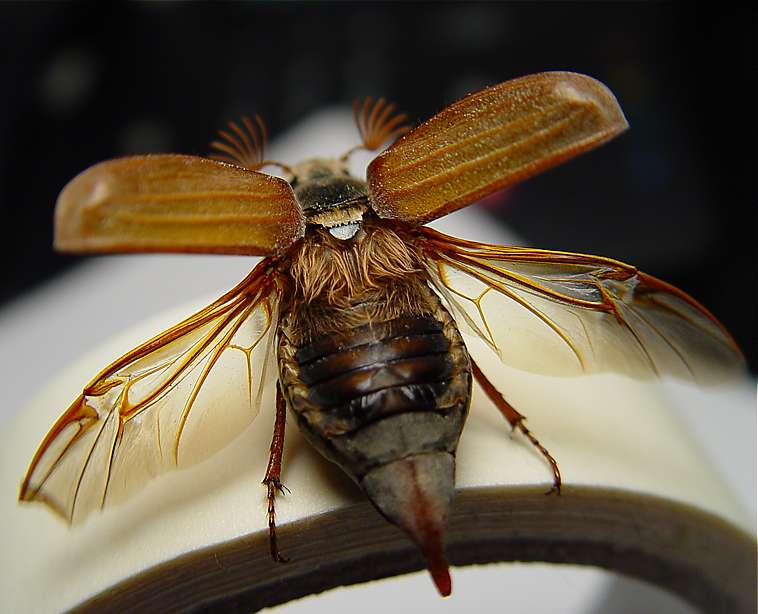 CockchaferMelolontha melolontha
-
 Hercules BeetleDynastes (Dynastes) hercules
Compare
Questions and answers
What is the body length of Lomanoxoides tesari?
Adults measure approximately 4.8–5.5 mm in length.[1]
What is the body colour of Lomanoxoides tesari?
The adult body is reddish brown.[2]
Where does Lomanoxoides tesari occur?
The species occurs in Argentina, Brazil, and Paraguay.[8]
Where has Lomanoxoides tesari been recorded in Brazil?
It has been recorded in Distrito Federal, Mato Grosso, Mato Grosso do Sul, Minas Gerais, Rio de Janeiro, Rondônia, and São Paulo.[9]
Where have specimens of Lomanoxoides tesari been found?
Specimens have been found inside nests of the ant species Atta sexdens.[7]
Sources
Passages the profile rests on
- Adults measure approximately 4.8–5.5 mm in length. Source passage: “Adults reach a length of about 4.8–5.5 mm (0.19–0.22 in).” — English Wikipedia
- The adult body is reddish brown. Source passage: “The body is reddish brown” — English Wikipedia
- The head has punctures that are coarser and more closely spaced on the frons. Source passage: “the head is punctate, with the punctures coarser and closer on the frons.” — English Wikipedia
- The pronotum is somewhat regularly convex and lacks an explanate form. Source passage: “The pronotum is not explanate, but somewhat regularly convex.” — English Wikipedia
- The elytral margin bears setae along its posterior and lateral portions. Source passage: “The margin of the elytra is setaceous posteriorly and laterally” — English Wikipedia
- The elytral interstriae are convex and tectiform, with two rows of fine punctures. Source passage: “the interstriae are convex and tectiform with two rows of fine punctures.” — English Wikipedia
- Specimens have been found inside nests of the ant species Atta sexdens. Source passage: “Specimens have been found within the nests of Atta sexdens” — English Wikipedia
- Lomanoxoides tesari occurs in Argentina, Brazil, and Paraguay. Source passage: “It is found in Argentina, Brazil (Distrito Federal, Mato Grosso, Mato Grosso do Sul, Minas Gerais, Rio de Janeiro, Rondônia, São Paulo) and Paraguay.” — English Wikipedia
- Within Brazil, the species has been recorded in Distrito Federal, Mato Grosso, Mato Grosso do Sul, Minas Gerais, Rio de Janeiro, Rondônia, and São Paulo. Source passage: “Brazil (Distrito Federal, Mato Grosso, Mato Grosso do Sul, Minas Gerais, Rio de Janeiro, Rondônia, São Paulo)” — English Wikipedia
Data
- Catalogue of Life, 2026-10-16 XR cc by
- Global Biodiversity Information Facility CC BY 4.0
- Wikidata CC0
- GeoNames CC BY 4.0
- Within the Catalogue of Life, this name comes from World Scarabaeidae Database cc by
References
- Stebnicka, Z. (1999). Neotropical Eupariini: New and little known genera and species (Coleoptera: Scarabaeoidea: Aphodiinae). Revue Suisse de Zoologie, Genève 106(2):285-300. https://doi.org/10.5962/bhl.part.80079 Link where the name was published
This species in other databases
Page built on 28 November 2026. See how the catalog is made and all sources and licences.
Cite this page
ScientificNames.org. (2026). Lomanoxoides tesari. Retrieved November 28, 2026, from https://scientificnames.org/species/lomanoxoides-tesari
“Lomanoxoides tesari.” ScientificNames.org, 2026, scientificnames.org/species/lomanoxoides-tesari. Accessed 28 Nov. 2026.
ScientificNames.org. “Lomanoxoides tesari.” Accessed November 28, 2026. https://scientificnames.org/species/lomanoxoides-tesari.
@misc{scientificnames_lomanoxoides_tesari,
  author = {{ScientificNames.org}},
  title = {Lomanoxoides tesari},
  year = {2026},
  url = {https://scientificnames.org/species/lomanoxoides-tesari},
  note = {Accessed 2026-11-28}
}