Species · Mammals
Gray Slender Loris Loris lydekkerianus
The scientific name of the Gray Slender Loris is Loris lydekkerianus. It is a species of mammal in the family Lorisidae (pottos), order Primates. The name dates from 1908.
- Scientific name
- Loris lydekkerianus Cabrera, 1908
- Common name
- Gray Slender Loris
- Genus
- Loris
- Family
- Lorisidae (Pottos)
- Order
- Primates
- Class
- Mammalia
- Red List category
- NT Near Threatened
- Recorded in
- 2 countries
- Name status
- accepted in the Catalogue of Life
Overview
Loris lydekkerianus lives in southern India and central, north-central, and east-central Sri Lanka.
Written 26 November 2026 from the sources listed below. Each statement was checked against the passage it cites; statements that could not be supported were removed.
Appearance
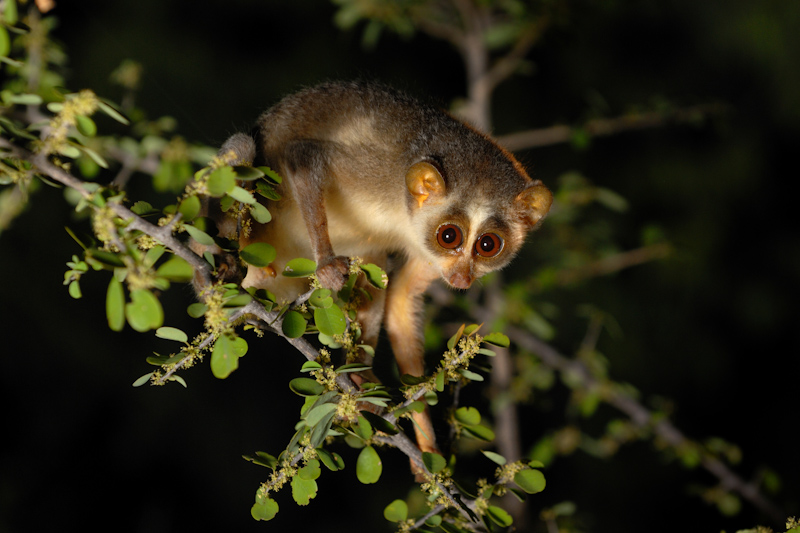
The Gray Slender Loris has short dorsal fur ranging from gray to reddish in colour, while its underside is covered in white or buff-coloured fur. Some individuals have a darker stripe extending from the head to the end of the back.[1][2][3]
Its large, forward-facing eyes are surrounded by darker fur, and a white patch of hair called the median stripe occurs between them. Its muzzle is larger and less pointed than that of the red slender loris.[4][5][6]
The species has extremely slender, long limbs and a reduced second digit that helps it grip small branches. Its tail is vestigial, although it is also described as lacking a tail.[7][8][9][10]
Adults develop their full body size and complete adult colouration from approximately four months of age.[11]
Habitat
The Gray Slender Loris inhabits primary and secondary rainforest, dry semi-deciduous forest, and montane cloud forest. It occurs at elevations reaching approximately 2,000 metres above sea level.[12][13]
The Malabar subspecies inhabits wet forests of the Western Ghats in Karnataka, Kerala, and Tamil Nadu. The Mysore subspecies inhabits tropical dry forests of the Eastern Ghats in Andhra Pradesh, Karnataka, and Tamil Nadu, and frequents open Euphorbia scrub forests and Acacia trees.[14][15][16]
The Mysore subspecies occurs at elevations of approximately 300 to 500 metres. Suitable habitat contains abundant oblique and horizontal surfaces that support climbing, feeding, and mating.[17][18]
Diet
The Gray Slender Loris primarily consumes insects. Its diet occasionally includes fruits, flowers, mice, and geckos.[19][20]
Its digestive system has specialisations associated with consuming toxic prey.[21]
Behaviour
The Gray Slender Loris is nocturnal and emerges from its roosting cavities at dusk. Individuals generally forage alone, although they sometimes roost in groups containing as many as seven individuals.[22][23]
Individuals interact at night and sleep in groups during the daytime. Adult males maintain larger home ranges than females.[24][25]
The species communicates using vocalisations, urine marking, and scent marking. It has a distinctive non-saltatory form of locomotion.[26][27]
Females mate with multiple males during a single oestrous cycle, while males mate with multiple females throughout the year.[28][29]
The species has an unusually low basal metabolic rate.[30]
Reproduction and life cycle
The female oestrous cycle lasts approximately 24 hours, and gestation lasts approximately 165 days. The interval between births is approximately seven months.[31][32][33]
Females have the reproductive potential to produce four infants per year. They have two sets of nipples, an anatomical feature associated with their ability to give birth to twins.[34][35]
The species gives birth to single offspring and twins at approximately equal frequencies. Mothers carry their infants continuously during the first four weeks after birth and begin leaving them parked at night at approximately four weeks of age.[36][37][38]
Both female parental care and male allocare occur in this species.[39]
Conservation
The Gray Slender Loris is classified as Near Threatened on the IUCN Red List. Habitat loss threatens the species.[40][41]
Habitat fragmentation and the loss of Acacia trees are identified as threats to the species.[42]
Uses
The Gray Slender Loris is used in some traditional practices involving preparations intended as love potions and treatments for leprosy and eye ailments. Some villagers keep individuals of this species as pets.[43][44]
Classification of the Gray Slender Loris
| Kingdom | Animalia |
|---|---|
| Phylum | Chordata |
| Subphylum | Vertebrata |
| Infraphylum | Gnathostomata |
| Parvphylum | Osteichthyes |
| Megaclass | Tetrapoda |
| Class | Mammalia (Mammal) |
| Subclass | Theria |
| Infraclass | Eutheria |
| Order | Primates (Primate) |
| Suborder | Strepsirrhini |
| Infraorder | Lorisiformes |
| Family | Lorisidae (Pottos) |
| Subfamily | Lorisinae |
| Genus | Loris (Slender Loris) |
| Species | Loris lydekkerianus Cabrera, 1908 |
Where the Gray Slender Loris is found
Checklists and occurrence records place Loris lydekkerianus in 2 countries across Asia. GBIF holds 249 georeferenced records of it.
Countries
Regions and cities with the most records
- Karnataka, India 88
- Dambulla, Sri Lanka 58
- Yelahanka, India 31
- Tamil Nadu, India 30
- Kerala, India 29
- Bengaluru, India 28
- Nelamangala, India 28
- Kuttampuzha, India 22
- Kotamangalam, India 21
- Iramallūr, India 17
- Māgadi, India 17
- Mūvattupula, India 13
- Doddaballapura, India 10
- Someshwar, India 10
- Muvattupuzha, India 9
- Vadamadurai, India 9
- Balakrishnapuram, India 8
- Chettināyakkanpatti, India 8
- Closepet, India 8
- Dindigul, India 8
- Sīlappādi, India 8
- V.S.K.Valasai (Dindigul-Dist.), India 8
- Adiyanuthu, India 7
- Agaram, India 7
- Tādikombu, India 7
- Chinnalapatti, India 6
- Kannānkurichchi, India 5
- Kondalampatti, India 5
- Matale, Sri Lanka 5
- Omalur, India 5
- Sakleshpur, India 5
- Salem, India 5
- Thodupuzha, India 5
- Tīrthahalli, India 5
- Ayyalur, India 4
- Goa, India 4
1 more country has a few records outside this range
These countries hold a few records of Loris lydekkerianus but lie outside the range the checklists give for it. Such records are often zoo or garden specimens, museum material or vagrants, so the species is not counted as occurring there.
Range as the checklists state it
Southern Asia
A number beside a place is its count of GBIF occurrence records. A place without a number comes from a checklist alone. Records show where a species has been observed or collected, which can include escapes and vagrants.
Common names
English
- Gray Slender Loris
- Dry Zone Slender Loris
- Grey Slender Loris
- Highland Slender Loris
- Northern Ceylonese Slender Loris
Names in 19 other languages
- Arabic
- لوريس نحيل رمادي
- Catalan
- Loris esvelt gris
- Czech
- lori šedý
- Dutch
- Grijze Slanke Lori
- French
- Loris mince gris
- German
- Grauer Schlanklori
- Greek
- Γκρίζος Λόρις
- Italian
- Lori grigio
- Japanese
- ハイイロスレンダーロリス
- Kannada
- ಕಾಡ ನರಮನಿ, ಕಾಡು ಪಾಪ
- Marathi
- वानर-मनुष्या
- Polish
- lori szary
- Russian
- Серый тонкий лори
- Sinhala
- අළු උණහපුළුවා
- Spanish
- Loris Esbelto Gris de Sri Lanka Suroriental, Loris esbelto gris
- Telugu
- అరవె పాప, దేవాంగ పిల్లి
- Thai
- ลิงลมเพรียวเทา
- Turkish
- Gri İnce Loris
- asm
- কৃশাঙ্গী বান্দৰ
Subspecies and varieties
- Loris lydekkerianus grandis (Highland Slender Loris) subspecies
- Loris lydekkerianus lydekkerianus (Mysore Slender Loris) subspecies
- Loris lydekkerianus malabaricus (Malabar Slender Loris) subspecies
- Loris lydekkerianus nordicus (Northern Ceylon Slender Loris) subspecies
- Loris lydekkerianus uva (Uva Red Slender Loris) subspecies
Related species
-
 Red Slender LorisLoris tardigradus
-
 Bangka Slow LorisNycticebus bancanus
-
 Pygmy Slow LorisXanthonycticebus pygmaeus
-
 Bengal Slow LorisNycticebus bengalensis
-
 Sunda Slow LorisNycticebus coucang
-
 Bornean Slow LorisNycticebus borneanus
-
 Philippine Slow LorisNycticebus menagensis
-
 Javan Slow LorisNycticebus javanicus
Compare
Questions and answers
What is the scientific name of the Gray Slender Loris?
The scientific name of the Gray Slender Loris is Loris lydekkerianus. Written with its author, the full name is Loris lydekkerianus Cabrera, 1908.
Which family does the Gray Slender Loris belong to?
Loris lydekkerianus belongs to the family Lorisidae, in the order Primates and the class Mammalia.
Where is the Gray Slender Loris found?
Checklists and occurrence records place Loris lydekkerianus in 2 countries: India and Sri Lanka.
What is the conservation status of the Gray Slender Loris?
The IUCN Red List category recorded for Loris lydekkerianus is Near Threatened (NT).
What other names does the Gray Slender Loris have?
Loris lydekkerianus is also known in English as Dry Zone Slender Loris, Grey Slender Loris, Highland Slender Loris and Northern Ceylonese Slender Loris.
What is the scientific name for slender loris?
The scientific name of the Gray Slender Loris is Loris lydekkerianus Cabrera, 1908.[45]
Are slender loris rare?
The Gray Slender Loris is classified as Near Threatened on the IUCN Red List.[40]
What does slender loris eat?
The Gray Slender Loris primarily consumes insects. Its diet occasionally includes fruits, flowers, mice, and geckos.[19][20]
Sources
Passages the profile rests on
- The species has short dorsal fur that ranges from gray to reddish in colour. Source passage: “The fur is short and gray or reddish on their backs” — English Wikipedia
- Its underside is covered in white or buff-coloured fur. Source passage: “The ventrum is white or buff-coloured.” — English Wikipedia
- Some individuals have a darker stripe extending from the head to the end of the back. Source passage: “sometimes a darker stripe extends from the top of their head to the end of their back.” — English Wikipedia
- The species has large, forward-facing eyes surrounded by darker fur. Source passage: “The eyes are surrounded with darker fur and have orbits which look straight forward giving excellent stereoscopic vision” — English Wikipedia
- A white patch of hair called the median stripe occurs between its eyes. Source passage: “Between the eyes there is a white patch of hair known as the median stripe.” — English Wikipedia
- Its muzzle is larger and less pointed than that of the red slender loris. Source passage: “The muzzle is larger and less pointed than the red slender loris.” — English Wikipedia
- Its second digit is reduced, helping it grip small branches. Source passage: “The hands are also highly specialised with a reduced second digit that allows the loris to cling to small branches.” — English Wikipedia
- The species has a vestigial tail. Source passage: “The tail is vestigial.” — English Wikipedia
- The species has extremely slender limbs and large eyes positioned unusually close together. Source passage: “Their distinctly forward facing eyes are large and set closely together, while the rostrum is small and pointed.” — animaldiversity.org
- Its limbs are long and extremely slim, and it lacks a tail. Source passage: “Grey slender lorises have no tails and the limbs are long and extremely slim.” — animaldiversity.org
- Adults develop their full body size and complete adult colouration from approximately four months of age. Source passage: “adults (4 months onward) exhibit full body size and complete adult coloration patterns.” — animaldiversity.org
- The species inhabits primary and secondary rainforest, dry semi-deciduous forest, and montane cloud forest. Source passage: “the gray slender loris inhabits primary and secondary rainforest, dry semi-deciduous forest, and montane cloud forest” — English Wikipedia
- The species occurs at elevations reaching approximately 2,000 metres above sea level. Source passage: “up to 2,000 metres (6,600 ft) above sea level.” — English Wikipedia
- The Malabar subspecies inhabits wet forests of the Western Ghats in Karnataka, Kerala, and Tamil Nadu. Source passage: “the Malabar gray slender loris occurs in the wet forests of the Western Ghats in the states of Karnataka, Kerala and Tamil Nadu” — English Wikipedia
- The Mysore subspecies inhabits tropical dry forests of the Eastern Ghats in Andhra Pradesh, Karnataka, and Tamil Nadu. Source passage: “The Mysore gray slender loris inhabits the tropical dry forests of the Eastern Ghats in the states of Andhra Pradesh, Karnataka and Tamil Nadu” — English Wikipedia
- The Mysore subspecies frequents open Euphorbia scrub forests and Acacia trees. Source passage: “frequenting open Euphorbia scrub forests and Acacia trees” — English Wikipedia
- The Mysore subspecies occurs at elevations of approximately 300 to 500 metres. Source passage: “at an altitude of 300–500 metres (980–1,640 ft).” — English Wikipedia
- Suitable habitat contains abundant oblique and horizontal surfaces that support climbing, feeding, and mating. Source passage: “the ideal environment for this largely arboreal species contains plentiful oblique and horizontal surfaces for climbing, feeding, and mating.” — animaldiversity.org
- The species primarily consumes insects. Source passage: “They primarily eat insects” — English Wikipedia
- Its diet occasionally includes fruits, flowers, mice, and geckos. Source passage: “but do occasionally eat fruits, flowers, and small animals like mice and geckos when given the opportunity.” — English Wikipedia
- Its digestive system has specialisations associated with consuming toxic prey. Source passage: “digestive specializations for ingesting toxic prey” — animaldiversity.org
- The species is nocturnal and emerges from its roosting cavities at dusk. Source passage: “they are nocturnal and emerge from their roost cavities only at dusk.” — English Wikipedia
- Individuals generally forage alone, although they sometimes roost in groups containing as many as seven individuals. Source passage: “They are usually solitary while foraging, and it is rare for them to be seen in pairs or groups. However they may roost in groups of up to 7” — English Wikipedia
- Adult males maintain larger home ranges than females. Source passage: “Males hold larger home ranges than females.” — English Wikipedia
- Individuals interact at night and sleep in groups during the daytime. Source passage: “Lorises interact throughout the night and sleep in groups during the daytime.” — English Wikipedia
- The species communicates using vocalisations, urine marking, and scent marking. Source passage: “Communicate with a range of vocalisations and also use urine and scent marking.” — English Wikipedia
- The species has a distinctive non-saltatory form of locomotion. Source passage: “a unique non-saltatory locomotor style” — animaldiversity.org
- Females mate with multiple males during a single oestrous cycle. Source passage: “Females mate with multiple males within a single estrous cycle” — animaldiversity.org
- Males mate with multiple females throughout the year. Source passage: “Males mate with multiple females throughout the year.” — animaldiversity.org
- The species has an unusually low basal metabolic rate. Source passage: “an unusually low basal metabolic rate.” — animaldiversity.org
- The female oestrous cycle lasts approximately 24 hours. Source passage: “The female estrous cycle lasts for 24 hours” — animaldiversity.org
- Gestation lasts approximately 165 days. Source passage: “gestation periods are approximately 165 days.” — animaldiversity.org
- The interval between births is approximately seven months. Source passage: “The interbirth interval lasts approximately 7 months” — animaldiversity.org
- Females have the reproductive potential to produce four infants per year. Source passage: “the female reproductive potential is 4 infants per year.” — animaldiversity.org
- Females have two sets of nipples, an anatomical feature associated with their ability to give birth to twins. Source passage: “Lastly, Loris lydekkerianus females have two sets of nipples, a feature that proves useful when females give birth to twins.” — animaldiversity.org
- The species gives birth to single offspring and twins at approximately equal frequencies. Source passage: “Grey slender lorises give birth equally frequently to single young and twins.” — animaldiversity.org
- Mothers carry their infants continuously during the first four weeks after birth. Source passage: “For the first 4 weeks of life, infants are carried all the time by the mother.” — animaldiversity.org
- Mothers begin leaving their infants parked at night at approximately four weeks of age. Source passage: “Approximately 4 weeks after birth, mothers begin to ‘park’ infants at night before leaving to forage.” — animaldiversity.org
- Both female parental care and male allocare occur in this species. Source passage: “Though grey slender lorises have a polygynandrous mating system, they demonstrate both female parental care and male allocare behaviors.” — animaldiversity.org
- The species is classified as Near Threatened on the IUCN Red List. Source passage: “Although considered near threatened on the IUCN Red List” — English Wikipedia
- Habitat loss threatens the species. Source passage: “It is threatened by habitat loss.” — English Wikipedia
- Habitat fragmentation and the loss of Acacia trees are identified as threats to the species. Source passage: “Habitat fragmentation is also a threat to the loris population, as well as loss of acacia trees” — English Wikipedia
- The species is used in some traditional practices involving preparations intended as love potions and treatments for leprosy and eye ailments. Source passage: “Loris is used to make love potions, treat leprosy and eye ailments.” — English Wikipedia
- Some villagers keep individuals of this species as pets. Source passage: “Some villagers keep lorises as pets” — English Wikipedia
- Spanish zoologist Ángel Cabrera first described the taxon in 1908 in Chennai, India. Source passage: “In 1908 Spanish zoologist Ángel Cabrera first described the Mysore slender loris (Loris tardigradus lydekkerianus) in Chennai, India” — English Wikipedia
- The species is native to India and Sri Lanka. Source passage: “It is native to India and Sri Lanka” — English Wikipedia
- Its distribution includes southern India and central, north-central, and east-central Sri Lanka. Source passage: “Grey slender lorises are found in southern India and in central, north-central, and east-central Sri Lanka.” — animaldiversity.org
Data
- Catalogue of Life, 2026-10-16 XR cc by
- Global Biodiversity Information Facility CC BY 4.0
- Wikidata CC0
- GeoNames CC BY 4.0
- Wikimedia Commons per image; credit shown with each image
- Within the Catalogue of Life, this name comes from The Integrated Taxonomic Information System cc0
References
- Bol. Soc. Esp. Hist. Nat., Madrid vol.1908 p.139 where the name was published
- Wilson, Don E., and DeeAnn M. Reeder, eds. (2005). Mammal Species of the World: A Taxonomic and Geographic Reference, 3rd Ed., Vol. 1.
- Mittermeier, Rusell A., Anthony B. Rylands, and Don E. Wilson, eds. (2013). Handbook of the Mammals of the World. Volume 3. Primates.
- Nijman, Vincent, Tim Robbins, Amy Jackson, Simon T. Maddock, and Andie Ang. (2020). Molecular Phylogeny, Taxonomy and Conservation of Slender Lorises. Primate Conservation, Vol. 34.
This species in other databases
Page built on 29 November 2026. See how the catalog is made and all sources and licences.
Cite this page
ScientificNames.org. (2026). Loris lydekkerianus (Gray Slender Loris). Retrieved November 29, 2026, from https://scientificnames.org/species/loris-lydekkerianus
“Loris lydekkerianus (Gray Slender Loris).” ScientificNames.org, 2026, scientificnames.org/species/loris-lydekkerianus. Accessed 29 Nov. 2026.
ScientificNames.org. “Loris lydekkerianus (Gray Slender Loris).” Accessed November 29, 2026. https://scientificnames.org/species/loris-lydekkerianus.
@misc{scientificnames_loris_lydekkerianus_gray_slender_loris,
  author = {{ScientificNames.org}},
  title = {Loris lydekkerianus (Gray Slender Loris)},
  year = {2026},
  url = {https://scientificnames.org/species/loris-lydekkerianus},
  note = {Accessed 2026-11-29}
}