Species · Flowering plants
Fringed Loosestrife Lysimachia ciliata
The scientific name of the Fringed Loosestrife is Lysimachia ciliata. It is a species of flowering plant in the family Primulaceae (primrose family), order Ericales.
- Scientific name
- Lysimachia ciliata L.
- Common name
- Fringed Loosestrife
- Genus
- Lysimachia
- Family
- Primulaceae (Primrose Family)
- Order
- Ericales
- Class
- Magnoliopsida
- Red List category
- LC Least Concern
- Recorded in
- 7 countries
- Name status
- accepted in the Catalogue of Life

Overview
Fringed loosestrife (Lysimachia ciliata L.) is a flowering plant in the family Primulaceae, order Ericales and class Magnoliopsida. It is native to North America and occurs across most of southern Canada and most of the United States, excluding the southwest. It has opposite leaves with densely fringed hairs on their winged petioles and yellow, star-shaped flowers that often have orange to red centers.
Written 26 November 2026 from the sources listed below. Each statement was checked against the passage it cites; statements that could not be supported were removed.
Appearance
Fringed loosestrife has an upright herbaceous growth form and can reach 120 cm in height. Its stems are square and smooth, with occasional pubescence in their upper portions.[1][2][3]
Its opposite, simple leaves range from oval on the lower portions to lanceolate on the upper portions. The leaves have rounded bases, pointed tips and margins that are entire or have very small teeth.[4][5][6][7]
The leaf petioles are winged and densely fringed with hairs. The flowers have five yellow petals with irregularly toothed margins and conspicuous pointed tips, often with orange to red centers.[8][9][10]
The yellow, star-shaped flowers are borne in midsummer. They occur singly on long stalks in the upper leaf axils.[11][12][13]
Habitat
Fringed loosestrife is native to North America. It occurs across most of southern Canada and most of the United States, excluding the southwest.[14][15][16]
Reproduction and life cycle
Fringed loosestrife reproduces through seeds and rhizomes. In the northern part of its range, it is pollinated by the oil bee Macropis nuda.[17][18]
Behaviour
Fringed loosestrife produces oil rather than nectar as a reward for pollinators. It can grow aggressively.[19][20]
Uses
Fringed loosestrife is cultivated as an ornamental plant. The cultivar 'Firecracker' has received the Royal Horticultural Society's Award of Garden Merit.[21][22]
Classification of the Fringed Loosestrife
| Kingdom | Plantae |
|---|---|
| Subkingdom | Pteridobiotina |
| Phylum | Tracheophyta |
| Class | Magnoliopsida |
| Order | Ericales |
| Family | Primulaceae (Primrose Family) |
| Subfamily | Myrsinoideae |
| Tribe | Lysimachieae |
| Genus | Lysimachia (Loosestrife) |
| Species | Lysimachia ciliata L. |
Where the Fringed Loosestrife is found
Checklists and occurrence records place Lysimachia ciliata in 7 countries across Europe and North America. GBIF holds 30,047 georeferenced records of it.
Countries where it is native or its origin is not stated
Countries where it has been introduced
Regions and cities with the most records
- Ontario, Canada 2,220
- Pennsylvania, United States 2,048
- New York, United States 1,633
- England, United Kingdom 1,589
- Quebec, Canada 1,384
- Michigan, United States 1,151
- Ohio, United States 1,107
- Minnesota, United States 1,059
- Wisconsin, United States 1,057
- Vermont, United States 1,049
- Illinois, United States 813
- Massachusetts, United States 732
- Virginia, United States 695
- Alberta, Canada 580
- Connecticut, United States 572
- Indiana, United States 499
- Maryland, United States 437
- Maine, United States 414
- Idylwood, United States 406
- Merrifield, United States 391
- New Jersey, United States 389
- McLean, United States 382
- West Falls Church, United States 381
- New Brunswick, Canada 376
- New Hampshire, United States 369
- Blackburn, United Kingdom 368
- Arlington, United States 365
- Darwen, United Kingdom 359
- Foggy Bottom, United States 353
- Adams Morgan, United States 351
- Golden Triangle, United States 350
- Manitoba, Canada 350
- Tysons, United States 345
- Bethesda, United States 344
- Washington, United States 339
- Baileys Crossroads, United States 337
13 more countries have a few records outside this range
These countries hold a few records of Lysimachia ciliata but lie outside the range the checklists give for it. Such records are often zoo or garden specimens, museum material or vagrants, so the species is not counted as occurring there.
Range as the checklists state it
England [I] (England [I], Wales [I], Isle of Man [I], Scotland [I]); Ireland [I] (Ireland [I]); Belgium [I]; Germany [I]; Alaska; Canada (Alberta, British Columbia, Manitoba, New Brunswick, Nova Scotia, Ontario, Prince Edward Isl., Québec, Saskatchewan); USA (Alabama, Arkansas, Colorado, Connecticut, District of Columbia, Delaware, Florida, Georgia, Iowa, Idaho, Illinois, Indiana, Kansas, Kentucky, Massachusetts, Maryland, Maine, Michigan, Minnesota, Missouri, Mississippi, Montana, North Carolina, North Dakota, Nebraska, New Hampshire, New Jersey, New Mexico, New York, Ohio, Oklahoma, Oregon, Pennsylvania, Rhode Island, South Carolina, South Dakota, Tennessee, Texas, Utah, Virginia, Vermont, Washington State, Wisconsin, West Virginia, Wyoming)
A number beside a place is its count of GBIF occurrence records. A place without a number comes from a checklist alone. Records show where a species has been observed or collected, which can include escapes and vagrants.
Common names
English
- Fringed Loosestrife
- Ciliate Loosestrife
- Fringed Yellow Loosestrife
Names in 6 other languages
- Finnish
- ripsialpi
- French
- lysimaque cilié, lysimaque ciliée, lysimaque fimbriée, stéironéma cilié
- Norwegian Bokmål
- nikkefredløs
- Norwegian Nynorsk
- nikkefredlaus
- Swedish
- guldlysing
- Welsh
- Trewyn Eddïog, Trewynyn Eddïog
Synonyms
15 other scientific names have been used for this species and are now treated as synonyms of Lysimachia ciliata.
- Lysimachia greeneana Hand.-Mazz.
- Lysimachia membranacea (Greene) Hand.-Mazz.
- Nummularia ciliata (L.) Kuntze
- Steironema ciliata (L.) Raf.
- Steironema ciliatum (L.) A. Gray
- Steironema ciliatum (L.) Baudo
- Steironema ciliatum f. elongatum D.Löve & J.-P.Bernard
- Steironema ciliatum var. heterophyllum Chapm.
- Steironema ciliatum var. occidentale Suksd.
- Steironema longipedicellatum (Lunell) Lunell
- Steironema membranaceum Greene
- Steironema pumilum Greene
- Steironema pumilum var. longipedicellatum Lunell
- Lysimachia grandiflora Nutt. ex R.Knuth ambiguous synonym
- Lysimachia longipedicellata (Lunell) Hand.-Mazz. ambiguous synonym
Related species
-
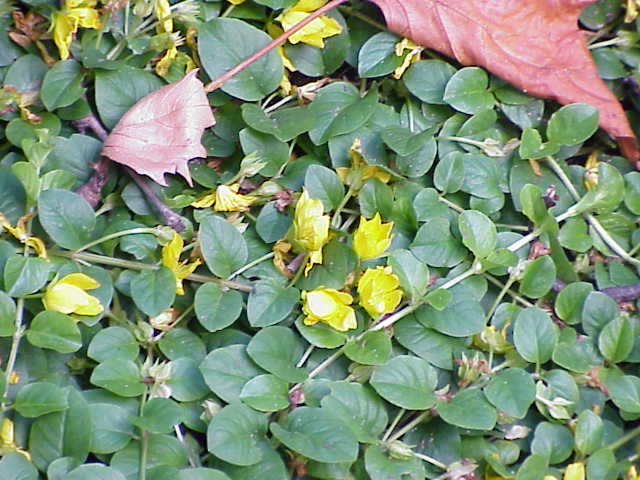 Creeping-JennyLysimachia nummularia
-
 Scarlet PimpernelLysimachia arvensis
-
 Gooseneck LoosestrifeLysimachia clethroides
-
 Yellow LoosestrifeLysimachia vulgaris
-
 Large Yellow LoosestrifeLysimachia punctata
-
 Arctic StarflowerLysimachia europaea
-
 Pacific StarflowerLysimachia latifolia
-
 Black SaltwortLysimachia maritima
Compare
Questions and answers
What is the scientific name of the Fringed Loosestrife?
The scientific name of the Fringed Loosestrife is Lysimachia ciliata. Written with its author, the full name is Lysimachia ciliata L..
Which family does the Fringed Loosestrife belong to?
Lysimachia ciliata belongs to the family Primulaceae, in the order Ericales and the class Magnoliopsida.
Where is the Fringed Loosestrife found?
Checklists and occurrence records place Lysimachia ciliata in 7 countries, including United States, Canada and The Netherlands.
What is the conservation status of the Fringed Loosestrife?
The IUCN Red List category recorded for Lysimachia ciliata is Least Concern (LC).
What other names does the Fringed Loosestrife have?
Lysimachia ciliata is also known in English as Ciliate Loosestrife and Fringed Yellow Loosestrife.
Is Lysimachia invasive?
Fringed loosestrife can grow aggressively.[20]
Is yellow loosestrife good for anything?
Fringed loosestrife is cultivated as an ornamental plant.[21]
Is Lysimachia the same as creeping jenny?
Fringed loosestrife belongs to the genus Lysimachia.[23]
Sources
Passages the profile rests on
- The species has an upright herbaceous growth form. Source passage: “an erect herbaceous perennial” — English Wikipedia
- The stems are square and smooth, with occasional pubescence in their upper portions. Source passage: “square, smooth and sometimes pubescent above” — umass.edu
- The plant can reach 120 cm in height. Source passage: “growing to 120 cm (47 in) tall” — English Wikipedia
- The plant has opposite, simple leaves. Source passage: “with opposite, simple leaves” — English Wikipedia
- The plant has opposite leaves ranging from oval on the lower portions to lanceolate on the upper portions. Source passage: “opposite, oval below to lanceolate above” — umass.edu
- The leaf margins are entire or have very small teeth. Source passage: “entire with very small teeth” — umass.edu
- The leaves have rounded bases and pointed tips. Source passage: “rounded base and pointed tip” — umass.edu
- The leaf petioles are winged and densely fringed with hairs. Source passage: “petioles winged with dense fringe of hairs” — umass.edu
- The flowers have five yellow petals, often with orange to red centers. Source passage: “5-petaled, yellow often with orange to red center” — umass.edu
- The petals have irregularly toothed margins and conspicuous pointed tips. Source passage: “petal irregularly toothed with conspicuous pointed tip” — umass.edu
- Its flowers are yellow and star-shaped. Source passage: “The star-shaped yellow flowers” — English Wikipedia
- Its flowers are borne in midsummer. Source passage: “are borne in midsummer” — English Wikipedia
- The flowers occur singly on long stalks in the leaf axils above. Source passage: “axillary above, facing outward or drooping/nodding, solitary on long stalks” — umass.edu
- The species is native to North America. Source passage: “It is native to North America” — English Wikipedia
- The species occurs across most of southern Canada. Source passage: “including most of southern Canada” — English Wikipedia
- The species occurs across most of the United States, excluding the southwest. Source passage: “most of the United States except for the southwest” — English Wikipedia
- The species reproduces through seeds and rhizomes. Source passage: “reproducing by seed and rhizome” — umass.edu
- The species is pollinated in the northern part of its range by the oil bee Macropis nuda. Source passage: “It is pollinated in the northern part of its range by the specialist oil bee Macropis nuda” — English Wikipedia
- The species produces oil rather than nectar as a reward for pollinators. Source passage: “to offer oil instead of nectar as a reward to pollinators” — English Wikipedia
- The species can grow aggressively. Source passage: “It can be aggressive” — English Wikipedia
- The species is cultivated as an ornamental plant. Source passage: “It is also cultivated as an ornamental plant.” — English Wikipedia
- The cultivar 'Firecracker' has received the Royal Horticultural Society's Award of Garden Merit. Source passage: “'Firecracker' has gained the Royal Horticultural Society's Award of Garden Merit.” — English Wikipedia
- The species belongs to the genus Lysimachia. Source passage: “Species. Lysimachia ciliata L.” — plants.sc.egov.usda.gov
Data
- Catalogue of Life, 2026-10-16 XR cc by
- Global Biodiversity Information Facility CC BY 4.0
- Wikidata CC0
- GeoNames CC BY 4.0
- Wikimedia Commons per image; credit shown with each image
- Within the Catalogue of Life, this name comes from Synonymic Checklists of the Vascular Plants of the World cc by
References
- L. (1753). Sp. Pl. [Linnaeus] 1: 147 (1753). where the name was published
This species in other databases
Page built on 26 November 2026. See how the catalog is made and all sources and licences.
Cite this page
ScientificNames.org. (2026). Lysimachia ciliata (Fringed Loosestrife). Retrieved November 26, 2026, from https://scientificnames.org/species/lysimachia-ciliata
“Lysimachia ciliata (Fringed Loosestrife).” ScientificNames.org, 2026, scientificnames.org/species/lysimachia-ciliata. Accessed 26 Nov. 2026.
ScientificNames.org. “Lysimachia ciliata (Fringed Loosestrife).” Accessed November 26, 2026. https://scientificnames.org/species/lysimachia-ciliata.
@misc{scientificnames_lysimachia_ciliata_fringed_loosestrife,
  author = {{ScientificNames.org}},
  title = {Lysimachia ciliata (Fringed Loosestrife)},
  year = {2026},
  url = {https://scientificnames.org/species/lysimachia-ciliata},
  note = {Accessed 2026-11-26}
}