Species · Flowering plants
Creeping-Jenny Lysimachia nummularia
The scientific name of the Creeping-Jenny is Lysimachia nummularia. It is a species of flowering plant in the family Primulaceae (primrose family), order Ericales.
- Scientific name
- Lysimachia nummularia L.
- Common name
- Creeping-Jenny
- Genus
- Lysimachia
- Family
- Primulaceae (Primrose Family)
- Order
- Ericales
- Class
- Magnoliopsida
- Red List category
- LC Least Concern
- Recorded in
- 49 countries
- Name status
- accepted in the Catalogue of Life
Overview
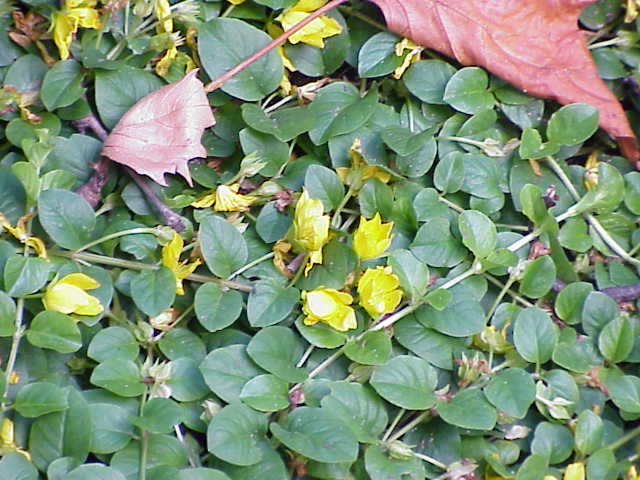
The species is native to Europe and western Asia and occurs in damp and wet habitats. It has a prostrate, evergreen growth habit and produces low-growing, creeping leafy mats with yellow, cup-shaped flowers.
Written 26 November 2026 from the sources listed below. Each statement was checked against the passage it cites; statements that could not be supported were removed.
Appearance
Creeping-Jenny has a prostrate, evergreen growth habit. Its rounded leaves are arranged in opposite pairs, and its flowers are yellow and cup-shaped.[1][2][3]
The plant grows to approximately 5 cm in height. Its flowers reach approximately 2 cm in diameter, and its leaves can reach 3/4 inch in diameter.[4][5][6]
Its low-growing, creeping growth produces a leafy mat. Its flowers can reach 3/4 inch across.[7][8]
Habitat
Creeping-Jenny is particularly associated with damp and wet environments and thrives in damp soils. It occurs primarily in floodplain forests and woodlands.[9][10][11]
The species inhabits riverbanks, the shorelines of lakes and ponds, wet meadows, and mesic grasslands. It also occurs in seeps, fens, bogs, marshes, and swamps.[12][13][14]
The species can grow in cultivated and fallow fields, successional fields, lawns, railway rights-of-way, roadsides, and ditches. It grows most vigorously in moist habitats, including wet meadows, swamps, floodplain forests, stream banks, ditches, and small water-body margins.[15][16]
Behaviour
Creeping-Jenny spreads rapidly and indefinitely through stem-rooting and can spread aggressively in favorable growing conditions. It tolerates limited foot traffic.[17][18][19]
The species can form large colonies through rhizome growth and self-seeding. Its dense mats can exclude native plant species.[20][21]
Reproduction and life cycle
Creeping-Jenny reproduces through rhizomes and self-seeding. Its stems can develop roots at leaf nodes that contact the soil or ground.[22][23][24]
No natural hybrids involving the species were known as of 2011.[25]
Conservation
Creeping-Jenny is considered invasive in some parts of North America. Dense mats can exclude native plant species.[26][21]
The species can be hand-pulled if all stems and stem fragments are removed. Prolonged submergence can kill it, and establishing native grasses to shade the plant can control it at restoration sites.[27][28][29]
Mowing is ineffective for controlling Creeping-Jenny because its numerous rooting nodes keep it close to the ground.[30]
Uses
Creeping-Jenny is cultivated as an ornamental ground-cover plant and is commonly used as ground cover in gardens and lawns.[31][32]
The species is suitable for bog gardens and aquatic marginal planting.[33]
Classification of the Creeping-Jenny
| Kingdom | Plantae |
|---|---|
| Subkingdom | Pteridobiotina |
| Phylum | Tracheophyta |
| Class | Magnoliopsida |
| Order | Ericales |
| Family | Primulaceae (Primrose Family) |
| Subfamily | Myrsinoideae |
| Tribe | Lysimachieae |
| Genus | Lysimachia (Loosestrife) |
| Species | Lysimachia nummularia L. |
Where the Creeping-Jenny is found
Checklists and occurrence records place Lysimachia nummularia in 49 countries across Asia, Europe, North America and Oceania. GBIF holds 387,081 georeferenced records of it.
Countries where it is native or its origin is not stated
- Aland Islands 18
- Albania 14
- Austria 7,733
- Belarus 350
- Belgium 22,714
- Bosnia and Herzegovina 42
- Bulgaria 37
- China 4
- Croatia 72
- Czechia 8,157
- Denmark 6,889
- Estonia 789
- Germany 48,577
- Greece 31
- Guernsey
- Hungary 339
- Ireland 184
- Isle of Man 115
- Italy 717
- Japan 63
- Kazakhstan 3
- Kosovo
- Latvia 168
- Liechtenstein 11
- Lithuania 274
- Luxembourg 2,780
- Moldova 33
- Montenegro 52
- North Macedonia
- Norway 4,265
- Poland 11,473
- Romania 161
- Russia 13,986
- Serbia 32
- Slovakia 8,240
- Slovenia 206
- Spain 98
- Sweden 11,448
- Switzerland 11,559
- The Netherlands 51,287
- Turkey 39
- Ukraine 3,578
Countries where it has been introduced
- Australia 109
- Canada 4,515
- Finland 3,372
- France 86,792
- New Zealand 47
- United Kingdom 52,599
- United States 23,109
Regions and cities with the most records
- England, United Kingdom 45,687
- Bavaria, Germany 29,031
- Bourgogne-Franche-Comté, France 19,118
- Centre-Val de Loire, France 13,366
- Grand Est, France 12,739
- Gelderland, The Netherlands 11,038
- Île-de-France, France 10,711
- Hauts-de-France, France 9,476
- Auvergne-Rhône-Alpes, France 7,813
- Sliedrecht, The Netherlands 7,057
- Alblasserdam, The Netherlands 6,908
- Gouda, The Netherlands 6,789
- Waddinxveen, The Netherlands 6,649
- Papendrecht, The Netherlands 6,632
- Hendrik-Ido-Ambacht, The Netherlands 6,417
- Krimpen aan den IJssel, The Netherlands 6,407
- Gorinchem, The Netherlands 6,240
- Ridderkerk, The Netherlands 6,219
- Dordrecht, The Netherlands 6,184
- Boskoop, The Netherlands 6,071
- North Rhine-Westphalia, Germany 6,014
- Zwijndrecht, The Netherlands 5,793
- Capelle aan den IJssel, The Netherlands 5,754
- Benthuizen, The Netherlands 5,644
- Woerden, The Netherlands 5,432
- Bodegraven, The Netherlands 5,429
- Bergschenhoek, The Netherlands 5,172
- Overijssel, The Netherlands 5,120
- Leerdam, The Netherlands 5,093
- IJsselstein, The Netherlands 5,009
- Zoetermeer, The Netherlands 4,875
- Berkel en Rodenrijs, The Netherlands 4,864
- Alphen aan den Rijn, The Netherlands 4,824
- Barendrecht, The Netherlands 4,810
- Upper Austria, Austria 4,776
- Vianen, The Netherlands 4,589
Range as the checklists state it
England (England, Wales, Isle of Man [I], Scotland [I], Orkney Isl. [I], Shetland Isl. [I], Isles of Scilly [I]); Ireland (Ireland, Northern Ireland); Denmark; Norway; Sweden; Finland [I]; Netherlands; Belgium; Luxembourg; Germany (Brandenburg, Berlin, Baden-Württemberg, Bayern, Hessen, Hamburg, Mecklenburg-Vorpommern, Niedersachsen, Nordrhein-Westfalen, Rheinland-Pfalz, Schleswig-Holstein, Saarland, Sachsen, Sachsen-Anhalt, Thüringen); Switzerland; Liechtenstein; Austria; Poland; Czech Republic; Slovakia; Hungary; France; Channel Isl. (Guernsey); Corsica [I]; Italy; Slovenia; Croatia; Bosnia & Hercegovina; Montenegro; Serbia; Kosovo; North Macedonia; Albania; Romania; Bulgaria; European Turkey; Greece (scattered N-Greece, rare C-Greece, Thasos, Samothraki); Estonia; Latvia; Lithuania; Belarus; European Russia; Moldova; Ukraine; Crimea; Siberia (Altay, W-Siberia); Russian Far East [I] (Primorye [I]); Northern Caucasus; Turkey (NW-Anatolia: Bithynia); Australia [I] (Tasmania [I]); New Zealand [I]; Canada [I] (British Columbia [I], New Brunswick [I], Newfoundland [I], Nova Scotia [I], Ontario [I], Prince Edward Isl. [I], Québec [I]); USA [I] (Alabama [I], Arkansas [I], California [I], Colorado [I], Connecticut [I], District of Columbia [I], Delaware [I], Georgia [I], Iowa [I], Illinois [I], Indiana [I], Kansas [I], Kentucky [I], Louisiana [I], Massachusetts [I], Maryland [I], Maine [I], Michigan [I], Minnesota [I], Missouri [I], Mississippi [I], North Carolina [I], Nebraska [I], New Hampshire [I], New Jersey [I], Nevada [I], New York [I], Ohio [I], Oregon [I], Pennsylvania [I], Rhode Island [I], South Carolina [I], Tennessee [I], Virginia [I], Vermont [I], Washington State [I], Wisconsin [I], West Virginia [I])
A number beside a place is its count of GBIF occurrence records. A place without a number comes from a checklist alone. Records show where a species has been observed or collected, which can include escapes and vagrants.
Common names
English
- Creeping-Jenny
- Herb-tuppence
- Creeping Jenny
- Creeping Loosestrife
- Creeping Yellow Loosestrife
- Moneywort
Names in 32 other languages
- Belarusian
- Лазаніца манетчатая
- Bulgarian
- Кръглолистно ленивче
- Chinese
- 黄金錢草
- Czech
- vrbina penízková
- Danish
- Pengebladet fredløs
- Dutch
- Penningkruid
- Estonian
- roomav metsvits
- Finnish
- suikeroalpi
- French
- Herbe aux écus, herbe-aux-écus, lysimaque nummulaire, monnayère
- German
- Münzkraut, Pfennig-Gilbweiderich, Pfennigkraut
- Greek
- Λυσιμαχία η ερματική
- Hungarian
- pénzlevelű lizinka
- Italian
- Mazza d’oro minore
- Japanese
- コバンコナスビ
- Latvian
- Pļavas zeltene
- Lithuanian
- Šliaužiančioji šilingė
- Norwegian Bokmål
- krypfredløs
- Norwegian Nynorsk
- krypfredlaus
- Persian
- لیسیمچیا نامولاریا
- Polish
- Tojeść rozesłana
- Portuguese
- Erva-dos-escudos
- Russian
- Вербейник монетный, Луговой чай
- Slovak
- čerkáč peniažtekový
- Slovenian
- okroglolistna pijavčnica
- Spanish
- Hierba de la Moneda, Monetaria
- Swedish
- penningarv, penningblad
- Turkish
- Karga otu, Yer Kargaotu
- Ukrainian
- Вербозілля лучне
- Welsh
- Canclwyf, Ceinioglys, Ceinioglys Cernyw, Dwygeinioglys, Llys y Ffynnon, Siani Lusg, Trewynyn Ymlusgaidd
- dsb
- Wužowe zele
- hsb
- Łažawa žołtnica
- ido
- Numulario
Synonyms
15 other scientific names have been used for this species and are now treated as synonyms of Lysimachia nummularia.
- Ephemerum nummularia (L.) Schur
- Lysimachia nummularia f. longipes (David) V.Nikolić
- Lysimachia nummularia f. suaveolens (Schönh.) Lüdi
- Lysimachia nummularia f. submersa Glück
- Lysimachia nummularia subf. longipes David
- Lysimachia nummularia var. festiva Bélézé
- Lysimachia suaveolens Schönh. ex Garcke
- Lysimachusa nummularia (L.) Pohl
- Nummularia centimorbia Fourr.
- Nummularia prostrata Opiz
- Nummularia repens Gilib.
- Lysimachia nemorum Geners. ex Roem. & Schult. ambiguous synonym
- Lysimachia repens (Gilib.) Stokes ambiguous synonym
- Lysimachia repens (Gilib.) Gray ambiguous synonym
- Lysimachia rotundifolia F.W.Schmidt ambiguous synonym
Related species
-
 Scarlet PimpernelLysimachia arvensis
-
 Gooseneck LoosestrifeLysimachia clethroides
-
 WillowwortLysimachia vulgaris
-
 Large LoosestrifeLysimachia punctata
-
 Arctic StarflowerLysimachia europaea
-
 Pacific StarflowerLysimachia latifolia
-
 Ciliate LoosestrifeLysimachia ciliata
-
 SaltwortLysimachia maritima
Compare
Questions and answers
What is the scientific name of the Creeping-Jenny?
The scientific name of the Creeping-Jenny is Lysimachia nummularia. Written with its author, the full name is Lysimachia nummularia L..
Which family does the Creeping-Jenny belong to?
Lysimachia nummularia belongs to the family Primulaceae, in the order Ericales and the class Magnoliopsida.
Where is the Creeping-Jenny found?
Checklists and occurrence records place Lysimachia nummularia in 49 countries, including The Netherlands, Germany, Belgium, Russia, Switzerland and Poland.
What is the conservation status of the Creeping-Jenny?
The IUCN Red List category recorded for Lysimachia nummularia is Least Concern (LC).
What other names does the Creeping-Jenny have?
Lysimachia nummularia is also known in English as Herb-tuppence, Creeping Jenny, Creeping Loosestrife, Creeping Yellow Loosestrife and Moneywort.
Is moneywort invasive?
Moneywort is considered invasive in some parts of North America. It can form dense mats that exclude native plant species.[26][21]
Sources
Passages the profile rests on
- The plant has a prostrate, evergreen growth habit. Source passage: “It is a vigorous, prostrate, evergreen perennial” — English Wikipedia
- Its leaves are rounded and arranged in opposite pairs. Source passage: “It has rounded leaves arranged in opposite pairs” — English Wikipedia
- Its flowers are yellow and cup-shaped. Source passage: “cup-shaped yellow flowers 2 cm in diameter” — English Wikipedia
- The plant grows to approximately 5 cm in height. Source passage: “growing to 5 cm (2 in) in height” — English Wikipedia
- Its flowers reach approximately 2 cm in diameter. Source passage: “cup-shaped yellow flowers 2 cm in diameter” — English Wikipedia
- Its leaves can reach 3/4 inch in diameter. Source passage: “rounded, slightly ruffled, leaves (to 3/4″ diameter).” — hortsense.cahnrs.wsu.edu
- The species produces a leafy mat through its low-growing, creeping growth. Source passage: “is a low-growing, creeping ground cover which forms a leafy mat only 2-4″ tall.” — hortsense.cahnrs.wsu.edu
- Its flowers can reach 3/4 inch across. Source passage: “Profuse, cup-shaped, bright yellow flowers (to 3/4″ across)” — hortsense.cahnrs.wsu.edu
- The species is particularly associated with damp and wet environments. Source passage: “It is particularly associated with damp or even wet areas” — English Wikipedia
- The species occurs primarily in floodplain forests and woodlands. Source passage: “It occurs primarily in floodplain forests and woodlands;” — fs.usda.gov
- The plant thrives in damp soils. Source passage: “Thrives in damp soils which will often kill off other types of ground covers.” — hortsense.cahnrs.wsu.edu
- The species inhabits riverbanks and the shorelines of lakes and ponds. Source passage: “along riverbanks and shorelines of lakes and ponds;” — fs.usda.gov
- The species occurs in wet meadows and mesic grasslands. Source passage: “in wet meadows and mesic grasslands;” — fs.usda.gov
- The species also occurs in seeps, fens, bogs, marshes, and swamps. Source passage: “in seeps, fens, bogs, marshes, and swamps.” — fs.usda.gov
- The species can grow in cultivated and fallow fields, successional fields, lawns, railway rights-of-way, roadsides, and ditches. Source passage: “cultivated, fallow, and successional fields, lawns, railroad rights-of-way, roadsides, and ditches” — fs.usda.gov
- The species grows most vigorously in moist habitats including wet meadows, swamps, floodplain forests, stream banks, ditches, and small water-body margins. Source passage: “it grows most vigorously and poses the biggest threat in moist areas such as wet meadows, swamps, floodplain forests, stream banks, bottoms, ditches, roadsides and along the banks of small water bodies.” — hortsense.cahnrs.wsu.edu
- The species spreads rapidly and indefinitely through stem-rooting. Source passage: “spreading rapidly and indefinitely by stem-rooting.” — English Wikipedia
- The species aggressively spreads in favorable growing conditions. Source passage: “It aggressively spreads in favorable conditions, such as low wet ground or near ponds.” — English Wikipedia
- The species tolerates limited foot traffic. Source passage: “Tolerates limited foot traffic.” — hortsense.cahnrs.wsu.edu
- The species can form large colonies through rhizome growth and self-seeding. Source passage: “Plants spread by rhizomes and self-seeding in optimum growing conditions to form large colonies.” — hortsense.cahnrs.wsu.edu
- The species can form dense mats that exclude native plant species. Source passage: “It can form a mat-like growth capable of excluding more desirable native plant species.” — hortsense.cahnrs.wsu.edu
- The species reproduces through rhizomes and self-seeding. Source passage: “Plants spread by rhizomes and self-seeding in optimum growing conditions to form large colonies.” — hortsense.cahnrs.wsu.edu
- Its stems can develop roots where leaf nodes contact the soil. Source passage: “Roots where leaf nodes come in contact with the soil.” — hortsense.cahnrs.wsu.edu
- The species' stems may root at leaf nodes that touch the ground. Source passage: “Stems may root where leaf nodes touch the ground.” — hortsense.cahnrs.wsu.edu
- No natural hybrids involving the species were known as of 2011. Source passage: “no natural hybrids were known as of this writing (2011).” — fs.usda.gov
- The species is considered invasive in some parts of North America. Source passage: “where it is considered an invasive species in some areas.” — English Wikipedia
- The species can be hand-pulled if all stems and stem fragments are removed. Source passage: “It can be weeded by hand, if all stems and stem fragments are removed” — English Wikipedia
- Prolonged submergence can kill the species. Source passage: “Prolonged submergence will kill Creeping Jenny.” — hortsense.cahnrs.wsu.edu
- Establishing native grasses to shade the plant can control it at restoration sites. Source passage: “At restoration sites, it can be controlled by establishing native grasses to shade it out.” — hortsense.cahnrs.wsu.edu
- Mowing is ineffective for controlling the species because its numerous rooting nodes keep it close to the ground. Source passage: “Mowing is not effective since Creeping Jenny adheres closely to the ground due to its many rooting nodes.” — hortsense.cahnrs.wsu.edu
- The species is cultivated as an ornamental ground-cover plant. Source passage: “It is cultivated as an ornamental plant, for groundcover where the range of its growth can be limited.” — English Wikipedia
- The species is commonly used as ground cover in gardens and lawns. Source passage: “Creeping jenny is a popular ground cover in gardens and lawns” — fs.usda.gov
- The species is suitable for bog gardens and aquatic marginal planting. Source passage: “It is also suitable as a bog garden or aquatic marginal plant.” — English Wikipedia
Data
- Catalogue of Life, 2026-10-16 XR cc by
- Global Biodiversity Information Facility CC BY 4.0
- Wikidata CC0
- GeoNames CC BY 4.0
- Wikimedia Commons per image; credit shown with each image
- Within the Catalogue of Life, this name comes from Synonymic Checklists of the Vascular Plants of the World cc by
References
- L. (1753). Sp. Pl. [Linnaeus] 1: 148 (1753). where the name was published
This species in other databases
- Catalogue of Life 73338
- Wikidata Q147305
- iNaturalist 51809
- World Flora Online wfo-0000442792
- GRIN 316741
Page built on 26 November 2026. See how the catalog is made and all sources and licences.
Cite this page
ScientificNames.org. (2026). Lysimachia nummularia (Creeping-Jenny). Retrieved November 26, 2026, from https://scientificnames.org/species/lysimachia-nummularia
“Lysimachia nummularia (Creeping-Jenny).” ScientificNames.org, 2026, scientificnames.org/species/lysimachia-nummularia. Accessed 26 Nov. 2026.
ScientificNames.org. “Lysimachia nummularia (Creeping-Jenny).” Accessed November 26, 2026. https://scientificnames.org/species/lysimachia-nummularia.
@misc{scientificnames_lysimachia_nummularia_creeping_jenny,
  author = {{ScientificNames.org}},
  title = {Lysimachia nummularia (Creeping-Jenny)},
  year = {2026},
  url = {https://scientificnames.org/species/lysimachia-nummularia},
  note = {Accessed 2026-11-26}
}