Species · Mammals
Sulawesi Palm Civet Macrogalidia musschenbroekii
The scientific name of the Sulawesi Palm Civet is Macrogalidia musschenbroekii. It is a species of mammal in the family Viverridae (oyans), order Carnivora. The name dates from 1877.
- Scientific name
- Macrogalidia musschenbroekii (Schlegel, 1877)
- Common name
- Sulawesi Palm Civet
- Genus
- Macrogalidia
- Family
- Viverridae (Oyans)
- Order
- Carnivora
- Class
- Mammalia
- Red List category
- VU Vulnerable
- Recorded in
- 1 country
- Name status
- accepted in the Catalogue of Life

Overview
Macrogalidia musschenbroekii is endemic to Sulawesi and occurs in lowland and montane forests, grasslands and areas near farms. It is partially arboreal, apparently nocturnal and omnivorous, and is described as a good seed disperser because of its preference for palm fruits.
Written 26 November 2026 from the sources listed below. Each statement was checked against the passage it cites; statements that could not be supported were removed.
Appearance
The Sulawesi Palm Civet has a soft, short coat that is light brownish-chestnut with numerous intermixed light hairs. Its underparts range in colour from fulvous to white, while its breast is rufescent.[1][2]
Its back has two indistinct longitudinal stripes and faint spots on the rear portion. Its whiskers contain a mixture of brown and white hairs.[3][4]
Its tail has alternating dark and pale brown rings that become indistinct underneath and disappear towards its dark tip. Its head-and-body length is approximately 89 cm, and its tail measures approximately 64 cm.[5][6][7]
Its skull has a bony palate that extends considerably backwards. Its cheek-tooth rows run nearly parallel rather than diverging widely towards the rear.[8][9]
Habitat
The Sulawesi Palm Civet has been recorded in lowland forest and occurs in lower and upper montane forests at elevations reaching 2,600 m. It has also been recorded in grasslands and near farms.[10][11][12]
It appears to occur more frequently in forests than in agricultural areas. There is no documented evidence that populations can persist independently of tall forest.[13][14]
The species was recorded in Bogani Nani Wartabone National Park and Tangkoko Batuangus Nature Reserve between September 2016 and April 2017. Records from these protected areas occurred at elevations between 253 and 1,515 m.[15][16]
Diet
The Sulawesi Palm Civet is omnivorous and feeds on small mammals, fruit and grass. It occasionally eats birds and consumes farm animals.[17][18][19]
The species is described as a good seed disperser because of its preference for palm fruits.[20]
Behaviour
The Sulawesi Palm Civet is partially arboreal and apparently nocturnal. Its estimated home range covers approximately 150 hectares.[21][22][23]
Conservation
The Sulawesi Palm Civet is listed as Vulnerable on the IUCN Red List.[24]
Its population is estimated to have declined by more than 30% over the last three generations, estimated at 15 years. This estimated decline is inferred from habitat destruction and degradation.[25][26]
Classification of the Sulawesi Palm Civet
| Kingdom | Animalia |
|---|---|
| Phylum | Chordata |
| Subphylum | Vertebrata |
| Infraphylum | Gnathostomata |
| Parvphylum | Osteichthyes |
| Megaclass | Tetrapoda |
| Class | Mammalia (Mammal) |
| Subclass | Theria |
| Infraclass | Eutheria |
| Order | Carnivora (Carnivores) |
| Suborder | Feliformia (Cat-like Carnivores) |
| Family | Viverridae (Oyans) |
| Subfamily | Paradoxurinae (Binturong) |
| Genus | Macrogalidia (Sulawesi Civets) |
| Species | Macrogalidia musschenbroekii (Schlegel, 1877) |
Where the Sulawesi Palm Civet is found
Checklists and occurrence records place Macrogalidia musschenbroekii in 1 country across Asia. GBIF holds 23 georeferenced records of it.
Countries
Regions and cities with the most records
Range as the checklists state it
Southern Asia
A number beside a place is its count of GBIF occurrence records. A place without a number comes from a checklist alone. Records show where a species has been observed or collected, which can include escapes and vagrants.
Common names
English
- Sulawesi Palm Civet
- Brown Palm Civet
- Celebes Palm Civet
- Sulawesi Civet
Names in 13 other languages
- Arabic
- زباد النخيل السولاويزي
- Czech
- oviječ velký
- Dutch
- Celebespalmroller
- Finnish
- Celebesinpalmunäätä, sulawesinpalmusivetti
- French
- Civette des Célèbes
- German
- Celebesroller, Sulawesi-Roller
- Italian
- Civetta delle palme di Sulawesi, Zibetto delle palme di Sulawesi
- Japanese
- セレベスパームシベット
- Norwegian Bokmål
- Brunpalmesivett, Celebespalmesivett, Kjempepalmesivett, Sulawesipalmesivett
- Polish
- Łaskun brązowy, Łaskuniak brązowy
- Portuguese
- Civeta-de-Sulawesi
- Russian
- Сулавесская цивета
- Spanish
- Civeta de Sulawesi, Civeta de las Célebes
Synonyms
One other scientific name has been used for this species and is now treated as a synonym of Macrogalidia musschenbroekii.
- Paradoxurus musschenbroekii Schlegel, 1877
Related species
-
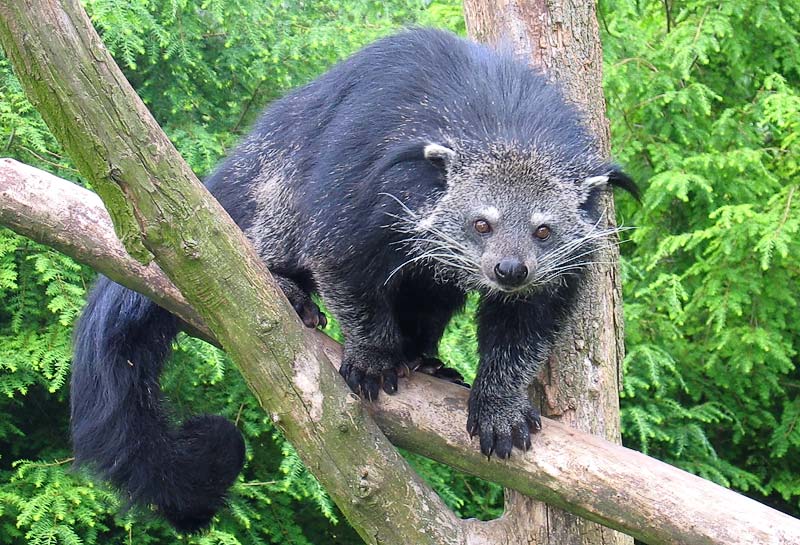 BinturongArctictis binturong
-
 Asian Palm CivetParadoxurus hermaphroditus
-
 African CivetCivettictis civetta
-
 Common GenetGenetta genetta
-
 Masked Palm CivetPaguma larvata
-
 Large Indian CivetViverra zibetha
-
 Malabar Large-spotted CivetViverra civettina
-
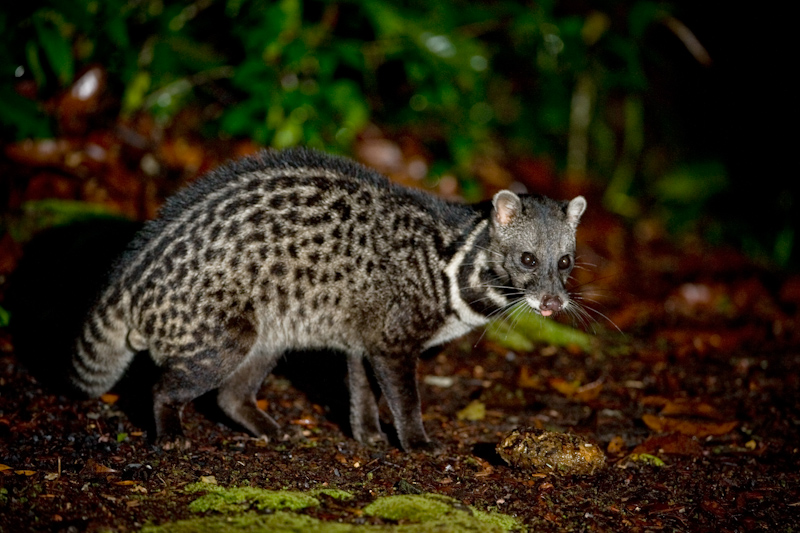 Malayan CivetViverra tangalunga
Compare
Questions and answers
What is the scientific name of the Sulawesi Palm Civet?
The scientific name of the Sulawesi Palm Civet is Macrogalidia musschenbroekii. Written with its author, the full name is Macrogalidia musschenbroekii (Schlegel, 1877).
Which family does the Sulawesi Palm Civet belong to?
Macrogalidia musschenbroekii belongs to the family Viverridae, in the order Carnivora and the class Mammalia.
Where is the Sulawesi Palm Civet found?
Checklists and occurrence records place Macrogalidia musschenbroekii in 1 country: Indonesia.
What is the conservation status of the Sulawesi Palm Civet?
The IUCN Red List category recorded for Macrogalidia musschenbroekii is Vulnerable (VU).
What other names does the Sulawesi Palm Civet have?
Macrogalidia musschenbroekii is also known in English as Brown Palm Civet, Celebes Palm Civet and Sulawesi Civet.
What do palm civets eat?
The Sulawesi Palm Civet is omnivorous and feeds on small mammals, fruit and grass. It occasionally eats birds and farm animals.[17][18][19]
What food does civet eat?
The Sulawesi Palm Civet feeds on small mammals, fruit and grass, and occasionally eats birds and farm animals.[17][18][19]
Sources
Passages the profile rests on
- The species has a soft, short coat that is light brownish-chestnut with numerous intermixed light hairs. Source passage: “The Sulawesi civet has a light brownish-chestnut coloured soft and short coat with numerous light hairs intermixed.” — English Wikipedia
- Its underparts range in colour from fulvous to white, while its breast is rufescent. Source passage: “The underparts vary from fulvous to white; the breast is rufescent.” — English Wikipedia
- Its back has two indistinct longitudinal stripes and faint spots on the rear portion. Source passage: “There is a pair of indistinct longitudinal stripes and some faint spots on the hinder part of the back.” — English Wikipedia
- Its whiskers contain a mixture of brown and white hairs. Source passage: “The whiskers are mixed brown and white.” — English Wikipedia
- Its tail has alternating dark and pale brown rings that become indistinct underneath and disappear towards its dark tip. Source passage: “The tail is marked with alternating rings of dark and pale brown, which are indistinct on the under surface, and disappear towards the dark tip.” — English Wikipedia
- Its head-and-body length is approximately 89 cm. Source passage: “The length of head and body is about 35 in (89 cm)” — English Wikipedia
- Its tail measures approximately 64 cm in length. Source passage: “with a 25 in (64 cm) long tail.” — English Wikipedia
- Its skull has a bony palate that extends considerably backwards. Source passage: “The skull with the bony palate is much produced backwards” — English Wikipedia
- Its cheek-tooth rows run nearly parallel rather than diverging widely towards the rear. Source passage: “the two cheek-series run nearly parallel, in place of being widely divergent posteriorly.” — English Wikipedia
- The species has been recorded in lowland forest. Source passage: “Sulawesi palm civets were recorded in lowland forest, lower and upper montane forest at elevations up to 2,600 m (8,500 ft), grasslands and near farms.” — English Wikipedia
- The species occurs in lower and upper montane forests at elevations reaching 2,600 m. Source passage: “lower and upper montane forest at elevations up to 2,600 m (8,500 ft)” — English Wikipedia
- The species has also been recorded in grasslands and near farms. Source passage: “grasslands and near farms.” — English Wikipedia
- The species appears to occur more frequently in forests than in agricultural areas. Source passage: “They appear to be more common in forests than in agricultural areas.” — English Wikipedia
- There is no documented evidence that populations can persist independently of tall forest. Source passage: “there is no evidence that populations can survive independent of tall forest.” — English Wikipedia
- The species was recorded in Bogani Nani Wartabone National Park and Tangkoko Batuangus Nature Reserve between September 2016 and April 2017. Source passage: “Between September 2016 and April 2017, Sulawesi palm civets were recorded in Bogani Nani Wartabone National Park and in Tangkoko Batuangus Nature Reserve” — English Wikipedia
- Records from the two protected areas occurred at elevations between 253 and 1,515 m. Source passage: “at elevations of 253–1,515 m (830–4,970 ft).” — English Wikipedia
- The species is omnivorous and feeds on small mammals, fruit and grass. Source passage: “omnivorous, feeding on small mammals, fruit and grass.” — English Wikipedia
- The species occasionally eats birds. Source passage: “They occasionally take birds and farm animals.” — English Wikipedia
- The species occasionally consumes farm animals. Source passage: “They occasionally take birds and farm animals.” — English Wikipedia
- The species is described as a good seed disperser because of its preference for palm fruits. Source passage: “These civets are good dispersers of seeds given their preference for palm fruits” — animaldiversity.org
- The species is partially arboreal. Source passage: “Sulawesi palm civets are partially arboreal” — English Wikipedia
- The species is apparently nocturnal. Source passage: “apparently nocturnal” — English Wikipedia
- Its estimated home range covers approximately 150 hectares. Source passage: “Their home range is estimated at 150 ha (0.58 sq mi).” — English Wikipedia
- The species is listed as Vulnerable on the IUCN Red List. Source passage: “It is listed as Vulnerable on the IUCN Red List” — English Wikipedia
- Its population is estimated to have declined by more than 30% over the last three generations, estimated at 15 years. Source passage: “population decline estimated to have been more than 30% over the last three generations (suspected to be 15 years)” — English Wikipedia
- The estimated population decline is inferred from habitat destruction and degradation. Source passage: “inferred from habitat destruction and degradation.” — English Wikipedia
- The species is endemic to Sulawesi. Source passage: “is a little-known viverrid endemic to Sulawesi.” — English Wikipedia
Data
- Catalogue of Life, 2026-10-16 XR cc by
- Global Biodiversity Information Facility CC BY 4.0
- Wikidata CC0
- GeoNames CC BY 4.0
- Wikimedia Commons per image; credit shown with each image
- Within the Catalogue of Life, this name comes from The Integrated Taxonomic Information System cc0
References
- Prosp. Mus. Publ. vol.1877 p.[unnumbered] where the name was published
- Wilson, Don E., and DeeAnn M. Reeder, eds. (1993). Mammal Species of the World: A Taxonomic and Geographic Reference, 2nd Ed., 3rd Printing.
- Wilson, Don E., and F. Russell Cole. (2000). Common Names of Mammals of the World.
- Wilson, Don E., and DeeAnn M. Reeder, eds. (2005). Mammal Species of the World: A Taxonomic and Geographic Reference, 3rd Ed., Vols. 1 & 2.
- Jennings, A. P., and G. Veron / Don E. Wilson and Russell A. Mittermeier, eds. (2009). Family Viverridae (Civets, Genets and Oyans). Handbook of the Mammals of the World. Vol. 1: Carnivores.
This species in other databases
Page built on 28 November 2026. See how the catalog is made and all sources and licences.
Cite this page
ScientificNames.org. (2026). Macrogalidia musschenbroekii (Sulawesi Palm Civet). Retrieved November 28, 2026, from https://scientificnames.org/species/macrogalidia-musschenbroekii
“Macrogalidia musschenbroekii (Sulawesi Palm Civet).” ScientificNames.org, 2026, scientificnames.org/species/macrogalidia-musschenbroekii. Accessed 28 Nov. 2026.
ScientificNames.org. “Macrogalidia musschenbroekii (Sulawesi Palm Civet).” Accessed November 28, 2026. https://scientificnames.org/species/macrogalidia-musschenbroekii.
@misc{scientificnames_macrogalidia_musschenbroekii_sulawesi_palm_civet,
  author = {{ScientificNames.org}},
  title = {Macrogalidia musschenbroekii (Sulawesi Palm Civet)},
  year = {2026},
  url = {https://scientificnames.org/species/macrogalidia-musschenbroekii},
  note = {Accessed 2026-11-28}
}