Species · Mammals
Sunda Pangolin Manis javanica
The scientific name of the Sunda Pangolin is Manis javanica. It is a species of mammal in the family Manidae (pangolins), order Pholidota. The name dates from 1822.
- Scientific name
- Manis javanica Desmarest, 1822
- Common name
- Sunda Pangolin
- Genus
- Manis
- Family
- Manidae (Pangolins)
- Order
- Pholidota
- Class
- Mammalia
- Red List category
- CR Critically Endangered
- Recorded in
- 10 countries
- Name status
- accepted in the Catalogue of Life

Overview
Manis javanica is native to Myanmar, Thailand, Cambodia, Laos, Malaysia, Singapore and Vietnam, and occurs on Borneo, Java, Sumatra and the Lesser Sunda Islands. It has brown scales, a toothless mouth and a long, sticky tongue used to collect ants and termites.
Written 26 November 2026 from the sources listed below. Each statement was checked against the passage it cites; statements that could not be supported were removed.
Appearance
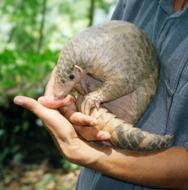
The Sunda Pangolin has brown scales, and some individuals have white scales along their tails. Its skin on the feet is granular, and its front feet have pads.[1][2]
It has thick, powerful claws used for digging into soil and tearing into termite mounds. It has poor eyesight and a highly developed sense of smell.[3][4]
The Sunda Pangolin has a pointed snout, a toothless mouth and a long, flexible tongue adapted to feeding on ants and termites.[5][6]
Its gastric fundus has numerous mucosal folds that expand its gastric surface area. Its pylorus has hard structures known as pyloric teeth, and its inner gastric surface has a thick layer of keratinized epithelial cells.[7][8][9]
The Sunda Pangolin does not have a caecum.[10]
Habitat
The Sunda Pangolin inhabits primary forests, secondary forests and scrub forests. It also inhabits rubber and palm oil plantations.[11][12]
Behaviour
The Sunda Pangolin is largely arboreal. It is normally solitary, nocturnal and timid, although individuals are sometimes found in pairs.[13][14]
When threatened, it protects its soft underparts by rolling into a ball. It digs burrows lined with vegetation near termite mounds and ant nests.[15][16]
Female Sunda Pangolins and their offspring can show brief increases in daytime activity shortly before the offspring become independent.[17]
Diet
The Sunda Pangolin feeds mainly on ants and termites. It uses its powerful front claws to dig into ant and termite nests.[18][19]
The Sunda Pangolin has less intestinal protease diversity than other animals. It lacks chymotrypsin and pancreatic elastase.[20][21]
Its intestinal microbial community resembles that of herbivores more than that of anteaters and other ant-eating animals.[22]
Reproduction and life cycle
Sunda Pangolins breed in autumn, and females give birth in winter burrows. Females give birth to one or two offspring annually.[23][24]
Mature female Sunda Pangolins have needle-like nipples used to feed their young. Females provide parental care for approximately three months.[25][26]
Similar species
The Sunda Pangolin is closely related to the Chinese pangolin. Compared with the Chinese pangolin, it is larger, lighter in colour and has shorter fore claws.[27][28]
Conservation
The Sunda Pangolin is classified as critically endangered. It is listed under CITES Appendix I, which prohibits commercial international trade in wild-caught specimens and their body parts.[29][30]
Uses
Sunda Pangolin scales are used in clothing manufacturing and traditional medicine. Kadazan people use the scales to make protective armour for warriors.[31][32]
Sunda Pangolin meat is consumed by indigenous peoples.[33]
Classification of the Sunda Pangolin
| Kingdom | Animalia |
|---|---|
| Phylum | Chordata |
| Subphylum | Vertebrata |
| Infraphylum | Gnathostomata |
| Parvphylum | Osteichthyes |
| Megaclass | Tetrapoda |
| Class | Mammalia (Mammal) |
| Subclass | Theria |
| Infraclass | Eutheria |
| Order | Pholidota (Pangolins) |
| Family | Manidae (Pangolins) |
| Subfamily | Maninae (Asian Pangolins) |
| Genus | Manis (Asian Pangolins) |
| Species | Manis javanica Desmarest, 1822 |
Where the Sunda Pangolin is found
Checklists and occurrence records place Manis javanica in 10 countries across Asia. GBIF holds 867 georeferenced records of it.
Countries
- Cambodia 15
- China 24
- Indonesia 409
- Laos 13
- Malaysia 173
- Myanmar 23
- Philippines 18
- Singapore 70
- Thailand 100
- Vietnam 22
Regions and cities with the most records
- Singapore, Singapore 53
- Novena, Singapore 52
- Bukit Timah, Singapore 51
- Queenstown Estate, Singapore 51
- Anak Bukit, Singapore 49
- MacPherson, Singapore 48
- Ang Mo Kio New Town, Singapore 47
- Eunos, Singapore 47
- Bukit Panjang New Town, Singapore 46
- Marine Parade, Singapore 46
- Jurong East, Singapore 45
- Jurong West, Singapore 45
- Choa Chu Kang New Town, Singapore 44
- Jurong Town, Singapore 44
- Keat Hong Village, Singapore 44
- Teck Whye, Singapore 44
- Yew Tee, Singapore 43
- Yio Chu Kang, Singapore 43
- Boon Lay, Singapore 42
- Sengkang New Town, Singapore 42
- Sabah, Malaysia 41
- Ulu Bedok, Singapore 41
- Matilda Estate, Singapore 39
- Bedok New Town, Singapore 37
- Punggol, Singapore 37
- Kampong Loyang, Singapore 34
- Kampong Pasir Ris, Singapore 33
- Yishun New Town, Singapore 33
- Marsiling, Singapore 32
- Sungai Simpang, Singapore 32
- Sembawang Estate, Singapore 30
- Woodlands, Singapore 30
- Johor Bahru, Malaysia 27
- Kampung Pasir Gudang Baru, Malaysia 26
- Pasir Gudang, Malaysia 26
- Iskandar Puteri, Malaysia 25
Range as the checklists state it
Southern Asia
A number beside a place is its count of GBIF occurrence records. A place without a number comes from a checklist alone. Records show where a species has been observed or collected, which can include escapes and vagrants.
Common names
English
- Sunda Pangolin
- Javan Pangolin
- Malayan Pangolin
Names in 24 other languages
- Arabic
- آكل النمل الحرشفي الجاوي, آكل النمل الحرشفي المالاوي, آكل النمل الحرشفي المالايي, آكل النمل الحرشفي سوندا, بنغولين سوندا
- Bengali
- মালয়ী বনরুই বা মালয়ী পিপীলিকাভুক
- Bulgarian
- Ява панголин
- Chinese
- 馬來穿山甲
- Czech
- luskoun ostrovní
- Dutch
- Javaans schubdier, Javaanse Schubdier, Palawanschubdier
- Finnish
- malesianmuurahaiskäpy
- French
- Pangolin Javanais, Pangolin Malais
- German
- Malaiisches Schuppentier
- Greek
- Παγκολίνος της Ιάβας
- Hungarian
- Jávai tobzoska
- Indonesian
- Trenggiling, Trenggiling Sunda
- Italian
- Pangolino del Borneo
- Japanese
- マレーセンザンコウ
- Khmer
- ពង្រួល
- Korean
- 말레이천산갑, 순다천산갑, 자바천산갑, 자와천산갑
- Malay
- Tenggiling
- Norwegian Bokmål
- Malayisk Pangolin, Malaypangolin, Malayskjelldyr, Sundaskjelldyr
- Polish
- pangolin jawajski, łuskowiec jawajski
- Portuguese
- Pangolim-Malaio
- Russian
- Яванский ящер
- Spanish
- Pangolín Malayo
- Swedish
- malajisk myrkott
- Thai
- ลิ่นชวา
Synonyms
7 other scientific names have been used for this species and are now treated as synonyms of Manis javanica.
- Manis aspera Sundevall, 1842
- Manis guy Focillon, 1850
- Manis leptura Blyth, 1842
- Manis leucura Blyth, 1847
- Manis sumatrensis Ludeking, 1862
- Pholidotus labuanus Fitzinger, 1872
- Pholidotus malaccensis Fitzinger, 1872
Related species
-
 Indian PangolinManis crassicaudata
-
 Chinese PangolinManis pentadactyla
-
 Philippine PangolinManis culionensis
- Cryptic PangolinManis mysteria
- Indo-Burmese PangolinManis indoburmanica
-
 Ground PangolinSmutsia temminckii
-
 Giant PangolinSmutsia gigantea
-
 Long-tailed PangolinPhataginus tetradactyla
Compare
Questions and answers
What is the scientific name of the Sunda Pangolin?
The scientific name of the Sunda Pangolin is Manis javanica. Written with its author, the full name is Manis javanica Desmarest, 1822.
Which family does the Sunda Pangolin belong to?
Manis javanica belongs to the family Manidae, in the order Pholidota and the class Mammalia.
Where is the Sunda Pangolin found?
Checklists and occurrence records place Manis javanica in 10 countries, including Indonesia, Malaysia, Thailand, Singapore, China and Myanmar.
What is the conservation status of the Sunda Pangolin?
The IUCN Red List category recorded for Manis javanica is Critically Endangered (CR).
What other names does the Sunda Pangolin have?
Manis javanica is also known in English as Javan Pangolin and Malayan Pangolin.
How rare is the Sunda Pangolin?
The Sunda Pangolin is classified as critically endangered.[29]
What does Sunda Pangolin eat?
The Sunda Pangolin feeds mainly on ants and termites.[18]
What kind of habitat do pangolins live in?
The Sunda Pangolin inhabits primary forests, secondary forests, scrub forests, rubber plantations and palm oil plantations.[11][12]
Sources
Passages the profile rests on
- The skin on the Sunda pangolin's feet is granular, and its front feet have pads. Source passage: “The skin of the Sunda pangolin's feet is granular, although pads are found on its front feet.” — English Wikipedia
- The Sunda pangolin has brown scales, and some individuals have white scales along their tails. Source passage: “The Sunda pangolin's scales are brown in color. Some even have white scales along their tails for an unknown reason.” — English Wikipedia
- The Sunda pangolin has thick, powerful claws used for digging into soil and tearing into termite mounds. Source passage: “It has thick and powerful claws to dig into the soils in search of ant nests or to tear into termite mounds.” — English Wikipedia
- The Sunda pangolin has poor eyesight and a highly developed sense of smell. Source passage: “The Sunda pangolin has poor eyesight, but a highly developed sense of smell.” — English Wikipedia
- The Sunda pangolin lacks teeth and uses a long, sticky tongue to collect ants and termites. Source passage: “Lacking teeth, its long, sticky tongue serves to collect ants and termites.” — English Wikipedia
- The Sunda pangolin has a pointed snout, toothless mouth and long, flexible tongue adapted to feeding on ants and termites. Source passage: “They also have a pointed snout, toothless mouth, and long, flexible, slimy tongue adapted to preying on ants and termites.” — pmc.ncbi.nlm.nih.gov
- The Sunda pangolin's gastric fundus has numerous mucosal folds that expand its gastric surface area. Source passage: “the gastric fundus of Sunda pangolins has many mucosal folds to expand the gastric surface area” — pmc.ncbi.nlm.nih.gov
- The Sunda pangolin's pylorus has hard structures known as pyloric teeth. Source passage: “the pylorus has hard spines called “pyloric teeth”” — pmc.ncbi.nlm.nih.gov
- The Sunda pangolin has a thick layer of keratinized epithelial cells on its inner gastric surface. Source passage: “The inner gastric surface of the Sunda pangolin (Manis javanica) has a thick layer of keratinized epithelial cells.” — pmc.ncbi.nlm.nih.gov
- The Sunda pangolin does not have a caecum. Source passage: “Neither the Chinese pangolin nor the Sunda pangolin has a caecum” — pmc.ncbi.nlm.nih.gov
- The Sunda pangolin inhabits primary forests, secondary forests and scrub forests. Source passage: “It prefers forested primary, secondary and scrub forest habitats” — English Wikipedia
- The species also inhabits rubber and palm oil plantations. Source passage: “but also lives in rubber and palm oil plantations.” — English Wikipedia
- The Sunda pangolin is largely arboreal. Source passage: “It is largely arboreal.” — English Wikipedia
- Sunda pangolins are normally solitary, nocturnal and timid, although they are sometimes found in pairs. Source passage: “Pangolins are sometimes found in pairs, but normally they are solitary, nocturnal, and behave timidly.” — English Wikipedia
- When threatened, Sunda pangolins protect their soft underparts by rolling into balls. Source passage: “They protect their soft underparts by rolling into balls when they feel threatened.” — English Wikipedia
- Sunda pangolins dig burrows lined with vegetation near termite mounds and ant nests. Source passage: “They are strong diggers and make burrows lined with vegetation for insulation near termite mounds and ant nests.” — English Wikipedia
- Female Sunda pangolins and their offspring can show brief increases in daytime activity shortly before the offspring become independent. Source passage: “Only a few weeks before the offspring becomes fully independent, the mother and her young can display brief spikes in diurnal activity.” — English Wikipedia
- The Sunda pangolin feeds mainly on ants and termites. Source passage: “The pangolin, also known as scaly anteater, is a specialized myrmecophage that consumes mainly ants and termites” — pmc.ncbi.nlm.nih.gov
- The Sunda pangolin uses powerful front claws to dig into ant and termite nests. Source passage: “pangolins have powerful front claws that allow them to dig into ant and termite nests.” — pmc.ncbi.nlm.nih.gov
- The Sunda pangolin has less intestinal protease diversity than other animals. Source passage: “Compared with other animals, the Sunda pangolin has less intestinal protease diversity” — pmc.ncbi.nlm.nih.gov
- The Sunda pangolin lacks chymotrypsin and pancreatic elastase. Source passage: “lacks key digestive enzymes, such as chymotrypsin and pancreatic elastase.” — pmc.ncbi.nlm.nih.gov
- The Sunda pangolin's intestinal microbial community resembles that of herbivores more than that of anteaters and other ant-eating animals. Source passage: “The intestinal microbial community of the Sunda pangolin is similar to that of herbivores but different from that of anteaters and other ant-eating animals.” — pmc.ncbi.nlm.nih.gov
- Female Sunda pangolins give birth to one or two offspring annually. Source passage: “Pangolins give birth annually to one or two offspring.” — English Wikipedia
- Sunda pangolins breed in autumn and females give birth in winter burrows. Source passage: “They breed in the autumn, and females give birth in the winter burrow.” — English Wikipedia
- Mature female Sunda pangolins have needle-like nipples used to feed their young. Source passage: “Mature female Pangolin have needle-like nipples that are used to feed young.” — English Wikipedia
- Female Sunda pangolins provide parental care for approximately three months. Source passage: “Parental care is given for about three months.” — English Wikipedia
- The Sunda pangolin is closely related to the Chinese pangolin. Source passage: “It is closely related to the Chinese pangolin” — English Wikipedia
- Compared with the Chinese pangolin, the Sunda pangolin is larger, lighter in colour and has shorter fore claws. Source passage: “the Malayan species is larger, lighter in colour, and has shorter fore claws.” — English Wikipedia
- The Sunda pangolin is classified as critically endangered. Source passage: “The Sunda pangolin is currently considered to be critically endangered.” — English Wikipedia
- The Sunda pangolin is listed under CITES Appendix I, which prohibits commercial international trade in wild-caught specimens and their body parts. Source passage: “all eight pangolin species are listed on CITES Appendix I, which prohibits commercial international trade of wild-caught specimens or their body parts.” — English Wikipedia
- Sunda pangolin scales are used in clothing manufacturing and traditional medicine. Source passage: “the Sunda pangolin is hunted for its skin, scales, and meat, used in both clothing manufacturing and traditional medicine.” — English Wikipedia
- Kadazan people use Sunda pangolin scales to make protective armour for warriors. Source passage: “The Kadazans use its scales to make special armour to protect their warriors.” — English Wikipedia
- Sunda pangolin meat is consumed by indigenous peoples. Source passage: “and pangolin meat is eaten by indigenous peoples.” — English Wikipedia
- The Sunda pangolin is native to Myanmar, Thailand, Cambodia, Laos, Malaysia, Singapore and Vietnam. Source passage: “It is native to Southeast Asia, including Myanmar, Thailand, Cambodia, Laos, Malaysia, Singapore, Vietnam” — English Wikipedia
- The species occurs on Borneo, Java, Sumatra and the Lesser Sunda Islands. Source passage: “and the islands of Borneo, Java, Sumatra and the Lesser Sunda Islands.” — English Wikipedia
Data
- Catalogue of Life, 2026-10-16 XR cc by
- Global Biodiversity Information Facility CC BY 4.0
- Wikidata CC0
- GeoNames CC BY 4.0
- Wikimedia Commons per image; credit shown with each image
- Within the Catalogue of Life, this name comes from The Integrated Taxonomic Information System cc0
References
- Mammalogie, in Encycl. Méth. vol.2 p.377 where the name was published
- Wilson, Don E., and DeeAnn M. Reeder, eds. (1993). Mammal Species of the World: A Taxonomic and Geographic Reference, 2nd Ed., 3rd Printing.
- Wilson, Don E., and DeeAnn M. Reeder, eds. (2005). Mammal Species of the World: A Taxonomic and Geographic Reference, 3rd Ed., Vols. 1 & 2.
- Wilson, D. E., and R. A. Mittermeier, eds. (2011). Handbook of the Mammals of the World, Vol. 2: Hoofed Mammals.
- Burgin, Connor J., Don E. Wilson, Russell A. Mittermeier, Anthony B. Rylands, et al. (2020). Illustrated Checklist of the Mammals of the World. Vol. 2. Eulipotyphla to Carnivora.
This species in other databases
Page built on 26 November 2026. See how the catalog is made and all sources and licences.
Cite this page
ScientificNames.org. (2026). Manis javanica (Sunda Pangolin). Retrieved November 26, 2026, from https://scientificnames.org/species/manis-javanica
“Manis javanica (Sunda Pangolin).” ScientificNames.org, 2026, scientificnames.org/species/manis-javanica. Accessed 26 Nov. 2026.
ScientificNames.org. “Manis javanica (Sunda Pangolin).” Accessed November 26, 2026. https://scientificnames.org/species/manis-javanica.
@misc{scientificnames_manis_javanica_sunda_pangolin,
  author = {{ScientificNames.org}},
  title = {Manis javanica (Sunda Pangolin)},
  year = {2026},
  url = {https://scientificnames.org/species/manis-javanica},
  note = {Accessed 2026-11-26}
}