Species · Mammals
Philippine Pangolin Manis culionensis
The scientific name of the Philippine Pangolin is Manis culionensis. It is a species of mammal in the family Manidae (pangolins), order Pholidota. The name dates from 1915.

Overview
Manis culionensis occurs naturally on Palawan, Busuanga, Culion, and Calauit islands in the Philippines, and has also been introduced to Apulit Island. It is distinguished by its dark, pointed, overlapping keratin scales, elongated snout, and long prehensile tail.
Written 26 November 2026 from the sources listed below. Each statement was checked against the passage it cites; statements that could not be supported were removed.
Appearance
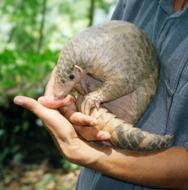
The Philippine Pangolin has an elongated snout, a rounded body, and a long prehensile tail. Its body is covered in dark, pointed, overlapping keratin scales, except for the nose, eyes, and underbelly.[1][2]
Infant individuals have soft, light-colored scales that harden as they mature. The species has large, sharp forelimb claws and a long, thin tongue coated with adhesive saliva.[3][4]
Habitat
The Philippine Pangolin inhabits primary and secondary forests and surrounding grasslands. It also occurs in lowland forests, grasslands, agricultural areas, and combinations of these habitats.[5][6]
Habitat destruction has driven some individuals into more developed areas.[7]
Diet
Individuals selectively consume preferred ant and termite species and may avoid other species when food is abundant. They use their forefeet to excavate insect mounds and logs while collecting insects with their tongues.[8][9]
The species consumes sand and small stones to assist food grinding in the stomach.[10]
Behaviour
The Philippine Pangolin is nocturnal, reclusive, and generally solitary or found in pairs. Individuals are arboreal but also spend time on the ground, and they prefer to sleep inside hollow trees.[11][12][13]
When threatened, individuals curl into a protective ball and can emit a noxious chemical to repel predators. They may also carry their offspring on their tails.[14][15][16]
Individuals are not known to be territorial.[17]
Reproduction and life cycle
The reported gestation period is approximately 18 weeks. Females usually give birth to one offspring at a time.[18][19]
Young are nursed for approximately four months and separate from their mothers at approximately five months of age. Female individuals may adopt orphaned young.[20][21][22]
Similar species
The Philippine Pangolin is distinguishable from the Sunda pangolin by its smaller scales, shorter head, and smaller body-to-tail ratio.[23]
The species has 19–21 lateral scale rows on its back, which are generally smaller than those of Javanese pangolins. Its tail is approximately as long as the combined head and body, unlike the shorter relative tail of Javanese pangolins.[24][25]
Compared with Javanese pangolins, it has a relatively small and weak palatine bone and a shorter zygomatic process. Its nuchal scales are centered along the neck, unlike those of Javanese pangolins, whose nuchal scales are positioned to one side.[26][27]
Conservation
The Philippine Pangolin is classified as Critically Endangered by the IUCN according to document 1 and Near Threatened according to document 2.[28][29]
International commercial trade in the species was prohibited under CITES Appendix I in 2016 according to document 1. Document 2 reports the species as listed under CITES Appendix II.[30][31]
Hunting and habitat destruction are identified as the main causes of population decline. The species is protected in the province of Palawan.[32][33]
Uses
The Philippine Pangolin is hunted for its meat, scales, organs, and skin for human consumption and traditional medicine. Its scales have been used in traditional East Asian medicine as a treatment for asthma.[34][35]
Classification of the Philippine Pangolin
| Kingdom | Animalia |
|---|---|
| Phylum | Chordata |
| Subphylum | Vertebrata |
| Infraphylum | Gnathostomata |
| Parvphylum | Osteichthyes |
| Megaclass | Tetrapoda |
| Class | Mammalia (Mammal) |
| Subclass | Theria |
| Infraclass | Eutheria |
| Order | Pholidota (Pangolins) |
| Family | Manidae (Pangolins) |
| Subfamily | Maninae (Asian Pangolins) |
| Genus | Manis (Asian Pangolins) |
| Species | Manis culionensis (de Elera, 1915) |
Where the Philippine Pangolin is found
Checklists and occurrence records place Manis culionensis in 1 country across Asia. GBIF holds 16 georeferenced records of it.
Countries
Range as the checklists state it
Southern Asia
A number beside a place is its count of GBIF occurrence records. A place without a number comes from a checklist alone. Records show where a species has been observed or collected, which can include escapes and vagrants.
Common names
English
- Philippine Pangolin
- Palawan Pangolin
Synonyms
2 other scientific names have been used for this species and are now treated as synonyms of Manis culionensis.
- Manis culionensis (de Elera, 1895)
- Pholidotus culionensis de Elera, 1915
Related species
-
 Indian PangolinManis crassicaudata
-
 Sunda PangolinManis javanica
-
 Chinese PangolinManis pentadactyla
- Cryptic PangolinManis mysteria
- Indo-Burmese PangolinManis indoburmanica
-
 Ground PangolinSmutsia temminckii
-
 Giant PangolinSmutsia gigantea
-
 Long-tailed PangolinPhataginus tetradactyla
Compare
Questions and answers
What is the scientific name of the Philippine Pangolin?
The scientific name of the Philippine Pangolin is Manis culionensis. Written with its author, the full name is Manis culionensis (de Elera, 1915).
Which family does the Philippine Pangolin belong to?
Manis culionensis belongs to the family Manidae, in the order Pholidota and the class Mammalia.
Where is the Philippine Pangolin found?
Checklists and occurrence records place Manis culionensis in 1 country: Philippines.
What is the conservation status of the Philippine Pangolin?
The IUCN Red List category recorded for Manis culionensis is Critically Endangered (CR).
What other names does the Philippine Pangolin have?
Manis culionensis is also known in English as Palawan Pangolin.
What is the habitat of Philippine pangolin?
The Philippine Pangolin inhabits primary and secondary forests, lowland forests, grasslands, and agricultural areas, including combinations of these habitats. Habitat destruction has driven some individuals into more developed areas.[5][6][7]
What is the diet of a pangolin?
The Philippine Pangolin is insectivorous and feeds exclusively on ants and termites. It may selectively consume preferred species and consumes sand and small stones to assist food grinding in the stomach.[36][8][10]
Sources
Passages the profile rests on
- The species has an elongated snout, a rounded body, and a long prehensile tail. Source passage: “Resembling armored anteaters , they have an elongated snout, a round body, and a long, prehensile tail.” — animaldiversity.org
- Its body is covered in dark, pointed, overlapping keratin scales, except for the nose, eyes, and underbelly. Source passage: “Their body is covered with pointed, overlapping scales that are dark in color and made of keratin. However, their nose, eyes, and underbelly are not armored in this way.” — animaldiversity.org
- Infant individuals have soft, light-colored scales that harden as they mature. Source passage: “Infant pangolins have scales that are soft and light in color that harden as they mature.” — animaldiversity.org
- The species has large, sharp forelimb claws and a long, thin tongue coated with adhesive saliva. Source passage: “They also possess large, sharp claws on their forelimbs and a long, thin tongue coated with adhesive saliva.” — animaldiversity.org
- The species inhabits primary and secondary forests and surrounding grasslands. Source passage: “Its habitat includes primary and secondary forests, as well as surrounding grasslands.” — English Wikipedia
- The species occurs in lowland forests, grasslands, agricultural areas, and combinations of these habitats. Source passage: “Philippine pangolins are found in lowland forests, grasslands, agricultural areas, and mosaics thereof.” — animaldiversity.org
- Habitat destruction has driven some individuals into more developed areas. Source passage: “Habitat destruction has also forced them into more developed areas.” — animaldiversity.org
- Individuals selectively consume preferred ant and termite species and may avoid other species when food is abundant. Source passage: “The Philippine pangolin is seem to have strong preferences when it comes to the insects they eat, selectively consuming a certain species of ant or termite they like, or even actively avoiding certain species when there is enough of a food abundance to be picky.” — English Wikipedia
- Individuals use their forefeet to excavate insect mounds and logs while collecting insects with their tongues. Source passage: “Its forefeet are used to dig into mounds and logs while its tongue harvests insects.” — English Wikipedia
- The species consumes sand and small stones to assist food grinding in the stomach. Source passage: “It consumes sand and small stones to help grind food in their stomachs.” — English Wikipedia
- The species is nocturnal, reclusive, and generally solitary or found in pairs. Source passage: “The Philippine pangolin is nocturnal and reclusive, tending towards being solitary or in pairs.” — English Wikipedia
- Individuals are arboreal but also spend time on the ground. Source passage: “Philippine pangolins are nocturnal, solitary, arboreal, and prefer to live in trees, though they spend some time on the ground.” — animaldiversity.org
- Individuals prefer to sleep inside hollow trees. Source passage: “When sleeping, they prefer to take refuge inside hollow trees.” — English Wikipedia
- When threatened, individuals curl into a protective ball. Source passage: “When threatened, pangolins roll into a tight ball, in which they are protected by their hard scales.” — animaldiversity.org
- Individuals can emit a noxious chemical to repel predators. Source passage: “They can also emit a noxious chemical to repel predators.” — animaldiversity.org
- Individuals may carry their offspring on their tails. Source passage: “Like most arboreal pangolins , Philippine pangolins carry their offspring on their tail” — animaldiversity.org
- Individuals are not known to be territorial. Source passage: “They are not known for being territorial animals” — English Wikipedia
- The reported gestation period is approximately 18 weeks. Source passage: “The young are born after a gestation period of around 18 weeks” — English Wikipedia
- Females usually give birth to one offspring at a time. Source passage: “Usually, only one offspring is born at once” — English Wikipedia
- Young are nursed for approximately four months. Source passage: “and are suckled by their mothers at about four months.” — English Wikipedia
- Young individuals separate from their mothers at approximately five months of age. Source passage: “At the age of about 5 months, the young will separate from their mother.” — English Wikipedia
- Female individuals may adopt orphaned young. Source passage: “Female pangolins even adopt lone young that have lost their own mother.” — English Wikipedia
- The Philippine pangolin is distinguishable from the Sunda pangolin by its smaller scales, shorter head, and smaller body-to-tail ratio. Source passage: “This species is distinguished from the closely related Sunda pangolin by its smaller body-to-tail ratio, smaller scales, and a shorter head.” — English Wikipedia
- The species has 19–21 lateral scale rows on its back, which are generally smaller than those of Javanese pangolins. Source passage: “Philippine pangolins have 19 to 21 lateral scale rows on their back, which are generally smaller in size than those of Javanese pangolins .” — animaldiversity.org
- Its tail is approximately as long as the combined head and body, unlike the shorter relative tail of Javanese pangolins. Source passage: “The tail of Philippine pangolins is almost equal in length to the combined length of its head and body, whereas the tail of Javanese pangolins is generally two thirds to three fourths the length of its combined head and body length.” — animaldiversity.org
- The species has a relatively small and weak palatine bone and a shorter zygomatic process compared with Javanese pangolins. Source passage: “The palatine bone of Philippine pangolins is relatively small and weak, and they have a shorter zygomatic process.” — animaldiversity.org
- Its nuchal scales are centered along the neck, unlike those of Javanese pangolins, whose nuchal scales are positioned to one side. Source passage: “nuchal scales are centered along the neck of Philippine pangolins and are off to one side on Javanese pangolins .” — animaldiversity.org
- The species is classified as Critically Endangered by the IUCN according to document 1. Source passage: “It is listed as Critically Endangered by the IUCN” — English Wikipedia
- The species is classified as Near Threatened by the IUCN according to document 2. Source passage: “Philippine pangolins are listed as near threatened by the IUCN” — animaldiversity.org
- International commercial trade in the species was prohibited under CITES Appendix I in 2016 according to document 1. Source passage: “In 2016, the Convention on International Trade in Endangered Species (CITES) listed the animal as protected under Appendix I (meaning commercial international trade was prohibited)” — English Wikipedia
- Document 2 reports the species as listed under CITES Appendix II. Source passage: “and in Appendix II by CITES.” — animaldiversity.org
- Hunting and habitat destruction are identified as the main causes of population decline. Source passage: “Hunting and habitat destruction are the chief causes of population decline of Philippine pangolins.” — animaldiversity.org
- The species is protected in the province of Palawan. Source passage: “This species is protected in the province of Palawan” — animaldiversity.org
- The species is hunted for its meat, scales, organs, and skin for human consumption and traditional medicine. Source passage: “Other than the meat, which is a delicacy in certain Asian cultures, the Philippine Pangolin is hunted for their scales, organs, and skin, which are used in traditional medicine.” — English Wikipedia
- Its scales have been used in traditional East Asian medicine as a treatment for asthma. Source passage: “The scales of Philippine pangolins are used as a reagent in traditional East Asian medicine and have been used to treat asthma.” — animaldiversity.org
- The species is insectivorous and feeds exclusively on ants and termites. Source passage: “Philippine pangolins, like all pangolins are insectivorous, feeding solely on ants and termites.” — animaldiversity.org
Data
- Catalogue of Life, 2026-10-16 XR cc by
- Global Biodiversity Information Facility CC BY 4.0
- Wikidata CC0
- GeoNames CC BY 4.0
- Wikimedia Commons per image; credit shown with each image
- Within the Catalogue of Life, this name comes from The Integrated Taxonomic Information System cc0
References
- Cont. Fauna Filipina, Manila, Col. Santo Tomás p.274 where the name was published
- Wilson, Don E., and DeeAnn M. Reeder, eds. (2005). Mammal Species of the World: A Taxonomic and Geographic Reference, 3rd Ed., Vols. 1 & 2.
- Wilson, D. E., and R. A. Mittermeier, eds. (2011). Handbook of the Mammals of the World, Vol. 2: Hoofed Mammals.
- Burgin, Connor J., Don E. Wilson, Russell A. Mittermeier, Anthony B. Rylands, et al. (2020). Illustrated Checklist of the Mammals of the World. Vol. 2. Eulipotyphla to Carnivora.
This species in other databases
Page built on 27 November 2026. See how the catalog is made and all sources and licences.
Cite this page
ScientificNames.org. (2026). Manis culionensis (Philippine Pangolin). Retrieved November 27, 2026, from https://scientificnames.org/species/manis-culionensis
“Manis culionensis (Philippine Pangolin).” ScientificNames.org, 2026, scientificnames.org/species/manis-culionensis. Accessed 27 Nov. 2026.
ScientificNames.org. “Manis culionensis (Philippine Pangolin).” Accessed November 27, 2026. https://scientificnames.org/species/manis-culionensis.
@misc{scientificnames_manis_culionensis_philippine_pangolin,
  author = {{ScientificNames.org}},
  title = {Manis culionensis (Philippine Pangolin)},
  year = {2026},
  url = {https://scientificnames.org/species/manis-culionensis},
  note = {Accessed 2026-11-27}
}