Species · Insects
Giant African Fruit Beetle Mecynorhina polyphemus
The scientific name of the Giant African Fruit Beetle is Mecynorhina polyphemus. It is a species of insect in the family Scarabaeidae (dung beetles), order Coleoptera. The name dates from 1781.
- Scientific name
- Mecynorhina polyphemus (Fabricius, 1781)
- Common name
- Giant African Fruit Beetle
- Genus
- Mecynorhina
- Family
- Scarabaeidae (Dung Beetles)
- Order
- Coleoptera
- Class
- Insecta
- Recorded in
- 9 countries
- Name status
- accepted in the Catalogue of Life

Overview
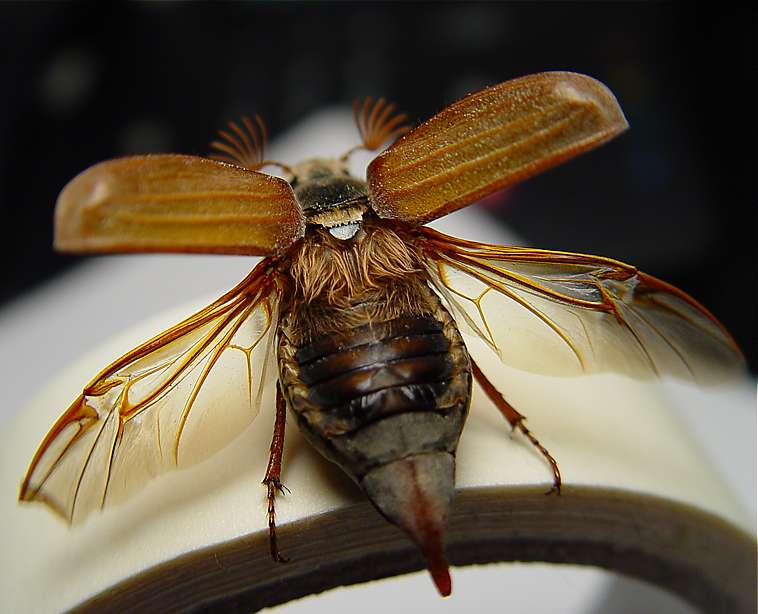
The Giant African Fruit Beetle belongs to the scarab beetle subfamily Cetoniinae. The species occurs in dense tropical African forests. Males and females exhibit sexual dimorphism, with males having horns and flat, velvety coloration and females having shiny surfaces, reflective prismatic coloration, and no horns.
Written 26 November 2026 from the sources listed below. Each statement was checked against the passage it cites; statements that could not be supported were removed.
Appearance
Females have a shiny surface, reflective prismatic coloration, and no horns. Males have horns and a flat, velvety coloration.[1][2]
Diet
The species frequently feeds on fruits. It also frequently feeds on sap flowing from tree wounds.[3][4]
Reproduction and life cycle
The larvae develop in compost made from decomposing logs. The third larval instar constructs an ovoid cocoon for metamorphosis and attaches it to a solid surface.[5][6][7]
In captivity, the cocoon may be attached to the wall of a glass container.[8]
Classification of the Giant African Fruit Beetle
| Kingdom | Animalia |
|---|---|
| Phylum | Arthropoda |
| Subphylum | Hexapoda |
| Class | Insecta (Insect) |
| Order | Coleoptera (Beetle) |
| Suborder | Polyphaga |
| Series | Staphyliniformia |
| Superfamily | Scarabaeoidea |
| Family | Scarabaeidae (Dung Beetles) |
| Subfamily | Cetoniinae |
| Tribe | Goliathini |
| Subtribe | Rhomborhinina |
| Genus | Mecynorhina |
| Species | Mecynorhina polyphemus (Fabricius, 1781) |
Where the Giant African Fruit Beetle is found
Checklists and occurrence records place Mecynorhina polyphemus in 9 countries across Africa. GBIF holds 35 georeferenced records of it.
Countries
- Benin
- Democratic Republic of the Congo 6
- Gabon 3
- Ghana
- Ivory Coast 16
- Liberia
- Sierra Leone
- Togo 4
- Uganda 6
Regions and cities with the most records
Range as the checklists state it
Afrotropical(Benin, Ghana, Ivory Coast, Liberia, Republic of Guinea, Sierra Leone, Togo)
A number beside a place is its count of GBIF occurrence records. A place without a number comes from a checklist alone. Records show where a species has been observed or collected, which can include escapes and vagrants.
Common names
English
- Giant African Fruit Beetle
- Magnificent Flower Beetle
- Polyphemus Beetle
Names in 1 other language
- Japanese
- ポリフェムスオオツノカナブン
Synonyms
One other scientific name has been used for this species and is now treated as a synonym of Mecynorhina polyphemus.
- Scarabaeus polyphemus Fabricius, 1781
Subspecies and varieties
- Mecynorhina polyphemus polyphemus subspecies
Related species
-
 Mecynorrhina TorquataMecynorhina torquata
-
 Mecynorhina harrisii
- Mecynorhina confluens
-
 CockchaferMelolontha melolontha
-
 Hercules BeetleDynastes (Dynastes) hercules
-
 Japanese BeetlePopillia japonica
-
 Japanese Rhinoceros BeetleTrypoxylus dichotomus
-
 Sacred ScarabScarabaeus sacer
Compare
Questions and answers
What is the scientific name of the Giant African Fruit Beetle?
The scientific name of the Giant African Fruit Beetle is Mecynorhina polyphemus. Written with its author, the full name is Mecynorhina polyphemus (Fabricius, 1781).
Which family does the Giant African Fruit Beetle belong to?
Mecynorhina polyphemus belongs to the family Scarabaeidae, in the order Coleoptera and the class Insecta.
Where is the Giant African Fruit Beetle found?
Checklists and occurrence records place Mecynorhina polyphemus in 9 countries, including Ivory Coast, Democratic Republic of the Congo, Uganda, Togo, Gabon and Benin.
What other names does the Giant African Fruit Beetle have?
Mecynorhina polyphemus is also known in English as Magnificent Flower Beetle and Polyphemus Beetle.
Sources
Passages the profile rests on
- Females have a shiny surface, reflective prismatic coloration, and no horns. Source passage: “The female has a shiny surface texture, reflective prismatic coloration, and no horns.” — English Wikipedia
- Males have horns and a flat, velvety coloration. Source passage: “The male has horns and flat, velvety coloration.” — English Wikipedia
- The species frequently feeds on fruits. Source passage: “It is a frequent feeder on fruits and sap flows from tree wounds.” — English Wikipedia
- The species frequently feeds on sap flowing from tree wounds. Source passage: “It is a frequent feeder on fruits and sap flows from tree wounds.” — English Wikipedia
- The larvae develop in compost made from decomposing logs. Source passage: “The larvae develop in decomposing log compost.” — English Wikipedia
- The third larval instar constructs an ovoid cocoon for metamorphosis. Source passage: “The third instar constructs an ovoid cocoon for metamorphosis” — English Wikipedia
- The third larval instar attaches its cocoon to a solid surface. Source passage: “and attaches it to a solid surface.” — English Wikipedia
- In captivity, the cocoon may be attached to the wall of a glass container. Source passage: “In captivity, the instar may attach the cocoon to a glass container wall” — English Wikipedia
Data
- Catalogue of Life, 2026-10-16 XR cc by
- Global Biodiversity Information Facility CC BY 4.0
- Wikidata CC0
- GeoNames CC BY 4.0
- Wikimedia Commons per image; credit shown with each image
- Within the Catalogue of Life, this name comes from World Scarabaeidae Database cc by
References
- Hope, F. W. (1837). Lamellicornia. The Coleopterist’s Manual, containing the lamellicorn insects of Linnaeus and Fabricius. Volume 1. Bohn: London :1-121. https://doi.org/10.5962/bhl.title.9229 Link where the name was published
This species in other databases
Page built on 28 November 2026. See how the catalog is made and all sources and licences.
Cite this page
ScientificNames.org. (2026). Mecynorhina polyphemus (Giant African Fruit Beetle). Retrieved November 28, 2026, from https://scientificnames.org/species/mecynorhina-polyphemus
“Mecynorhina polyphemus (Giant African Fruit Beetle).” ScientificNames.org, 2026, scientificnames.org/species/mecynorhina-polyphemus. Accessed 28 Nov. 2026.
ScientificNames.org. “Mecynorhina polyphemus (Giant African Fruit Beetle).” Accessed November 28, 2026. https://scientificnames.org/species/mecynorhina-polyphemus.
@misc{scientificnames_mecynorhina_polyphemus_giant_african_fruit_beetle,
  author = {{ScientificNames.org}},
  title = {Mecynorhina polyphemus (Giant African Fruit Beetle)},
  year = {2026},
  url = {https://scientificnames.org/species/mecynorhina-polyphemus},
  note = {Accessed 2026-11-28}
}