Species · Fishes
Spotted Hoplo Megalechis thoracata
The scientific name of the Spotted Hoplo is Megalechis thoracata. It is a species of fish in the family Callichthyidae (mailed catfishes), order Siluriformes. The name dates from 1840.
- Scientific name
- Megalechis thoracata (Valenciennes, 1840)
- Common name
- Spotted Hoplo
- Genus
- Megalechis
- Family
- Callichthyidae (Mailed Catfishes)
- Order
- Siluriformes
- Class
- Teleostei
- Environment
- freshwater
- Recorded in
- 11 countries
- Name status
- accepted in the Catalogue of Life

Overview
The Spotted hoplo is a freshwater ray-finned fish in the armoured catfish subfamily Callichthyinae. It occurs in the Amazon, Orinoco and upper Paraguay River basins, as well as coastal rivers of the Guianas and northern Brazil.
Written 26 November 2026 from the sources listed below. Each statement was checked against the passage it cites; statements that could not be supported were removed.
Appearance
The Spotted hoplo is a freshwater ray-finned fish belonging to the armoured catfish subfamily Callichthyinae.[1]
It can reach approximately 15 centimetres in length.[2]
Habitat
The Spotted hoplo inhabits slow-flowing, oxygen-poor waters in the Amazon, Orinoco and upper Paraguay River basins.[3]
It occurs east of the Andes in the Amazon, Orinoco and upper Paraguay River basins, and also in coastal rivers of the Guianas and northern Brazil. Introduced populations have been recorded in the upper Paraná River drainage.[4][5][6]
Diet
The Spotted hoplo feeds on small to medium-sized worms, other invertebrates, small fish and detritus.[7]
Behaviour
Males aggressively defend their territories against intruders. Both sexes produce sounds during aggressive interactions.[8][9]
Males produce sounds during territorial behaviour at nest sites, particularly during spawning.[10]
Reproduction and life cycle
Male Spotted hoplos guard bubble nests during breeding.[11]
Classification of the Spotted Hoplo
| Kingdom | Animalia |
|---|---|
| Phylum | Chordata |
| Subphylum | Vertebrata |
| Infraphylum | Gnathostomata |
| Parvphylum | Osteichthyes |
| Gigaclass | Actinopterygii |
| Superclass | Actinopteri |
| Class | Teleostei (Teleost) |
| Order | Siluriformes (Catfish) |
| Family | Callichthyidae (Mailed Catfishes) |
| Subfamily | Callichthyinae |
| Genus | Megalechis |
| Species | Megalechis thoracata (Valenciennes, 1840) |
Where the Spotted Hoplo is found
Checklists and occurrence records place Megalechis thoracata in 11 countries. GBIF holds 1,363 georeferenced records of it.
Countries
- Argentina 7
- Bolivia 62
- Brazil 532
- Colombia 108
- Ecuador 24
- French Guiana 202
- Guyana 94
- Paraguay 14
- Peru 121
- Suriname 121
- Venezuela 78
Regions and cities with the most records
- Amazonas, Brazil 82
- Loreto, Peru 77
- Pará, Brazil 55
- Beni Department, Bolivia 44
- Amazonas, Venezuela 38
- Casanare Department, Colombia 38
- Mato Grosso, Brazil 28
- Amazonas Department, Colombia 26
- Roraima, Brazil 26
- Iquitos, Peru 24
- San Juan, Peru 24
- Sipaliwini District, Suriname 19
- São Paulo, Brazil 19
- Mato Grosso do Sul, Brazil 18
- Upper Demerara-Berbice, Guyana 17
- Leticia, Colombia 16
- Tabatinga, Brazil 16
- Amazonas, Peru 15
- Manaus, Brazil 14
- Apure, Venezuela 11
- Meta Department, Colombia 11
- Maranhão, Brazil 10
- Upper Takutu-Upper Essequibo, Guyana 10
- Acre, Brazil 9
- Alvarães, Brazil 9
- Iranduba, Brazil 9
- Kourou, French Guiana 9
- Barcarena, Brazil 8
- Putumayo Department, Colombia 8
- Belém, Brazil 7
- Caicara del Orinoco, Venezuela 7
- Guárico, Venezuela 7
- Orellana Province, Ecuador 7
- Sucumbíos, Ecuador 7
- Madre de Dios, Peru 6
- Puerto Leguízamo, Colombia 6
1 more country has a few records outside this range
These countries hold a few records of Megalechis thoracata but lie outside the range the checklists give for it. Such records are often zoo or garden specimens, museum material or vagrants, so the species is not counted as occurring there.
A number beside a place is its count of GBIF occurrence records. A place without a number comes from a checklist alone. Records show where a species has been observed or collected, which can include escapes and vagrants.
Common names
English
- Spotted Hoplo
Names in 5 other languages
- Czech
- pancéřníček kropenatý
- Danish
- Amazon-pansermalle
- French
- Hoplo tacheté
- German
- Gemalter Schwielenwels, Rehbrauner Schwielenwels, Tüpfel-Schwielenwels
- Portuguese
- Cambuí, Tamboatá, Tamoatá, Tamuatá
Synonyms
11 other scientific names have been used for this species and are now treated as synonyms of Megalechis thoracata.
- Callichthys exaratus Müller & Troschel, 1849
- Callichthys longifilis Valenciennes, 1840
- Callichthys personatus Ranzani, 1841
- Callichthys thoracatus Valenciennes, 1840
- Hoplosternum personatus (Ranzani, 1841)
- Hoplosternum thoracatum (Valenciennes, 1840)
- Hoplosternum thoracatum surinamensis Hoedeman, 1952
- Hoplosternum thoracatum surinamensis Hoede-man, 1952
- Hoplosternum thoracatum thoracatum (Valenciennes, 1840)
- Megalechis personata (Ranzani, 1841)
- Megalechis personata Reis, 1997
Related species
-
 Bartail HoploMegalechis picta
-
 Pygmy CorydorasCorydoras pygmaeus
-
 Bronze CorydorasCorydoras aeneus
-
 Panda CorydorasCorydoras panda
-
 Sterba's CorydorasCorydoras sterbai
-
 Brown HoploHoplosternum littorale
-
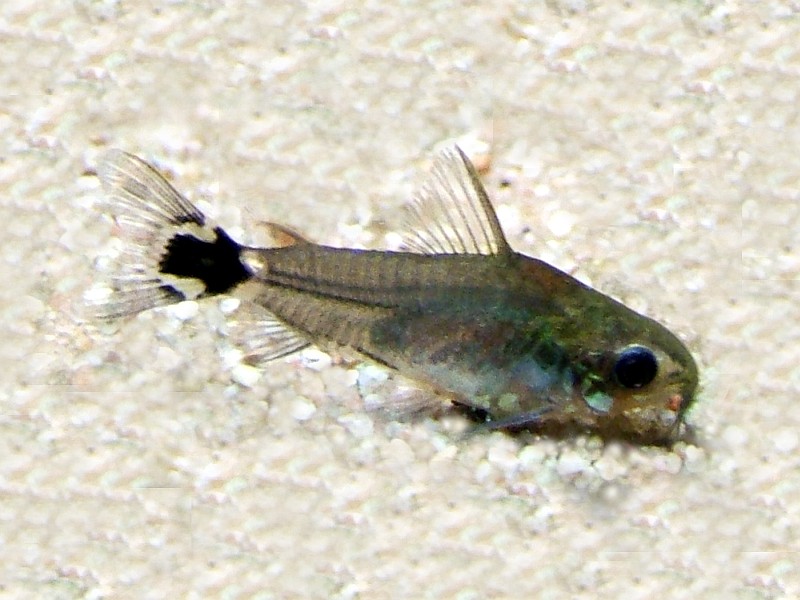 Dwarf CorydorasCorydoras hastatus
-
 Threestripe CorydorasCorydoras trilineatus
Compare
Questions and answers
What is the scientific name of the Spotted Hoplo?
The scientific name of the Spotted Hoplo is Megalechis thoracata. Written with its author, the full name is Megalechis thoracata (Valenciennes, 1840).
Which family does the Spotted Hoplo belong to?
Megalechis thoracata belongs to the family Callichthyidae, in the order Siluriformes and the class Teleostei.
Where is the Spotted Hoplo found?
Checklists and occurrence records place Megalechis thoracata in 11 countries, including Brazil, French Guiana, Peru, Suriname, Colombia and Guyana.
What is the maximum size a Hoplo Catfish can reach?
The Spotted hoplo can reach approximately 15 centimetres in length.[2]
Are Hoplo Catfish aggressive?
Male Spotted hoplos aggressively defend their territories against intruders. Both sexes produce sounds during aggressive interactions.[8][9]
What does a Hoplo catfish eat?
The Spotted hoplo feeds on small to medium-sized worms, other invertebrates, small fish and detritus.[7]
Sources
Passages the profile rests on
- The species is a freshwater ray-finned fish in the armoured catfish subfamily Callichthyinae. Source passage: “a species of freshwater ray-finned fish belonging to the family Callichthyidae and the subfamily Callichthyinae, the armoured catfishes.” — English Wikipedia
- The species can reach approximately 15 centimetres in length. Source passage: “maximum size of around 6 inches or 15 centimetres.” — English Wikipedia
- The species inhabits slow-flowing, oxygen-poor waters in the Amazon, Orinoco and upper Paraguay River basins. Source passage: “The natural habitat of Megalechis thoracata is slow flowing, low oxygen parts of the Amazon, Orinoco, and upper Paraguay River basins.” — English Wikipedia
- The species occurs east of the Andes in the Amazon, Orinoco and upper Paraguay River basins. Source passage: “M. thoracata is found east of the Andes in the Amazon, Orinoco, and upper Paraguay River basins” — English Wikipedia
- The species also occurs in coastal rivers of the Guianas and northern Brazil. Source passage: “as well as in the coastal rivers of the Guianas and northern Brazil.” — English Wikipedia
- Introduced populations have been recorded in the upper Paraná River drainage. Source passage: “Recent introductions were recorded in the upper Paraná River drainage.” — English Wikipedia
- The species feeds on small to medium-sized worms, other invertebrates, small fish and detritus. Source passage: “They will feed on small to medium-sized worms and other invertebrates, small fish, and general detritus.” — English Wikipedia
- Males aggressively defend their territories against intruders. Source passage: “M. thoracata males aggressively defend territories against intruders.” — English Wikipedia
- Both sexes produce sounds during aggressive interactions. Source passage: “and during aggressive behavior in both sexes.” — English Wikipedia
- Males produce sounds during territorial behaviour at nest sites, particularly during spawning. Source passage: “M. thoracata has been observed to produce sounds during territorial behavior in males at their nest sites and especially during spawning” — English Wikipedia
- Male individuals guard bubble nests during breeding. Source passage: “when the males are guarding a bubble nest at breeding time.” — English Wikipedia
Data
- Catalogue of Life, 2026-10-16 XR cc by
- Global Biodiversity Information Facility CC BY 4.0
- Wikidata CC0
- GeoNames CC BY 4.0
- Wikimedia Commons per image; credit shown with each image
- Within the Catalogue of Life, this name comes from World Register of Marine Species cc by
References
- Cuvier and Valenciennes, 1840 where the name was published
This species in other databases
- Catalogue of Life 72VPS
- Wikidata Q1573248
- iNaturalist 609744
- WoRMS urn:lsid:marinespecies.org:taxname:1021884
- ITIS 639381
Page built on 28 November 2026. See how the catalog is made and all sources and licences.
Cite this page
ScientificNames.org. (2026). Megalechis thoracata (Spotted Hoplo). Retrieved November 28, 2026, from https://scientificnames.org/species/megalechis-thoracata
“Megalechis thoracata (Spotted Hoplo).” ScientificNames.org, 2026, scientificnames.org/species/megalechis-thoracata. Accessed 28 Nov. 2026.
ScientificNames.org. “Megalechis thoracata (Spotted Hoplo).” Accessed November 28, 2026. https://scientificnames.org/species/megalechis-thoracata.
@misc{scientificnames_megalechis_thoracata_spotted_hoplo,
  author = {{ScientificNames.org}},
  title = {Megalechis thoracata (Spotted Hoplo)},
  year = {2026},
  url = {https://scientificnames.org/species/megalechis-thoracata},
  note = {Accessed 2026-11-28}
}